
Inde Navarrette and Michael Johnston in ‘Obsession’ (2025) (Focus Features/Courtesy Everett Collection)


While Inde Navarrette gives a chilling performance in Obsession, she’s responding to discourse over the character being both a villain and victim.
The actress, who plays Nikki in the Curry Barker horror film, explained why she “wanted to humanize” the character after her best friend Bear (Michael Johnston) makes a wish that she would love him more than anything in the world.
“It meant a lot to me, and I really wanted to take it seriously,” she told DiscussingFilm. “I didn’t wanna just shy away from anything about that, so I really sat with Nikki for quite sometime … but I really wanted to take her seriously, and I wanted to humanize her. I really wanted to portray her as a real girl. And I wanted people to see themselves and to feel every aspect of themselves, if that was their experience.”
Navarrette continued, “But I found that there was a difference between what Bear was intending to do versus the way that it impacted Nikki, and how sometimes, what you can intend is not always how it might come across.”
While Naverrette plays Nikki as being possessed by a sinister spirit who’s obsessed with Bear, her performance also includes tortured outbursts as the real Nikki sporadically breaks free from her subconscious to react in horror as her friend takes advantage of the situation.
Inde Navarrette and Michael Johnston in ‘Obsession’ (2025) (Focus Features/Courtesy Everett Collection)
Now playing in theaters, Obsession also stars Cooper Tomlinson, Megan Lawless and Andy Richter.
Following Barker’s 2024 directorial debut Milk & Serial, Obsession marks his breakout, ahead of a full slate that includes Blumhouse’s Anything but Ghosts and A24’s Texas Chainsaw Massacre.
>

EXCLUSIVE: Soho’s post-production village has had its fair share of closure over recent years, but here’s news of something opening.
Playhouse Post has officially opened doors to its new 12,000 sq ft facility on Noel Street in London’s West End, with newly refurbished cutting rooms overlooking Soho and end-to-end post-production services provided.
Kim Bartley’s Lemonade, which premiered at the Toronto International Film Festival, was the first feature to complete post-production at Playhouse Post and was also financed by Playhouse Studios.
The news comes not long after we revealed Playhouse had bought the assets of Halo Post, which went into administration, and took over the Noel Street facility. What followed was Halo’s assets merging with those of another British post house that went into administration, LipSync, and the launch of Playhouse Post.
Noel Street has now been refurbed with a studio offering colour grading, VFX, picture finishing, sound, VFX, colour and delivery in Dolby Atmos and Dolby Vision-equipped facilities. Cutting rooms will provide productions with editorial bases along with remote offline solutions and wider post-production finishin services.
There is also a 4K theatrical grading theater and two Dolby Vision 4K HDR grading suites, two purpose-built 4K HDR Flame suites provide dedicated finishing and client review space, whilst another three finishing rooms for grade, VFX and online. On the sound front, three refurbished Pro Tools studios will offer a range of services, including voiceover facilities for film, drama and doc projects.
“Playhouse Post’s revamped Noel Street facility gives productions the flexibility to move through multiple stages of post under one roof, supported by the infrastructure and creative environment needed for increasingly complex workflows,” said Mark Foligno, CEO of Playhouse Post. “We’re excited to be opening our high-spec London facility to continue supporting ambitious projects of every scale, from development through to final delivery.”
For Playhouse, the launch comes as the Dublin-based company continues to seek expansion in the UK and Ireland, and follows the launch of a Belfast office, which has Martin Brennan and Janine Cobain leading it as Director of Playhouse Northern Ireland and Head of Production, respectively.
Besides buying up post assets, Playhouse has begun investing in its own suite of film and TV projects.
>
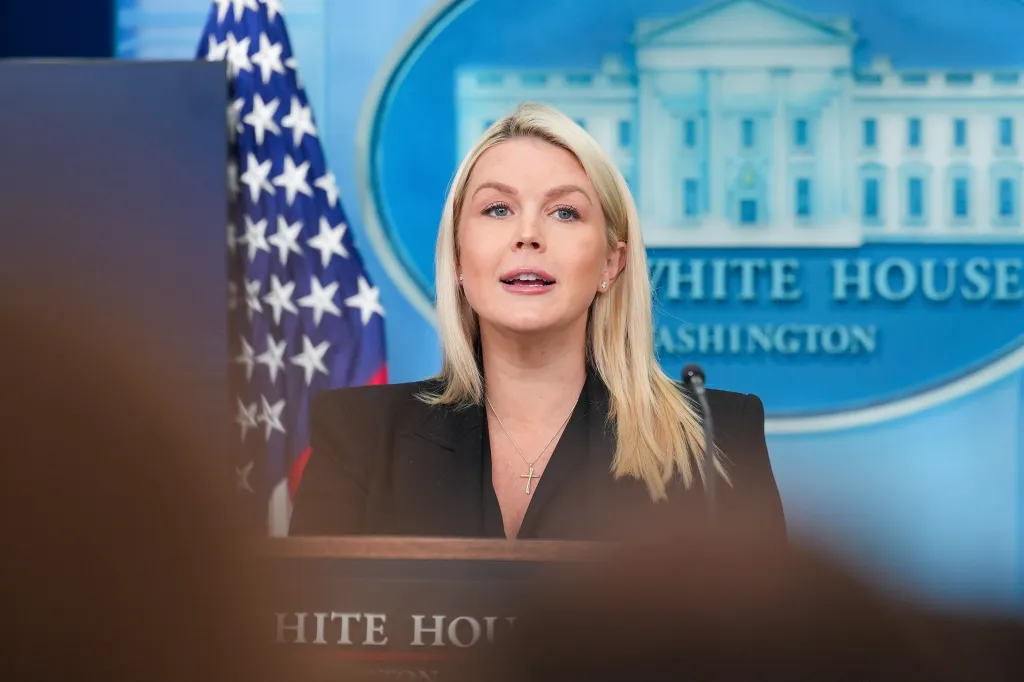
Karoline Leavitt has a new gig. The former White House Press Secretary has joined Fox News As a contributor, the network announced Monday. She’ll begin her new role providing commentary and analysis on November 1.
“Karoline’s firsthand experience in the White House and on the presidential campaign trail gives her a distinct understanding of today’s political landscape,” said Fox News Media CEO Suzanne Scott. “We look forward to her providing our audience with authentic and sharp insight across all FOX News Media platforms.”
Leavitt served as Donald Trump’s press secretary in his second term until August, when she stepped down to spend more time with her family, Trump said at the time. The youngest person in history to hold the position, she held weekly press briefing that at times were confrontational with the press corps. She frequently criticized the media in her opening statements, while zealously defending the president and his record and attacking Democrats.
Prior to joining the White House, Leavitt served as national press secretary for Trump’s 2024 presidential campaign. She previously ran as the Republican candidate for congress in her home state of New Hampshire’s 1st Congressional District in 2022 and served as communications director for then-House Republican Conference Chair Rep. Elise Stefanik (R-NY). Earlier in her career, Leavitt worked in Trump’s first administration as a presidential writer and assistant press secretary.
“I am grateful for the opportunity to continue appearing on FOX News Channel as an official member of the extraordinary team at Fox News Media,” Leavitt said in a statement. “I look forward to bringing my unique perspective from my experience as White House Press Secretary, along with the same energy and candor that defied my tenure, to Fox’s millions of viewers across their many platforms.”
>

There was a hush when Ian Charleson appeared on the National Theatre’s Olivier Theatre stage as Hamlet, having taken over the role from Daniel Day Lewis in Richard Eyre’s 1989 production.
I had known that the Scottish-born actor was ill. I was aware of the rumors spoken of quietly in various West End hangouts: that the Chariots of Fire star was sick with an incurable disease.
Even so, his appearance shocked me. Just a few years earlier, I’d seen him on the very same stage as Sky Masterson, in a brilliantly uproarious Guys & Dolls, also directed by Eyre, with an ensemble that included Bob Hoskins, Julia McKenzie and Julie Covington.
Officially, the National and Michael Whitehall, his agent, had insisted that Charleson was suffering from a sinus infection.
It’s difficult to convey how different those times were. Loved ones were dying. People were scared. Few people understood what HIV/AIDS was.
Heroically, Charleson was using art — in this case Shakespeare — as a way of feeling alive. That’s what Andrew Scott, as Charleson, captures unbelievably powerfully in Elsinore, as he depicts Charleson’s dogged determination to play Hamlet, even as his own life was ebbing away. As Beresford puts it, Charleson would “rather die from performing Hamlet than AIDS.”
Andrew Scott as Ian Charleson in ‘Elsinore’.
Anthony Dickenson / © 2026 FOCUS FEATURES LLC
The movie, directed by Simon Stone (The Dig, The Daughter, National Theatre Live: Yerma) from a screenplay by Stephen Beresford (Pride, Old Vic: In Camera – Three Kings), will open the BFI London Film Festival on Wednesday on London’s Southbank.
Elsinore bears the unmistakable quality signature of London-based producer Gabrielle Tana (Philomena, The Duchess, Coriolanus, The Dig). She’s the first to say that many others were involved in the making of Elsinore, however, she admits that it was she who brought all the parties together to tell the story of the extraordinary Charleson, acting as if his very life depends on it, in a movie that stars an equally extraordinary thespian: Scott.
The film isn’t about Daniel Day Lewis, but it begins when he famously left the National’s Olivier Theatre stage mid-performance, while playing Hamlet. Back then, I was the Daily Mail’s entertainment columnist and I pounced on the story and doggedly pursued sources to find out who would take over the role.
In those days, I was at theatre openings and movie premieres each and every night, as was my late friend and colleague, critic Jack Tinker. Late one night, when we met up at Joe Allen in Covent Garden, he shared that he’d heard Charleson was being considered to play the Danish prince at the NT, following Day-Lewis’ departure.
There was more. Charleson was not well. And when rehearsals started, I heard that Charleson was taking time away due to ill health.
Someone — actually a friend of Charleson’s from the film world — let slip that Charleson was receiving treatment for HIV/AIDS. We couldn’t say that in the paper. I trod around it as carefully as I could because this was so delicate. It felt like intrusion. It was intrusive. It was a dilemma for me, because on one hand I would normally just barge in and, hopefully politely, ask the question. But I can remember refusing to go the National’s stage door to wait for Charleson to emerge and ask him directly about his condition.
Also, Charleson wasn’t out as a gay man, at least publicly.
Later, when Charleson died, the newspaper ran the story on the front page, with Ian McKellen declaring that that’s what Charleson and his family had wanted — to stop the pussyfooting around HIV/AIDS.
Ian would be proud to have been represented by Andrew Scott, and I feel that it’s a gift to Ian that we were able to channel the spirit of his extraordinary sacrifice.
Simon Stone, director of Elsinore.
The film also shows the theatre community coming together and putting a protective arm around Charleson. This was a time when the general public was mostly in the dark about the AIDS crisis. What they thought they knew scared them. “There was so much fear, and the fact that all those people came together and worked with him is quite a testament,“ says Tana, who lost her two best friends to the disease.
However, in a way, the film isn’t at all sad, because it celebrates life — a point Tana and I discuss several times as we sit together on a green leather banquette at The Delaunay on London’s Aldwych. The seats being somewhat reminiscent of the red banquettes at Dan Dana’s, the landmark Hollywood hangout her father founded in 1964.
Ian Charleson in ‘Chariots of Fire’ (1981).
20th Century Fox Film Corp. All rights reserved. Courtesy: Everett Collection.
As with most movies, this one has a tangled genesis. Tana was introduced to writer and filmmaker Ethan Silverman (Angelheaded Hipster:The Songs of Marc Bolan & T.Rex) and they discussed a project he’d been working on about Charleson with Lucky Red’s Andrea Occhipinti and Cameron McCracken when he was at Pathé. Stephen Beresford had been asked to pen a screenplay and Andrew Scott, even at that early stage, was attached to portray Charleson.
At that point, says Tana, the project was a road movie set in Italy, inspired by Silverman’s own friendship with Charleson when the actor was making Dario Argento’s dotty 1987 horror pic Opera.
But Tana then rehired Beresford to come back and work on the script, because she shared his view that the film should not be a road movie. When the writer then explained how he wanted to tie the film to Charleson’s final bow as Hamlet at the National, she knew she had to ensure that Scott was still keen.
Tana contacted Scott’s longtime rep, Lindy King of United Agents (her Oscar-winning clients include Olivia Colman and most recent honoree, Jessie Buckley). Tana recalls asking King: “Is Andrew still interested in doing this?” King got back to her with good news. Says Tana, “Andrew was more desperate than ever to do it. So that helped.”
Beresford’s decision to focus on Charleson’s charge into Hamlet was one of the themes that appealed to Scott, due to him having himself played the Dane in Robert Icke’s 2017 Almeida Theatre production (Bridgerton’s Luke Thompson was also in that production, and he appears in Elsinore as Georgie, a friend of Charleson’s.]
Andrew Scott as Ian Charleson and Olivia Colman in as Margaret Johnson in ‘Elsinore’.
Anthony Dickenson / © 2026 FOCUS FEATURES LLC
“Ian doing Hamlet was a comfort,” Tana says. “It’s a solace. I mean, being able to completely throw himself into the work made him feel more alive than ever.” Armed with such a phenomenal story, she had confidence that “we’d pull it off somehow.”
Her business partner came up with pre-production financing that allowed them to hire heads of department and begin scouting “just with the firm belief that somehow it would all come together,” even though Pathé hadn’t come back in.
However, Occhipinti, who was close to StudioCanal, encouraged them to join in, while Tana brought in some other financiers to backstop the U.S. “And of course we had to be quite draconian with a budget, and slash and burn, and get to a number where we felt comfortable, and then when we got there, we were basically already I think in production.”
Tana sighs as she recounts how her team at Magnolia Mae Films, including co-founder Carolyn Marks Blackwood, along with producers Occhipinti, Mickey Liddell (Judy, Jackie) Pete Shilaimon and the cast and crew of the film, worked tirelessly on research. And this meant finding and speaking to all those that worked on the original NT’s Hamlet starring Charleson.
Ian doing Hamlet was a comfort. It’s a solace. I mean, being able to completely throw himself into the work made him feel more alive than ever.
Elsinore producer Gabrielle Tana.
That production’s director Eyre visited the film set and provided background information to Johnny Flynn who portrays him in Elsinore. The actor Paul Jesson (he’s also fabulous, by the way, in Mike Leigh’s Tender Loving Care) played Horatio opposite Charleson on stage, and he dropped in to watch filming too. He also takes part, along with Charleson’s family, and many recipients of the Ian Charleson Award, which rewards actors under 30 who triumph in a classical role.
Tana says that the film was cast “collectively” with Stone, Scott and Beresford “putting their heads together“ with casting director Jessica Ronane (Emma, Queer, After the Hunt). The film’s cast — a roll-call of top actors — incudes an almost unrecognizable Billie Piper, Matthew Beard, Peter Mullan, Georgie Glen, Paul Chahidi, Joe Locke, Charles Edwards, Juliet Stevenson, Monica Dolan, Nonso Anozie, Nigel Havers (Chariots of Fire), Michele Austin, Hilton McRae and Jamie Bogyo. Olivia Colman stars as Professor Margaret Johnson, a pioneer of HIV/AIDS treatment, who cared for Charleson at the Royal Free Hospital in Hampstead, London.
Casting the Oscar-winning Colman, says Tana, “helped provide a timeline” because Colman had just five days to do her scenes back in early January. “And so that made everybody pay attention in terms of closing finance. Andrew got in touch with her pretty much immediately and asked her if she would play Margaret, and she came on.”
It was a smart move, because it’s the best five days work Colman has done in a long time. Such a beautifully controlled, underplayed performance. The scenes that Colman does with Scott are priceless, especially one where they discuss the poignant “there’s a special providence in the fall of a sparrow” speech from Hamlet, about destiny being beyond their control.
Colman’s Professor Johnson is as close to an antagonist as you could have in a a film as humanist as this, says Stone, speaking from his home base in Vienna. Johnson initially ascribes the actor’s intent to perform Hamlet while he’s so ill to a kind of egotism. She has, says Stone, “this idea that Hamlet is a kind of an achievement that he feels he needs to have against all better wisdom.” Indeed, Charleson’s determination may seem “counterintuitive,” Stone says. “When you’re facing the end of your life, to choose to not only exhaust yourself in service of a play, but also to to bear every part of your soul in front of an audience.”
L-R: Andrew Scott, Stephen Beresford and Billie Piper of ‘Elsinore’.
Josh Telles/ Deadline
But Stone suggests Charleson was playing Hamlet because “he had a particular insight that nobody else, almost nobody, having played Hamlet, has ever had. And Stephen [Beresford] realised this — the idea of knowing that you’re facing the hereafter while you’re playing it. So every time you’re doing the ‘to be or not to be’ speech, every time you’re speaking about the end, what comes after, you’re actually letting the audience into a moment of catharsis that you know what he did there is unprecedented.”
Stone adds: ”Ian would be proud to have been represented by Andrew Scott, and I feel that it’s a gift to Ian that we were able to channel the spirit of his extraordinary sacrifice. I mean, it’s a sacrifice to spend your dying days on stage in front of a group of people. And, you know, that lone wolf, solitary man, whose greatest place of shelter was ironically in front of 2,200 eyeballs, as he says in the movie.”
And it’s where he felt safest, I suggest. Stone nods, noting that most of us have anxiety about appearing on stage. ”But I think Ian shared what a lot of us outsiders who end up in the theater share, which is a sense that maybe you haven’t ever felt at home in your own body, or felt at home in your own life, or in your own community. But you find this kind of ersatz community in the theater world, and I think the gay scene was definitely like that in the ’80s, because it had to protect itself from from judgment, discrimination, violence, and I think the theater scene was a natural adjunct to the gay scene, and there’s always been overlap between those two scenes, and especially, especially in the years where you could live a little bit freer in the theater world than you could in the average world. So I think the film is also a celebration of shelter, the shelter that we find when we feel very lonely in the places that other people feel safe, and then all of a sudden we feel safe in the places that anyone else would have a panic attack.”
Beresford astutely uses passages from Hamlet to underscore certain points. And, as noted earlier, Scott had played the Dane before. However, Beresford says Scott had to ”almost unlearn it in order to do it again as someone else, and you know, the two Hamlets are very distinct, his Hamlet and Ian’s.”
Beresford, along with Stone and Scott, began mining the play for relevant moments to echo the film. It was Scott who realized, says Beresford, Hamlet’s 20,000 men marching to their deaths speech to Fortinbras, “suddenly, because of the context, just completely sings out.”
Beresford chuckles when he says that if Charleson had been doing any other play, this would not have worked. “If he’d been doing The Misanthrope or Mack and Mabel, there’s no film. He was doing the ultimate play about life and death, and that’s why it’s such a great story.”
Focus Features will open Elsinore in select U.S. theaters on November 20, expanding to additional markets over Thanksgiving and throughout December. StudioCanal releases Elsinore in U.K. cinemas on January 29 2027.
>


Search For Canadian TV Actor Stewart McLean Now Homicide Investigation


These ’90s fashion trends are making a comeback in 2017
According to Dior Couture, this taboo fashion accessory is back
Model Jocelyn Chew’s Instagram is the best vacation you’ve ever had
Emily Ratajkowski channels back-to-school style
9 Celebrities who have spoken out about being photoshopped


Rurouni Kenshin: Hokkaido Arc Manga Takes 1-Issue Break – News


HIDIVE to Stream English Dubs for The World Is Dancing, The Forsaken Saintess and Her Foodie Roadtrip in Another World, The Dangers in My Heart: The Movie Anime – News