
Tech
SEM-guided low-kV FIB finishing for leading-edge semiconductor failure analysis


Join us to discover how the new ZEISS Crossbeam 750 with its see while you mill capability delivers precision and clarity—every time—for demanding FIB-SEM workflows. Designed for extremely challenging TEM lamella preparation, tomography, advanced nanofabrication, and APT‑ready lift‑out, Crossbeam 750 combines a new Gemini 4 SEM objective lens, a double deflector, and a next‑generation scan generator to elevate both image quality and process confidence. You’ll learn how better resolution and better SNR translate into more image detail and shorter acquisition times, while the low‑kV FIB performance enables more precise lamella prep.
We’ll demonstrate High Dynamic Range (HDR) Mill + SEM—an interwoven SEM/FIB scanning mode that suppresses FIB‑generated background. This enables immediate, clean visual feedback, even during nudging the FIB pattern live while milling . The result: confident endpointing with uninterrupted FIB milling and pristine, metrology‑grade surfaces with the lowest possible sample damage.
This session is ideal for semiconductor failure analysists, yield teams and materials scientists seeking faster time‑to‑TEM, higher first‑pass success, and consistent outcomes at low kV. See how Crossbeam 750 empowers you to make earlier stop‑milling decisions, cut rework, and reliably plan turnaround time—so you can move from sample to insight with confidence.
>
OpenAI will start adding an invisible watermark to text generated by ChatGPT and Codex in the European Union to comply with the EU AI Act, the company said Monday in a blog post.
The EU AI Act’s transparency rules, which took effect on August 2, require AI companies to mark AI-generated content in a way other systems can identify.
OpenAI said the watermark will roll out over the coming weeks to eligible ChatGPT and Codex users on all plans, but only in the EU. Developers using OpenAI’s API anywhere in the world can turn it on for select models starting today; it’s off by default. OpenAI said it is not making text watermarking a global default at launch.
The watermark is not an actual symbol, but works by subtly shaping the model’s word choices, leaving a pattern readers can’t see, but a detector can pick up. Because it lives in the words themselves, it travels with the text when it’s copied and pasted. OpenAI said the watermark doesn’t identify the user, and that it saw no meaningful change in its models’ performance with it switched on.
OpenAI also published a technical report for its method, called textGrain, alongside the announcement. Co-written with researchers from the University of Pennsylvania and Yale, it walks through an example of using a secret key to sort next-word predictions to finish the sentence. Add hundreds of these nudges together, and the detector can spot AI-generated content using only the text and the key.
Can the watermark be removed by editing? OpenAI’s tests suggest yes. In one test, replacing 10% of words with synonyms dropped detection from about 92% to 66%. The company also said short passages, math answers, and translated text are harder to detect.

“These limitations contribute to our decision to provide initial detector access only to approved researchers and expert organizations, who can help us evaluate reliability and responsible uses,” said the company.
OpenAI also cautioned that a missing watermark “does not prove human authorship.” The text could be too short or too heavily edited, or it could come from another company’s AI.
“[Watermarks] can indicate that an OpenAI system generated or processed part of a passage, but not how much human judgment, editing, or creativity went into it,” the company said.
The announcement comes two months after Anthropic said it would watermark text generated by Claude, a move it’s applying worldwide. That decision drew backlash from some Claude users, who argued they had supplied “the instructions, context, decisions” while Claude was just “the tool.”
OpenAI had built a text watermark before but held off on releasing it, partly over concerns that users would switch to rivals that didn’t watermark, The Wall Street Journal reported in 2024.
Anthropic, Google, Meta, Microsoft and OpenAI are among the companies that have committed to following the EU’s code of practice on AI-generated content.
When you purchase through links in our articles, we may earn a small commission. This doesn’t affect our editorial independence.
>
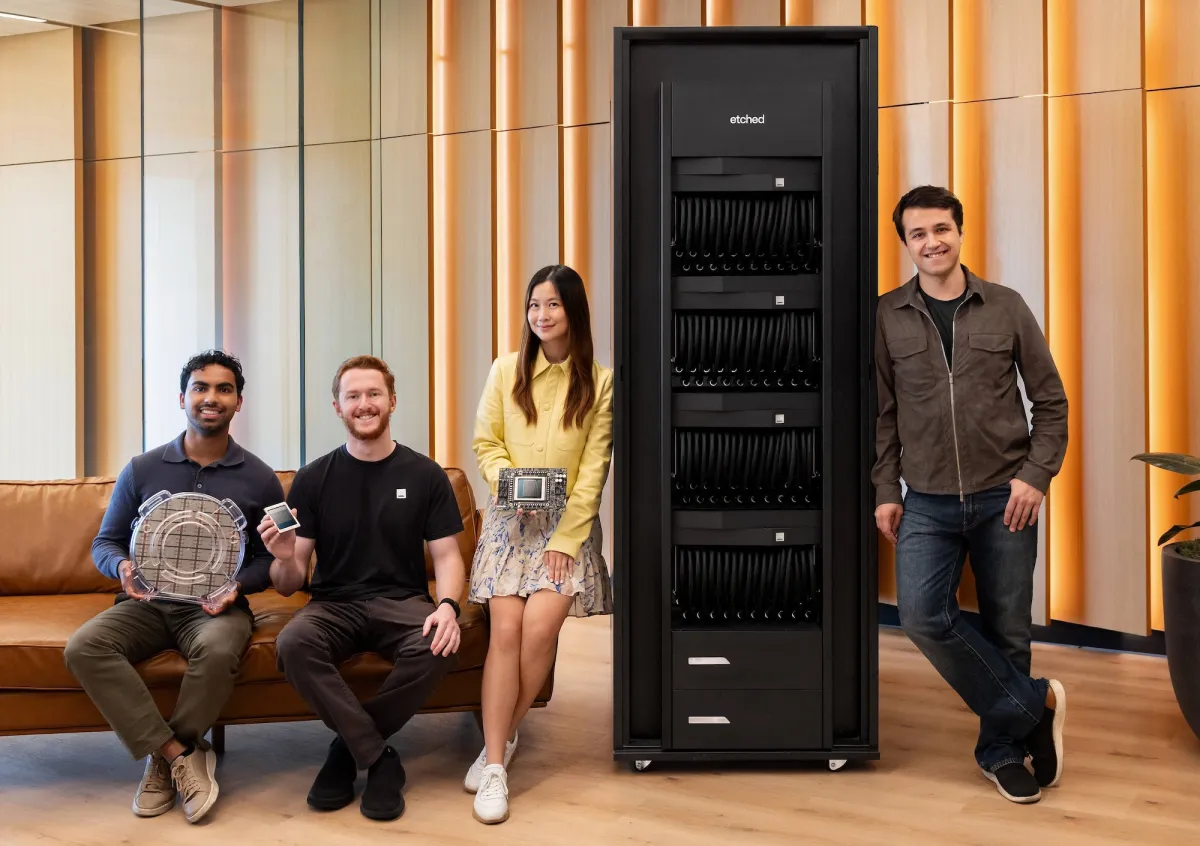
Although it’s only been a couple of months since Etched raised $700 million at a $21 billion valuation, the AI chip startup is already being plied with investment offers at double or more its value, according to people familiar with the company.
Etched is reviewing incoming bids that range from $40 billion from top-tier investors to $50 billion from lesser-known backers, one person said. These fundraising talks are early, so terms of any deal, should one happen, may change. Etched declined to comment.
While this may seem like a fast time-table to raise another mega round, Etched is pursuing a particularly expensive segment of the AI industry: building full AI hardware systems powered by its own proprietary chips. The person familiar with these offers said that if it raises as much as its last round, this could give Etched a cushion of as much as 3.5 years of runway.
There are reasons why VCs are hot to own a piece of Etched. The four-year-old startup shows promise of challenging Nvidia. Not only did quant trading firm Jane Street lead the last $700 million round, it is also a customer that took delivery of an early system. Etched said in July that it had already secured $1 billion in customer orders, including the one from Jane Street, after manufacturing its test chip at a TSMC factory this summer.
Co-founder and COO Robert Wachen previously told TechCrunch that investors are so enthusiastic because Etched has designed two new components from scratch to speed up inference — the computing process that happens after a user submits a prompt.
The company claims its chips can process more tokens faster and at a lower cost than Nvidia’s. That’s the reason its processors have been so attractive to Jane Street for whom a microscopic advantage in speed can yield massive profits.
The startup has also impressed investors with its ability to attract engineers from Nvidia, with roughly 15% of Etched’s 400-person workforce having previously worked at the chip giant, according to the Wall Street Journal.
Etched also operates a new 10-megawatt datacenter in Silicon Valley and established a facility in Taiwan to coordinate production near TSMC.
Co-founders Gavin Uberti and Chris Zhu famously met in an advanced math course at Harvard, while Wachen was Uberti’s roommate and they dropped out to pursue the company.
In terms of fast rounds at big leaps in valuations, Etched already has a history of them. The startup announced a $300 million round at a $10.3 billion led by Sequoia in July. It announced the $700 million round at a $21 billion valuation in September. Back-to-back funding rounds, which essentially act as a single financing split into two tranches with separate valuations, are increasingly common among the buzziest startups.
When you purchase through links in our articles, we may earn a small commission. This doesn’t affect our editorial independence.
>

Reflection AI is officially unveiling Beam, its first frontier, open-weight AI model. The two-year-old, Brooklyn-based startup claims Beam matches the performance of leading Chinese open models on advanced reasoning benchmarks at dramatically lower costs, a claim that could heat up the race to build a Western answer to DeepSeek, Qwen, and Z.ai.
Reflection’s announcement confirms reporting from Axios over the weekend that the startup was close to a launch. The company shared new details in a lengthy blog post Monday, which described Beam as a text-only mixture-of-experts model trained on high-compute reinforcement learning to be effective at reasoning, coding, and agentic tasks at “a fraction of the token cost and inference time compute” of rivals.
Beam is a 501-billion-parameter model with 23 billion active parameters. It was pre-trained on 23.8 trillion tokens and has a 1 million token context window. To compare, Z.ai’s GLM-5.2 has roughly 744 billion total parameters with 40 billion active.
Reflection’s performance claims haven’t been independently verified, but on advanced reasoning benchmarks, the company says Beam scores on par with Z.ai’s GLM-5.2 and outperforms today’s leading Western open models while using “3-4x less inference compute.” Reflection calls it a “workhorse model” for enterprises, the public sector, and developers.
Reflection is positioning itself against closed labs like Anthropic and OpenAI, against popular open models from Chinese developers, and against Western players like Mistral, Meta, and Cohere. Its most direct U.S. rival might be Inkling, the open model from Mira Murati’s Thinking Machines Lab released in July. Reflection’s own benchmarks show that Beam outscores Inkling on four coding tests where both report results, but Inkling is a multimodal model and Beam is text-only.
Reflection was founded in 2024 by two former Google DeepMind researchers and has raised roughly $4.7 billion from backers including Nvidia, Sequoia Capital, and Lightspeed Venture Partners, per PitchBook. Its last round valued the company at a $25 billion pre-money valuation.
The startup has also been locking up compute — a key ingredient needed to train frontier models capable of luring customers away from Anthropic’s and OpenAI’s closed models, as well as the cheaper open-weight models from Chinese labs. This summer, Reflection signed deals collectively worth more than $7 billion with SpaceX and Nebius to secure access to Nvidia’s GB300 chips through 2029.
Reflection is aiming Beam and future models at enterprises and sovereign nations. The pitch is to build “AI factories,” a product that would let institutions build their own customized, local AI system by training Reflection’s AI models on their own proprietary data. Nvidia CEO Jensen Huang, whose company backs Reflection, has long championed the “AI factory” idea and pushed to strengthen the open AI ecosystem — a vision that would also benefit Nvidia, whose GPUs would power those systems.
Axios reported that hedge funds and trading firms are among those eager to build such systems. Reflection has already begun testing the concept of a sovereign AI factory partnership with Shinsegae Group in South Korea.
Reflection says it will release Beam’s weights and full technical details this month, with distribution through hyperscalers and neoclouds and integrations across open source libraries at launch.
Reflection did not respond in time to TechCrunch’s requests for more information.
When you purchase through links in our articles, we may earn a small commission. This doesn’t affect our editorial independence.
>

5 New Shows to Stream This Week on Prime Video, Hulu, and More

Sebastian Maniscalco, SiriusXM Urged To Restore Raw Dog Airplay

JJ Gabriel: Man Utd prodigy still expected to leave despite first-team photo inclusion – this is how it unfolded | Football News
-

 movies5 months ago
Search For Canadian TV Actor Stewart McLean Now Homicide Investigation
-

 Fashion9 years ago
These ’90s fashion trends are making a comeback in 2017
-
Fashion9 years ago
According to Dior Couture, this taboo fashion accessory is back
-
Fashion9 years ago
Model Jocelyn Chew’s Instagram is the best vacation you’ve ever had
-
Fashion9 years ago
Emily Ratajkowski channels back-to-school style
-
Fashion9 years ago
9 Celebrities who have spoken out about being photoshopped
-

 Anime4 months ago
Rurouni Kenshin: Hokkaido Arc Manga Takes 1-Issue Break – News
-

 Anime3 months ago
HIDIVE to Stream English Dubs for The World Is Dancing, The Forsaken Saintess and Her Foodie Roadtrip in Another World, The Dangers in My Heart: The Movie Anime – News