
Entertainment
‘La Gradiva’ Review: Astounding Coming of Age Film Is One for the Ages


A major work played in a minor key, cinematographer-turned-director Marine Atlan’s magnificent, melancholic and moving feature directorial debut “La Gradiva” is one of those true discoveries that you only get a few times in life. It’s not just an illuminating portrait of youth, but a potent film about history, the now, and the future, gently reflecting on big questions through the eyes of a generation right on the cusp of having to face down all of it as adults.
At the same time that it engages with these more existential, increasingly heavy questions, it also remains wonderfully light on its feet. It’s often quite funny, perfectly capturing the banter that can take place between kids. Shot by Atlan and her collaborator Pierre Mazoyer, it’s a film of consistently stunning, sublime visuals.
Whether it’s through one of the most striking dream sequences you’ll ever see or in a shot lingering on a boat floating away from the shore, every evocative composition only heightens the sense of emotional upheaval that’s on the horizon for all its characters. It’s all part of how the film finds an enduring splendor in both the beauty of youthful exploration and the complex, quietly tragic revelations that it all builds to.

The film, which recently won the top prize at the Cannes sidebar Semaine de la Critique (Critics’ Week) at the Cannes Film Festival, follows a group of French high schoolers who are going on a class trip to the ruins of Pompeii. Overseen by their kindhearted and passionate yet exhausted teacher Mercier, an excellent Antonia Buresi, they all have their own distinct personalities that Atlan remains wonderfully attuned to.
Most centrally, there is Toni (Colas Quignard), who we first meet when he is surreptitiously observing his best friend James (Mitia Capellier-Audat) and Angela (Hadya Fofana) trying (and failing) to discreetly hook up on the train. Without a word being uttered, we can already see that Toni, a boisterous yet insecure young man who often takes part in such hook-ups of his own, is still jealous and hurt by what he’s seeing. His desire for James, someone who seems to largely remain above the struggles or concerns of everyone else, is matched only by his desire for a better understanding of himself and where his family came from.
Indeed, just as the stories of Pompeii soon become a critical part of the film (whose title refers to the 1902 Wilhelm Jensen novel “Gradiva: a Pompeian fantasy” about an archaeologist who becomes fixated on the statue of a woman in a museum), so too do the stories of Toni’s own family. He recounts, with great storytelling verve, how his grandmother, a cleaner at a manor, and his grandfather, her employer, fell in love only for societal expectations and an earthquake to break them apart.
It’s a nice, romantic story, though it is already one that you can feel Toni is quite taken by and needs to be true. He’s hoping that on the trip he’ll be able to get more insight into this past and see the ruins of the manor that is at the center of the story.
But for Toni and the rest of the class, which also includes Suzanne (Suzanne Gerin), secretly the most interesting character of the film, the truth about their lives that gets uncovered on their trip is not one that any of them could have expected. Critically, the film does not hinge on a shock twist, but on all the accumulating details of their lives before they will be brought face to face with the fragility of them. With her co-writer Anne Brouillet, the way Atlan completely immerses us in the little textures of their lives, their passions, their conflicts, and their aspirations for themselves, makes even this brief snapshot feel eternal.

All the characters are not just remarkably well-written, but they’re acted with such naturalism that they immediately feel like fully-formed people. It’s as though you’re just looking in on an actual class of kids, many of whom are proving to be a headache for Mercier, yet are still ones you profoundly care for.
When the future and past, already intertwined in the film, further converge, with Toni eventually going on a pilgrimage of sorts to find answers just as college acceptances are being sent out, “La Gradiva” goes from being good to great. Contradictions are brought into focus, the stories characters told themselves about life unravel, and whatever small sliver of youthful innocence the students had is dashed in the blink of an eye. It immediately brought to mind the feeling I had when first encountering an unexpected loss growing up. For a film to conjure this, something I haven’t thought about for decades, is as remarkable as it is agonizing.
In a shattering scene where Mercier must deliver information to her students, we can see already in her eyes and posture how she knows that it will mark the end of something for each of the students. All the pieces fall into place just as they break apart, with the inescapably life-changing moment becoming one that brings everything else into focus.
As this moment lingers before we’re then whisked away from it, there is a closing denouement of such quiet, earnest power that I found myself holding my breath and not daring to look away. At this moment, Atlan doesn’t offer up any final easy answers, but, down to the very last line, creates an astounding achievement all the same in the pursuit.
1-2 acquired “La Gradiva” out of Cannes for theatrical release.
>

EXCLUSIVE: Amazon has instituted a significant shift in the way its film and TV business affairs division operates and has hired three executives from rival Netflix as part of the move.
The streamer has hired Diana Bernstein, Chris Carter and Matt Rea from Netflix, each of whom have worked there for over a decade.
It comes as it moves to a “genre-based BA model”. This means that business affairs will work directly with each “creative genre vertical” such as drama, comedy, nonfiction, animation, world-building and IP.
The changes follow earlier changes to its business affairs division that resulted in the departure of Dan Scharf as Head of Global Business Operations at Amazon MGM Studios. It essentially got rid of its centralized studios BA team and installed three teams embedded within TV, film and international originals.
Mandy Schaffer joined the company in May, also from Netflix, as Head of Business Affairs, Global TV, reporting to Peter Friedlander, Head of Global Television, Amazon MGM Studios.
Bernstein becomes Head of BA, Drama, partnering with Kara Smith and her team. Carter is Head of BA, MGM and YA, partnering with Lindsay Sloane and Carina Walker, respectively. Rea joins as Head of BA, World-Building and Comedy, partnering with Blair Fetter and Andy Weil, respectively.
The trio, who were formerly Co-Heads of BA for the Drama division, will start the week of October 26.
Elsewhere, Dan Matusov will move into a role as Head of BA, Animation, partnering with Melissa Wolfe and her team.
Julia Shapiro becomes Head of BA, IP, partnering with Lauren O’Connor and her team. O’Connor will also be the BA team leader focused on first-look deals and overall pacts.
Ryan Singer will continue in his role as Head of BA, Nonfiction, partnering with Jenn Levy and her team, and Megan Shapiro will continue in the role she has held previously heading up its global TV deal-making with third-party studios, which is now refered to as Originals Studio Partnerships.
In a note sent to colleagues, seen by Deadline, Schaffer wrote, “As our Global TV slate continues to grow, we are moving to a genre-based BA model — aligning dedicated BA leadership to each creative genre vertical. This structure ensures that our deal-making, talent partnerships, and business strategy are embedded directly alongside our creative teams from development through execution.”
“This structure is designed to give our creative partners, talent community, and cross-functional teams a clear point of contact for each vertical,” she added. “I’m looking forward to this next chapter together.”
>
Warning: Spoilers ahead!
Hal Jordan has never been my favorite Green Lantern.
Don’t get me wrong: I love the character, as evidenced by the Geoff Johns and Dennis O’Neil trades sitting on my bookshelf. But I never connected with him on the same level as some others who took up the mantle, your Kyle Rayners, Jessica Cruzes and, yes, John Stewarts of the world. He was never my guy.

I guess I always just felt a bit removed from Hal. In most of my favorite stories featuring the character, he largely felt like an emblem, the living embodiment of will, courage made manifest and sent to watch over the worlds of Sector 2814. His cockiness and charm made him fun to read, but they never let me get in close.
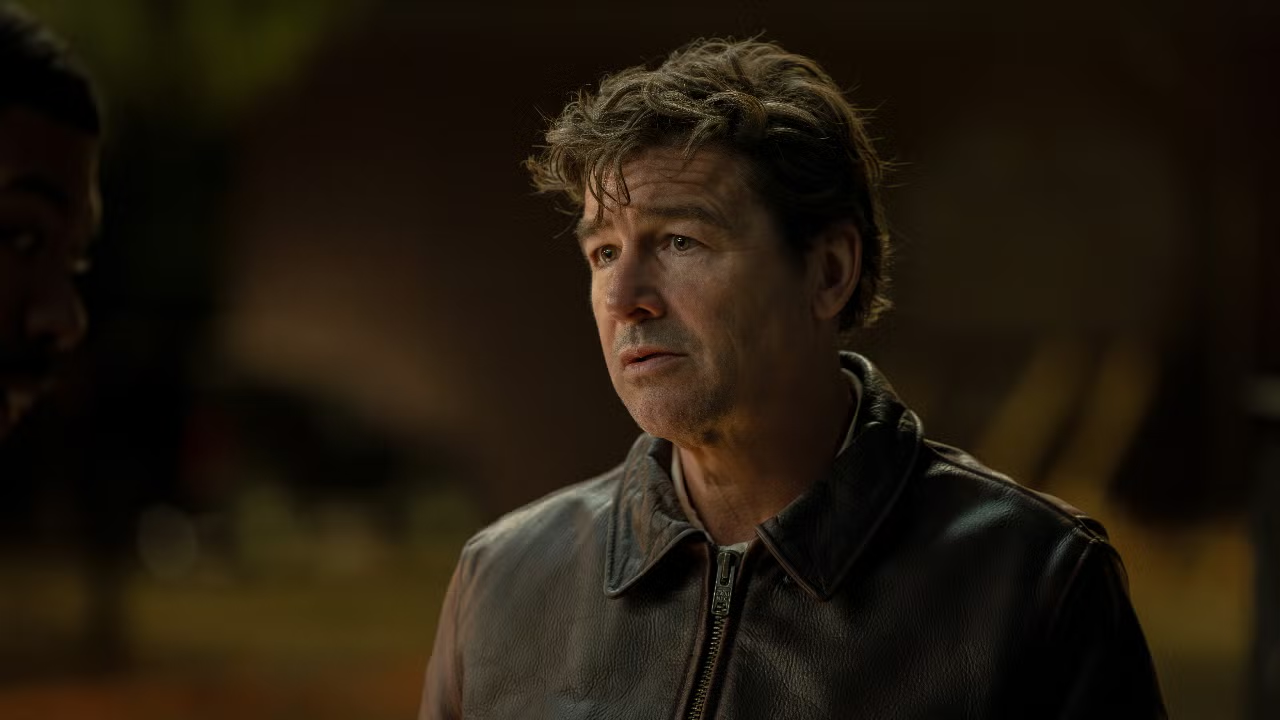
That is, until Kyle Chandler put on the ring.
While many were thrilled by this perfect marriage of actor and character, Chandler’s casting also gave some diehard fans pause. I think that’s fair. He is — I hope he doesn’t mind me saying — a bit old for the part as most comic readers would imagine it. Before the show released, it became clear that Aaron Pierre’s John Stewart (another incredible performance) was the one who was in it for the long haul, flying into theaters next summer with “Man of Tomorrow.” Many of Hal Jordan’s greatest adventures, if they happened at all, occurred before his “Lanterns” journey.
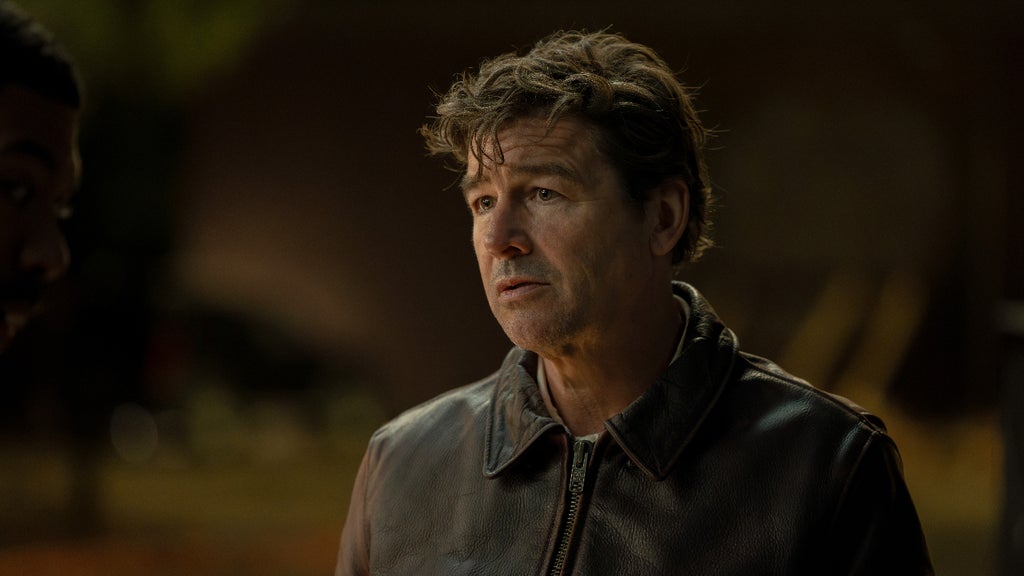
I knew Chandler would be a good fit for the part, but I still remember watching Hal’s scheme at the bar during the premiere episode, and a wave of excitement rippling through me as I realized what exactly he was planning with the jukebox. When the camera cut to Chandler’s s–t-eating grin as Rushville police officers pressed him against the wall, I knew with certainty that, despite whatever changes were in store, this guy was Hal Jordan. This feeling cemented itself later in the episode when Hal cleverly interrogated one of Antaan’s alien scouts — a scene nearly every comic book fanatic I know brought up to me the week of release to say they’re hooked.
In these scenes and numerous others, Chandler embodies everything fans love about DC’s first intergalactic lawman. He’s cocky, but the confidence is earned. He has a big mouth, but he’s willing to take a punch for it. He can be a pest, but damn it if he isn’t charming.
Chandler and the “Lanterns” writers — led by co-creators Chris Mundy, Damon Lindelof and Tom King — soon revealed that they weren’t interested in showing TV watchers the same old Hal. From beginning to end, bold choices and surprising swerves characterized the latest chapter of the DCU.

Suddenly, Hal Jordan wasn’t a character who recited the Green Lantern oath with his full chest, but one who rushed through the words like they were poison on his lips. Hal had become jaded, couldn’t bear to put on his costume or recharge his ring unless it was an absolute must. At the same time, when the prospect of being replaced came about, Hal clung to his title as if his life depended on it — as a seventh-episode origin change revealed, it maybe did.
And then of course, there’s the fact that the first episode concluded with Hal dead on some high school bleachers, staying that way through the end of the finale. To quote a villain from a different superhero universe, “No resurrections this time” — or, at least, this season.
Each of these changes, if done poorly, would be taken as sacrilege by some of the internet’s loudest comic book fans. They’re the kind of swings most shows can’t recover from. I was one of the lucky journalists who got to view the first seven episodes of “Lanterns” before the premiere aired, and with each passing minute, the same thought kept ringing through my head: I love this show, but the internet is going to hate it.
And sure, there has been a little bit of that, of people complaining that Atrocitus and Black Hand didn’t fly in with different-colored Lanterns to validate their theories. But for the most part, people have approached “Lanterns” the way any adaptation should be approached: on its terms rather than your own. Of course, the show isn’t bulletproof or immune to criticism. But I’ve been heartened by how few critiques I’ve seen that boil down to “This isn’t what I wanted.”
Because what people really wanted, it seems, was a good story. We can watch our favorite comics get big-budget adaptations all day long, but I will 10 times out of 10 prefer to see writers animated to carve their own path over an uninspired recreation of what I’ve seen before. I am OK with something being unfaithful to the “lore” as long as it’s faithful to the heart. After all, you can’t be a comic book fan without getting used to some retcons and resets. After a while, the canon starts to be less important than the narrative.

It’s not like “Lanterns” shows us none of the “classic” Hal Jordan fans have come to love. Nearly every scene with the Halogram feels ripped off the pages of “Green Lantern.” One can imagine seeing that era of Chandler’s character living out every iconic adventure from the comics.
Yet many of my favorite Hal Jordan moments come from the contrast between the Halogram and the Hal Jordan of 2016. I think of Hal clawing for the power ring during his Episode 5 fight with John, Chandler morphing his face into a Gollum-like obsession. I think of Hal interrogating Sinestro, confronting the fact that the Guardians seek to punish him despite sacrificing his second father figure. I think about the sadness, the exhaustion that Chandler manages to convey under Hal’s bluster and bravado.
Plenty of comics support this read on Hal. What if his fearlessness was actually a mask? What if the ring was actually a curse? What if his womanizing was a means of keeping others from getting too close? These ideas exist in the text, but I don’t know that I’ve ever seen them explored so well.
“Lanterns” may be Earthbound and alien-light, but it’s a Green Lantern story through and through. Chandler and Pierre’s performances are undeniable.
In the end, Hal Jordan fought the same climactic battle he always does: a battle of will, of proving that he’s more than just a ring on a finger. But instead of conjuring up the biggest weapon or besting Sinestro, powerless, at a construction site, Hal exhibited willpower of a different form.
He had the will to live another day, despite all the darkness swimming in his head. He had the will to seek amends, righting his wrongs from when the ring was all he knew. He had the will to choose “I love you” as his dying words — twice — after his heart was shattered by two father figures.
It may not be a fight against Parallax or Black Hand, but it’s still a hell of a story.
I’ve seen many people say that “Lanterns” would function better as an Elseworlds narrative, something that exists outside the main DCU continuity. I understand the appeal. When a story takes as bold of swings as this one, it’s hard not to wonder about what could have been.

But the DCU is itself an Elseworlds, a universe iterating on roughly a century of DC comics and forging its own path. Franchises like this aren’t as bulletproof as they used to be, and with complicating factors like a looming studio merger, who knows how many years of gas the DCU has left in the tank? I would rather see strong, unique stories like “Lanterns” while we can than perfect facsimiles of what exists on the page.
I have read hundreds of Green Lantern comics in my time, and I am sure I’ll read hundreds more. So let me tell you: This show doesn’t recreate the best Green Lantern stories, but it sure as hell understands what makes them special.
When you’re a fan of comic books for long enough, you come to realize the value of an ending. We of course don’t want to see our heroes die off or be left behind, but it’s often far worse to see them dragged through years of static characterization and inert narratives. I don’t want to see every character I love trotted out until they’re 90. After a while, you come to appreciate good stories — however fleeting they may be — over a bigger sandbox.
Green Lantern is a particularly tough hero to approach in a cinematic universe due to the fact that the name doesn’t belong to any one character. John Stewart fans have just as much a right to want their character to be the DCU Green Lantern as Hal Jordan fans, as Kyle Rayner fans, as Jo Mullein fans. What characters get to be on screen, and for how long, is not an easy choice. But I, for one, am grateful for the eight glorious hours we got to spend with Hal, even if that’s all we see (and frankly, I’d be surprised if that were the case).
I’m not from the planet Krypton, and I can’t breathe in space, but I can relate to the loneliness of Superman sitting by himself on the moon. I can’t swing from webs or crawl on walls, but I can relate to Spider-Man feeling like the punchline of life’s great joke. I don’t have infinite willpower or a glowing green ring, but I can relate to Hal Jordan feeling like a curse lives inside him, fearing what would happen if he stopped moving long enough to sit in solitude.
I don’t need my superheroes to face depression for me to find them relatable. I don’t need every comic book project to be a grim exploration of self. But I will always appreciate when creators treat these characters as more than icons and action figures.
In “Lanterns,” I can relate to Hal Jordan. I don’t know that I ever really could before.
Through Kyle Chandler, we get to see Hal Jordan as both the man and the legend. Despite being Earth’s first Green Lantern, it’s one of the first times I’ve ever felt like he’s truly human. So, as much as I love Geoff Johns’ GL saga, I’m fine with not seeing Hal take on the Yellow Lantern Corps, fight Parallax or survive the Blackest Night.
If these eight hours of Hal are all we get, he’ll still go down as one of the all-time great superhero portrayals. And that’s enough.

>
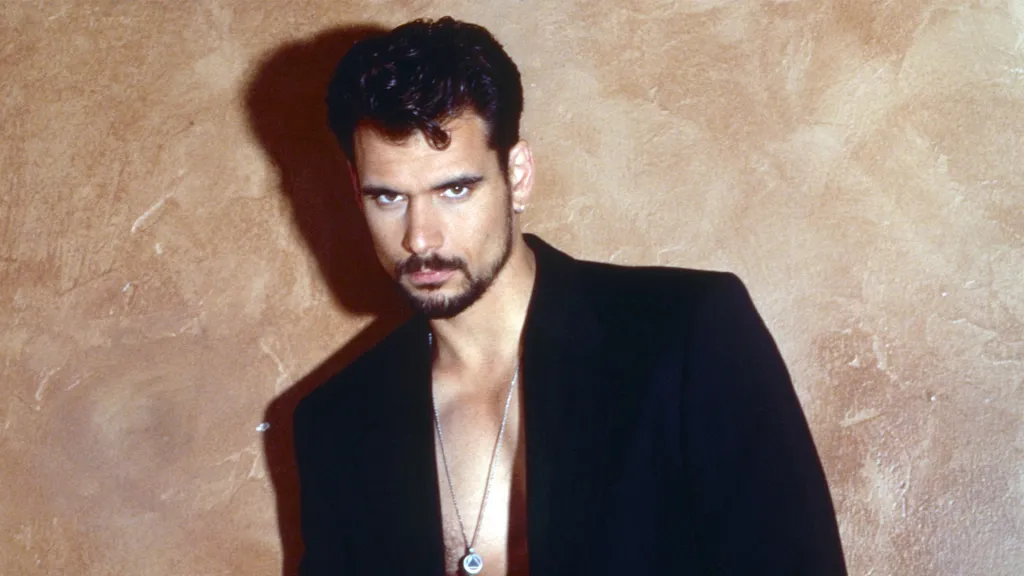
Robert Kelker-Kelly, known best for his role as Bo Brady on NBC soap Days Of Our Lives and for his work on Another World, died October 3 at his home in St. Peters, Missouri. He was 62.
St. Peters police officers responded to his home at aound 8:16 p.m. for a report of an unconscious man who was not breathing, as paramedics and other EMS were en route, according to a police statement.. Kelker-Kelly had reportedly complained of chest pain shortly before becoming unresponsive and the circumstances appeared consistent with a medical event, police said.
Officers and paramedics administered life-saving measures, but were unsuccessful.
Kelker-Kelly’s acting career began in 1987 when he was cast as Sam Fowler on NBC soap Another World, appearing in the daytime drama for three years until 1990. Two years later his big break came when he landed the established role of Bo Brady on Days Of Our Lives, taking over for Peter Recksell who had exited. He portray Bo Brady opposite Kristian Alfonso’s Hope Brady and Lisa Rinna’s Billie Reed before Recksell returned to the role in 1995.
In 1996, he returned to Another World playing the role of professional race car driver Bobby Reno, who was later discovered to actually be Dr. Shane Roberts. He played the role until 1998.
He also portrayed Stavros Cassadine on General Hospital
He also portrayed Stavros Cassadine on General Hospital in 2001, appearing in guest spots from 2002-2014.
Kelker-Kelly was back in the headlines recently after Rinna revealed in her new memoir, You Better Believe I’m Gonna Talk About It, that she and Kelker-Kelly had a difficult relationship off-screen.
“Behind the scenes, we hated each other,” Rinna wrote, adding, “Remember when Kathy Hilton said I was the biggest bully in Hollywood? Not true. Not even close! I have legit stories about the real bullies in this town. Robert Kelker-Kelly is one of those bullies.”
“He made my life a living hell on the set of Days. He was horrible to me,” she continued. “I’d go so far as to say verbally abusive. He was passive-aggressive, manipulative and played weird mind games.”
Kelker-Kelly did not publicly respond to Rinna’s allegations.
Rinna and Kelker-Kelly earned a Soap Opera Digest Award for Hottest Soap Couple in 1995 for their work on Days, the same year they both exited the show.
Kelker-Kelly later became a professional pilot, working in the field from 2003 to 2015.
TMZ was first to report Kelker-Kelly’s death.
>

Martin Brundle’s verdict on Bahrain GP software ‘chaos’ and how track tricked Ferrari and McLaren into wrong tyre choice | F1 News

North American Anime & Manga Releases for October

Luke Littler beaten by Cam Crabtree in semi-finals of World Youth Championship | Darts News
-

 movies5 months ago
Search For Canadian TV Actor Stewart McLean Now Homicide Investigation
-

 Fashion9 years ago
These ’90s fashion trends are making a comeback in 2017
-
Fashion9 years ago
According to Dior Couture, this taboo fashion accessory is back
-
Fashion9 years ago
Model Jocelyn Chew’s Instagram is the best vacation you’ve ever had
-
Fashion9 years ago
Emily Ratajkowski channels back-to-school style
-
Fashion9 years ago
9 Celebrities who have spoken out about being photoshopped
-

 Anime4 months ago
Rurouni Kenshin: Hokkaido Arc Manga Takes 1-Issue Break – News
-

 Anime3 months ago
HIDIVE to Stream English Dubs for The World Is Dancing, The Forsaken Saintess and Her Foodie Roadtrip in Another World, The Dangers in My Heart: The Movie Anime – News