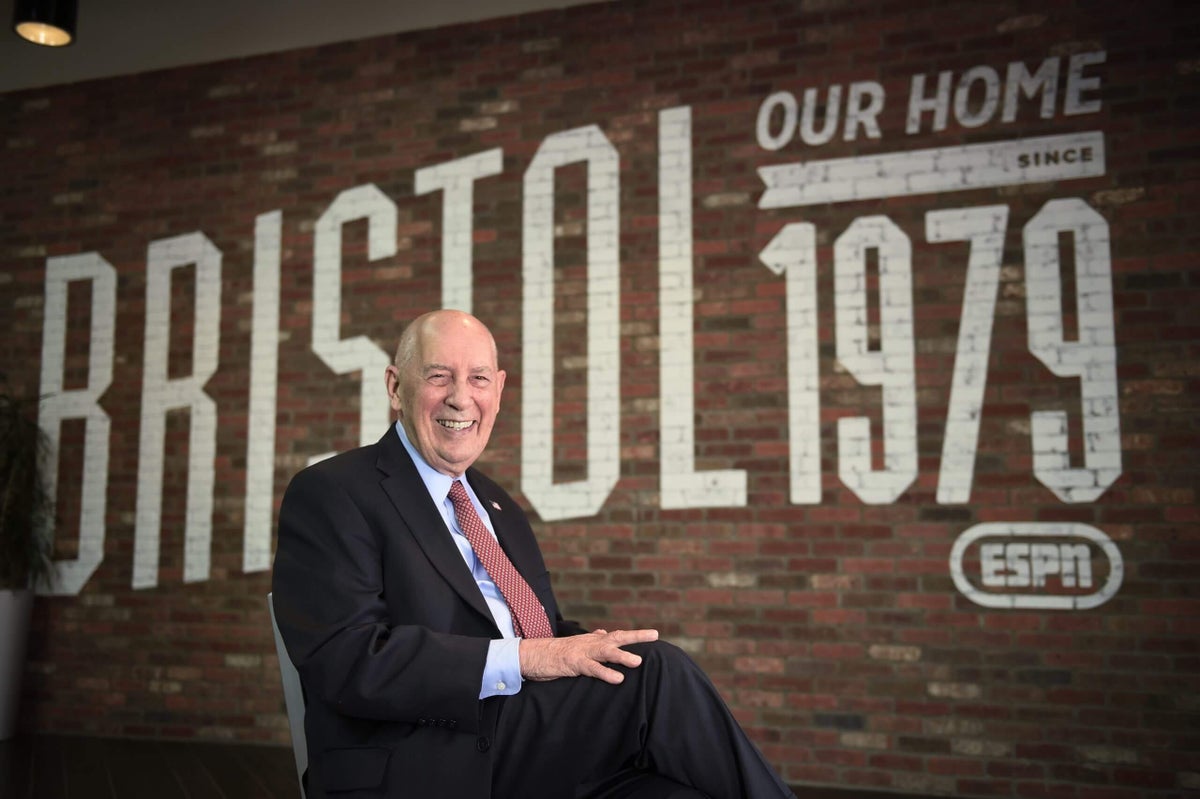
Bill Rasmussen, the co-founder of ESPN and innovator of around-the-clock sports television, died Tuesday at the age of 93, the network announced. The media company said he died from the effects of Parkinson’s disease.
Along with his son Scott, Rasmussen’s vision of a 24-hour sports TV network was a wildly innovative idea in the late 1970s and initially was met with skepticism. A few years later, however, ESPN was a media fixture.
Rasmussen left the company in 1980 but reconnected with the network in 1999 ahead of its 20th anniversary.
“Bill was a remarkable man — a visionary and an innovator who conceived the idea of a network entirely devoted to sports,” ESPN Chairman Jimmy Pitaro said. “Quite simply, none of us would be here today if it wasn’t for Bill’s passion and all the hard work and entrepreneurial spirit he put into building ESPN in the late 1970s — key aspects of our company culture that still carry on to this day.”
Rasmussen, who was inducted into the Sports Broadcasting Hall of Fame in 2025, was born in Chicago in 1932 and later served in the United States Air Force. His media career began in the 1960s at radio stations in Massachusetts before he joined the New England Whalers as communications director in 1974.

Rasmussen, who reconnected with ESPN in the late ’90s, standing on the “SportsCenter” set in 2005.
After being fired by the Whalers in 1978, he pursued the idea of a television channel dedicated solely to sports.
“I thought, why not a channel that’s on all the time?” Rasmussen told Cronkite News decades later. “Sports don’t stop at 6 o’clock.”
At 7 p.m. on Sept. 7, 1979, ESPN launched with the first broadcast of its new show, “SportsCenter,” from its headquarters in Bristol, Conn.
“It’s not to say that there wouldn’t have been a 24-7 sports operation at some point, but it certainly wouldn’t have been in remote Connecticut,” James Andrew Miller, co-author of “Those Guys Have All The Fun,” the definitive oral history of ESPN, told The Athletic. “And the fact that it was in remote Connecticut allowed them to take chances and to do things differently than the three broadcast networks in New York City. And that became part of the foundation of their success.
“So: No Bill, no ESPN.”
Six months before that TV debut, Rasmussen and the founding team had sold 85 percent of the fledgling company to Getty Oil. This controlling stake ultimately led to Rasmussen’s loss of power and, a year after that first edition of “SportsCenter,” his ouster from the company he helped create.
In that first year, ESPN’s live-sports strategy was built on an early deal with the NCAA, which gave them access to around 50 college football games, a couple dozen soccer games and, in what would be a signature element of ESPN’s early years, college basketball.
The rest of the early rights lineup included tennis, pro bowling and hockey exhibition games featuring the U.S. Olympic men’s team, as it prepared for the 1980 Olympics. An eclectic mix of programming rarely seen on national TV rounded things out, including American Legion baseball, lacrosse, full-contact karate, rugby and the Slo-Pitch Softball World Series, between the Milwaukee Schlitzes and the Kentucky Bourbons.
The relationship between founder and company remained strained for 19 years, until outreach from ESPN’s then-president George Bodenheimer ahead of the network’s 20th anniversary brought Rasmussen back into a venerated place. In the spring of 2026, ESPN released a documentary and accompanying book, “Sports Heaven: The Birth of ESPN,” about the network’s founding with Rasmussen’s experience front and center.
“Bill was the eternal optimist who brought his energy to the crazy idea of 24-hour-a-day sports,” ESPN historian Mike Soltys, who was hired by Rasmussen in 1980 as his first intern, told The Athletic. “He rebounded from being fired by the Whalers to change the future of sports television.
“My career, and thousands of others, came about because of Bill’s passion and belief in his idea. His warm approach and quick wit endeared him to everyone he met. It has been a joy to be his friend and celebrate ESPN’s success with him for 46 years.”