
The triage area on The Pitt


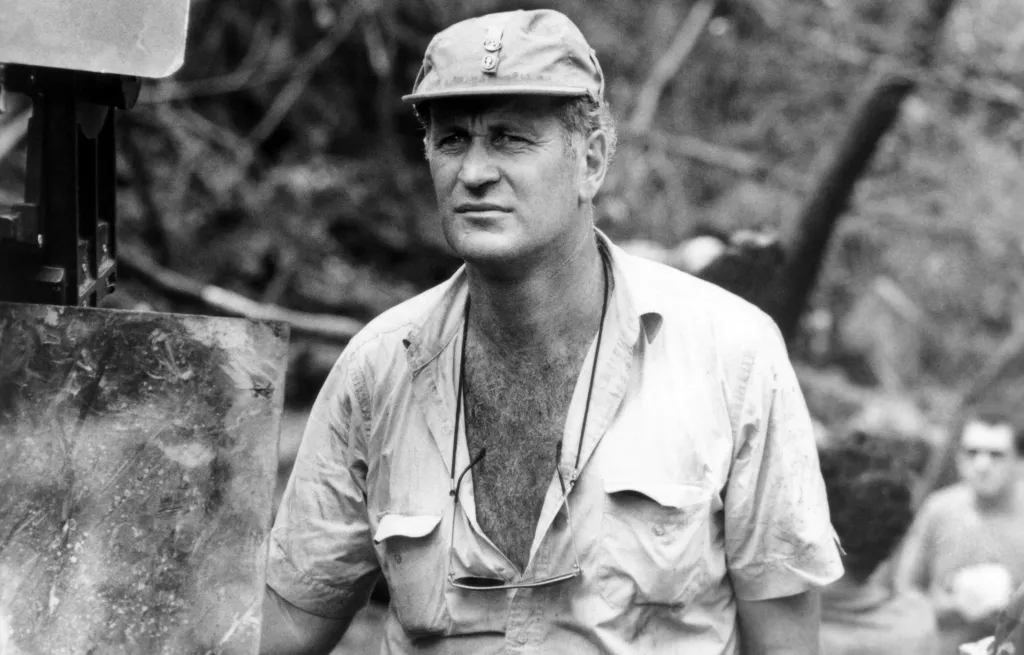
British filmmaker John Irvin, known for action movies including Hamburger Hill and Raw Deal and BAFTA-winning TV series Tinker Tailor Soldier Spy, has died aged 86.
According to Irvin’s producers, the multi-BAFTA nominee died peacefully at the UK home of his sister-in-law on 11th August, surrounded by his family.
Irvin made more than thirty features in a career that spanned TV, documentaries, and independent film.
Irvin was known for his versatility and breadth of career. In a 2021 interview with Roel Haanen, it was written: “Not many filmmakers directed both Fred Astaire and Patrick Swayze. Or followed up a tender, thoughtful film written by Harold Pinter with an Arnold Schwarzenegger action flick. But John did …”
Born to parents Charles and Elsie Winifred Irvin (neé Bending) his father Charles was a mechanical engineer who during the war joined the Royal Engineers and was deployed to the Middle East where he was involved in the construction of the Iran/Iraq Pipeline transporting oil from the Middle East. John Charles Greenway Irvin and his twin brother, David, were born in Wallasey Cheshire, on the 7th May 1940. Both boys went to Durham School, a renowned chorister school where John featured prominently in the choir. He was also a keen boxer and rowed competitively for Durham College
Irvin opted not to go to university; for a short while he taught Latin in a preparatory school to fund his enrollment into the London Film School. Irvin began his career working for British Movietone News. He directed his first film Gala Day (1963), a documentary financed by the British Film Institute, which was bought by the BBC. Within the same year his documentary short Inheritance (1963) was released. It was a film about the aftermath of the Algerian War, narrated by the legendary Richard Burton. It would win Irvin his first BAFTA, presented to him by Audrey Hepburn.
Throughout the sixties, Irvin made a number of acclaimed documentaries for his own company Mithras Films. He also worked during this time for the BBC and ITV where his work included several short films starring the young actors Edward Fox and Sir Anthony Hopkins. Irvin gave Hopkins his first TV role in The Peasants Revolt (1969), culminating in the same year was his omnibus film Beautiful, Beautiful (1969) an acclaimed documentary that highlighted photojournalists and the work of the war photographers who defined visual reporting in the 1960s. It featured Sir Don McCullin, Larry Burrows, Bruce Davidson and Eugene Smith, and was shot primarily in Vietnam, Northern Ireland and various conflict zones.
At the start of the seventies, Irvin began a prolific career in TV drama. He directed the acclaimed TV dramas The Nearly Man and Hard Times starring Timothy West for Granada TV. Then followed the critically acclaimed John Le Carre TV adaptation Tinker, Tailor, Soldier, Spy (1979) for the BBC. Sir Alec Guinness, Sir Ian Richardson, Sir Patrick Stewart, Beryl Reid O.B.E and Michael Jayston starred. The series scored multiple BAFTA wins and was Emmy-nominated in the U.S.
Guinness wrote in later years about Irvin that he “admired a director with balls behind the camera!”
For the next thirty years Irvin worked closely with Hollywood and various studios. First up of note was The Dogs of War (1980), an adaptation of the Fredrick Forsyth bestselling book starring Christopher Walken and Tom Berenger. Irvin followed this with the horror film Ghost Story (1981) starring Fred Astaire, Melvyn Douglas, Douglas Fairbanks Jr. and John Houseman. The film was the third-highest grossing horror film of its year, taking $24M at the box office.
Next, Irvin made the biographical film Champions (1984) starring Sir John Hurt, Turtle Diary (1985) was adapted for the screen by Harold Pinter and starred Sir Ben Kingsley, Dame Glenda Jackson and Sir Michael Gambon. Then Raw Deal (1986) starred Arnold Schwarzenegger. The well-received Hamburger Hill followed in 1987 starring Don Cheadle, Dylan McDermott, Michael Boatman, Steven Weber and Courtney B. Vance – a film about one of the bloodiest battles of the Vietnam War. Paramount picked the film up for release stateside.
Irvin then made the crime thriller Next of Kin (1989) starring Patrick Swayze and Liam Neeson. Eminent Domain (1991) starred Donald Sutherland and Anne Archer. Next, Robin Hood(1991) starred Patrick Bergin and Uma Thurman. Widows Peak (1993), starring Mia Farrow, Dame Joan Plowright, Natasha Richardson, Jim Broadbent and Adrian Dunbar. Then, A Month By The Lake (1994) starring Dame Vanessa Redgrave, Edward Fox and Uma Thurman. In 1997 Irvin directed City Of Industry, a neo-noir crime thriller starring Harvey Keitel, Stephen Dorff and Timothy Hutton.
When Trumpets Fade (1998), with Ron Eldard, was commissioned by HBO as a forerunner to the same network’s Band Of Brothers.
It was at this time that Irvin, a longtime client of Independent Talent Group, made the move to making indie pictures in Europe. These include Shiner (2000) starring Sir Michael Caine, The Boys And Girl From County Clare (2003) starring Andrea Corr and Colm Meaney, followed by The Moon And The Stars (2006) starring Alfred Molina, Catherine McCormack and Sir Jonathan Pryce, and The Garden Of Eden (2008) with Jack Huston, Mena Suvari, Richard E Grant, Carmen Maura and Matthew Modine.
Irvin divided the last twenty years of his life between London and the Sussex countryside where he co-founded with his producer Claire Evans their own production company DearHeart. They began research in 2008 for Mandela’s’ Gun. Developed and researched by John and Claire, it was six years in the making and shot in seven countries… in 2016, producer Vaughn Mullady joined them. In early 2017 a festival cut of Mandela’s Gun was requested by the speaker of the U.K. Houses of Parliament to be screened in honor of President Nelson Mandela in the Speakers State Rooms where Mandela had been in residence.
At the time of Irvin’s death, he was working with new material and completing a final edit of Mandela’s Gun. He was also directing a feature documentary Water From An Ancient Well about his friend, the late and great South African musician Abdullah Ibrahim.
In 1970, Irvin married Sophie (neé Litchfield) who tragically died of cancer in 1991. Together John and Sophie had three children; Emilie, Luke, and Amy Irvin (who survive him) and two grandchildren, Finn and Isla Irvin, all of whom surrounded him in his final weeks and months of his life, rewatching movies with him while Irvin still found time to dictate work to his producers.
>
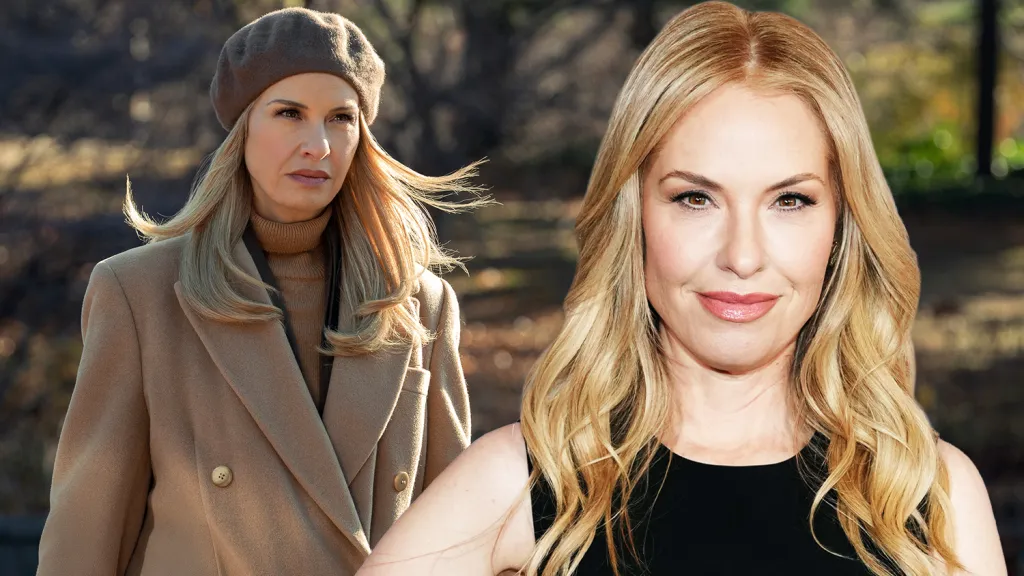
EXCLUSIVE: If Queen Flossie left you wanting more on Power Book III: Raising Kanan, Leslie Grossman will be back to reprise the role in the new prequel Power: Origins. Grossman will recur in the new prequel series, which picks up after the events of the Raising Kanan series finale.
When we last saw Florence “Flossie” Siegel, she denied Raquel (Patina Miller) a lifeline as the walls were closing in on the now deceased queenpin. Later, Flossie met up with Jukebox (Hailey Kilgore). Juke’s dad Marvin (London Brown) left a note behind for his daughter should anything happen to him. After his murder at the hands of his nephew Kanan (Mekai Curtis), Juke received a suitcase of money and the letter, telling her that the only person she should trust is Flossie.
Power: Origins will continue to explore the “Power” Universe “in fresh and compelling ways,” the network touts, while delving into the origin story of fan-favorite characters Ghost, Tommy and Kanan. The trio is ambitious young entrepreneurs on the rise, determined to make their mark on the streets of New York City.
Starz calls Origins “a fun, rambunctious exploration of a new time period in the ‘Power’ franchise that the latest prequel series will highlight the unbridled audacity of young men on the rise, determined to become legends in the game.”
Production on Season 1, which took place in New York and New Jersey, has been completed.
Power: Origins is the fourth spinoff in the “Power” Universe, preceded by Power Book II: Ghost, Power Book III: Raising Kanan, and Power Book IV: Force. A fifth spinoff, Power: Legacy, set in the present timeline that will follow the events of Power Book IV: Force, was also recently greenlit at Starz.
Power: Origins is created by Courtney A. Kemp and Sascha Penn. Penn serves as showrunner and executive producer of the series, from a pilot co-written by Penn and Kemp. The “Power” Universe series is executive produced by Kemp, the creator and showrunner of the original Power, through her production company, End of Episode; Curtis “50 Cent” Jackson, through G-Unit Film and Television; and Mark Canton, through Canton Entertainment. Also executive producing are Chris Selak; Kevin Fox; and Pete Chatmon, who also serves as a director. Lionsgate Television produces the series for Starz.
Grossman will next be seen in the 13th Season of Ryan Murphy’s anthology series, American Horror Story. Her breakout TV role was as spoiled rich girl Mary Cherry on the WB’s Popular, and four seasons of What I Like About You. Additional TV credits include Hulu’s Love, Victor, ABC’s The Goldbergs, Prime Video’s Goliath, ABC’s Black-ish, and Showtime’s Dexter. Grossman is represented by Innovative Artists and Brillstein Entertainment Partners.
>
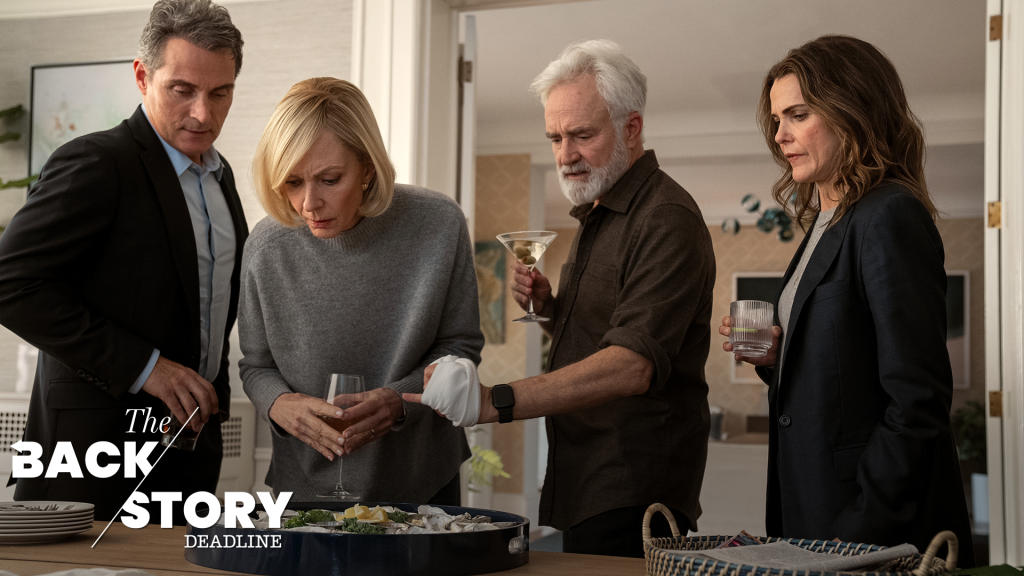
A tray of bloody oysters, served during the middle of an international crisis, was the key to unlocking relationships that changed the dynamic of The Diplomat.
In the scene, two couples are ruminating on the events of the day, including the President of the United States debating whether to tell the British Prime Minister that she was responsible for a major attack on one of its aircraft carriers, as well as dealing with issues in their own marriages.
These are not, however, two ordinary couples: there’s President Grace Penn, played by Allison Janney, and her husband Todd, played by Bradley Whitford, and Vice President Hal Wyler, played by Rufus Sewell, who is married to Keri Russell’s Kate Wyler, who also happens to be the Ambassador to the UK.
Creator and showrunner Debora Cahn said the scene, which appears in “Amagansett”, the sixth episode of the third season of the Netflix political thriller, helped her shape the fourth season, which returns on October 15.
“The oyster scene, in a way, was the proving ground for what then became a real spine for season four, which is how are these couples relating to each other and dealing with the same set of circumstances very differently? It’s such a fun, delicious little scene,” Cahn told Deadline as part of The Backstory series.
The scene starts with the Penns arguing as they enter the room and the Wylers discussing the British situation before Todd cuts himself shucking oysters. The Shinnecocks are then brought out, but they have blood on them.
“I just gave a fucking tone poem to the bivalve,” Todd says before realizing the bloody mistake.
Some 425 local fresh oysters and 72 impoysters were used during the scene.
“He’s not a full-on method actor, but there are certain things, like he’s definitely eating all the oysters and wasn’t going to spit them out after,” said Cahn.
“I’m the kind of actor when I’m off camera, I’m going to eat the oyster,” joked Whitford. “My favorite thing is writing that combines the most serious and the silliest.”
“The sound of them schlooping into the garbage was such an important thing,” added Cahn. “The amount of money that got schlooped into that garbage, there are so many oysters on that tray, the waste. [Todd] keeps talking earlier in the episode about how Grace hates waste.”
The foursome then sit down where President Penn opens a bag of pretzels and squishes the empty bag behind the side of the sofa.
“One of my favorite prop moments is with the pretzel bag. I’m not going to go back to the kitchen. I’m like going to ball it up. I thought of something I think I’ve seen my mother do, I was just shoving it behind the pillow,” said Janney.
Whitford called it “Hall of Fame of prop work”.
Rufus Sewell added, “She’s the President of the United States, but she’s also a person with an empty pretzel bag in her hand, and it’s the empty pretzel bag in the hand, and the dramatic contrast between that and the position and the uniform and the status as perceived, that’s where the show lives.”
It’s scenes like this that helped The Diplomat receive seven Emmy nominations. Russell, Janney, Whitford and Sewell were all nominated and the series also picked up a nod in the Outstanding Drama Series category.
The oysters and the pretzels are amusing moments, but the real tension comes as the group are just sitting and talking. It’s clear that Todd is an intelligent and successful man, but he’s not involved in the administration and Kate Wyler is on the outside as ambassador.
“Writing two roles that are both juicy and delicious in one scene is not so difficult. Writing four in one scene is a lot. It’s a lot, and wanting to make it kind of equally substantive for everybody in the room is a thing,” Cahn said. “I came from theater… and am always just looking for opportunities to be doing theater in a television show, and it’s not an easy thing to do. Most scenes on TV shows are two pages, three pages, maybe a page and a half. To put four characters in a room for nine pages is not common.”
“When I read it, I just it felt very much like a play, and I thought this is going to be so much fun to act with Carrie and Rufus and Brad, and the fact that this is the first time you’re seeing these couples as outside of their environment, outside of their you know political operativeness,” said Janney.
“You live for writing like this. It was like a scene out of Virginia Woolf,” added Whitford. “We’re human beings here, terribly awkward human beings in complicated relationships without the sort of armor of our roles.”
There are other things at play as well; Todd is clearly jealous of his wife’s relationship with her Vice President and Kate Wyler is aware that her husband has a certain charm. This is also where we begin Season 4, which sees Janney and Whitford promoted to series regulars and the group handles the fallout of the carrier attack.
“Not many things are tied up with a neat little bow, said Sewell. “Things continue to iterate out, and it’s certainly the case for Season 4 that there’s even more of that. It gets even more complex.”
>
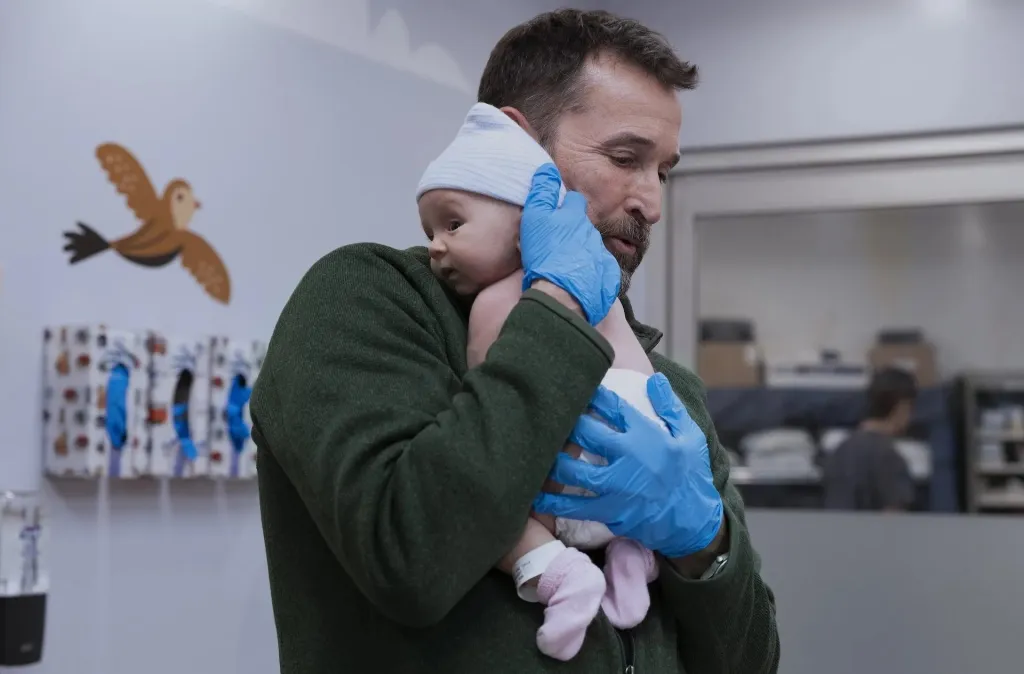
From creator R. Scott Gemmill, The Pitt highlights the challenges U.S. frontline healthcare professionals face through the lens of the fictional Pittsburgh Trauma Medical Center’s emergency department. In a real-time, hour-by-hour format, audiences see the medical cases and the personal turmoil (and occasional life-saving joys) that physicians and nurses must navigate as they reckon with an overabundance of patients and a lack of resources.
For production designer Nina Ruscio, creating that world meant building an emergency department capable of sustaining the series’ relentless pace without ever feeling repetitive. The Season 2 expansion completes more of the 360-degree set, giving the camera and performers even more room to move through the hospital’s maze-like environment. But much of Ruscio’s most meticulous work is designed to go unnoticed, from embedding lighting into the set itself to camera-testing every material and paint color. Even seemingly small details, like an owl carved into the hospital’s columns, carry deeper meaning. Here, Ruscio takes Deadline inside the design of The Pitt, from its pediatric and waiting rooms to the painstaking details that make the emergency department feel lived-in and real.
DEADLINE: What has changed between The Pitt Season 1 and Season 2? How do you make the environment more dynamic when an emergency room is just an emergency room?
NINA RUSCIO: We actually made a big addition to the second stage. Essentially, the set is on two different stages. On the first stage, we went fire lane to fire lane and completed every single inch of that thing. There’s not a single spot on that stage that’s not well used for full-on immersive scenery.
But on the second stage, we drew a line in the sand in the first season because we wanted to preserve a big batch of that stage for other purposes. But at the beginning of Season 2, we gave that up. We wanted to make the set on the second stage—the triage and the waiting room—as immersive and 360-degree photographic as possible.
The triage area on The Pitt
DEADLINE: Are there any areas of the hospital that you’d love to explore onscreen that viewers haven’t seen yet?
RUSCIO: Well, there are. That’s a twofold answer that I’m going to give you. What’s very impressive to me is that we are now working towards 45 episodes of this show. As someone was saying to me the other day, it’s 45 hours of television in an environment that was essentially designed as a pilot. And that it has sustained this much storytelling is very satisfying for everybody because it was a daunting task to be asked to do something without written words, and for it to have had all the life that it’s had. And people are not at the doldrums level of it yet. I’m very proud of how the set has sustained people’s interest. And it was intentionally designed to confuse you at the beginning, so you couldn’t take it all in and fully understand the geography as a viewer.
If you look at all the curves in the floor and ceiling, keep your eye going as if you can continue around, so you never really know where the beginning and the end of something is. So if you’re wondering what parts of the hospital we’d want to explore, we’re so dominantly the emergency department that the need in the story would have to be born out of a need in the story to tell of another department in the hospital, which would be a little counterintuitive for this show because there’s so many stories to tell about the emergency department.
Owl design on The Pitt
HBO
DEADLINE: Any Easter eggs you’d like to point out for the fans that they might not notice?
RUSCIO: There’s an owl carved into the columns. They are as if they’re painted terracotta tile, essentially. And I love this owl detail. Owls are a symbol of the transition between life and death and wisdom and knowledge. They are also fierce and scary. For me, it represents metaphorically what happens here every day. The stakes are very high. You’re dealing with this intersection of where life might meet death and death might meet life. And all of that is the subtextual intensity of working in this environment because the stakes are really high. And that it’s a symbol of knowledge. I love that. And that maybe no one’s ever seen it. Maybe people have been watching this show for a while, and they’ve never seen it. But for me, these little gestures that point to what this place is all about, I love.
And the other thing that I love, that people have embraced, is this idea that these columns are in this physical space that are part of the original history of the 100-year-old hospital and that they haven’t plastered over them because this is the idea that the show is in a pit, that you’re in the basement of this hospital, and that this hospital emergency department is the foundational support for all the rest of the hospital that we don’t get to see.
DEADLINE: Was there a set piece that looks deceptively simple but is actually incredibly difficult to put together?
RUSCIO: Because the environment is 360 degrees, everything has to be capable of being looked at in detail, whether it’s the foreground, the mid-ground or the background, and all of it has to be accurate. But because we’ve made this very brave choice, and it’s borne itself out as satisfying, to light the environment primarily and exclusively with the practicals that are in the set – we don’t use traditional lighting. We don’t use ground-based lighting, and there’s not a lot of grip equipment. But we do not light from the ground because, as a director or as an actor, you can walk from one end of this set without any equipment in your way, as if it is a real emergency department. After all, all of the lighting is embedded there.
But the functions of what happens on a normal set, where there have to be bounce boards to light back up people’s faces, and all that stuff, that’s all designed into the set as well. So all of these flooring materials and all of these counter materials are calibrated and specifically chosen to function as grip equipment for uplighting. All of the top lighting is being reflected up, and that’s why the lighting is so full, because all of this stuff has factored in as functional elements of the craft that we normally would see as equipment that is not supposed to be seen. We needed to include all of that into the design because we couldn’t have that physical stuff in the space.
So it looks deceptively simple. But every single one of these materials was camera-tested. Every single paint color was camera-tested. The levels of sheen and saturation in a beautiful dark-ish palette of the wardrobe make people pop out because they’re the most important part of the story.
Dr. Robby (Noah Wyle) in the Pedeatric “Peds” room in The Pitt
HBO
DEADLINE: I love the pediatric room. What conversations were had about the creation of that?
RUSCIO: Peds was born out of my very first meeting because I met with John [Wells] and Noah [Wyle] and Scott [Gemmill] and Michael Hissrich when they talked to me about doing the project. They approached me to design an emergency department before they wrote anything. And that’s an extremely flattering and unique position to be in because I needed to cover any possibility that they might come up with. In speaking with them, we tossed around a lot of ideas, and whether it was an institutional design, it still has the essence of what should be an emotional reflection of the people that are in it.
And so my conversation with Noah centered on the idea of a space where there would be a discordance between what the physical space looked like and what was happening emotionally in that room. He had this idea of a single animal, and I suggested it could be a menagerie of animals. And this space, this ironic room of cartoon animals and colors, would be the place of such extreme trauma. And that juxtaposition holds true to a lot of life. A lot of really bad things happen in a lot of really powerful, beautiful places. And then these places hold emotional psychotraumatic weight, ultimately, always, no matter when you step into them. So that was born out of that.
DEADLINE: The waiting room next to Peds also has color, not as much color, of course, but it matches that elaborate staircase in the back where we sometimes see characters taking a moment of respite.
RUSCIO: This waiting room is the idea that the emergency department has a completely historical space that hasn’t been renovated in a hundred years; that was a big important part of the story to tell. And then there’s all kinds of layers of time in these furnishings. Maybe they got these chairs when they first got there, and then they got all jacked up, so they covered them with plastic. Then they tried to get more chairs from the same manufacturer, but they didn’t make them. All of these are brand-new, custom-made, and aged to tell these stories. But all of these subtle internal details help make the space look real and invisible because that’s what it would be if you had a hundred people in here every hour of every day. It would be a really pretty, physically traumatized space and beat to shit.
The Pitt waiting room
HBO
DEADLINE: Does anyone still get lost on set?
RUSCIO: People do still get lost, but really part of that is solved by our OSHA compliance. So all the emergency signs and exit signs are real. If you go to them, they will take you out, and you will be safe. But also, if you keep walking and walking in a circle, you’re going to get back to where you came from. It’s both practical and real.
>


Search For Canadian TV Actor Stewart McLean Now Homicide Investigation


These ’90s fashion trends are making a comeback in 2017
According to Dior Couture, this taboo fashion accessory is back
Model Jocelyn Chew’s Instagram is the best vacation you’ve ever had
Emily Ratajkowski channels back-to-school style
9 Celebrities who have spoken out about being photoshopped
Your comprehensive guide to this fall’s biggest trends
A photo diary of the nightlife scene from LA To Ibiza