
Tech
Smart glasses without a camera? Even Realities bets productivity beats recording everyone

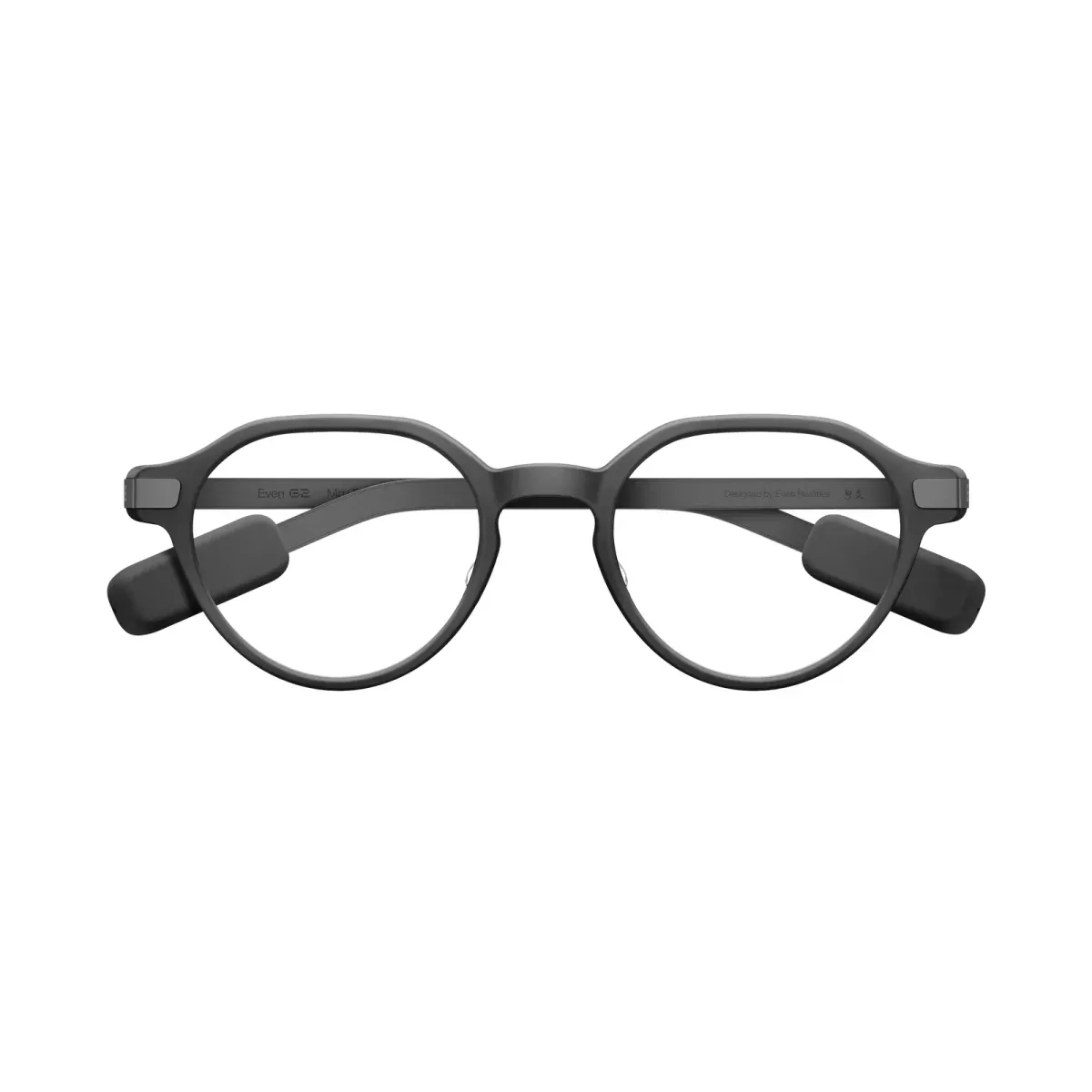
In the past few years, multiple tech executives have told us that glasses could be the next big interface for consumer hardware. And yet, today’s smart glasses rely a lot on phones, even if they have good hardware. Even Realities’ G2 smart glasses are in the same boat. They’re a premium-looking pair of glasses with a neon-style heads-up display you can see in any lighting — but their functionality relies heavily on their connectivity with the phone, which can be** unreliable and frustrating.
Even Realities takes a different approach to smart glasses than players like Meta. Their devices have a monochrome heads-up display that shows text and information in green, giving it the look of a neon board.
There are no cameras or speakers, and that is by design. The company wants to focus on productivity rather than recording, so the people around you don’t have to worry about being filmed.
The G2 is the second pair of smart glasses from Even Realities and an improvement over the G1 released a few years ago. The G2 has a brighter 1,200-nit display (vs. 1,000 nits on the G1), four mics (vs. two), and a 75% larger display area than its predecessor. The new display also has a better 60Hz refresh rate, compared with 20Hz on the G1.
In the few months I’ve used the G2, the connectivity with the phone has improved tremendously. Early on, the glasses would disconnect from the app so frequently that I nearly gave up on them. But after a few app updates, that issue got better.
The glasses are targeted at people who might be constantly in meetings, giving presentations, and traveling to countries where different languages are spoken.
Design
The glasses, which come in two frame designs, are very light at 35 grams. The frame is made out of magnesium alloy, and the temples (the arms that go over your ears) are made out of titanium alloy. In terms of weight and fit, the glasses were comfortable to wear.
Since I work from home most of the time, though, I didn’t feel much need to wear them all day. That said, the lenses have UV protection built in, so they’re still worth wearing outside just for eye protection — smart features or not.

The company claims that, based on typical usage, G2’s battery can last up to two days on a single charge. The glasses come with a protective case that can recharge them up to seven times before needing to be plugged in itself. I personally didn’t test the two-day claim, but the battery lasted me long enough to put them back into the case without running out of juice.
That case is big — you can’t shove it in a pocket — but it’s solid, and the glasses fit in snugly.
Features and operation
The glasses act as your companion for schedules, reminders, and access to notes. You can wake them up by tapping on the stem-based controls. If you double-tap on the control pad on the stem, you will see a dashboard with information like your upcoming meetings, stocks, and top news.
The G2 can also show real-time phone notifications, but the pop-ups weren’t always reliable — and since my phone is usually within reach anyway, I didn’t find much use for the feature.
Long-pressing the temple control opens a menu with several functions: a notifications tray, Translate, Conversate, Teleprompt, a to-do list, and Navigate. Translate lets you set a target language and converse with anyone. At the recent Global Connect Show (GCS) in China, I wore the glasses while talking to company reps doing demos, and the translation was good enough for me to follow along when someone spoke Chinese. I also tried it with other journalists speaking various languages, including French and Spanish. (The downside of this feature is that the other person doesn’t know what you’re saying in your language unless they’re also using the app.)
Navigate is a cool feature that shows turn-by-turn directions on the heads-up display. The catch: it doesn’t work with Google or Apple Maps. Instead, you have to set your route through the Even Realities app. I tried it a few times walking to cafes near my house. The directions showed up well on the display, but the app kept getting the addresses wrong, so I can’t rely on it for places I don’t already know how to get to. Still, I could see cyclists or motorbike riders finding it useful once the company fixes the accuracy issues.
Conversate, at first, just showed a live transcript of the conversation on the glasses, which felt pointless since you can just as easily record a meeting with an app or an external notetaker. Later, the company added a “prep notes” feature that surfaces more context: you can manually add notes or documents ahead of a meeting and let the AI reference them during the conversation, or let it listen in real time and pop up short explainer bubbles for concepts as they come up. For instance, during a briefing about energy, it showed me a bubble for “Green Hydrogen,” and tapping it brought up a definition right in front of my eyes. That was genuinely useful — though I wouldn’t want a transcript or explainer bubbles for every conversation I have.
At the center of all this is the built-in assistant, Even AI. As with any voice assistant, you say a wake word to activate it and ask questions or add items to your to-do list. It often misunderstood my to-do list requests, and for general questions, the answers were often long paragraphs that streamed across the screen with no way to interrupt or skip ahead.
Another issue: despite having four mics, Even AI often failed to activate, or misheard me, when I was outside. The ambient noise in India could have played a part, but I’d still expect a modern gadget to have better noise handling.
The G2’s screen was legible in most conditions, but in a bright room I had to adjust the brightness manually through the app. Even if the company hasn’t built an automatic-brightness sensor yet, I’d like to see a manual brightness control built into the glasses themselves, rather than requiring the phone app.
Don’t put the R1 ring on it
Even launched a companion ring called the R1 alongside the G2. The idea is to control the glasses through a touch surface on the ring instead of the glasses’ own touch controls. But its price and functionality don’t quite justify the cost.
The ring works well, and I didn’t have any issues using it. But I struggled to find scenarios where I actually needed it, since the touch-sensitive temples on the glasses already do the same job.

On top of that, Even built health tracking into the ring — heart rate, calories, steps, sleep, and SpO2 (blood oxygen level). Personally, I’d rather go for a dedicated ring like Oura or Ultrahuman if I wanted that form factor with health tracking. Second, if I already use a fitness tracker, I wouldn’t want to buy a ring where health is an auxiliary function for a ring that is meant to control the glass.
All this functionality bumps up the ring’s price to $249, which is not cheap. If I used my smart glasses a lot, I would consider buying a controller ring at a lower price if it also had a mic, which I could use for issuing commands to the AI assistant. As it stands, I’d skip the R1.
Where does Even G2 stand?
Smart glasses are coming out fast. Camera-equipped, screen-free models like the Meta Ray-Bans are popular, but Meta, Snap, and other competitors are racing to build glasses with color screens, too. Only a handful of Chinese companies — like Rokid and Inmo — are making glasses with this same neon-display style.
The Even G2 costs $599 and delivers solid hardware in a light, good-looking frame. The company is also working to make the glasses more customizable by supporting third-party apps, though I didn’t find any app compelling enough to make me reach for the glasses more often. They’re a nice-to-have: fun to explore if you like tinkering with new hardware and don’t mind trying out third-party apps.
The hardware itself is good, but outside of jobs that require constant translation or teleprompting, it’s hard to find a clear everyday use case for smart glasses like these.
Even’s bet is that skipping the camera and speakers is the right move for a productivity-focused device — and I don’t disagree with that direction. But now that the company has newly reached unicorn status, it needs to build out more first-party software to make the glasses something people actually reach for every day.
When you purchase through links in our articles, we may earn a small commission. This doesn’t affect our editorial independence.
>

A pattern is emerging among people who’ve already made it big. They’re rolling up their sleeves again, seemingly out of fear of missing AI’s defining moment and, presumably, the irresistible allure of making even more money — potentially a lot more.
Tom Blomfield, who co-founded GoCardless and Monzo before spending 4.5 years mentoring founders as a Y Combinator Group Partner, announced on Monday that he is taking a leave of absence to join Anthropic’s compute team — not as an executive, but as a member of technical staff.
He’s not alone in making that kind of move. Instagram co-founder Mike Krieger joined Anthropic as Chief Product Officer in 2024, and Andrej Karpathy, a founding member of OpenAI who went on to lead AI at Tesla and start his own company, Eureka Labs, joined Anthropic’s pre-training team in May, framing the decision almost identically to Blomfield’s, writing that “the next few years at the frontier of LLMs will be especially formative.”
Not everyone is joining someone else’s lab. Chamath Palihapitiya, the “SPAC King” who has mostly stuck to boardrooms and all things “All In” since leaving Facebook in 2011, just took his first full-time operating role in over a decade as CEO of 8090 Labs, his enterprise AI coding startup, which he announced a couple of weeks ago along with a $135 million Series A led by Salesforce Ventures. Wrote Palihapitiya on X, “I am convinced that what we are building now is even more important, so there was no decision to make except to be all in.”
Similarly, Eric Wu, who ran Opendoor for a decade before stepping back in 2023, recently launched NavigateAI, an AI “copilot” for construction workers, with $25 million in seed funding. Wu told me directly on a recent call about his decision to dive into an AI startup, “I knew if I looked back in 10 years and didn’t do something related to it, I would probably regret that.”
The clearest sign of how keen people who’ve already “made it” are to work on what they view as the still-early-innings of AI might be the job title itself. “Member of technical staff” is the deliberately flat, non-hierarchical label that Anthropic and OpenAI use for nearly everyone on their technical teams, regardless of seniority. It’s the same title Blomfield is taking.
It’s also the title that Peter Bailis took this March, just months after becoming Workday’s CTO, a role overseeing AI strategy across an $8 billion-revenue business. Bailis lasted less than a year before trading it for a spot at Anthropic.
When you purchase through links in our articles, we may earn a small commission. This doesn’t affect our editorial independence.
>
Tech
Uber’s product chief on hotels, robotaxis, and why the company doesn’t want to be “everything for everyone”

Uber has spent the last year quietly pushing beyond the two businesses most people associate it with. There’s ride-hailing, of course, and delivery, but spend time in the app and you’ll now find hotel bookings powered by Expedia, “shop for me” concierge features, and boat rentals in Europe.
Under the hood, so to speak, there’s also a lot happening. Think debit cards for drivers, a data-labeling side hustle for these same earners looking to make more moolah, and a six-month-old, business unit called AV Labs, which is developing a fleet of sensor-equipped vehicles that’s separate from Uber’s regular driver network and designed to gather ever-larger amounts of driving data. Uber frames the initiative as a way to strengthen its relationships with autonomous vehicle partners, several of which it also holds equity in, but it sure looks like a hedge, as well. Uber competes directly with some of those same partners, with Waymo chief among them, and owning the data layer gives Uber both some leverage and optionality.
Whether Uber becomes a full-blown “everything app” similar to some Asian super-apps like Grab, remains an open question. But in this conversation, Uber Chief Product Officer Sachin Kansal walks TechCrunch through the company’s financial-services ambitions, its increasingly complicated relationship with Waymo, its new AV Labs data operation, and how AI is starting to show up in ways riders and drivers will actually notice.
This interview has been edited for length and clarity.
TC: You unveiled hotels, boat rentals, and more shopping features earlier this year. How did that list get made, and what didn’t make the cut?
SK: Every year our teams are obviously building a lot of stuff, and a subset of that we decide is worth sharing with the world on the biggest stage. This year the theme that we gravitated towards was really travel. 1.5 billion trips on the Uber platform every year actually happen outside of a user’s home city, so we know that travel is something that’s a very common use case for Uber users. Our headline announcement this time was actually introducing hotels on Uber as a partnership with Expedia. But travel is so much more than that — you need rides to go from the airport to the hotel, and you need food. We heard from a lot of our users that a lot of them had stopped using room service and were just using the Uber Eats app. With “shop for me,” the goal was for us to enable you to shop from any local store even if that store is not available on Uber Eats with the entire catalog. Travel really is, in my opinion, the third leg of the stool — we had rides, then we added eats, and now we are adding travel.
Is Uber moving toward offering its own financial services, the way “everything apps” in Asia do?
Financial services for us cuts across multiple different entities — consumers, but also drivers and couriers, and merchants. We have multiple products today focused mostly on drivers and couriers, where we have what we call the Uber Pro card, which they can use as a debit card and transfer all their earnings onto. We are starting to experiment with some of those products for merchants in certain parts of the world right now. As far as consumers are concerned, we’ll see if that makes sense for us in the long term. Right now there is a currency for consumers to use — we call them Uber credits — and this ties to our membership program. On hotels, for example, members get 10% cash back on a $1,000 transaction, that’s $100 back as credit that you can then use on rides and eats.
Would Uber ever offer its own buy now, pay later product?
I’m not sure, because we want to make sure that the experts do what the experts do. We already have announced partnerships with others in the industry who are already providing that service, so that at checkout you have the ability to do that. In terms of our general product strategy, we’re not trying to be everything to everyone.
With boat rentals, in Europe, tapping the tab hands users off to a partner’s own booking flow rather than checking out inside Uber. Is that handoff model a template for what’s coming?
Definitely there are some instances, especially when we are doing something new, for us to rely on our partners, because a two-way integration just does take a lot of time, and in some cases it’s good for us to try before we integrate deeply. In the case of Expedia, we decided it just makes sense to integrate deeply — we built the entire UI on our own in partnership with Expedia. But in some cases it may make sense for us to hand off the rest of the experience to the experts in that field, and if you get great traction, we can always integrate them deeply.
Your Uber One membership product now has 51 million members and accounts for roughly half of bookings. Do you have data showing the cross-sell actually works — that a delivery user later starts taking more rides?
On the delivery side, it takes you two to three orders for you to break even the monthly fee that you pay. As members get more habituated to the program, it’s increasing their frequency within the line of business they are already using. And it’s also leading to more usage of the other sides of the business — we are seeing people who are mobility only also start to use delivery, and people who are delivery only also start to use mobility.
Delivery has been one of the hardest businesses in tech to make profitable. Is Uber Eats still leaning on ride-hailing to stay healthy?
During the early years of Uber Eats it was not profitable yet, but over the last several quarters, Uber Eats has been independently a profitable business for us, and generating a lot of profit.
A story I wrote this spring framed Uber as unexpectedly competing more directly with Airbnb, which is now offering airport transfers through a partner. Do you see it that way? Who are you most focused on?
There’s no dearth of competitors — Lyft in the U.S., Didi and 99 in Latin America, Bolt, Ola around the world, and on delivery, DoorDash, Delivery Hero. But I only spend a very small percentage of my time thinking about that. The bigger percentage of my time, or what keeps me up at night, is are we providing our users all the value that we can provide.
You recently wound down the Waymo pilot in Phoenix while scaling elsewhere. How do you keep the experience coherent when you’re partnering with — and in some cities competing with — the same supplier?
Phoenix was the first city that we launched with Waymo, with about a dozen cars, but our scale launches have been in Austin and Atlanta, where we have hundreds of cars with them. When we recently looked at the Phoenix pilot, we mutually decided that it doesn’t make sense for us to continue. Waymo is an excellent partner of ours, but in many cities they’re also a competitor. We are not in the race to be an L4 autonomy provider — what we are focusing on is laying down the race tracks so we can work with multiple players. We believe in the hybrid network, human drivers as well as autonomous vehicles in the same city, because it allows us to balance demand and supply.
Regarding AV Labs, what can Uber offer autonomy partners that they don’t already have?
We are going to be equipping hundreds of cars with sensors, deployed through our fleet partners, and through that we’ll be collecting millions of miles worth of driving data. That really helps with the long-tail problem — you want to see all the edge cases, not just the P95, P99 level. Beyond the data itself, there’s so much know-how from our 10 million earners in terms of how pickups and drop-offs work. We handle 25 million lost items every single year — how do you operationally handle that in the world of autonomy? That’s the kind of operational expertise we can bring.
Is Uber selling driver and rider data to Gen AI companies?
I would divide this into two parts. In terms of Gen AI companies, we are able to label data for them using our earner base, or through audio collection, and yes, we have commercial relationships with them and we are selling it to them — that’s a part of the business that is new, and we are extremely bullish about it. AV Labs is separate, and we are still figuring those models out for sharing that data with partners. It’s a little early.
Are drivers recording conversations with riders for this data work?
No, no, no — I want to be very clear, there’s no conversation being recorded as part of that while they’re on a ride. When they’re not on a trip, they’re not driving, they’re not delivering, they’re just talking, or they’re listening to a piece of audio and transcribing it. They get paid for doing that, by the way.
Where has AI actually shown up in ways a rider or driver would notice?
If you are an earner on our platform, we have an earner assistant — the number one question on their mind is how do I make more money, and it will say, look, it’s actually pretty light in the South Bay, but you may want to go five miles away where there’s a lot of demand. On the Eats side, there’s a grocery cart assistant where you can say “I want milk, eggs, bread” and it creates the cart very quickly. And on rides, you’re able to use voice to request a ride — say “I’m looking for a ride to the airport, I have six pieces of luggage, six people.”
So a fully agentic Uber — “plan and book my whole trip” — is on the horizon?
I can’t put a date on it, and I can’t tell you exactly what the feature set will be, but I think AI is going to be a huge enabler of that, where I can leave the complexity to the platform and just tell an agent what exactly I want. Easier said than done — we want to make sure we’re not just checking a box by shipping an agent that maybe doesn’t work that well.
As CPO, how do you personally prioritize with so many ideas in flight?
I would say I spend 70% to 80% of my time making sure that our existing products, or the products we are about to launch, are as solid as possible. All the new ideas are like shiny objects — if you have 100 ideas, maybe five of them are good, and those five then need a lot of cultivation and conviction. So probably 20% of the time is on new ideas — including, by the way, I go out and drive and deliver myself, just to see our product from the other side firsthand.
When you purchase through links in our articles, we may earn a small commission. This doesn’t affect our editorial independence.
>

X has made a “tweak” to its algorithm to boost the visibility of posts to users’ “mutuals” — the people they follow who follow them back, head of product, Nikita Bier, said Monday.
“We noticed this data was missing from the algo and it made your friends appear less in your replies. This resulted in the reply section feeling more like a battleground with people you don’t recognize.”
The change may not drastically revamp the site’s user experience, but may make X feel a little bit more like a community rather than a torrent of disparate voices shouting into the digital abyss.
Bier noted that the change would also “help clusters form around interests more easily, which many people have asked for.”
X has introduced a number of changes lately — many of which seem designed to make the site a bigger hub for creators. Earlier this year, the site changed how it compensates accounts in an effort to incentivize original content rather than mere aggregation, and, earlier this month, it also introduced a video editor designed to make it easier for users to work on the platform.
This tweak follows changes that Meta’s Threads has been making to its algorithm aimed at creating communities, largely as a differentiation from its main rival X. For instance, last month Threads rolled out a Your Algo feature which lets users privately control what they see in their feed. It also reached 500 million monthly active users.
>

World Cup 2026: Who will win the tournament? The view from the semi-finalists

BBC Sport quiz: Who am I? Guess World Cup star footballer #37

World Cup 2026: Time for Lamine Yamal to ignite? Or another Mbappe World Cup masterclass?

-

 Fashion9 years ago
These ’90s fashion trends are making a comeback in 2017
-
Fashion9 years ago
According to Dior Couture, this taboo fashion accessory is back
-
Fashion9 years ago
Model Jocelyn Chew’s Instagram is the best vacation you’ve ever had
-
Fashion9 years ago
Your comprehensive guide to this fall’s biggest trends
-
Fashion9 years ago
A photo diary of the nightlife scene from LA To Ibiza
-
Fashion9 years ago
9 Celebrities who have spoken out about being photoshopped
-
Fashion9 years ago
Emily Ratajkowski channels back-to-school style
-

 Tech3 months ago
OpenAI CEO apologizes to Tumbler Ridge community

