
Sports
Bears’ left tackle competition adds another contender; Colston Loveland shines


LAKE FOREST, Ill. — When the Chicago Bears’ starting offense took the field Friday, a new player manned the left tackle spot.
Kiran Amegadjie, a 2024 third-round pick, took most of the reps with the first unit.
Considered somewhat of an afterthought in the left tackle competition, Amegadjie played a day’s worth of snaps for the coaches to observe. On two snaps, defensive end Austin Booker appeared to get the better of Amegadjie, but this was also a non-padded practice.
Amegadjie was part of the competition last summer, but injuries limited him in camp. He made the 53-man roster, but was inactive the first two games before landing on injured reserve.
In April 2025, coach Ben Johnson expressed his interest in Amegadjie from the previous draft, when he was still part of the Detroit Lions coaching staff.
“I liked Kiran a lot coming out last year,” Johnson said that April. “He was a guy we had earmarked as a potential developmental prospect. He had a lot of traits to work with. I don’t know if the vision last year in Chicago was for him to have to play so quickly. But they were kind of forced into that spot.”
GM Ryan Poles saw something in Amegadjie to take him in Round 3 coming out of Yale. The front office liked what Amegadjie put on tape against the Washington Commanders in 2024 before he had the difficult situation of having to start last minute at the Minnesota Vikings.
It could be just Friday’s plan, and maybe Braxton Jones — who was next in line for snaps Friday — or Jedrick Wills Jr. gets the shot Saturday. As with all things in the trenches, clarity will come in padded practices, but practice No. 3 was a reminder not to rule Amegadjie out just yet.
Rome Odunze clarifies how his foot has healed from injury
Kevin Fishbain
Player in the spotlight: LT Braxton Jones
Jones played a couple of snaps with the starters earlier in practice. He reiterated Friday that his physical comfort is “night and day” compared to last summer.
Coming off a 2024 ankle injury, Jones was never fully healthy last training camp, even when he entered the season as the starting left tackle. He lost the job to Theo Benedet in Week 4, who eventually ceded it to Ozzy Trapilo, and Jones later went to IR.
“It’s really hard. If you’ve really dealt with one of these injuries, it’s really significant like this, it’s really a mental thing,” Jones said about his battles last year. “Like, yes, my leg wasn’t strong enough, but the mental part of it was worse than anything.”
Jones has always been open about struggling against power in the pass rush, and he said working with retired All-Pro Terron Armstead, who played for offensive line coach Dan Roushar, has helped him improve that element of his game.
Armstead also helped Jones get back to playing free after the injuries.
“One of my biggest things with Terron is just he allowed me that space to gain that confidence back,” Jones said. “I talked about the muscle mind and gaining that back, realizing I did have some of that power in the leg. I just wasn’t connecting it, trusting it. Working with him really gave me that life.”
Pressing question
When will Darnell Wright’s extension get done?
The fourth-year right tackle seemed unconcerned about his contract situation or the negotiations going on between his agents and the Bears.
“My main focus really is just football. Being as best as I can be for the team,” Wright said. “Obviously, I know I’ll be here for a long time, hopefully my whole career. Those things kind of just handle themselves, but I just have to stay focused on the main things. That’s just getting better, consistency every day.”
Wright reiterated that he plans to be a Bear “for a long time,” and that it “doesn’t really matter” when a deal gets done.
Poles recently alluded to the goal of getting a deal done before games begin, to avoid distractions. Since the beginning of training camps, the Eagles extended defensive tackle Jalen Carter, selected one pick before Wright, while the Saints extended wide receiver Chris Olave, drafted in 2022.
A second-team All-Pro last year, Wright could be looking at the top of the right tackle market. Vikings right tackle Brian O’Neill just inked an extension averaging $24 million per year, $1 million shy of Lane Johnson. O’Neill is a two-time Pro Bowler.
Keep an eye on: Running back Salvon Ahmed
Ahmed hasn’t played in an NFL game since 2023. He went on IR last August as a member of the Indianapolis Colts. With second-year back Kyle Monangai out for the second day in a row, Ahmed took the second-team reps.
On his first handoff, Ahmed cut back to the left and found lots of room to run, taking off for an explosive play and drawing a big cheer from fans. Monangai will be the No. 2 to D’Andre Swift, but if Ahmed runs well and proves himself on special teams, could he challenge Roschon Johnson for the No. 3 role?
Quote of note
“We’re the No. 1 regression candidate so … I think we’ve got plenty of motivation ourselves. We talked about Caleb (Williams) in the past. He’s used to handling a lot of attention, so I’m not worried about that.” — Coach Johnson
Jacksonville Jaguars coach Liam Coen quipped about how no one’s talking about the Jaguars, yet the Bears’ quarterback is all over NFL coverage. Williams reposted the clip, and Johnson was asked about it Friday.
For a coach to publicly acknowledge the regression discussion is something, and it was a fair retort. Johnson is also confident Williams isn’t fazed by any of this. As seen by how he reacted on social media, he seems to get a kick out of it.
All eyes are on Caleb Williams entering Year 2 under Ben Johnson
Kevin Fishbain
Quick hits
• Tight end Colston Loveland was featured often Friday. He made four catches during the end-of-half drill, including the touchdown to end it. He also caught a big pass over linebacker Devin Bush on a play-action throw from Williams and hauled in a 4-yard touchdown during red-zone drills.
• Backup quarterback Tyson Bagent had one of the best plays of the morning with a back-shoulder throw to Jahdae Walker, who adjusted well to haul it in. The two connected shortly thereafter on a play-action pass for a first down.
• Rome Odunze made one of the best catches of the day, skying to high-point a pass from Williams over the middle.
• Cornerback Jaylon Johnson scored the first interception of Williams this training camp, picking him off in seven-on-seven drills.
>

Rico Lewis was asked how it felt to be back in action before the new season following Manchester City’s first friendly against Inter in Hong Kong last Saturday, and he had a message.
“Yeah, first of all I want to thank my Lord and Saviour Jesus Christ for giving me the opportunity to play today, and to be alive,” Lewis said. “He is the reason I’m here today and everything I do is in the glory for him and his kingdom, but yeah, happy to be back on the grass with the team, we played a good game in both halves, both halves were a bit different.”
Lewis’ faith has blossomed over the past year and is very important to him. This summer, the 21-year-old held a charity football tournament in Manchester, with the proceeds going to homeless charities, something motivated by his Christian values.
“One day… it’s weird, I was speaking to my wife and I said, ‘I want to buy a bible’,” he told The Athletic in July. “She was brought up Catholic anyway so she was always in and around the faith, but it was just something that I started reading, and I guess it touched my heart, and it’s changed me from the inside.

Rico Lewis signs a shirt on Manchester City’s pre-season tour in Seoul (Chung Sung-Jun/Getty Images)
“It’s something I wanted to investigate and as soon as I started looking into it, it changed me in a way where I couldn’t look back. I was changing and it changed my whole life, hopefully my family’s life as well. That could spread to many people around me and hopefully, ideally, for everyone.”
Lewis is the latest City player to have embraced the message of the bible. Following a fine performance in November’s 3-0 win against Liverpool, winger Jeremy Doku put his improved performances down to his faith.
“What changed for me this season, I have God in my life,” he told reporters. “That’s what changed, and that’s what you can see. On the pitch, I have His presence with me. That’s the difference. I’m just happy that now I can just deliver the way I want to play without any fear or doubt or anything.”
Doku and his wife, Shireen, were baptised by American pastor Tim Timberlake in December last year, the footage of which features in a video on the winger’s YouTube channel. Last week, he uploaded a 20-minute video titled, “How faith carried me through the World Cup”, a time when he and Shireen welcomed their first child.
Antoine Semenyo, who signed for City in January, is from a Ghanaian background and comes from a religious family. “Mum and Dad didn’t let me go to football on Sundays without going to church first,” he told reporters in Hong Kong.
He was also baptised in December, in a ceremony on Bournemouth beach just before his move to Manchester. “I’ve been wanting to do it for so long and I had couple of days where I could do it, and I said to the local pastor, ‘I wanted to do (it)’. I always wanted to, I knew that I’m obviously walking with God at the moment, and I want to maximise my faith as much as I can, so practising gives me the opportunity to do that,” he told reporters in Hong Kong. “I’m so happy I’ve done it and I’m (on) the walk of faith now and it’s been amazing.”
He says it has helped him settle in at City, alongside fellow January signing Marc Guehi, whose father, John, is a devout Christian and a former church minister.
“I think that’s definitely a factor for sure,” Semenyo added. “Me, Jeremy, Marc, we speak a lot and we always pray a lot. We pray before the games, we pray in the hotel the night before together. When you have brothers in Christ, it just gives us the maximum strength to go into the games knowing that we’re confident and we’ve got belief in God, so it’s great.”
Semenyo and some of his team-mates are part of the Ballers in God movement, started by former Tottenham Hotspur midfielder John Bostock, which states that its mission is “to use the global platform of football to make Jesus known”.
Its website sells shin pads emblazoned with different religious themes and messages, which are backed by testimonials from Anthony Elanga, Alex Iwobi and Trevoh Chalobah, among others. Players who are part of Ballers in God meet up with each other over video calls.
“We did it a couple of times before the World Cup started to send a message about God coming back and it was great,” Semenyo says. “A lot of celebrations with the crown coming off our heads and going down, to obviously praise God for coming back. We do it all the time.”
The group affiliated with Timberlake — Lewis, Doku and occasionally Divin Mubama, Stephen Mfuni and Ryan McAidoo — also participate in video calls once or twice per week, where they spend 30-40 minutes examining different verses from the bible.
“We started doing bible studies and stuff like that and we talk about it frequently,” Lewis said. “Jeremy’s had a big change, you would have seen that on his social media. He’s the one who really drove it and it was good for us, especially for me at the start of my journey.
“He has a pastor that he met, and he actually speaks to us and takes us through a verse, we could be there 45 minutes on just four or five words. There’s so much that goes into it that can change your life and if everyone can take the time to just explore… it’s not an easy thing to do but there’s a bigger picture and it can change a lot of people’s lives.”
It is clearly a message that is spreading in the City dressing room.
>

“From the data we have and the metrics we look at, it suggests that we are the biggest Premier League club in the United States. I believe we’re in a unique position in terms of our pulling power.”
Liverpool’s chief commercial officer Ben Latty is talking to The Athletic about the impressive foothold they have established in the American market and their grand plans for further expansion.
According to audience research company GWI (formerly Global Web Index), Liverpool have 26 million supporters in the U.S. and boast the fastest-growing fanbase of any Premier League club in that country.
They have 62 official supporters’ clubs spread across 32 states and 12 international football academies based there. The U.S. is Liverpool’s biggest retail market outside the United Kingdom, accounting for 26 per cent of all international sales.
No wonder they have just returned from a lucrative two-week-long pre-season tour which saw new coach Andoni Iraola’s side play in front of more than 116,000 fans across three matches in Nashville, New York and Chicago.
“As a club, obviously we get money to go to the U.S., but it’s much bigger than the fees we get,” Latty explains. “It’s about the importance of being on the ground there. Our partners see the U.S. as a big market and want us to activate more there.
“With our ability to sell tickets, the strength of our retail business, the size of the TV audiences and engagement figures on our social-media channels, we’re perfectly poised to take advantage of the U.S. market. That’s one of the reasons why we travelled out there rather than staying in Europe.
“There’s so much potential for growth, based on the huge opportunity we can offer U.S. brands to tap into the global appeal of the Premier League.”

Liverpool went on a U.S. tour to start their pre-season (Geoff Stellfox/Getty Images)
In recent years, Liverpool have struck a host of multi-million-pound deals with high-profile blue-chip U.S.-based brands, such as mobile-phone firm Google Pixel, logistics and shipping giant UPS and digital strategists Orion Innovation.
American fashion brand Tommy Hilfiger came on board in January, one of six new partnerships agreed last season, along with SAS, PayPal, Trimble, Haier and EC Markets.
The fact Liverpool have around 227 million followers on social media, more than any U.S. sports team, certainly helps when it comes to attracting business.
Last season, they had 1.5 billion social-media engagements and were the most engaged Premier League club for the third successive campaign. They also had the most-visited club website in the Premier League for 2025-26, with more than 91 million globally.
Currently, 11 of Liverpool’s 28 commercial partners (39 per cent) are headquartered in the States — the highest number of any European club. It’s the reason the club’s commercial director Kate Theobald is based at their New York office.
They also have a presence in Boston, where they benefit from the input of sports marketing firm Fenway Sports Management, a subsidiary of Fenway Sports Group, the conglomerate from that city which owns Liverpool.
The pre-season tour involved plenty of discussions with potential partners as well as cementing relationships with existing sponsors. Latty believes interest generated by the recent World Cup will open more doors for Liverpool in North America.
“Despite all its flaws, it was still a successful tournament, and we have to ensure we capitalise on the growing popularity of football there post-World Cup,” he says.
“I have to say that the broadcaster, NBC, have done an amazing job promoting the Premier League in the U.S. with their coverage. They have found this niche window at the start of the U.S. sporting weekend. They have made a big deal of it and increased the fandom of the sport.
Liverpool vs Wrexham ahead of kick-off
James Pearce
“We’ve been able to benefit from that trajectory over the past five to 10 years, but I think the World Cup takes it to another stratosphere in terms of what the popularity of the sport could be.
“Kate and her team have been very busy hosting existing partners and speaking to other brands who are interested in getting into the Premier League and using Liverpool for that. These are big deals with big brands who have big expectations, so we need to up our game in terms of delivering for them. We pride ourselves on having a strong success rate when it comes to renewals. We recently renewed a few more that will be made public soon.”
Part of the grand plan involves growing Liverpool’s global network of standalone retail stores. Currently, they have 26, which is more than any other sports team in the world. Eight have opened in the past year alone, including in Singapore, Hong Kong, Dubai and London.
However, they have yet to open any in the States. That is set to change in the coming months, with the club also keen to set up a distribution centre in America rather than having to rely on every order being dispatched from a hub in the Netherlands.
“We haven’t found the right partner yet in terms of opening stores in the U.S. but we’re working on it, and I believe it will happen,” Latty adds.
“We’re ambitious. We’re up to 26 stores at the moment. Ideally, we want to get to 40, if not more, over the next few years. With the plan we’ve got, we should have over 30 by the end of this season.
“You have to find the right partner to make sure it’s a long-lasting project rather than a flash in the pan. Opening a U.S. distribution centre is something else we’re looking at. That would allow us to have more capacity to stock more products, plus cheaper postage rates and things like next-day delivery, etc.
“If we can do that as well as opening bricks-and-mortar stores in multiple cities across the U.S., it would be another exciting addition to what we can offer. The potential is massive for us out there.”

The kit deal with Adidas is expected to boost Liverpool’s commercial income (Geoff Stellfox/Getty Images)
Their latest set of accounts, for 2024-25, showed that the club’s commercial revenue climbed to a record £323million. However, that figure is set to increase considerably, given the success of a new kit deal with Adidas, which is worth around £90m per year. Adidas took over from Nike last summer.
The 2025-26 home and away kits were both the highest-selling in the club’s history. The home one outstripped sales of the previous year’s equivalent by 700 per cent, with orders received from more than 150 countries.
“It’s been unbelievable. It’s exceeded all expectations, and Adidas have been a great partner to work with,” Latty says. “I think we’ve also exceeded their expectations too, in terms of where we sit in world football. As a result, they are offering more products, more capsules, more special-edition releases this season.
“Last year’s kits broke all records, and this summer’s releases aren’t far behind, despite what was a difficult period on the pitch towards the end of last season.
“It’s different to the Nike deal, which was more royalty-based. This model works for us. We worked hard with Adidas in the short window we had to find the perfect structure. Every year, we intend to grow our retail business through more products, more stores and better e-commerce.”
Latty, who reports to Liverpool chief executive Billy Hogan, was promoted to chief commercial officer in 2024, two years after returning to the club as commercial director. He had stepped down as head of global partnership sales in 2021 to join a group in Bristol operating professional teams across football, rugby union and basketball.
Liverpool’s deals with long-standing shirt-front sponsor Standard Chartered and shirt-sleeve sponsor Expedia both expire in the summer of 2027. Discussions over possible extensions are underway.
“We’re talking with them,” Latty reveals. “Naturally, we speak to our incumbent partners about the future as well as speaking to other brands across the market.
“In terms of Standard Chartered, I don’t know what will happen at this point. We still have another year, and conversations are ongoing. Seventeen years (as Liverpool’s main shirt sponsor) is a long time, and it’s a great relationship. We’ll probably find out pretty soon what direction that’s heading.
“As for Expedia, they have had a big leadership change recently. They came on board during the Covid years, which was a bold move for a travel business. The great thing about Liverpool is that with our reach and our values, if a brand is looking to invest in a big Premier League club, I’d like to think that puts us at the front of that queue.
“I am confident in terms of where we are. We have such a great property to take to market, in the event we need to do that. I am not concerned.”
Given the costs associated with ensuring Liverpool continue to compete for the biggest prizes on the pitch, there’s pressure on Latty and his staff to keep on delivering off it.
“I don’t think we’re anywhere near the ceiling of where we could be commercially,” he adds. “This can has to be run in a sustainable way and every pound we make gets reinvested into the club.
“Ultimately, we’re here to win trophies as a football club, and our job is to make sure the resources are there to give us the best possible chance of achieving that.”
>
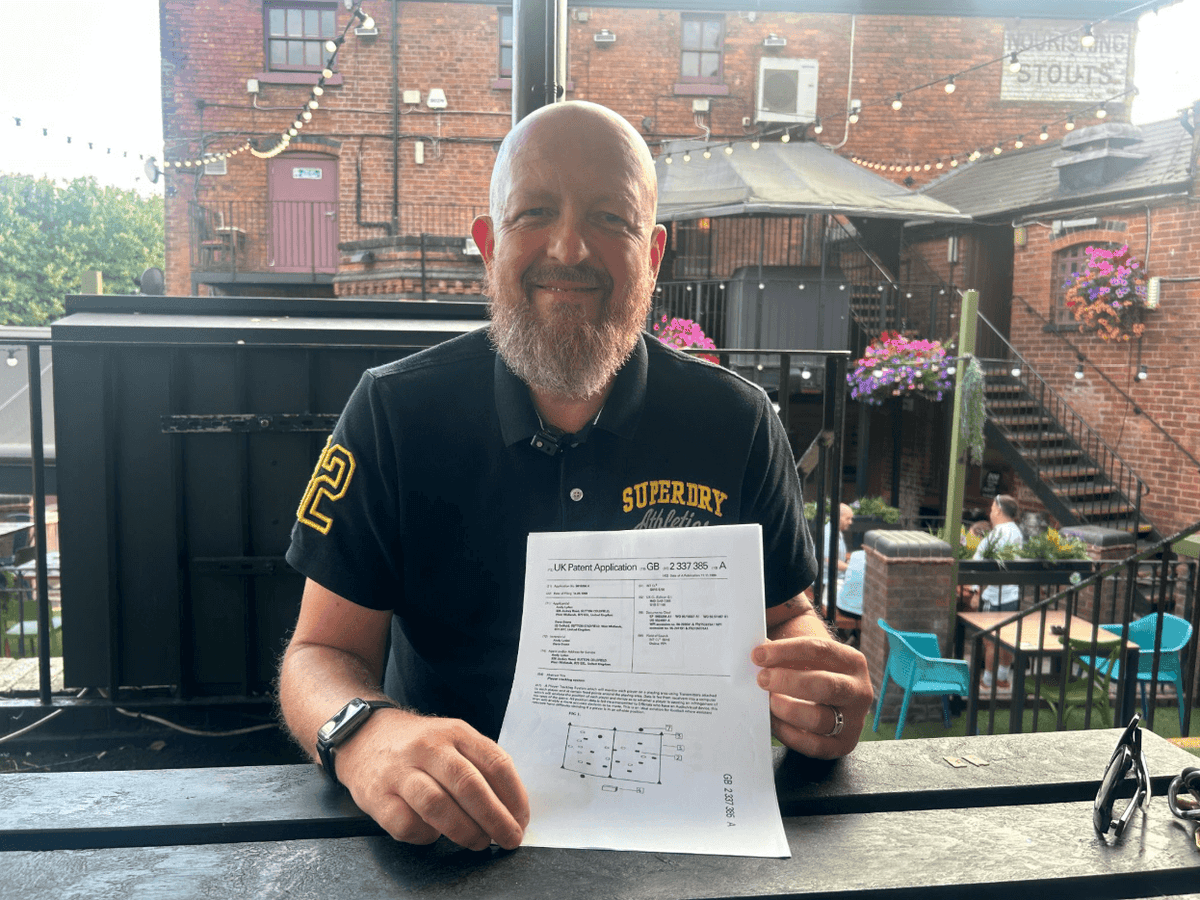
At a train station pub six miles north east of Birmingham, England, Andy Lyden looks over a patent application he had almost forgotten existed for a concept that later changed football.
The West Bromwich Albion supporter and his Aston Villa-supporting friend Dave Evans filed it from Evans’ kitchen table in their hometown of Sutton Coldfield in May 1998. Their system would track players, detect possible offsides and alert referees almost instantly, which they hoped would make football decisions more accurate.
While football would not approve goal-line technology until 2012, conduct its first official semi-live video assistant referee (VAR) trial until 2016 or introduce semi-automated offside at a World Cup until 2022, Lyden and Evans had imagined elements of all three. Not only that, but they also warned that frame-by-frame video reviews would slow the sport down, damaging its tempo and atmosphere.
“We were hoping to make ourselves millionaires, as I suppose quite a lot of young people are,” Lyden says.
It was not their only attempt at invention. Evans, now 69, says the pair were always discussing ideas and that he had previously spent thousands of pounds trying to protect a couple of his own.

Dave Evans (Michelle Evans)
Lyden was 31 and Evans 40 when they submitted the application. They had met a few years earlier through Sutton Coldfield Baptist Church, where their families attended and their children, who were of similar ages, grew up together.
The two men lived less than a mile apart and regularly met at Evans’ house, either around the kitchen table or in the office upstairs.
“It was literally just thinking, ‘What do we think is going to happen in the future?’,” Lyden says. “It was around the time I was still getting my head around emails.”
The late 1990s felt like the beginning of a technological transformation. Mobile phones were enormous, and the internet remained a novelty in many British homes. Lyden had a job with electronics company Philips and now works in programme and project management for Rolls-Royce and Jaguar Land Rover. He admits Evans was the more technically minded half of the partnership.
Evans, who now lives in Ramsgate, Kent, worked in the insurance industry as a programmer in C++, a language for building software, and was involved in early methods through which insurers could collect and share information. Nevertheless, he credits Lyden with starting the conversation.
“He was the one who said to me, ‘I’ve been thinking about this’,” Evans says. “We sat down and fleshed out the details.”
“One night, this just came out,” Lyden says. “Football will all be electronically tagged, linesmen will become defunct because you will know when the ball is out and you will know when it has crossed the line.
“Me and Dave would have spent hours and hours talking about how it would be, how it could be and how we saw it in the future.”
Why are there so many people in the VAR room?
Tifo Football
They eventually decided to protect the idea, but a patent application is a request for legal rights over an invention and filing one does not mean the technology has been built, tested or approved.
Their application, titled Player Tracking System, was submitted on May 14, 1998. It proposed placing transmitters at fixed points around the pitch, along with fitting each player with a miniature version.
The signals would be sent to a central receiver connected to a computer. For an offside decision, the system would identify when an attacking player had moved beyond the relevant defender and send the information to the official responsible for that half of the pitch.

Picture 1, above: from the patent application showing the transmitters attached to the players and the officials for the game represented by black circles. Picture 2, below: how the system would work. (Credit: Andy Lyden)

The patent said officials would carry an “audio/visual device”, although it did not explain exactly what it would look like. Lyden says he and Evans imagined something resembling a modern smartwatch worn on the referee’s wrist that could buzz to alert the official and display information or a replay of the incident.
The system was designed to assist with objective decisions across the pitch, not only goals and offsides. By continuously tracking the ball and every player, it could establish whether the ball had crossed a boundary line and alert officials to possible position-based infringements. Decisions involving judgement, such as whether a challenge constituted a foul, would remain with the referee.
“We knew the technology was there because of all the things that were happening with GPS and maps in cars,” Evans says.
The idea came years before the arrival of recognisable smartwatches as Microsoft launched its SPOT watch platform in 2004, while the first Apple Watch was released in 2015.
Cricket had already begun using replay officials — a ‘third umpire’ was first deployed in Test cricket during South Africa’s series against India in 1992 — while rugby league introduced a video referee when Super League began in 1996. Those systems required another official away from the field to review television pictures and communicate a decision.
Lyden and Evans’ patent warned against lengthy frame-by-frame reviews, describing the process as “completely unacceptable” for a high-tempo sport and proposing “split-second analysis” instead.
“Our idea was that it was totally electronic,” Lyden says. “This would give you the decision.
“We tried to think of a system that took humans out of it, and the way they have implemented VAR is that they have added another step, but you still come back to a human decision.
“VAR was introduced to take ambiguity out of decision-making but it actually adds more. They are looking at video evidence 20 times instead of the referee having one moment.”
Evans believes technology has prevented obvious errors, but remains frustrated by marginal offsides and lengthy checks.
“As a football fan, you do get really cheesed off when it takes three minutes to make a decision,” he says. “It can spoil the game.”
The application was published in November 1999, meaning its description and drawings became publicly available, but it never became a granted patent as the application was withdrawn in August 2000 as Lyden and Evans stopped progressing it before securing enforceable rights over the invention.
“It’s always the same thing with ideas like these,” Evans says. “It’s the costs.”
Lyden remembers paying several hundred pounds to submit the application before discovering that the next stage would require a further payment of around £2,000. Neither had the resources to manufacture the equipment or build a working version of the system.
“You could imagine that you’d have spent £20,000 just to set up a demonstration,” Evans says.
“You can have a great idea, but these things are difficult to get off the ground unless you’ve got money that you’re not afraid to lose.”
“We were stupid enough to put a patent in that we couldn’t afford to carry forward,” Lyden says.
Both men had young families and neither could risk losing that amount of money on an idea football might ignore. They also had no contacts in the sport who could help them develop a prototype or place it in front of the Football Association.
The application was left behind, although its publication meant the idea remained publicly available and later patent applications concerning offside detection, player positioning and referee-assistance technology cited Lyden and Evans’ work.

The VAR system has been embedded in matches across the world (Alex Pantling/Getty Images)
The arrival of similar technology was gradual enough that Evans cannot remember one moment when he realised football had caught up with their discussions.
“It came in slowly,” he says. “It was talked about for a few years before it was actually implemented.”
“We talked about that 20 years ago,” he says. “Why has it taken so long for these people to see the usefulness of it?”
FIFA conducted its first official semi-live VAR test during France’s 3-1 friendly victory over Italy in Bari in September 2016, before using the system at the Club World Cup three months later.
Hawk-Eye Innovations, which is owned by Sony, was appointed as FIFA’s VAR technology provider in 2017 and now supplies the system to competitions including the Premier League, Serie A and Ligue 1.
The values of its FIFA and Premier League contracts have not been made public, but the scale of the industry is considerable. Germany’s Bundesliga spent €1.8million introducing a VAR system in 2017, while Hawk-Eye — which now operates in 25 sports — recorded revenues of £81.7million and pre-tax profits of £14.8million in the year to March 2025.
Evans jokes that life might have looked rather different had football adopted their system. “I’d be sitting on a beach somewhere,” he says. “Not having to go to work.”
Players are now electronically tracked, offsides are calculated by computers and referees receive signals on wearable devices when the ball crosses the goal line and the delays caused by frame-by-frame video reviews, which Lyden and Evans warned about in 1998, arrived too.
Lyden looks down again at the printouts on the pub table and offers his explanation for why their own system never reached a football pitch.
“We were too early and too skint.”
>

Rico Lewis and Antoine Semenyo on finding strength and community in their faith

Liverpool’s commercial power in America, their 40-store plan and sponsorship future

‘We invented a VAR system in 1998… but couldn’t afford to build it’
-

 movies3 months ago
Search For Canadian TV Actor Stewart McLean Now Homicide Investigation
-

 Fashion9 years ago
These ’90s fashion trends are making a comeback in 2017
-
Fashion9 years ago
According to Dior Couture, this taboo fashion accessory is back
-
Fashion9 years ago
Model Jocelyn Chew’s Instagram is the best vacation you’ve ever had
-
Fashion9 years ago
Your comprehensive guide to this fall’s biggest trends
-
Fashion9 years ago
9 Celebrities who have spoken out about being photoshopped
-
Fashion9 years ago
Emily Ratajkowski channels back-to-school style
-
Fashion9 years ago
A photo diary of the nightlife scene from LA To Ibiza