
David Duchovny and Gillian Anderson The X-Files: I Want to Believe.
Diyah Pera


Why does Hollywood keep making sequels? Is it because they’re all out of ideas? Or is it because they make a lot of money? On second thought, do they even make a lot of money, or is Hollywood’s obsession with sequels a vicious cycle of chasing a perceived upside that isn’t there? It’s time to really dive into the numbers.
Since 2000, over 530 movies that are a direct sequel have been released in theaters and grossed at least $5 million domestic, according to data provided to IndieWire by Rentrak. That doesn’t include remakes, prequels, spinoffs, streaming films, movies that made less than that, or just ripoffs of better movies. Together, those films have grossed over $74.3 billion at the domestic box office in that span of 25+ years. Does that sound like a lot? Perhaps it even sounds low compared to what we’ve come to expect from studios.


But consider that of the roughly 18,450 movies that have been released in that 25-year span, 530 films is not quite 3 percent of all theatrical films, yet in that span the domestic box office has brought in roughly $245.2 billion, and those sequels have accounted for 30 percent of the overall gross. Granted, nearly all of those sequels hail from major studios, and if we only looked at studio output in that span, with no indies that drive a good chunk of the box office, the overall percentage of sequels to studio titles would likely be far greater.

The current narrative is that original films, not franchises, are driving more of the box office. Audiences are seeing movies like “Obsession,” “The Odyssey,” “Backrooms,” and “Project Hail Mary” while new “Star Wars,” “Minions,” and others have underperformed. In fact, through July of this year (not including “Spider-Man: Brand New Day”), sequels have made $1.4 billion at the domestic box office. More than halfway through this year, that’s slightly less than half of the $3.1 billion sequels brought in throughout all of 2025. That’s even down 33 percent from the $4.70 billion sequels made in 2024. 2024 however, which included films like “Inside Out 2,” “Moana 2,” “Beetlejuice Beetlejuice,” “Twisters,” and “Dune: Part 2,” was the third-largest year for sequels since 2000, only slightly behind 2019 ($4.79B) and 2017 ($4.73B), not adjusted for inflation.
So the questions are twofold: Does making as many sequels still make the same financial sense as it once did when the audience appetite for franchise films was at its highest, and which studios are making the best decisions over time when it comes to sequels? We were surprised by some of the takeaways.
When you look at how many sequels were made year over year, the curve looks pretty similar to the above chart of dollars brought in by those sequels, with a few exceptions. Hollywood in 2016 released 30 movies that were sequels, more than any other year, and the box office for those 30 films was $3.6 billion domestic, with an average of just $120 million per sequel, which was as low as it had been since 2008. But in 2015 and 2019, the two highest years for sequel box office, studios produced nearly as many sequels as at any point, and their average was similarly higher, $175M and $171M respectively, than at any point prior.

It sounds like more sequels meant more money, but correlation is not necessarily causation. The box office for those movies went up because there were more of them, generally. But at least for a while, the fact that they were sequels didn’t necessarily lead to outsized box office results.
So let’s look at the overall percentage of those sequels’ box office dollars compared to the complete annual box office. Between 2002 to 2014, sequels hovered somewhere between 20 to 30 percent of the overall annual box office, with a few peaks and valleys in between. Starting in 2015 through 2019, the peak Marvel years, that percentage surged, with the high points of 2015 and 2019 also accounting for a whopping 42 percent of the overall box office for the year. Truly, sequels dominated the conversation. Yes, those years included “Avengers: Age of Ultron” and “Avengers: Endgame,” respectively, but they also included some big hits like “Taken 3,” “Furious 7,” “Mad Max: Fury Road,” “Jurassic World,” “Magic Mike XXL,” “Mission: Impossible – Rogue Nation,” and more in 2015, and in 2019 “The Lego Movie 2,” “John Wick 3,” “Toy Story 4,” “Frozen 2,” and “Star Wars: The Rise of Skywalker.”

Unfortunately post-pandemic, we all know that the box office, especially the lower end of it for anything that’s not an “event” to get people out of the house, has meant that Hollywood’s reliance on sequels has gotten even worse. In 2023, Hollywood released 29 sequels, as many as some of the peak years, and even released 25 sequels in the pandemic-addled 2021. In 2022, a year that included “Top Gun Maverick,” “Black Panther: Wakanda Forever,” “Thor: Love and Thunder,” “Minions: The Rise of Gru,” and “Avatar: The Way of Water,” sequels accounted for a whopping 60 percent of the overall gross for the year.
In 2025, 24 sequels made an average of $130.5 million and were 36 percent of the overall box office for the year. That average is below the average across all 25 years, roughly $138 million, even though the overall percentage of the box office is on par with what we saw in the few years pre-pandemic. It may portend that while the massive highs for sequels are still achievable, the floor is much lower, leading to worse results overall, and the possibility that Hollywood needs to reassess how many sequels it is putting into the pipeline.
Gun to your head, if you had to guess which of the Big Six major studios made the most money from sequels over the last 25 years, you’d probably guess Disney. You’d of course be right. Since 2000 according to the Rentrak data, Disney movies — and that is movies solely with “Disney” as the listed distributor, not 20th Century Studios or Searchlight movies in more recent years that encompass most notably the “Avatar” sequels — have made $18.1 billion at the domestic box office. The next highest, Universal, which again does not include Focus Features or some DreamWorks titles, made $11.6 billion.
Incredibly though, Universal led all major studios with 83 released sequels in that 25 year span. Though Universal has no superhero IP to speak of, it has milked the “Fast & Furious” franchise, the “Despicable Me” and “Minions” franchises, “Jurassic World,” “Shrek,” “Meet the Fockers,” “Bourne,” “The Purge,” and so much more. Disney, remarkably, came in fourth among all studios, with just 61 total sequels behind Warner Bros. (76) and Sony (66), though that total goes up to 68 if you add in seven 20th Century Studios titles. It would eclipse all studios if you included the 51 movies 20th Century Fox released in its span before being absorbed by Disney in 2019. Paramount came in fifth with 59 sequels, and Lionsgate came in behind 20th Century Fox with 46 sequels.


So what does all this mean? Is Universal making too many sequels? Is Lionsgate not making enough? That’s a little too simple. Keep in mind that these are studios that have undergone massive change in this 25 year span, including the introduction of streaming changing the calculus for theatrical films, new regimes coming in and calling the shots, and in the case of Disney and 20th Century Fox, Warner Bros. and New Line, or Amazon and MGM, entire studios absorbing entire other studios. It’d be impossible to make a one-to-one comparison over such a long period of time.
So we looked at a few other breakdowns to see if we could spot some trends. Universal in three of the last 25 years, including most recently in 2025, released 7 sequels in that given calendar year. No other studio at any point in time released more than 6. Last year Universal released “Five Nights at Freddy’s 2,” “Wicked: For Good,” “Black Phone 2,” “Nobody 2,” “The Bad Guys 2,” “Jurassic World Rebirth,” and “M3GAN 2.0.” Those films made a combined $1 billion, more than any studio last year (Disney was second with $795M).

On the other side of the coin, each of the major studios, with the exception of Warner Bros., had at least one year in which the studio released no sequels per our tally, though they were certainly mining IP or doing reboots in those given years. We also looked at which studios led the way at the box office with their sequels: Disney consistently was the leader, winning the year of sequels 11 times, including every year between 2015 and 2019. Every other studio though, including Fox, Paramount, Sony, Universal, and WB, had at least three years a piece in which their sequels collectively grossed more than their competitors. Some years they led the way because they released more films, in some years a single title or two dominated the year, and others they lagged behind despite releasing the most titles that year.
But some studios had more dramatic swings than others or curves over time. Disney during its peak Marvel years saw its box office rising year after year from sequels, even surpassing $1 billion domestic from sequels for the first time, and post-pandemic/”Endgame,” it has struggled to reach those same highs, something that has been well-documented and observed by the powers that be at Disney and Marvel.

A few other trend lines jumped out. Paramount had an impressive stretch in the early 2000s between 2003 to 2005 when it was releasing all original films, films like “School of Rock,” “Mean Girls,” “Team America: World Police” and a few remakes like “The Longest Yard” and “The Manchurian Candidate.” It followed that period up with a run where it became increasingly enamored with sequels that would do better and better. Franchises like “Transformers” and “Mission: Impossible” were cleaning up for Paramount, and it even had the distinction of releasing “Iron Man 2” and some of the “Shrek” sequels. It hit a peak in 2011 that fell all the way until 2022 with “Top Gun Maverick.” Movies in the “Terminator” franchise started to fizzle, and it saw diminishing returns from “Paranormal Activity” by the fourth and fifth entries. Now it has tapped into some revived franchises with “Scream” and the launch of the “Sonic the Hedgehog” franchise.

Universal had a massive spike year in 2015 between “Jurassic World,” “Ted 2,” “Furious 7,” and “Pitch Perfect 2,” and since then, it has stepped up the number of sequels it makes each year, between 4-7, but also increased its floor, landing around $500 million even in its down years and closer to $800 million in other years. The new “Super Mario Galaxy Movie” and the latest “Minions” has Uni in good shape for another boom year in 2026.

And Lionsgate was doing as well as any studio with its slate of sequels in the mid 2010s, when the “Twilight” films and “Hunger Games” movies were all going strong, not to mention some of the “Saw” movies.” But it has struggled to retain that former glory, with the “John Wick” franchise its only true standout in recent years.
It all suggests that other than the dominant run for Disney, studios are going to have wins and losses, hits and bombs, highs and lows, and the like. That’s not surprising. None of this factors in budgets or expectations, but perhaps the real surprise is that such sequels, by literally every studio, are treated like sure things, the safe choice in a given year compared to the risks that original films are perceived to be. For pretty much any studio, that may never have really been the case.
>
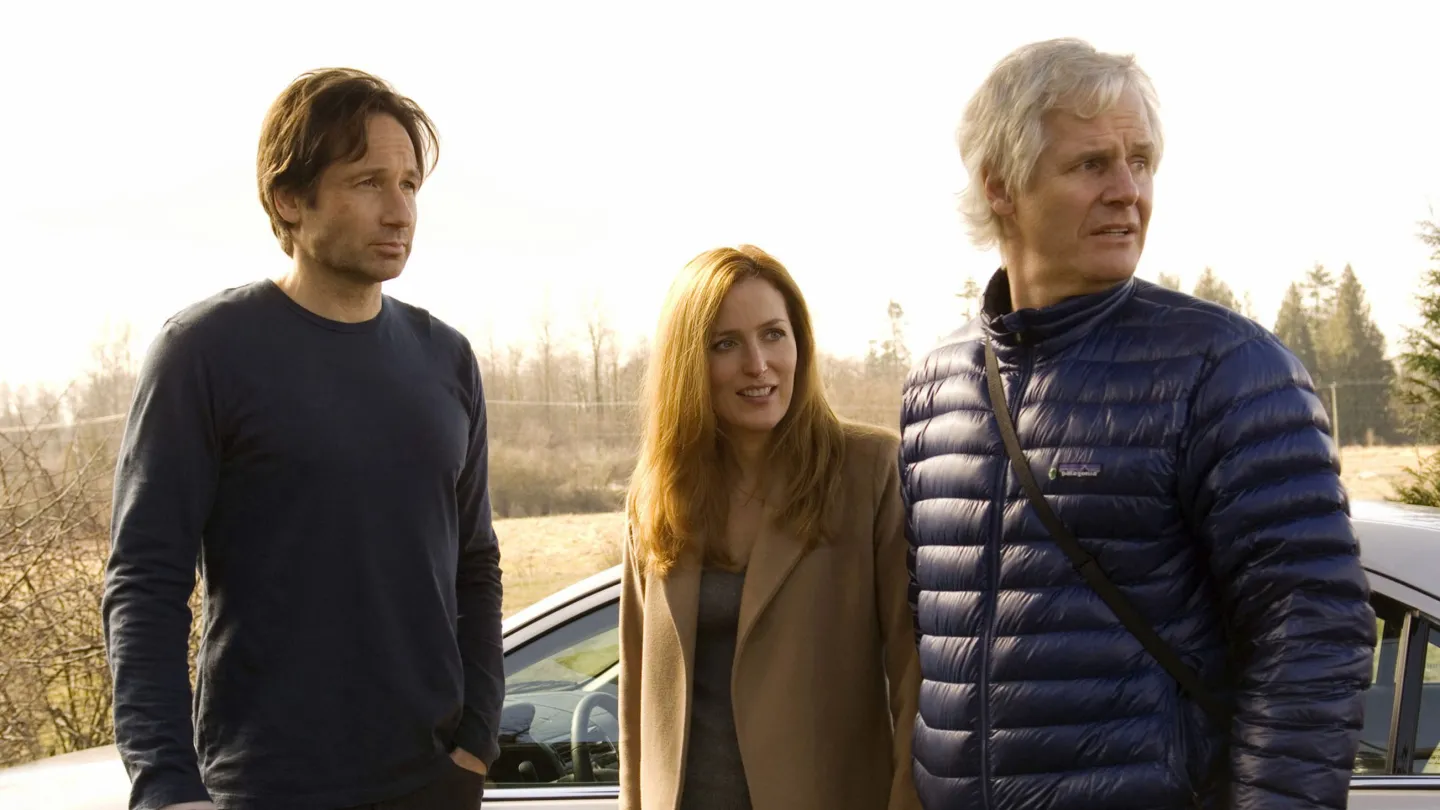
An updated version of the truth is out there — and streaming on Disney+ come Aug. 14.
Almost 20 years after releasing the second film in his TV and movie franchise, The X-Files creator Chris Carter has recut The X-Files: I Want to Believe (now titled The X-Files: I Want to Believe – Vrach Frankenshteyn) to give his devoted fanbase the version he set out to make. Leaning harder into the standalone mystery, a contemporary retelling of Dr. Frankenstein, the new version amps up the horror elements that 20th Century Fox and the MPA wanted removed from the film in 2008 to give it a PG-13 rating.
“Unlike most director’s cuts, I didn’t throw in everything but the kitchen sink,” says Carter. “It’s actually shorter than the original. I hope it finds a wider audience, and I hope I give fans what they wanted.”
Since the release of the original I Want to Believe, Carter has twice revisited The X-Files. Revivals in 2016 and 2018 are canonically regarded as the 10th and 11th seasons of the original series starring David Duchovny and Gillian Anderson as special agents Fox Mulder and Dana Scully that ended in 2002. Speaking earlier in August, Carter says the trio still isn’t finished telling their story — though when and how they return depends a lot on what Ryan Coogler does with his take on the material. (The Sinners filmmaker shot a pilot for an update of The X-Files for Hulu earlier this summer.) Carter also spoke about sparring with executives back in the day, his skepticism over those Congressional hearings about UFOs and his unique relationship with his very vocal audience.
Take me back to 2007-2008, when I’m assuming you were in post-production on this film. At what point did it become apparent that the film that you wanted to make and the film the studio wanted to release were different films?
It was the first screening for the studio in a little theater at 20th Century Fox. There was, let me call it, mild outrage that we had not delivered a PG-13 movie. It was a tense discussion, and we agreed to cut it down to the version that we’d apparently promised them. When we handed the new version over to the MPA, they said, “This isn’t a PG-13 movie.” We cut it back a second time. For me, trying to do a scary X-Files, this wasn’t what we had set out. What’s ironic is that the PG-13 standards for a movie were less permissive than the standards and practices for a television show at the time. So my feeling is that the movie became a relationship heavy movie. The scares were second to that. I wanted to go back and put in the scares.
You have worked in the entertainment industry for some time. Looking at the tense back and forths and creative concessions you’ve made in your career, where does the original version of this film rank?
It’s a movie in itself. (Laughs.) I’ll tell you a funny story. Glen Morgan and James Wong had done an episode called “Home” [in 1996]. It’s probably it’s one of the favorite, if not the most favorite, episodes of the show. It’s a very scary episode, but this was in season four. By that time, the studio had left us alone. I don’t know how we snuck it past the censors, but it aired and I got a screaming call from an executive the next day that the episode would never air again … that we had gone too far. All of a sudden, all eyes were on us. It affected the show going forward. We were held to a much stricter standard.
So tell me how this happened. It isn’t often that a studio pays someone to release a directors cut these days.
I was talking to Steve Asbell at 20th Century Studios about something else. I asked if they’d ever considered doing a director’s cut of I Want to Believe. He said, “No, but let’s talk about it.” It was as easy as that. I did not have to put my own money behind this. This was a labor of love when Frank Spotnitz and I set out to do this way back when. So I knew we had a movie that no one ever got to experience. And I think the production values are so rich. We filmed it almost entirely in a very forbidding environment, all snow and ice. I went through nine pair of boots and my feet were never warm. And there’s a message in the movie, beyond “I want to believe,” and it’s “Don’t give up.” It sounds like something that could go on a Nike T-shirt. It’s simple. But that’s what it’s all about. Mulder doesn’t give up on the case. Scully doesn’t give up on Mulder or the young child she’s trying to heal in the picture.
I believe you remain in touch with Gillian Anderson and David Duchovny. Have you spoken with them about the new cut of the movie?
When the original was released, I went out and promoted it. The studio didn’t promote it, so it I felt it was never really seen by a wider audience. X-Files fans went to it because they are the greatest. The movie made money. We made it for less than $25 million. And I haven’t had an opportunity to show the director’s cut to Gillian. But I showed it to David, who was very pleased. High praise.
You mention fans of the franchise. I spent a little time on X-Files Reddit before speaking with you, and you seem to be uniquely engaged with that community. Is that fair to say? And have you found that to be a healthy habit?
David Duchovny and Gillian Anderson The X-Files: I Want to Believe.
Diyah Pera
Definitely. And, yes, it is. We had we had a 30th anniversary reunion in Minnesota, and I had kids come up to me, kids whose parents didn’t even know each other when the X-Files premiered and tell me they’re fans of the show. It’s amazing that the show has lasted and is as popular as it is, these 30-odd years later.
Fan feedback was so different three decades ago than when you released the new seasons on Fox in 2016 and 2018. It’s certainly different from now. Do you engage in with the dialogue even when it’s more critical?
Sure, serve it up. I’m open to criticism. I’m open to applause, boos. Give it to me. We’ve always relished the feedback. There’s someone who used to be the head of the X-Files online group. She was very critical of some of my work in the last reboot. I just took it on the chin. And I got criticism from someone important to the show who said that I didn’t give the audience what they wanted. I think I didn’t give the audience what they expected. And that is left to come. There are four episodes and the last two reboots that were all part of a bigger plan that I hope to reveal to X-Files fans if and when we should do another reboot.
I always bristle at this idea that audiences deserve to get their way even if it’s not the creators’ intent.
There’s a point at which you need to deliver on a promise. And I wanted to deliver more than the promise. I wanted to give them what they least expected. I know that sounds somewhat confusing, but I had a bigger plan and it all made sense. It will make sense, and so hang with me.
What can you tell me about the bigger plan?
There was a big revelation at the end of the season finale in season 11 that Scully is pregnant. Some people were horrified, outraged. They hated me. It was big. And once again, as I say, this is taken on the chin because I have a bigger idea in mind. I think that time will tell.
If you had your druthers, what would be next — another season of the series? A movie?
I don’t know. The thing that was unexpected, but now highly anticipated, is the Ryan Coogler reboot. I don’t want to do anything to compete with that. I don’t want to do anything to get in the way of that. I don’t want to play off of that. I want to continue to tell and finish the story arc that I have in mind. That said, I’m anxiously awaiting his version. My name is on it as executive producer, but I have done exactly nothing. I am, like everyone else out there, excited about what it may be.
It’s not really a reboot, per se. Danielle Deadwyler and Hamish Patel are not playing Scully and Mulder. So, in success, do you see a world in which this new show and a future iteration of your original story can exist contemporaneously?
My choice was not to read the script, because I wanted to watch it like everyone else. So, it really depends on his vision.
Since the last season of the X-Files aired, we’ve had some declassified files. We’ve had some hearings. We’ve had some whistleblowers. There’s been a lot of dialogue about the possibility that extraterrestrials have visited the earth or at least our atmosphere. You’ve said in the past that, like Mulder, you identify with that idea of “I want to believe.” Has this info dump changed the way you think about aliens?
No. There’s been a lot of talk, a lot of testimony. There isn’t a whole lot of evidence. Next to none. Is this another smoke screen? Is there a category that is above top secret that even those in the highest echelons don’t know about it? Are we keeping that secret to prevent a kind of anarchy and pandemonium in the world if they find out that we are not alone? I don’t know. But once again, this is interesting storytelling material.
Courtesy of FOX
Has all of that gotten your wheels turning on your own story?
Yeah, obviously. And people like Steven Spielberg, it got his wheels turning too. I saw Disclosure Day. He’s my favorite director in my lifetime. He can do no wrong.
Ok, this is a mild spoiler, but it’s a 20-year-old movie so I think it’s fine. There’s a sequence in the closing credits of I Want to Believe that that’s an aerial shot Mulder in Scully in a boat in some tropical locale. Right before it fades to black, they both look up and they wave to the camera. What was the intention there originally? And what was the intention to keep it in this time, given how much darker the film was?
Apart from Mulder’s red swimsuit, which only the hard core fans picked up on, the choice was simply environmental. We had just shot through a long, cold winter. I thought the viewers, the filmmakers and, in particular, Mulder and Scully needed a trip to a tropical locale and the warmth that that provided.
At the time, sitting in the theater, I interpreted this as the last I was ever going to see of the characters and they were waving goodbye.
No, they were waving, “Thank you for watching our movie.” Yes, it was breaking the fourth wall, but of course you could do that on a credit sequence.
I guess I’m a soft-core fan. What’s the red swimsuit?
There’s a scene in season two, where Mulder’s in a red speedo. It lit the nascent internet on fire. For hardcore fans, it’s one of those iconic scenes from the show.
>
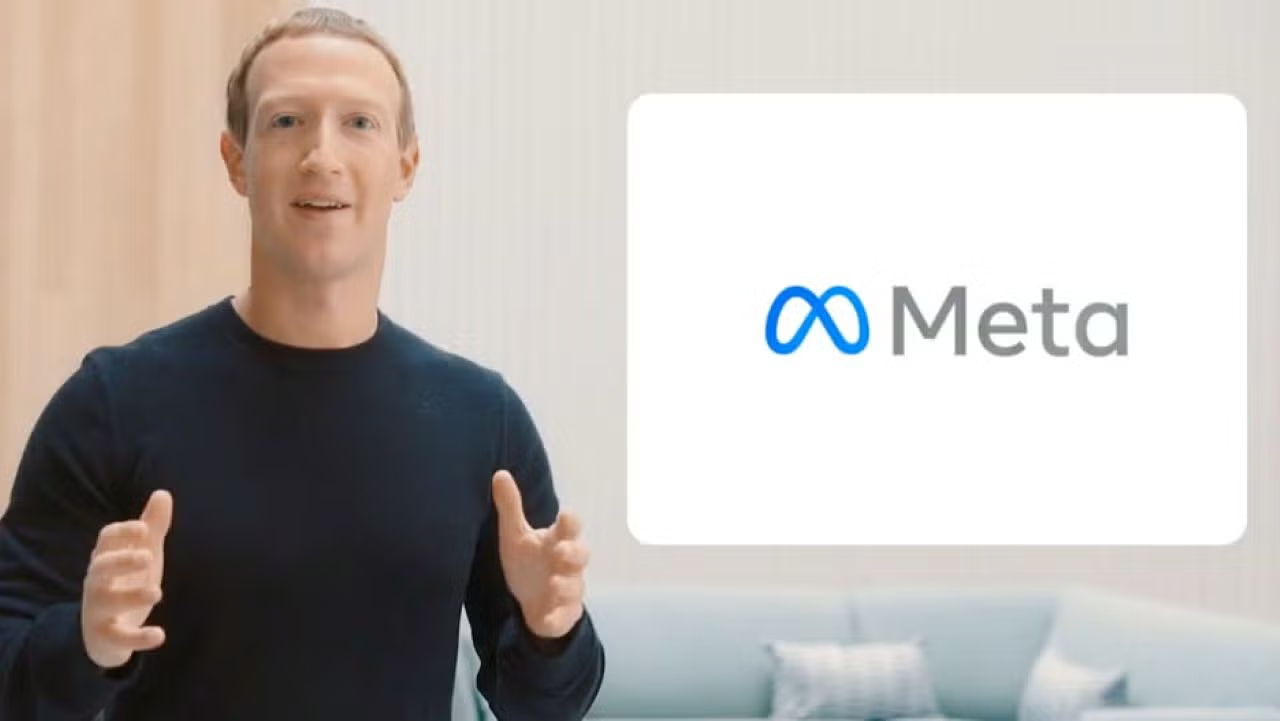
As Hollywood and the media industry grapple with artificial intelligence’s potential impact on jobs, Mark Zuckerberg says companies may need fewer workers — but he rejects the idea that AI will lead to mass unemployment.
The Meta CEO laid out his case Monday in “The Future Is for Everyone,” a sweeping manifesto outlining his vision for artificial intelligence and what he calls “personal superintelligence.”
“Company sizes may shrink — just as they did in the transition from industrial giants to tech companies,” Zuckerberg wrote. “But this doesn’t mean fewer jobs overall.”
Instead, the billionaire envisions an economy with more companies employing fewer people, predicting that small groups equipped with AI agents could eventually operate businesses at significant scale. That vision has particular implications for entertainment and media, where the growing use of AI has fueled questions about the future of creative work. AI protections became a major issue during Hollywood’s 2023 writers’ and actors’ strikes, and the technology has continued to spread across content creation and other parts of the media business.

Zuckerberg also acknowledged that workers will have to adapt as AI changes existing jobs. However, he argued that the technology could generate entirely new professions and businesses faster than automation eliminates existing ones.
Some of his examples touch directly on creative work. Zuckerberg imagined “world builders and experience designers” creating games, stories and adventures, and pointed to social media creators and app developers as jobs that largely didn’t exist a generation ago.
He also rejected some of the more dire predictions about where AI is headed. “It is surprising that the discourse from many developing AI is so filled with doom,” Zuckerberg wrote.
Rather than primarily automating existing work, Zuckerberg argued that AI should expand what individuals can invent and create. “The more superintelligence serves as a tool of invention,” he noted, “the more likely that individual capability outpaces automation and the future is better for people.”

>
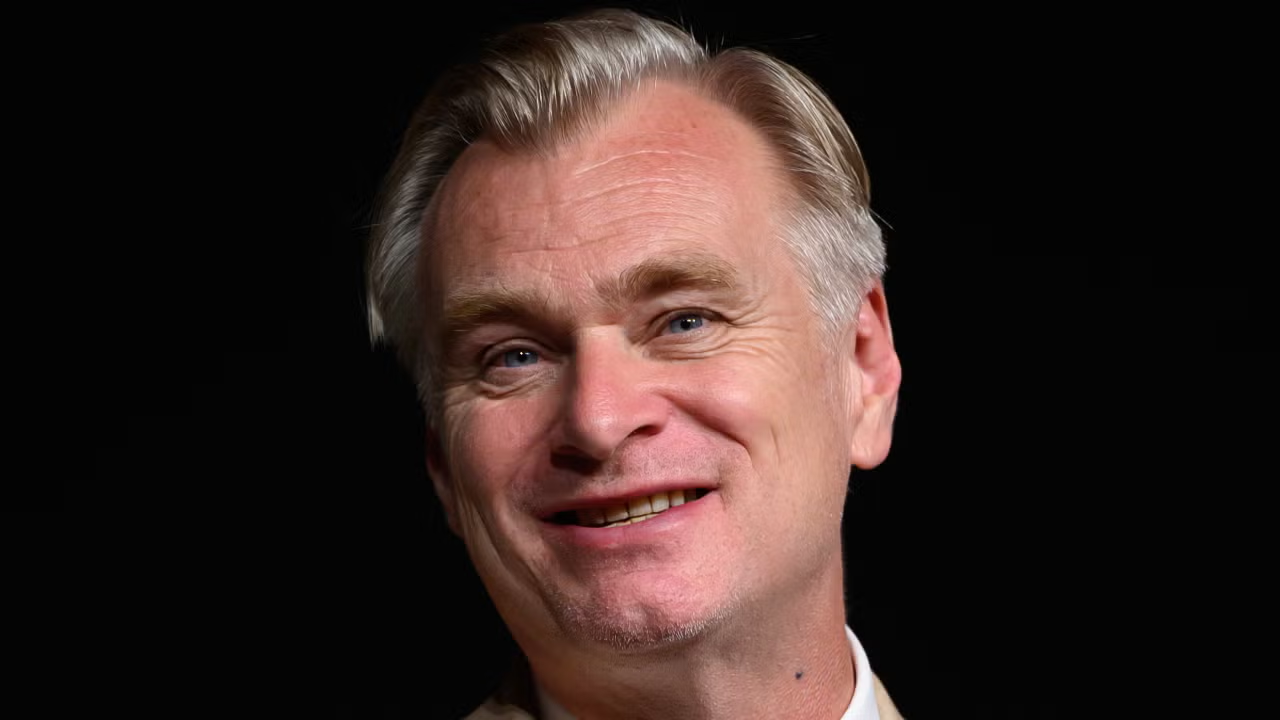
Christopher Nolan took cues from “Star Wars” when he crafted the opening of “The Odyssey.”
The epic new film in the director’s filmography opens with the words “A time of apparent magic” which was born out of a hook the director found in “Star Wars.” He wanted the sword and sandals epic based on Homer’s poem to evoke the feeling of the sci-fi classic’s opening crawl – and was specific about wording because he wanted his story that has real magic to feel as grounded as possible.
“One of my earliest movie experiences, a very profound one, was seeing George Lucas’s first ‘Star Wars.’ He began that film with a title that said ‘A long time ago in a galaxy far, far away.’ That immediately told me how to watch the films,” Nolan said in an interview with a Chinese media show promoting the film’s Asia release. “It put me in the right frame of mind to receive the imagery. I felt with this film, I was chasing that kind of experience where you want to create a world that the audience loses themselves in and takes on its own terms. So I was looking for that as an example, as a way of giving a phrase that would help the audience understand the terms of the story, and the word ‘apparent’ in particular to me, was very much about acknowledging the idea that yes, if we tell the story realistically, to some extent, we have to explain why there’s magic in a way. “
You can watch his explanation in the video below.
He added: “And I was very interested in the idea that a person living in the Bronze Age, there’s magic all around you. There are things that you cannot explain, and so there are fanciful and sometimes correct and incorrect explanations for the things you’re seeing, the things you’re experiencing, the mysteries of life in a way. I wanted to put that in people’s heads as they start watching the film.”
Despite some negative thoughts from “The Odyssey” translator Emily Wilson, the latest Nolan film has proven to be a massive success at the box office. In its fourth weekend, “The Odyssey” added an impressive $52 million from Imax screenings. All that while competing against the second weekend of Marvel’s massive “Spider-Man: Brand New Day.”
“The Odyssey” has become the highest grossing movie in Imax history, passing the lifetime $256 million gross of James Cameron’s “Avatar” with releases in China and Japan still to come. In total “The Odyssey” has grossed $289 million from Imax screens with an overall global total of $1.1 billion and counting.

>


Search For Canadian TV Actor Stewart McLean Now Homicide Investigation


These ’90s fashion trends are making a comeback in 2017
According to Dior Couture, this taboo fashion accessory is back
Model Jocelyn Chew’s Instagram is the best vacation you’ve ever had
Your comprehensive guide to this fall’s biggest trends
9 Celebrities who have spoken out about being photoshopped
Emily Ratajkowski channels back-to-school style
A photo diary of the nightlife scene from LA To Ibiza