
Entertainment
Anthony Anderson Actually Impressed by Trump’s Covert Turkey Exit

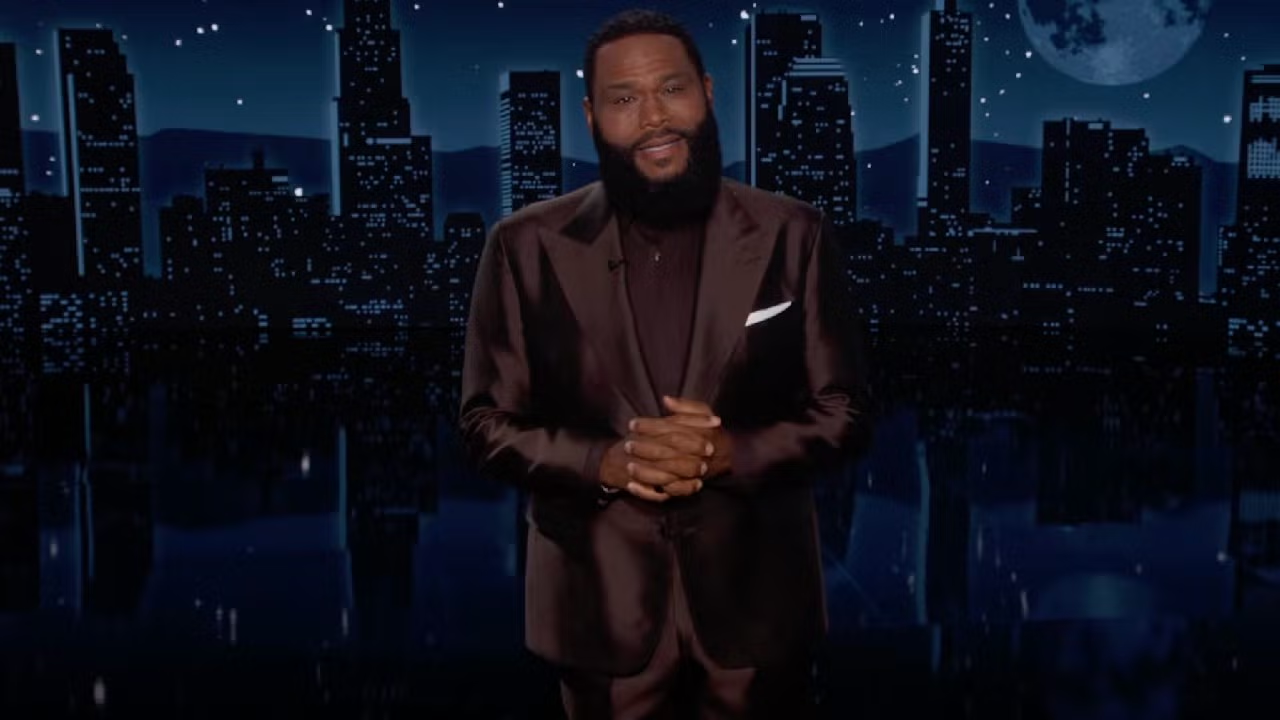
It was revealed this week that President Trump pulled a plane switcheroo after leaving a NATO Summit last month, flying separately from press without telling anyone. The move has raised concerns and criticisms, but honestly, Anthony Anderson is impressed.
During his “Jimmy Kimmel Live!” monologue on Tuesday — Anderson is guest hosting all this week, as Kimmel himself is still on summer vacation — Anderson first laughed at how “dumb” the move was, joking that “just when you think you’ve heard every dumb thing there is to know about this president, he always finds a way to surprise you.” That said, he offered his compliments to the Secret Service.
“Let’s give it up to the Secret Service. Do you know how hard it is to sneak a pig out of Turkey?” Anderson joked.
According to The Washington Post, after a NATO Summit in Turkey, Trump boarded Air Force One in front of cameras and waved, but then snuck out a door on the other side of the plane into an airport catering truck, which then drove him to a smaller military jet. The switch came as a result of security concerns.
“That’s the same way he used to get ontp Epstein’s plane!” Anderson said.
That said, the “Black-ish” star did think that choosing a catering truck to escort Trump to another location was maybe not the most intuitive choice in vehicles.
“Now I’m no security expert, but if I was trying to find Donald Trump, a catering truck is the first place I’d look,” he joked. “Next time, hide his ass in a bookmobile.”
You can watch Anthony Anderson’s full monologue in the video above.

>

Definitions first: a legacy sequel (aka legacyquel) is made when a meaningful amount of time has elapsed from the last installment, beginning almost afresh rather than being produced as another installment prolonging a profitable franchise. At least some of the original cast members must be involved, and their conspicuously aged appearance will inevitably be poignant — an optional but generally baked-in emotional component.
The first legacy sequels came from TV, and a little digging suggests that the first American feature-length instance could be “Father Knows Best Reunion” in 1977, followed that winter by “Father Knows Best: Home for Christmas,” 17 years after a series which began on radio in 1949 ended its TV run in 1960. The first big-screen legacy sequels also grew out of TV. In 1979, “Star Trek: the Motion Picture” jump-starteda feature-film second act for the crew, culminating 15 years later in a feature-film handoff from Captain Kirk to Picard in 1994’s straightforwardly-titled “Star Trek: Generations,” which killed off the original show’s captain for extra-bathetic measure.


But the legacy sequel as near-inevitability didn’t really take off in earnest until the 2000s, when millennial nostalgia started contracting in quicker cycles. 2011’s “Scream 4” reunited the unkillable core cast a decade-plus after the last film for lots of jokes about hating younger people; the villain is social media-fixated, while previously goofy characters like David Arquette’s Dewey Riley have acquired unexpected gravitas simply by surviving and aging with quasi-dignity.
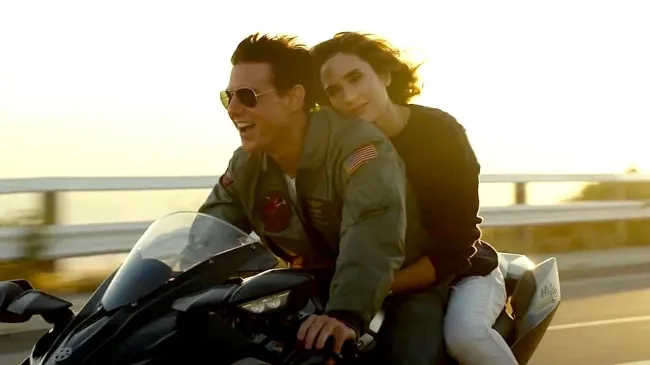
More recently, “Top Gun: Maverick” and “Final Destination: Bloodlines” leaned upon the pathos of visibly ill actors playing old favorites (Val Kilmer and Tony Todd, respectively) and audience awareness that we’re watching someone genuinely saying farewell onscreen. Less manipulatively, “Toy Story 5” found Buzz and Woody 31 years on down the line cracking receding hairline jokes. If I’m sounding needlessly skeptical about how those emotional chords are hit, that’s partly because I’m as susceptible to this emotional effect as anyone and I’m not pleased that I’m such an easy mark for unearned teariness.
To be fair, this effect can also be leveraged for genuine art; “Twin Peaks: The Return” leans hard into this quality to devastating effect. Earlier this year, Lisandro Alonso gave the world its first Hard Art legacy sequel, revisiting 2001’s extra-severe “La libertad” and re-staging vast chunks of it with no real changes save the aged body of its logger protagonist; the emotional effect isn’t necessarily that different from a cruder Hollywood IP revival even if the rewards are greater.
How is a legacy sequel conceived and what materials does it draw upon? Read on.
The Actor

Screenwriters Ed Solomon and Chris Matheson started thinking of a third “Bill & Ted” film 17 years after “Bill & Ted’s Bogus Adventure”; by the time “Bill & Ted Face the Music” actually came out, three full decades had passed since the duo’s first outing in “Bill & Ted’s Excellent Adventure.” Poignance was conceptually baked-from the get-go, says co-star Alex Winter: “It just seemed like, ‘This works because we’re old.’ They have kids, they have families, and they’re actually pretty content — but they did not do what they thought their destiny was [write a world-uniting song], which is such a nice metaphor for middle age. We did realize that the older we got, the funnier and more poignant it would be.”
Even though he wasn’t a writer on either of the first two films, Winter “felt ownership” of Bill “at the first audition, because it wasn’t really dictated in the script how to play these guys. I read that script, and I was like, ‘I’m not sure what this: a valley comedy? A sci-fi thing? Who are these guys? They’re not surfers, and they’re not stoners. They’re like children that live in the suburban wasteland of America.’ Keanu [Reeves], weirdly, came at it really similarly—I think because we’re both from the East Coast and so not like these guys. We reverted to being like little kids, and it worked.”
Matheson and Solomon pitched the threequel at a dinner party Winter threw for friends. “Keanu and I had never thought about doing another movie,” Winter recalled, “and the guys knew that we had no real interest or intention of doing another movie. And Chris and Ed were also not desperate to do another movie. So, it was kind of a good position to be in because no one particularly needed it or wanted it.”
To get into the appropriate mindset, Winter drew on “Anvil! The Story of Anvil” (2008), a documentary which trains an affectionate eye on the struggles an also-ran Canadian metal band trying to finally get the success they believe they deserve: “They’re a garage band that never stopped playing in the garage, and that became the trick to the third,” Winter said. Then, “I spent a year just trying to find the guy’s body. I went back and took tap dancing class again. I did a lot of training: who is this guy? What is his body? How does he move? That took some work. So much of the movies depend on how we work together physically. Thankfully, Keanu and I are kind of like a band in a weird way — we’re good friends, but we don’t perform together that much anymore. We really work like a rhythm section: once we were together, we had a groove.”
The Costume Designers

George Romero’s “Dead” films are inherently anti-nostalgic. Politically, the project of “Night of the Living Dead” (1968), “Dawn of the Dead” (1978) and “Day of the Dead” (1985) was to continue dissecting present-day dystopias; by eliminating returning main cast members, the possibility for the gratification of reunion was entirely precluded.
After “Day,” the franchise went dormant before being rebooted at Universal. Fresh off the second and third installments of “Ginger Snaps,” costume designer Alex Kavanaugh didn’t think she’d get the job due to her lack of big-budget experience; “Land of the Dead” was, at $18 million, the highest-budgeted film of the series. Higher budget was relative to the other new “Dead” film being shot simultaneously, Zach Snyder’s remake of “Dawn of the Dead”: “They had so much more money than us,” Kavanaugh recalled.
For “Land,” a starting idea was that the zombies have been walking for a long time since the previous installment. “We never called them ‘zombies,’” Kavanaugh said. “We always called them ‘walkers,’ and the walkers had been walking for many many years. So, we bleached out the tops of their clothes to show that they’ve just been walking around in the elements. All the blood stains are very old; we made them very dark and purplish, brownish.” Though Romero wasn’t available to access his archival materials from previous films for reference, special effects makeup designer Greg Nicotero provided additional visual memory from the previous films. “Simon Pegg and Edgar Wright did a little cameo, and when they did Simon’s makeup, it was very much a nod to Bub from ‘Day.’ We were all a bunch of fans; there were a lot of Easter eggs and nods to his earlier works.”

After “Land,” Kavanagh returned for the lower-budgeted final installments, “Diary of the Dead” and “Survival of the Dead.” “On ‘Land,’ we had zombified a huge stock of clothing for all the background and stunts,” she noted. “At the end we sold it to a local company that was starting a costume rental house. When we went to do ‘Diary,’ there was such a tiny budget I didn’t know how we were going to do the bigger scenes, but I was able to get back the whole stock from ‘Land’ (it had been in storage and never used), which I sent back at the end of filming—and was able to get again for ‘Survival.’ So, if anyone looked closely, there are some of the same clothes on the zombies in all three films. That stock then went to ‘Resident Evil 5.’”
After we’re done talking, Kavanagh recommends I talk to her colleague Luis Sequeira, who worked on a legacy prequel. 2011’s “The Thing” takes place just before the vents of John Carpenter’s 1982 remake, and many of the clothing items had to be made from scratch because, Sequiera said, “in general, you never get a bible.” Beyond that, the major differences were in creating outerwear designed to be worn in extreme cold; “some of the outerwear was remade because those items were not available any longer in that look. Modern technology has given us things that are more more flexible and warmer with less bulk.”
Sequiera also worked on the 2013 remake of “Carrie,” which rendered Stephen King’s novel in a present-day setting. “It was a different time period, even though it was the same story, so we updated the looks, just as the script was updated to some modern themes of bullying. The same thing with Carrie’s dress — it was modified to a more modern play on it, even though the dress itself was a period-looking dress.” Those types of revisitations are inevitable when you’re drawing on the same starting source material, he says: “ultimately, there’s always a visual” that creeps back in.
The Graphic Designer

In the last two years, graphic designer Teddy Blanks has worked on three different legacy sequels. He confirms that there’s never been a bible for any of them, and additionally notes that there’s a firewall between marketing materials and the credits typography he actually works on. In the case of “The Devil Wears Prada 2,” the marketing’s signature pitchfork-heeled shoes bear no relation to what’s actually in the movie. The first film used Didot typefaces for its opening sequence; “the trouble with using a font like that for film titles,” Blanks said, “is that it’s very high contrast, meaning the thick strokes are much much thicker than the thin strokes. The horizontal strokes are very thin, the vertical strokes are very thick, and whenever you get really thin strokes and try to move them around on screen, you start to have problems. So, I designed a custom version of this type of font just for use in the movie. To the naked eye, it would look like the same font.”


The disjuncture between marketing materials and in-film credits also applies to last year’s “I Know What You Did Last Summer.” “The typography for the names and the titles is not a million miles away from the original movie,” Blanks said of his work on the new film. That said, “the main title in this film is this ’80s VHS-looking, hand scrawled, horror-y-looking title treatment that has nothing to do with any of the other movies. The director of this film, Jennifer Caden Robinson, did not feel like she needed to have the titles match the original — which is interesting, because she had totally recreated the the cinematography of the original title sequence: the same location, the same helicopter shot over the water. I think it’s mapped on almost exactly to the original opening titles, but she was a little bit more open to experiment with the typography. While we did land somewhere similar with how we articulated the names of the actors and crew members, the main title is its own thing.”
For the rebooted “Scary Movie,” the title card logo was established by the second sequel. “That series has a logo which is a marketing logo and also has been used as the title for every movie” after the first film, Blanks noted. “The original scary movie, the logo that you associate with scary movie is not in the titles, but it’s on the poster. Then, starting with ‘Scary Movie 2,’ they’re using the logo from the poster on the titles — there was no decision to make. There’s no brand book. Nobody’s giving me the logo in vector format. Somebody’s just taking Futura Black and typing it in anew every single time, so it’s going to look different every single time and mine’s a little different too. I made some small tweaks to the logo kerning-wise. Little things about the letters were bugging me. The space between the O and the V are a little bit tighter on mine than on other versions of the logo. I wanted to fix that and didn’t articulate that to anyone ever, because who would care? At the end of the day, the logo looks the same as it always has. It’s just ever-so-slightly improved from a typography standpoint.”
At the end of our conversation, I propose that typography isn’t part of the nostalgic effect legacy sequels count upon. Blanks politely disagreed: “They do and they don’t. If you saw a ‘Scary Movie’ and it didn’t have the giant fat Futura bold letters stacked on top of each other, it would be weird. I think there can be a nostalgic connection to the typography and titles” — in this, as with everything else.
>
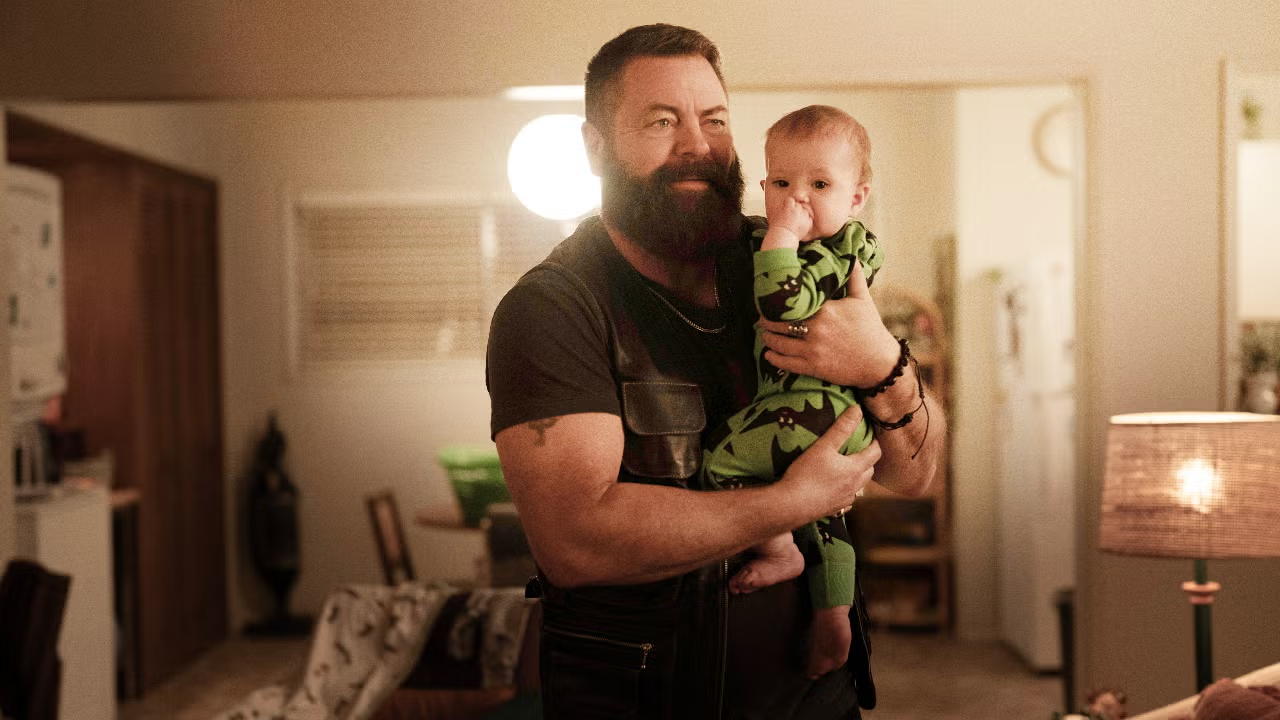
Nick Offerman never set out to comment on masculinity. But this year, he nabbed two Emmy nominations doing just that.
On paper, the two roles couldn’t be more different. In Apple TV’s “Margo’s Got Money Troubles,” Offerman stars as Jinx, a former pro wrestler and absentee father who re-enters his daughter’s life after he exits rehab and she has a baby. In Netflix’s “Death by Lightning,” Offerman portrays veep-turned-president Chester A. Arthur as a drinking, brawling, boisterous crony of Stalwart leader Roscoe Conkling (Shea Whigham).
“I saw one message from somebody that said something plural,” said Offerman, who didn’t watch the Emmy nomination broadcast. “I was like, hang on, was that a typo? I was gobsmacked.”


The two characters may seem wholly distinct on the page, but they each echo notes Offerman has performed skillfully throughout his career. From the gruff libertarian Ron Swanson in “Parks and Recreation” to the isolated survivalist Bill in “The Last of Us” (a role that won him an Emmy for guest actor in a drama series), Offerman has a habit of playing manly men whose exteriors belie hidden tenderness—masculine characters experiencing slow awakenings to their emotional truths.
“I didn’t even realize that I would be accused of masculinity until Ron Swanson and ‘Parks and Recreation’ started and people were like, ‘You’re an example of masculinity!’” he said. “I was like, ‘OK? I thought I was a goofy theater actor.’ I’m so grateful, that being said, for the opportunity to weigh in on the side of empathy.”
The double nominee Zoomed in from his dressing room at Chicago’s Goodman Theatre, where he currently stars in the play “Iceboy!” with his wife, Megan Mullally. Offerman moved to the city in the ’90s, pursuing a career on the stage. When life later brought him to Los Angeles, he initially struggled to appreciate its theater scene in comparison to Chicago’s. But those feelings soon went away, particularly after he met Mullally, who was cast as the lead in the first L.A. play he was ever in. “I’ve been in a pretty good mood ever since,” he said.
Before he became a staple of the screen, Offerman needed to get some of his stage instincts out of his system, to “turn down my bombastic theatrical volume.” The actor recalled feeling like “a total circus clown” while shooting a scene opposite Ben Affleck in his first film, “Going All the Way.”
“With all due respect to circus clowns,” he added. “A noble profession indeed.”
Thankfully, Jinx allows him to mix the best of both worlds. His “Margo’s Got Money Troubles” character is a total showman one moment and an open wound the next. He’s a onetime wrestling superstar who, with his glory days in the rearview, simply tries to move past his pain.

“I’m doing my best to achieve the raw humanity, the emotional honesty that’s been written into these beautiful scripts,” Offerman said. “I’m so grateful when they’re like, ‘By the way…he’s a professional wrestler.’ Thank God, I can work out my bombast. I can bring a little vaudeville, even if it’s jumping off the top rope.”
“Margo’s Got Money Troubles” may be a comedy, but Offerman spoke of the show’s rich themes just as he would any drama on the stage. He described Elle Fanning’s Margo, attempting to pay for childcare by becoming an OnlyFans model, as “an Arthur Miller character who looks like Venus.”

“Jinx represents the other side of the coin, podcast guys who are selling testosterone like, ‘Buy my supplements so that you can dominate women.’ No, man, that may be on the surface a wrestling facade of macho masculinity, but everyone should understand — I think by now they’re coming to — that these are all broken, needy people, just like anybody else, that just happen to be putting on a cape and playing a superhero, or a unitard and playing a wrestler.”
To embody Jinx, Offerman worked with various professional wrestlers and was struck by the generosity required for the sport. “Everyone is hurt,” he said. “They’re all these incredible athletes that are beating themselves up for our pleasure, and so they really help each other as much as they can. While they’re playing the most vicious of enemies, they’re secretly like, ‘You OK, brother? I got you.’ I found that really moving.”
It’s this camaraderie and empathy that keeps the world turning in Offerman’s eyes. The idea is just as present in “Death by Lightning,” which centers on the belief that politics and decency need not be antithetical. The actor wishes he saw some more of that in the real world.

“Empathy is simply evolution,” he said. “Everybody knows it — all those jerks, the secretary of defense, that are like, ‘Violence is the answer to everything. Aggression. We need to be big, tough, macho guys.’ We all know by now that that’s a cry for help, that he’s a weak, sad little boy. I feel so bad for your lovers — if you can get one — because you’re just announcing that you’re not open, that you’re not vulnerable to lovemaking or negotiation or civilization or, you know, progressive thought. I’m as stupid as the next guy, but at least I know to listen to you and say, ‘We are neighbors. We are friends. Whoever we are, we’re sharing this creation.’”
It isn’t lost on Offerman that “Margo’s” marks the first time he will be a series regular for two seasons of a TV show since “Parks and Rec.” He also acknowledged the privilege of filming such a show in Los Angeles as local production continues to struggle: “It’s so weird that they built this place and that’s where they keep all the cameras and stuff, and that’s where all the people made their lives to learn how to make film and television, and then our governments and culture have allowed it to go everywhere else.”
So when he gets parts like these — roles he compared to hearty, filling meals — he knows not to take them for granted.
“It makes me keep my head down and say, ‘Man, just keep minding your manners and don’t screw this up,’” he said. “Because this is a very beautiful platter of beef wellington that’s being set in front of you.”
This story first ran in the Down to the Wire Comedy issue of TheWrap’s awards magazine.

>
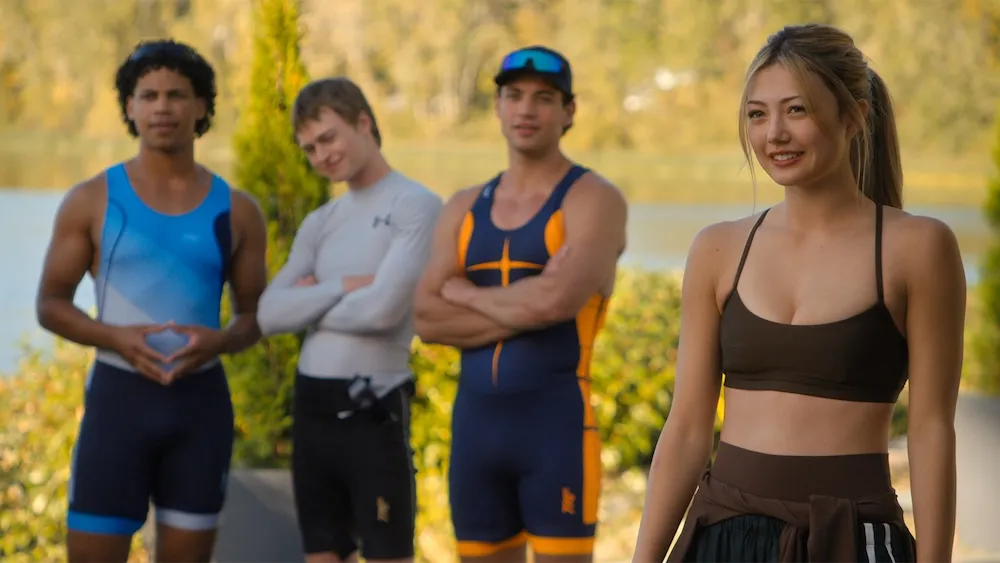
A new YA drama is sailing onto Netflix next month. The streamer released a trailer for Crew Girl on Wednesday, giving audiences a look at the coming-of-age story about an elite East Coast prep school’s teenage rowing team.
The trailer introduces audiences to 16-year-old Teagan Tao (Miku Martineau), a high-school student and star rower whose life is upended when her father’s misdeeds come to light, forcing she and her mom to relocate to the east coast. At her new school, Teagan becomes the coxswain of a dysfunctional all-boys rowing team.
The school year that follows includes loads of warring rivals, messy romantic entanglements, and betrayed friendships that spill drama both in and out of the boat.
Watch the trailer above. In addition, Netflix also released some first look images from all eight episodes, which are embedded below.
Created by Vivian Lin, Crew Girl arrives on Netflix on September 10.
The eight-episode series also stars Sam Braun as Josh Regis, Kyle Clark as Cam Dillinger, Jessica Paré as Teagan’s mom Ella, and Thomas Cadrot as Coach Matt Hayden.
Crew Girl was developed for television by Vivian Lin and Morwyn Brebner. The series is produced by Great Pacific Media, Thunderbird Entertainment’s scripted and unscripted live-action division.
Lin serves as writer, executive producer and showrunner. Jeff Norton (Geek Girl, Finding Her Edge), Lindsay Macadam, Hillary Zwick Turner, Tony Chung, and Lori Massini also serve as executive producers. Simon Barry, creator and showrunner of Netflix’s Bet, which also stars Martineau, directs the pilot episode.


>

Google’s Pixel 11 lineup offer fewer hardware changes, but much more Gemini

How Legacy Sequels Took Over the World

Crystal Palace have bid rejected for Monaco’s Lamine Camara
-

 movies3 months ago
Search For Canadian TV Actor Stewart McLean Now Homicide Investigation
-

 Fashion9 years ago
These ’90s fashion trends are making a comeback in 2017
-
Fashion9 years ago
According to Dior Couture, this taboo fashion accessory is back
-
Fashion9 years ago
Model Jocelyn Chew’s Instagram is the best vacation you’ve ever had
-
Fashion9 years ago
Your comprehensive guide to this fall’s biggest trends
-
Fashion9 years ago
9 Celebrities who have spoken out about being photoshopped
-
Fashion9 years ago
Emily Ratajkowski channels back-to-school style
-
Fashion9 years ago
A photo diary of the nightlife scene from LA To Ibiza