
Entertainment
Jon Lovitz Called Out Adam Sandler for ‘Always Casting Me as a Pervert’


Jon Lovitz has done a lot of movies with Adam Sandler, and if you’ve noticed he’s a bit typecast in them, well, so has Lovitz. In fact, according to the actor, he asked Sandler directly why he’s “always casting me as a pervert.”
Lovitz appeared on Tuesday night’s episode of “The Tonight Show,” in support of his new film “Don’t Say Good Luck,” which stars Sandler’s daughter Sunny, and Sandler himself produces. The film marks just the latest collaboration between Adam Sandler and Lovitz, which Jimmy Fallon was quick to point out, asking how many it’s actually been.
“A lot. And I’m always playing a pervert,” Lovitz responded.
Fallon immediately tried to push back on that, saying it wasn’t true, but Lovitz had his receipts ready to go.
“‘Wedding Singer’ was sleaze-bag, ‘Little Nicky,’ I’m peeping Tom,” he rattled off. “‘Grown Ups 2,’ I’m a janitor that takes over a gym class with women, and then get them to do all these, you know, sexual exercises.”
As Fallon continued to try and fight for at least “The Wedding Singer,” Lovitz admitted that he’s called Sandler out for this type-casting.
“And I said, ‘Adam, why are you always casting me as a pervert?’” he said, before launching into his Sandler impression for the answer. “‘Yeah, I think it’s funny!’”

Fallon moved right along from that, instead asking where Lovitz and Sandler first met, prompting the actor to recall their first encounter at a stand-up gig. Lovitz recalled offering Sandler some advice on “SNL,” since Sandler had recently gotten the job.
“He’s the best,” Lovitz said. “You’re nice to him once, and he’s just nice to you the rest of your life.”
You can watch Jon Lovitz’s full appearance on “The Tonight Show” in the video above.

>

Note: This story contains spoilers from “X-Men ’97” Season 2, Episode 9.
The second season of “X-Men ’97” has come to an end, but not before leaving viewers with one major character death.
This season of the hit animated TV show (a continuation of the 1990s “X-Men: The Animated Series”) sees Professor Xavier, Cyclops, Jean Grey, Wolverine and the merry gang of mutants in a fight against Apocalypse — one that starts with the team divided as members are flung into the far future and distant past.
The finale of “X-Men ’97” Season 2, showrun by Matthew Chauncey, sees the titular team in a final fight against Apocalypse as they attempt to free Gambit from the evil mutant’s influence. Meanwhile, X-Force (led by Cable) and X-Factor (led by Dr. Valerie Cooper) join forces to assassinate Gambit and prevent Apocalypse from reasserting control.
In the end, Gambit is saved — but the X-Men’s fight comes with a heavy price. So who dies in the “X-Men ’97” finale, what does their sacrifice mean and what could be coming in Season 3? Read on to find out.
Who dies in the “X-Men ’97” finale?
After the notable death of Gambit (A. J. LoCascio) in “X-Men ’97” Season 1, the card-throwing mutant was resurrected by Apocalypse as his Horseman of Death in Season 2. Though Gambit’s new power allowed him to kill Apocalypse, the X-Men later discovered that the villain’s soul remained inside their friend and ally, looking for a way to gain control. Rogue (Lenore Zann) manages to temporarily sedate Gambit in the penultimate episode, but this leaves the X-Men with a ticking clock before Apocalypse reawakens.

Searching for a way to save Gambit, a team consisting of Rogue, Beast (George Buza) and Nightcrawler (Adrian Hough) return to Apocalypse’s ship (named Ship and voiced by Rachel Kimsey), which they’d previously visited in Ancient Egypt before Apocalypse’s reign. It was on this ship that Apocalypse made contact with Eson the Searcher, a Celestial who granted him the Celestial Death Seed that greatly increased his strength and power.
While there, Rogue visits Eson herself and makes a bargain: The Celestial gives her the power to save Gambit, but she must sacrifice her own life in return. Rogue accepts the offer to rescue her love from Apocalypse, leaving Nightcrawler and Beast behind on Ship.
In the end, Rogue saves Gambit, but Beast returns with a Bible in hand to reveal that she is not the one who will be sacrificing herself. Instead, it is Nightcrawler (Rogue’s brother) who gives his life to the Celestial, bartering with Eson to save Rogue in return. Nightcrawler gives an emotional speech about how he knows the X-Men will mourn his life, but that they will one day recover and continue to be the heroes the world needs.
“I have faith,” he reasons in the episode’s closing moments.
It’s an emotional conclusion to a character that has often provided the X-Men a beating heart. This final line also ties into Nightcrawler’s religiosity, a core aspect of the blue-skinned, teleporting, sword-fighting mutant created by Dave Cockrum.

Why does Eson demand a sacrifice?
Eson the Searcher is one of the Celestials, a race of gigantic cosmic beings created by Jack Kirby in 1976’s “Eternals #1.” Celestials have appeared in the MCU proper before, with several showing up in “Eternals” and Eson having a cameo in “Guardians of the Galaxy.”
In the “X-Men ’97” finale, Eson speaks to Rogue and Nightcrawler about the necessity of a sacrifice to combat Apocalypse. This is because Eson believes in a “survival of the fittest” philosophy, one that Apocalypse himself adopts.

“All creation is forged from destruction,” Eson tells En Sabah Our (also known as Apocalypse) earlier in the season. “The end bringing forth the beginning, the beginning returning to the end.”
This mindset ties into Kirby’s initial conception of the Celestials in his 1970s “Eternals” series. There, he established that the Celestials will visit planets in a series of four groups, or “Hosts,” to test their inhabitants. During the First Host on Earth, the Celestials created a group of evolved beings (Eternals) and devolved beings (Deviants) that branch off of humans, while also creating the possibility for mutants and mutation to arise from baseline humans. They would also appoint individuals to help oversee the growth of these species, as Eson does with Apocalypse.
But the Celestials didn’t always bring gifts. During the Second Host, the cosmic beings noticed that the Deviants had begun to subjugate humans, causing them to eradicate and sink the Deviant city of Lemuria as penance. The Fourth Host (which is what Kirby’s “Eternals” series focuses on) sees the Celestials return to judge progress of Earth over a 50-year period. Led by Arishem, the Celestials would then determine whether the planet should be allowed to live or be destroyed.
It’s all very heady sci-fi, right at home with Kirby’s other works. Chloé Zhao sets up Arishem’s judgment of Earth at the end of “Eternals,” with the Celestial abducting Sersi (Gemma Chan), Kingo (Kumail Nanjiani) and Phastos (Brian Tyree Henry) to determine if humanity should continue living or be destroyed. This would seemingly be settled in a sequel that, as of now, is not in development.
But Eson’s mindset in “X-Men ’97” reflects that of his comic book counterpart. Just as the Celestials judge humanity, the Eternals and the Deviants to see if they should continue to survive, he believes that the life of Gambit requires sacrifice to be saved. If Gambit cannot overcome Apocalypse on his own, then another mutant must give their own life to prove he is, indeed, worth saving.

How does “X-Men ’97” Season 2 end?
After Kurt’s sacrifice, a mid-credits scene shows Dr. Valerie Cooper (Catherine Disher), leader of X-Factor, studying a file on Mystique (mother to both Nightcrawler and Rogue). Valerie Cooper then walks in the door, revealing that the audience was actually watching Mystique using her mutant power to disguise herself as the X-Factor leader. Mystique then dispatches the real Dr. Cooper with ease.
“X-Men ’97” fans had theorized for weeks that Dr. Cooper had actually been Mystique this entire season. This scene, however, reveals that this was not the case to this point, but that Season 3 will surely see Mystique taking over for the X-Factor leader.
What stories will follow from there remains anyone’s guess, but this puts Mystique in a powerful position (leading a mutant team with government backing) to carry out her own plans.
“X-Men ’97’ Seasons 1-2 are now streaming on Disney+.

>
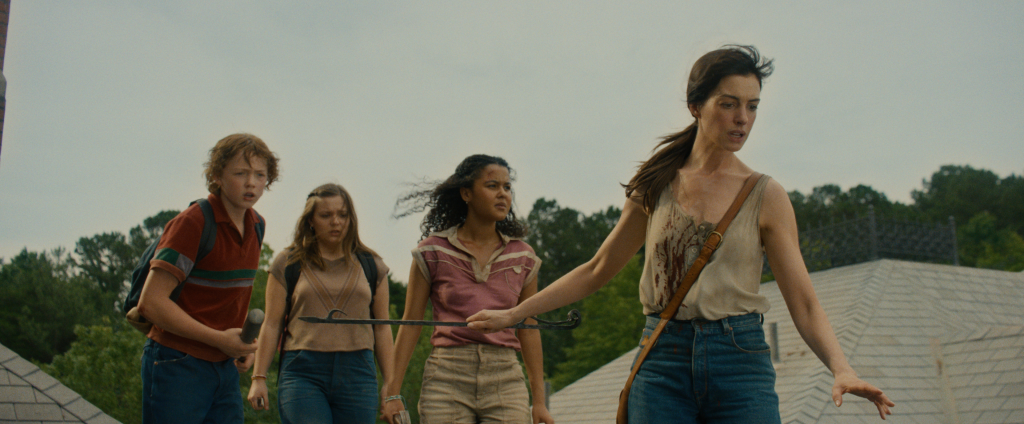
Anne Hathaway has five, count ’em, five movies in release this year between May and October. The End Of Oak Street is the one that clearly isn’t going to take her back to the Academy Awards. However considering the sheer hell her suburban wife and mother goes through battling packs of dinosaurs while trying to save her marriage and family is worthy of something. Hathaway and co-star Ewan McGregor really go for it in this unrelenting monster mash of a personal childhood fantasy writer/director David Robert Mitchell has dreamed up, and though the dialogue often is laughably cheesy at times, the sheer level of balls-out action at a pace that never lets the audience breathe is kind of jaw dropping. You may hate yourself in the morning for succumbing to this B-movie-starring A-listers confection but count me in. I had a blast.

Ironically, or maybe on purpose, this isn’t the only Dinosaur-themed wide release this week as we also get the very young-skewing Paw Patrol Dino Movie but this one is something the whole family can likely get into. Mitchell, who hit Hollywood’s consciousness with the well-regarded 2014 psychological horror film, It Follows, and then lost the heat with his followup, 2018’s convoluted Under The Silver Lake (though it does have its admirers) is now back eight years later. His return is a commercial genre period piece set, not accidentally, in 1982, prime time for Amblin and Spielbergian movies like E.T. and Poltergeist, not to mention gems like The Goonies and Gremlins. Like these films it is all set in white suburban America (Atlanta suburb standing in for Michigan) where extraordinary events take place in a very “normal” environment.
Zeroing in on the typical American family of the Platts, we see a normal summer day in the lives of Mom Denise (Hathaway) and Dad Greg (Ewan McGregor), along with teen daughter Audrey (Maisy Stella) and younger brother Brian (Christian Convery) when strange things begin to happen. Bolts of unusual light strike the sky, some weird noises, and then Denise’s visit to her elderly neighbor, a woman who points to a flower plant in her backyard that suddenly has just sprouted up out of nowhere over the last couple of days. Some quick research indicates it is a plant that hasn’t existed for millions of years. Uh oh. A massive storm moves in, more creepy things interrupt the family dinner and disturb their dog, Starbuck (played superbly by Buzz and Brisket), and finally KABOOM! It feels like an atom bomb has detonated but what the family Platt is about to discover is that their whole neighborhood has moved, and the end of Oak Street is now a lush and dense jungle. What the hell is happening, here?
Well, as Maisie, ever so familiar with the writings of Carl Sagan, posits this could all be a weird cosmic happening, the convergence of two periods in time separated by millions of years but now meeting in the same corner of the planet. As Denise ventures out and discovers her kindly neighbor now lying in a pool of blood, odd creature-like footprints on the kitchen floor, things are getting scary. From this point on it is a mad dash for survival as all sorts of dinosaurs including the treacherous Allosaurus turn this all frequently into edge-of-your-seat chase stuff as the Platts face real danger. No kidding. “Are we all gonna die?” Brian screams. Yes, probably.
In the midst of all this havoc and destruction, and as dinos from every prehistoric era seem to have a similar goal of chomping down PG13 style on these strange human beings they find have moved into their ‘hood, serious issues come to the surface between Denise and Greg who choose this time to get into a big argument about their marriage. He has lost his job and now delivers pizza but was afraid to tell her. She has been writing a book about their lives and her unhappiness but kept it secret. They raise their voices, the kids are disturbed, and I want to yell at the screen, “WHAT THE HELL! THERE ARE MOTHERF**KING TYRANNOSAURUSES IN YOUR BACKYARD. SNAP OUT OF IT!”
It is also at this point where I decided to stop demanding anything approaching plausibility and just go with it. Lay it on me, I’m ready. If you approach this admittedly wildly entertaining ride for what it is, a Twilight Zone on steroids, you will be in the fun zone. Of course there will be comparisons to the Citizen Kane of the genre, Jurassic Park (and its endless sequels) but Mitchell is going for basics and not really trying to explain away the idea of dinosaurs vs humans in scientific terms and experiments like Jurassic does with the man-made variety. No, this is a bit more awesome in its sheer chutzpah. What WB’s The Meg was to Jaws, The End Of Oak Street is to Jurassic. The film is only 99 minutes, wastes little time getting to the goods, and never stops for a moment to let us realize this is all pretty silly, but really who cares? With a PG13 rating it still feels like it is skirting on the edge of R territory in terms of vividly gross dino dining habits. The actors, starting with the two likeable stars, all are game, the dog is irresistible, plus the dinostars under the guidance of Visual Effects Supervisor Jay Cooper and the wizards at ILM (of course) are a deliciously created mixed bag of types big and small and slimy. The best, hands down, is an overgrown ooozing snake-style reptile that literally seems to span several miles. The scene where it slowly slides its way through the house as unsuspecting family members are oblivious (really? an hour into this thing?) is instantly classic terror. Shout-out also to cinematographer Mike Gioulakis, production designer Maya Shimoguchi, composer Michael Giacchino, and all the stunt performers. Miraculously you have pulled it off for (reportedly) well under $100 million.
And if ever there is a movie to see in a packed theatre it is this one. The audience reaction to all this absurdity is just as entertaining as what is on the screen.
Producers are J.J. Abrams, Hannah Minghella, Jon Cohen, David Robert Mitchell, Matt Jackson and Tommy Harper.
Title: The End Of Oak Street
Distributor: Warner Bros.
Release Date: August 14, 2026
Director/Screenwriter: David Robert Mitchell
Cast: Anne Hathaway, Ewan McGregor, Maisy Stella, Christian Convery, Buzz, Brisket
Rating: PG13
Running Time: 1 hr 39 mins
>
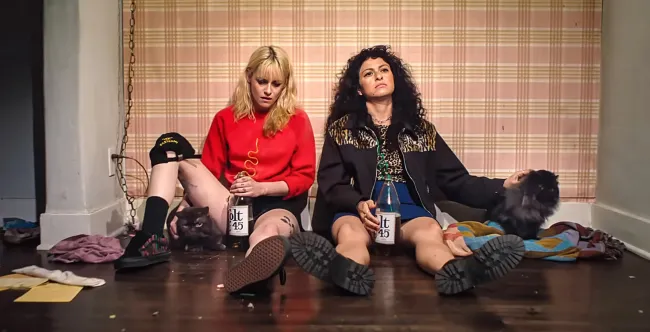

This spring, IndieWire declared the stoner movie practically dead. Little did we know, filmmaker Dylan Meyer was already holding the antidote.
Opening with the camera swallowed by the waves of the Pacific Ocean, “The Wrong Girls” immediately establishes itself as a film that needs to be tactile. Soon, we’re beneath the surface, watching a bioluminescent squid spray its ink as the title blossoms across the screen — the words themselves suggesting an intrinsic understanding of stoner culture. Very Deadhead. Very good start.
From there, we’re transported to Casa de Chill Zone, the Los Angeles home shared by best friends Frankie (Kristen Stewart) and Molly (Alia Shawkat). Starry-eyed, sharp-tongued, and mostly warmhearted, the roomies are watching a nature documentary, discussing how they supposedly “solved climate change” the previous night, and lamenting their desperate need for rent money.


Recognizable? Absolutely. But “The Wrong Girls” doesn’t fully lock in until Frankie gets her ass to work.
Leaving Molly at home to experiment with blue cheese and THC as brownie ingredients, the Kwik Thingz delivery girl heads out in uniform. She startles herself by activating a talking lawn ornament (again, relatable!), then arrives with a “cheese sculpture” at the home of some rich yuppie (Tony Hale). He’s mostly ignoring her, but breaks his train of thought long enough to ask one magnificent question.
“Are you literally smoking a lit joint right now?”
“My bad,” Frankie says, flicking the evidence out of her mouth and onto his driveway.

It’s the beginning of a movie that reinvigorates the stoner comedy in countless ways. So clever you want to grab Meyer by the shoulders and stare deep into her eyes until she really gets the compliment, “The Wrong Girls” bottles a new era for 420-friendly filmmaking by locating the sweet spot where being a pothead is still somewhat taboo — even in California.
Legalization has flattened the narrative stakes that used to make weed movies work. Getting high no longer automatically puts a character at odds with the cops, their parents, or another authority figure, so marijuana has lost some of the low-level transgression that sustained classics from “Fast Times at Ridgemont High” to “Pineapple Express.”
But Frankie isn’t funny because she’s afraid of being arrested. She’s funny because being brazenly checked-out from modern society, even while functioning within it, still feels socially incorrect. “The Wrong Girls” understands that weed is mainstream in 2026, but being visibly and unapologetically high is still seen by plenty of people as a kind of offense.
Is living your life from behind a curtain of smoke, particularly in a modern world this dire, really a bad thing?
Testing that theory, Molly and Frankie start the film at a crossroads. Ask Molly’s boyfriend Josh (Zack Fox) and he’ll tell you the girls’ shared comfort may be holding one or both women back. Frankie dropped out of an engineering program at Stanford years before, and Molly could be a professional baker if her talents weren’t always diverted toward party antics. Their friendship is an obvious life raft. But from the outside, it can also resemble an anchor.
Frankie confronts that insecurity when she goes alone to see an ex-boyfriend at a concert and finds him with a successful scientist who, minus the Lisa Loeb glasses, looks eerily like her. Following an altercation, Frankie is left half-drunk and wearing her rival’s broken frames when a mysterious man we’ll come to know as Not Metal Head Dave (a pitch-perfect LaKeith Stanfield) makes a terrible mistake. Yep, that’s how Frankie winds up with a briefcase containing “the most important scientific breakthrough of our time.”

The glowing substance inside, we eventually learn, was derived from the wordless coexistence of deep-sea creatures and designed to address humanity’s urgent need for empathy. But stuck in a money jam, Frankie and Molly immediately decide to sell it like any other recreational drug. Of course, not before taking two vials themselves — y’know, just to make sure they’re safe.
The psychedelic sequence that follows, punctuated by three European henchmen tailing the girls in a black SUV, is funny enough. But it’s not until the next morning, when Frankie and Molly feel the brain they already tend to share working on an actual telepathic level, that “The Wrong Girls” kicks into high gear.
Zoning out while the world feels like it’s on fire can be a kind of superpower, and Meyer uses supernatural abilities amplified by THC to explore how the stoner lifestyle can both mess up your day and save you from yourself. Think “Superbad” meets “Smiley Face,” with a nautical “Spider-Man” twist.
Stewart, having the absolute time of her life, allows the cool persona she’s cultivated across the modern indie scene to give way to an insecure brattiness that’s wonderfully refreshing. Adding syllables to words she’s annoyed to say (you’d be shocked how much disdain she can fit inside the name “Josh”), Stewart makes Frankie sound fundamentally different from any character she has played before — save for maybe a few bits on “SNL.” She’s highly capable but beaten down by a world that has made her feel like she isn’t enough, and just smart enough to almost think her way out of that trap.
But Frankie needs Molly and the sunny homemaker energy she brings to everyday life. Recalling her turn as a Texas waitress and another great best friend in Drew Barrymore’s “Whip It,” Shawkat plays Molly like your sweetest childhood friend crossed with a blissed-out Keebler Elf. When Frankie gets down on herself, Molly rattles off obstacles they’ve already escaped together. Whether inventing the Bong-a-Tron or freeing themselves after hours trapped inside a Party City parking lot, these misadventures almost always hinge on weed.

That isn’t a reflection of two friends struggling to spend time together sober. Rather, marijuana is part of the private language keeping Molly and Frankie afloat, and instead of feeling ashamed, the soulmates have designed their lives around celebrating weed as a kind of romance. There are moments when you want Molly and Frankie to kiss instead of toke up, but it ultimately feels more authentic that they don’t. Suffice to say, women have been the sexual punchline in party movies for too long, and “The Wrong Girls” finally gives stoner chicks access to the messy joy the genre has historically reserved for men.
The fantasy and sci-fi elements prove somewhat trickier for Meyer to navigate, but that mainly leads to happy accidents. As the increasingly zany plot heightens the stakes, her script — chock-full of hysterical lines like “What day is it? March?” — repeatedly steers the girls’ attention inward. The pacing feels off throughout much of the film, with comic and contemplative asides gumming up the central caper. But that shagginess is redeemed by how tactile “The Wrong Girls” remains.
Birds chirp as Frankie zones out while talking to the landlord. Later, she and Molly return to Hale’s rich guy hoping to sell the drugs while wearing matching cocktail dresses made from garbage bags. (Their house has been burgled, by the way.) An extended bit involving his maddeningly sleek front door, which just won’t close, does nothing for the plot and everything for the vibe.
These distractions make the movie resemble its heroines. They interrupt the action but deepen our connection to Frankie and Molly, allowing “The Wrong Girls” to exhibit the same introspection it locates in their lifestyle. Meyer makes space to laugh, look around, and fixate on the wrong object. The result will pleasantly scratch the brain this movie was made to reach.
If the experimental drug also at the heart of “The Wrong Girls” isn’t real, almost everything else about this extremely Los Angeles production is. The movie captures the very deep relationship so many stoner Angelenos have with their living rooms. Frankie’s suggestion that they “hole up in the Chill Zone until this Kock problem blows over” (Kock is the corporation chasing them for the drugs) lands less like a joke than a reasonable response to life today. And the supportive environment these two friends have built over a decade-plus allows them to retreat into a daily routine that gives them comfort. One of their biggest devastations doesn’t come from being followed, but learning the cheap buffet they frequent may close.

Even Dio and GG, the girls’ cats (voiced by Seth Rogen and Kumail Nanjiani), have distinct strains of snooty homebody energy. Able to communicate with the animals as well as each other — and using Stanfield as their endlessly funny straight man — Stewart and Shawkat embody the real world creeping in on the safety of an L.A. home without making that collision dire. Kate McKinnon is similarly delightful as Dr. Chapman, a beleaguered genius who becomes the girls’ ally despite repeatedly insisting they should be dead. (Geena Davis appears in a part so small you could see the movie and forget she was there.)
The details are impeccable, from the EDGLRD T-shirt spotted on the rich guy’s son to the “818” tattoo flying across Frankie’s knuckles when she beats him at “Street Fighter.” Slasher synths lend the psychedelia a “Goosebumps” energy that makes nearly all of Los Angeles feel like Halloween night. Through kaleidoscopic lighting and inventive camerawork, Meyer roots her world in the kind of DIY mysticism you might associate with, say, a pizza tattoo.
Pay attention to the cardboard cutout of Celine Dion in the kitchen, too. She’s more important than you’d think. Those recognizable totems keep “The Wrong Girls” wondrous and nonthreatening even as its plot becomes increasingly action-packed. Violence gives way to dance (yes, literal dance) in a feel-good movie that doesn’t ignore the not-so-feel-good conditions making Frankie and Molly relatable. “How much rent is enough rent?” is only one of several surprisingly insightful questions they ask, and Meyer even takes a position on gun control without preaching.
Most importantly, “The Wrong Girls” rejects Josh’s assumption that growing up requires dismantling the life Frankie and Molly have built. Their lifestyle can grow. The mentality they share — and the friendship sustaining it — is a beautiful and powerful thing. In a world inundated with rage bait and political turmoil, that’s a mighty valuable export.
At one point, Frankie can’t open the drug briefcase and collapses onto the floor like a marionette, announcing, “Too hard! I quit!” Just days before her film opens nationwide, Meyer’s Instagram bio reads: “It’s good to give up.” That’s an incredibly compelling thought today, and perhaps a way forward for anyone struggling to cope. Sometimes giving up isn’t surrender. Sometimes it means refusing the exhausting terms you’ve been handed and returning to the people, places, and pleasures that make another future possible.
With her effervescent directorial debut, Meyer announces herself as a cinematic Caterpillar for the Alice in Wonderlands of our time. The great American stoner comedy isn’t dead. It just needed the wrong girls to save it.
Grade: A-
From Neon, “The Wrong Girls” is in theaters on Friday, August 14.
Want to stay up to date on IndieWire’s film reviews and critical thoughts? Subscribe here to our newly launched newsletter, In Review by David Ehrlich, in which our Chief Film Critic and Head Reviews Editor rounds up the best new reviews and streaming picks along with some exclusive musings — all only available to subscribers.
>

Formula 1: Cadillac replace team principal Graeme Lowdon with Marcin Budkowski

Why Stream ring-maker Sandbar says the future of AI wearables is voice

X-Men ’97 Ending Explained: What That Credits Scene Means for Season 3
-

 movies3 months ago
Search For Canadian TV Actor Stewart McLean Now Homicide Investigation
-

 Fashion9 years ago
These ’90s fashion trends are making a comeback in 2017
-
Fashion9 years ago
According to Dior Couture, this taboo fashion accessory is back
-
Fashion9 years ago
Model Jocelyn Chew’s Instagram is the best vacation you’ve ever had
-
Fashion9 years ago
Your comprehensive guide to this fall’s biggest trends
-
Fashion9 years ago
9 Celebrities who have spoken out about being photoshopped
-
Fashion9 years ago
Emily Ratajkowski channels back-to-school style
-
Fashion9 years ago
A photo diary of the nightlife scene from LA To Ibiza