There are bad seasons, and then there are seasons that prompt articles from national writers. You can tiptoe through the bad seasons and hope that nobody else notices, but when the rest of the country starts to care, it’s a sign that an organization has screwed up majorly.
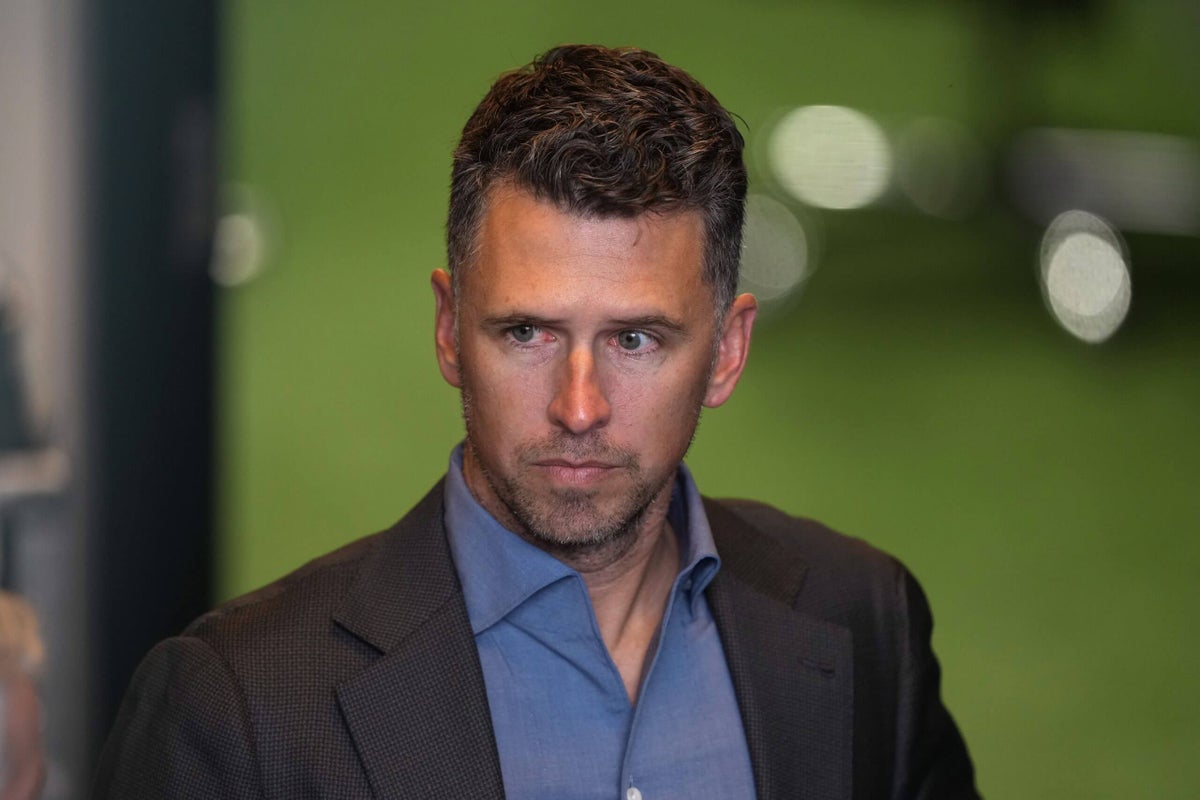
On that note, our own Brittany Ghiroli had an excellent look at the brutal start to the Buster Posey era, using the unflattering technique of “describing what’s happened so far.” All of the losses, and all of the surrounding nonsense, have conspired to produce the perfect description in the headline: “Buster Posey’s Giants legacy is on the line as adulation is shifting to anger”.
The Giants’ Buster Posey put his legacy on the line. Will it work?
Brittany Ghiroli and more
For my money, the legacy question isn’t important. Jeff Kent spent four years wearing Dodger blue and sneering at the Giants. If you would like more information on this dastardly turn of events and how it affected his legacy, you can learn about it at Jeff Kent Day at Oracle Park on Aug. 29. Eventually, the Giants might have to plow this whole front office under and hope it’s good for the soil, but there will still be standing ovations and pre-game ceremonies. For what it’s worth, I still think of Tom Haller as one of the most underrated Giants in franchise history, even though he also built the only 100-loss team in franchise history.
You shouldn’t be worried about how Posey will be perceived in 2036. You should, however, be very concerned with how the baseball got so bad in 2026. Now that you’ve read Ghiroli’s article through (required reading, test on Monday), let’s focus just on this season for now. Most of the team’s struggles, flaws, needs, wants and failures in the 2026 season are included in the article. Let’s rank the problems of 2026 and only 2026, as they appear.
Again, this is only looking at how the Giants got here this season. If you’re worried about next season, I can’t help you in this article. If you comment about how the Giants have already messed up next season, your penance is to watch this video explaining how you’ve made me feel.
Here we go: the best reasons to Monday-morning quarterback the Giants, even though it’s still early Sunday evening in this analogy, starting with a couple that you really shouldn’t care about at all.
5. Not signing a closer
Posey took significant heat on local radio earlier this season for saying he “didn’t regret” not signing a closer in the offseason.
The silliest of complaints, made only by casuals who parachute into the baseball offseason after the Super Bowl ends. Edwin Díaz was, by leaps and bounds, the best closer available this offseason. The Giants could have built their entire offseason around him and felt like they came out on top. Díaz has an 11.57 ERA and just blew a two-run lead for the Dodgers on Thursday night.
The Giants could have signed Robert Suarez for something like three years, $50 million, but let’s check on his status over the next two seasons, when the Giants might actually need a closer. It wouldn’t have helped them to have a great closer this year. It simply would have added a year to your lifespan.

Signing a big-money closer like Robert Suarez alone wouldn’t have fixed what has ailed the Giants’ bullpen (and pitching staff as a whole) this season. (Edward M. Pio Roda / Getty Images)
Note that this is distinct from “addressing the bullpen” or “screwing up the entire pitching staff.” We’re just talking about throwing money at the problem. It almost never works, and it wasn’t going to work this time.
4. The biggest contracts
This is the easiest problem on the surface to clock: The Giants will owe Rafael Devers, Willy Adames and Matt Chapman a combined $480 million-plus after this season, yet this season has been a complete disaster.
The Devers trade made sense at the time, giving the Giants the big-name slugger they kept missing in free agency. But in retrospect, the timing looks off.
There is no easy way out for Posey, who told local media after the Aug. 3 trade deadline — when he drew largely favorable reviews — he “was glad” to have Devers, Adames and Chapman still on the team.
So far this season, the three players are worth 6.2 WAR according to Baseball-Reference and 3.1 WAR according to FanGraphs, which is a substantial difference. But it’s also safe to assume the Giants have gotten at least some value out of their highest-paid players.
Compare that to the Brewers, who had a preseason payroll estimate of approximately $105.4 million and spent $44 million of it on Brandon Woodruff and Christian Yelich, both of whom aren’t helping them at all right now (Woodruff had season-ending shoulder surgery in July and Yelich is a below-replacement level DH). They would love to have their highest-paid players contributing a couple wins here and there.
No, the biggest problem isn’t that the Giants are paying Adames superstar money to be an average shortstop, and it’s not that Devers is getting paid 140 OPS+ money to have a 120 OPS+. The players around them have been a much bigger drag on the team. And if the argument is that their high salaries are preventing the Giants from giving the money to different, greener free agents on the other side of the fence, I have news about how most free-agent contracts work out.
More than any of that, though, is that this is a choice the Giants have made. If they want to pretend like they’re the kind of organization that gets only a couple chances at a big contract, then, yes, Devers, Adames and Chapman hurt the Giants in term of opportunity cost — they had a finite number of “spend big” tokens, and this is how they used them.
Except the tokens aren’t meted out by a tough-but-fair baseball god. Ownership distributes them, making the choice to invest in the Curran Theatre instead of Dylan Cease. Is it unfair to cherry-pick Cease instead of, say, Tatsuya Imai, who was almost as exciting a few months ago? Yes. Yes, it is. But the point stands: the three biggest contracts affect the Giants only if they’re committed to an internal salary cap, which they appear to be. Their payroll is about the same as it was a decade ago, even though inflation marches on.
The Giants’ highest-paid players aren’t living up to expectations. It’s not ideal. But it’s also something that teams can overcome, even when their entire payroll looks like a Dodgers’ rounding error, like it does with the Brewers.
3. Inattention at the margins
The Giants have spent most of the season with an open 40-man roster spot, and they’ve made hardly any waiver claims. This is the biggest departure from the Farhan Zaidi era, and it’s jarring.
At the same time, this is more of a long-term concern that hints at a lack of creativity (or an overwhelmed front office) that bears scrutiny. The difference between Christian Koss and Shay Whitcomb, recently claimed by the Giants on waivers, wasn’t going to be the difference in 2026.
This inattention has piled up, though, leaving the Giants with lopsided benches, unexpected spot starters, poor pinch-hitting options and all sort of other calamitous outcomes.
2. Hiring Tony Vitello
Again, this is about 2026 only. For what it’s worth — and it’s not much — Posey is hinting that Vitello is coming back.
“One of the challenges in this job is trying to understand when is the time to act and when is it time to not and just hold the course,” Posey says. “I look at the job that Tony and his staff are doing, I don’t have any reason not to believe that what they’re doing isn’t gonna get us to a place where we’re playing more consistent winning baseball.”
It might not be up to Posey if he’s not coming back, but let’s focus on the initial decision to hire a college coach without any major-league experience.
For the single-season sample of 2026, it’s been a disaster. The learning curve was always supposed to be too high, but it’s possible that massive difference was actually an understatement. There was simply too much to learn on the fly at the major-league level, and if you’re still high on Vitello as a person, personality or clubhouse binder, this season must have felt like watching a champion NASCAR driver in a boat race. “Where’s the clutch?”, he seems to ask every other inning or so. “Why’s the road sopping wet?”
That’s a charitable view of the hire, one that still gives Vitello the benefit of the doubt and assumes that it’s possible to learn through experience. Even then, the idea that it’s possible to squeeze immediate extra wins out of a college coach with no major-league experience seems dead. It might be a good long-term play, depending on the situation, but there will be an upfront cost, and it’s a doozy.
1. Incorrectly evaluating what makes an effective pitcher in 2026
Mad about the lack of attention paid to the bullpen this offseason? Don’t perseverate on the free agents the Giants didn’t sign. Focus more on the decisions the Giants made when evaluating their internal and external options. Think about their evaluation of Ryan Walker last offseason. They compared his 2024 season (one of the best bullpen efforts in franchise history) and 2025 (a disappointing follow-up) and believed in the 2024 version. They were wrong.
They were wrong a lot. Tyler Mahle is pitching well enough for the Braves that it wouldn’t hurt to say “Game 7 starter, Tyler Mahle” out loud once, just so it doesn’t surprise you into a heart attack if it actually happens. But with both Mahle and Adrian Houser, the Giants were gambling that they would get an entire season of that kind of pitching, while saving money for the owners and avoiding longer-term deals that have a way of tying the Giants’ hands. What they got was the kind of inconsistency that sends starting pitchers down to that tier of free agency in the first place.

The Giants bet that Adrian Houser and Tyler Mahle would be inexpensive but effective rotation stalwarts, but it was a miscalculation. (Ezra Shaw / Getty Images)
The bullpen is filled with mediocre strikeout rates and iffy walk rates, a brutal combination. It’s true that the strikeout rate for the league has dropped, while the walk rates have increased, but the Giants seem like one of the teams that’s been caught most off-guard by the shifting sands of pitcher evaluation.
This is the big one, the reason for the Giants’ horrible season. Everything else — the managerial weirdness, the contracts, the decision to spend anywhere but the bullpen — pales in comparison to the franchise’s ability to determine which pitchers are likelier to get outs than others.
Perhaps this is all on Posey. Maybe the dirty secret is that he’s quietly overruling all of the other people in the room and making baseball-player-brained decisions, like “Mahle was always a tough AB. I like the cut of his jib, too.”
Or, more likely, it took a village to whiff like this. If you think the roster is built by Posey flipping through the box scores by himself in the morning, you’re way off. They might have the wrong quants or not enough quants or maybe they’ve outsourced their data distillation to an AI chatbot named YORVIT that kept telling them that Erik Miller was going to throw strikes any day now.
In Ghiroli’s article, she directly asks Posey if he’s scared that he’s surrounded by yes-men, and he responded by saying that he didn’t think so, but didn’t exactly call the idea ridiculous.
Later in the article, Posey address the Pride Night debacle.
Posey feels burned by some in the media. He’s not on social media but is well aware of the online backlash. In person, he said, fans have been overwhelmingly supportive. Encouraging even.
“I haven’t had anybody berate me publicly,” he says. “It would be kind of interesting if they did.”
This is selection bias. People are more likely to say nice things to someone than mean things. They’re especially likely to feel more comfortable saying nice things to a franchise icon. This isn’t evidence; it’s an anecdote, and it should be one of the easiest cognitive biases to grasp. If you’re impressed by this one, you have no chance of spotting the yes-men among you.
Still, it’s hard to see this being a roster that’s been built through the singular vision of a rogue ex-player. There might be times when Posey’s voice is the only one that matters on a decision, but the bigger problem is that the decisions have been wrong, especially on the pitching side, almost certainly because of faulty logic, data, poor luck, or a combination thereof. There are just under 400 pitchers in the majors. The Giants have 12 of them, and not all of them should be among the 400. The rotation looked shaky, and the Giants took a risky way out. It was easy to find fault with the strategy then.
Again, if the Giants had prevented fewer runs in 2026, they would have seemed almost normal. Not completely normal. There still would have been plenty of second-guessing. But the kind of fire where the flames are noticeable from all over the country? That takes some serious screwing up. And, lo, the Giants have screwed up.
They’ve screwed up in a way that calls every season after this one into question, and the fatal flaw of this front office might eventually be “didn’t know how to prevent runs.” It’s enough to put an organization in the gutter for a long time. It’s also the main problem this season, and while there have been plenty of other problems, and they’ve been both distracting and infuriating for everyone involved, you’ll never believe how many problems will go away if they can find starters and relievers who can keep the other team from scoring.
The Giants are a, uh, quirky organization that’s paying for their quirkiness this season, and they lost an entire season because of some very bad ideas. When it comes to a 2026 postmortem, though, the tune hasn’t changed: The Giants needed to assemble a pitching staff that’s better than this. They have deeper problems, but solving that one might be the only one they need to address this offseason in order to have a much, much better season next year.