Formula 1 is witnessing the emergence of a generational talent.
At 19 years old and in only his second F1 season, Kimi Antonelli holds a 50-point lead atop the world championship standings. This year, he has become the sport’s second-youngest race winner, its youngest championship leader and youngest pole-sitter. If he wins the 2026, 2027, 2028 or 2029 title, he will become F1’s youngest world champion.
Antonelli is not the first enormously talented athlete to break out at such a young age and tear up the record books. But sport is filled with stories of great prospects struggling in the spotlight or never quite reaching their full potential. Many end up being overhyped.
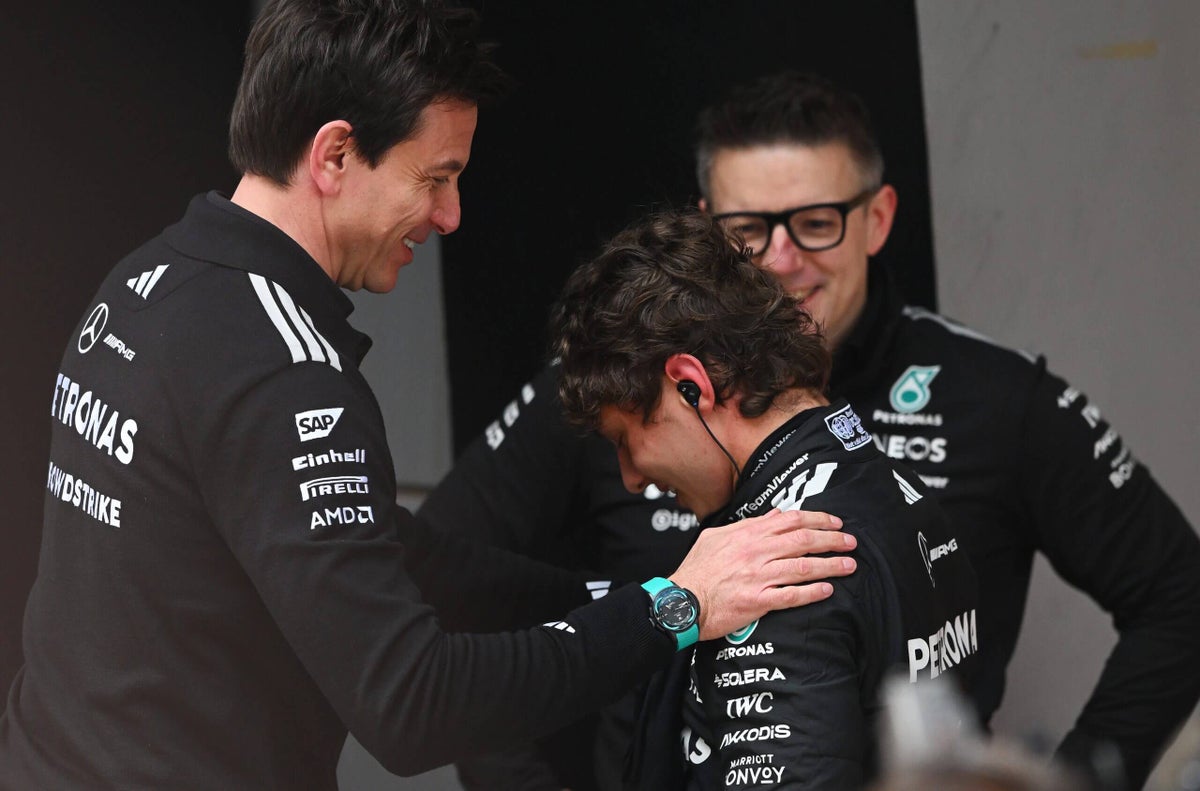
Toto Wolff, the Mercedes team principal, has constantly warned against putting too much pressure on Antonelli. His message is particularly aimed at the Italian press that has understandably latched onto a new home hero. Italy hasn’t had an F1 champion since 1953.
But far from struggling in the spotlight, Antonelli, who turns 20 next week, has taken the newfound fame in his stride. He credits this to the Mercedes support network.
“I have a great team who help me, keep me grounded, and try to steer me in the right direction whenever I’m maybe losing sight of the goal,” Antonelli said.
The creation of that network began very early in Antonelli’s life. He first popped up on Mercedes’ radar in go-karts at age 11, before signing to its academy in early 2018. In go-karting, the traits of the very best drivers will generally begin to shine.
“It’s the way they are developing, the way they are improving their professional approach on every aspect: the technical side, mental side, physical side,” Gwen Lagrue, the long-serving chief of Mercedes’ young driver program, who is joining Red Bull in 2027, told The Athletic in an interview.
By the time a young driver moves from go-karting to single-seater racing, usually starting in Formula 4, Lagrue explained that Mercedes will begin to offer the necessary support to aid their transition.
“When you switch a kid from go-karts to F4, you also need to start to put the people around them,” explained Lagrue. “Who will be the trainer? The mental coach? The guy who will monitor and support on track? Which team will we go to? Which series?”
Lagrue explained that his team at Mercedes had been “much more focused on the human side rather than the technical” aspects of racing with its youngsters. They are trusted to perform as Mercedes tries to place them in the best team at each level of racing, making personal skills the critical ones to foster.
“This is very important,” said Lagrue. “We are not building robots. They are humans, so values are important. Our role is to make sure we’re guiding them the right way.”
Antonelli was supported from his first F4 races in 2021, starting with half a season in the Italian national championship. Lagrue said Mercedes immediately found him a personal trainer, as the 15-year-old Antonelli was “not ready yet for the intensity of F4”.
Mercedes linked Antonelli up with Sergi Ávila, via Aleix Casanovas, who has been George Russell’s trainer since he was a youngster racing in Formula 3. Ávila and Casanovas remain part of Antonelli and Russell’s respective entourages. Stability benefits the drivers as they move up racing levels.
But F4 is the point when drivers start to become more fully integrated into the Mercedes team.

Charles Leclerc, Gwen Lagrue (center) and Fred Vassuer at the 2026 Miami Grand Prix. (Clive Mason/Getty Images)
“They start to have marketing and communication guidance (at that stage),” Lagrue said. “They need to develop and know the culture of the team — what it means to be a Mercedes young driver. They need to realize there are 2,000 people in the team.”
The Mercedes culture bred in Antonelli helped his rapid trajectory toward an F1 seat.
The original plan was for him to spend two years in F2, but Lewis Hamilton left for Ferrari at the end of 2024, forcing Mercedes to change its plans. To Wolff, it was an easy call: He was happy to put in an F1 rookie, something the team had not done since returning to F1 in 2010.
Antonelli spent one season in F2 in 2024, alongside an intense private F1 testing program to ensure he was ready for his 2025 debut alongside Russell.
Regardless of Mercedes’ faith, finding out you’re going to replace F1’s statistical all-time great is a lot for a 17-year-old. But Mercedes felt Antonelli was never overawed.
“The biggest help was the fact he had been with us for six years already (by 2024),” said Lagrue.
“He was part of the family, and he was known by every team member. He was already completely integrated. He was used to having discussions with Toto, with all of us. It was quite an easy transition.”
Lagrue explained that another key part of nurturing talent is appreciating that young drivers are often still teenagers, facing many of the normal challenges of growing up alongside the demands of racing.
The team becomes an important part of their life away from the racetrack too, taking an interest in everything from their personal relationships to schooling.
“Most of the time, we are involved in their worries, even their private stuff,” Lagrue said. “You see them growing up, so we deal with divorce, with the death of a family member, first relationships, the first love failure, fights with friends.”
Lagrue said some juniors struggle with loneliness because their lives are so different from those of typical teenagers, so weekly check-ins are set up with the entire support network.
A big part of that support concerns actual families. Parents want the very best for their children, and Lagrue said Mercedes strives for alignment with the families of its junior drivers on how to handle certain topics, even if there is the occasional challenge.
“You don’t want an ‘us versus them’ (situation),” Lagrue said. “We try to always have the family on board with any decision we are making, especially when they are under 18.”

Marco Antonelli (left) celebrates with his son after F1 qualifying at Spa in July. (Andrej Isakovic / AFP / Getty Images)
Antonelli’s father, Marco, has his own racing team and has been a regular presence at the racetrack throughout his son’s career. He is also close with Wolff.
The strength of this network not only helped Antonelli deal with his sudden transition to F1 racing but also helped him through the mid-year slump of his rookie campaign. His nadir in 2025 came at Spa, where Antonelli was left close to tears facing the media after a bad qualifying session.
He was struggling to click with the Mercedes car and his confidence dipped. A year later, at Spa, he won the race commandingly.
Lifting Antonelli out of the tough time in mid-2025 also required an adjustment from Mercedes, a team used to working with world champions and experienced drivers. But Lagrue was glowing about the work it did to adapt its approach for a rookie, picking out last year’s race in Interlagos, where Antonelli finished second and fended off a charging Max Verstappen, as his first truly strong F1 race.
“We never had any doubt about his speed,” said Lagrue. “It was more all the other parameters — how to deal with an entire race weekend, how to deal with your energy tank, how you are trying to rest and to not have too many distractions, which is very easy to have in F1.
“Sergi did a mega job. The family did a good job. We had some tense moments. When it’s not working, and it’s hard for their son, they will worry as parents. And they were not necessarily happy with what was happening, which is fair enough.
“We had some very tough, but open discussions, and they made a really strong effort to also help the system and help Kimi get through it. It was teamwork.”
It all helped set Antonelli up for his blistering start to 2026, where he rattled off five wins in the first six races to seize control of the championship, with his win at Spa coming four races later.
The foundations for this success were laid not only through his challenges in 2025, but also right back to his early integration within the Mercedes setup.
“You can just see his self-confidence building from weekend to weekend,” said Bradley Lord, Mercedes’ deputy team principal. “(But) not in a way that he’s getting carried away with anything. His feet are very firmly on the ground, and are kept there by his family and inside the team as well.
“But you can just see his self-belief growing and that’s really impressive.”
The F1 driver who can probably best understand what Antonelli is going through is Verstappen, who debuted at 17 and won a race in his second season at 18 with Red Bull. He said he always expected Antonelli to take a big step going into 2026.
“In your first year, there are certain mistakes that you make,” said Verstappen. “We all make them. When you’re driving for a top team, it’s always highlighted a little bit more. There was never a doubt that he would make a jump the year after and be a lot more consistently competitive.
“It’s normal in the progression of a driver. In your rookie season, it can be quite tough. He’s doing an amazing job.”

Kimi Antonelli in action at the 2026 Belgian GP, his most recent F1 win. (John Thys / AFP / Getty Images)
Antonelli does recognize that so much success this soon has come as a surprise to many F1 observers. But there can be no relenting now that F1’s grandest prize is within his sights in just his second season.
“I did not expect to find myself in this position,” Antonelli told reporters before the summer break. “The car has been extremely good, the team has done an incredible job, and, on my side, I try to maximize every opportunity I have.
“There’s still lots of work to do, lots to learn, but it was a good first half of the season. Now I’m looking forward to the second half. We’re just going to keep pushing.”
But in credit to his character — the aspect that struck Lagrue the most when he first met an 11-year-old in go-karts — and the support network around him, Antonelli hasn’t changed with his success.
He’s still playing pranks on his race engineer, Peter Bonnington. He’s still joking with journalists in press sessions. He’s still taking time to wander the paddock with his headphones in and board shorts on between sessions to clear his head.
He has not fallen into the trappings that could come with emerging as F1’s newest superstar. He’s still Kimi.