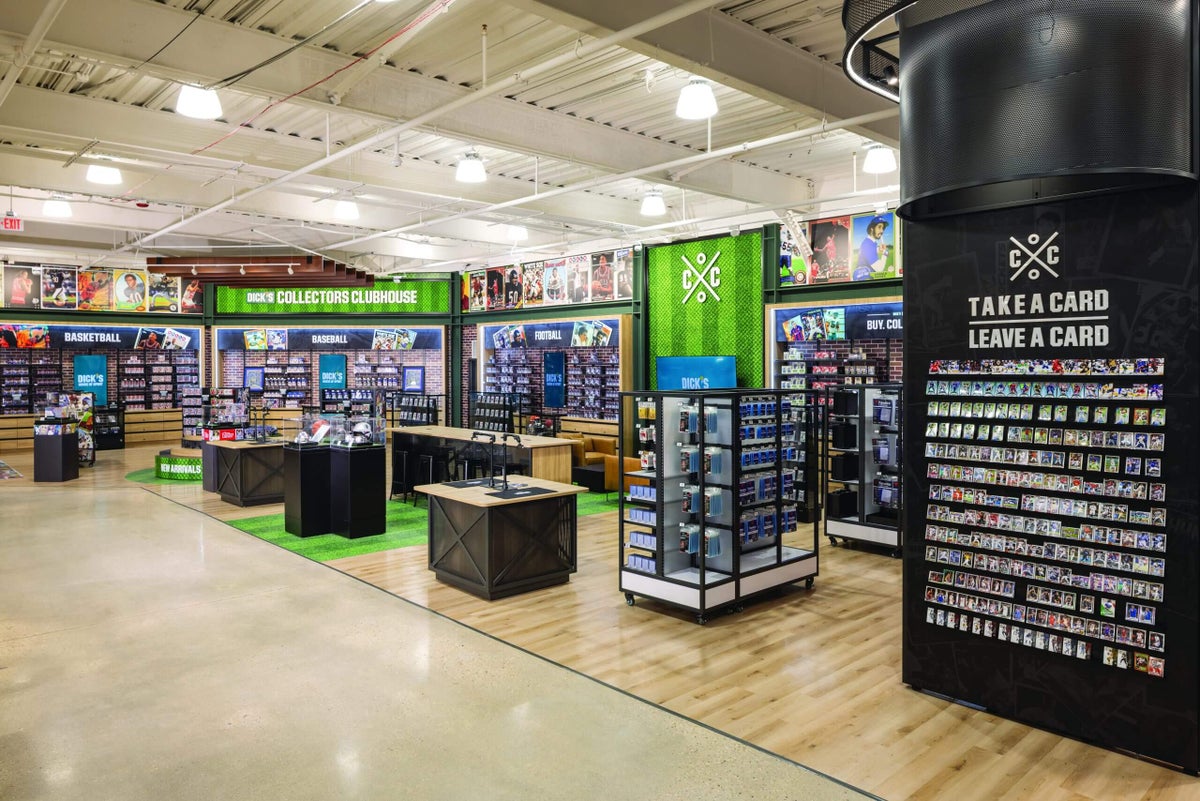
Dick’s Sporting Goods doesn’t make it a habit of going to flea markets in New York to hunt down Knicks hoodies or baseball gloves to add to inventory. Or to yard sales in Los Angeles to shop for Lakers hats or basketball shoes to fill the store racks.
But to be a serious player in the sports trading card business, outside of selling sealed retail boxes direct from manufacturers like Topps and Panini, Dick’s realized it needed to pivot from conventional strategies to build a proper collector’s experience inside their stores. That meant shopping for individual cards at tables at card shows like the National Sports Collectors Convention, where its buyers purchased a haul of cards from around the show floor.
Dick’s passed on a massive branded space of its own at the National like it had nearly two weeks earlier at Fanatics Fest in New York, another event filled with trading card dealers. For the National, Dick’s sent a team of inconspicuous buyers to shop for sports cards of Michael Jordan, Shohei Ohtani and anyone else who might attract customers for their stores.
“We’re developing our muscle,” said David Progar, the company’s senior vice president of hardlines. “We think having a really good singles assortment is critical to our success in this business.”
How far outside of the Dick’s wheelhouse is this process?
“It’s very different and it’s something that we’re learning quickly,” Progar said. “We’ve got some people on our team that are passionate trading card enthusiasts and they’ve helped us with negotiations and handling that. But it’s definitely a totally new business and different business for us.”
The plan for Dick’s has been to create “Collector’s Clubhouse” areas within the company’s “House of Sport” centers, which are larger than its traditional stores and include interactive elements like batting cages, climbing walls and golf simulators. The hope will be to build a hobby shop type of atmosphere that will attract both long-time card enthusiasts as well as first-time collectors with a selection of hobby and retail sealed products, as well as individual cards.
National retailers like Target and Walmart that have long been destinations for collectors, as well as other newcomers to the space like GameStop are also expanding their trading card footprints within stores across the country. For Target, the trading card space became a billion dollar revenue stream last year, on top of whatever else a shopper purchased along the way during a trip to the store for cards. And so the strategy is a simple one for Dick’s: there’s revenue to be made in selling sports cards, and there’s a decent probability customers will buy more traditional sporting goods, as well.
“We were testing some products and we’re seeing incredible success selling (cards) in our stores in a small way,” Progar said. “We started to expand the footprint a little bit more and we started to see both the sales success, but also some data on the consumer that’s buying these cards. They shop more frequently than our traditional consumer, which we really liked.”
Dick’s executives spoke bullishly about the growth opportunity for the company within the trading card space during the company’s first-quarter earnings call in late May. Yet chief financial officer Navdeep Gupta said the company experienced a “little bit of a mix headwind” causing a lower gross margin by diving into the sports collectibles business. This spurred a question on the call about collectibles being a “source of pressure” on the gross margin. President and CEO Lauren Hobart wouldn’t quantify the contributions from the cards and collectibles space from the first quarter, but expressed optimism for the increased attention to that industry.
“The collectibles business, the trading card business are such exciting, incremental opportunities,” Hobart said. “So while they do have a lower margin than our overall mix, I think thinking of them as pressure or any sort of negative thing is the wrong way to look at it. It’s incremental gross margin dollars, bringing people in more frequently, appealing to a younger audience, totally incremental from the rest of our store and driving trips. So we’re thrilled about that business and Navdeep’s point, the math will (work) so that we can grow gross margin the full year.”
The company’s initial splash into the hobby certainly drew the attention from collectors that it desired.
In March 2025, Dick’s won the auction for one of the more publicized sports cards produced in the last few years when it paid $1.11 million for the Paul Skenes one-of-one 2024 Topps Chrome Update MLB Debut Patch autographed rookie card last year. It’s still the most expensive Topps Debut Patch card ever publicly sold, according to sales database Card Ladder.

Paul Skenes with his Topps MLB Debut Patch card, on display at the Pittsburgh-area House of Sport location. (Photo courtesy of Dick’s Sporting Goods)
The chain fended off numerous suitors for the card, most notably the Pittsburgh Pirates, which offered two season tickets behind home plate at PNC Park for 30 years and a host of other unique experiences and items. Livvy Dunne, Skenes’ girlfriend, social media influencer and LSU gymnast, offered the card’s owner a chance to sit with her in a suite at the stadium during a game if the person took the Pirates’ deal.
“We knew we’d get a ton of excitement in the media around this, with us trying to get serious about the business,” Progar said. “We didn’t think this was like a one-time thing. This is something that we’ve put in our local House of Sport store here in Pittsburgh. We’ve had lots of fans, not just Pittsburgh fans, but fans from other Major League teams come into the city and come see it, take pictures with it. So it’s really been much bigger than what we thought it would be. But it was something we decided, ‘Hey, let’s take a shot at this thing and see what it does.’”
Progar and Dick’s executive chairman Ed Stack kept in close contact throughout the bidding war for the card, even enjoying the thrill of the auction hunt as bidding on Fanatics Collect went past midnight in the midst of March Madness. Progar said there was never a specific ceiling the company would be willing to spend.
“We probably would have tapped out at some point, but we felt like it was worth what we paid just over $1 million,” Progar said.
And like any hobby shop, just about every card or item has a price. So would Dick’s ever be willing to sell the Skenes card or possibly make the card available through an elaborate giveaway?
Never say never.
“It’s something that we’ve talked a lot about,” Progar said. “We’re exploring what we’re going to do with it, but we haven’t quite decided what the next move is with the card right now. We’re really happy with it in our ‘House of Sport’ store in Pittsburgh.”
Searching for cards of the GOAT at The National
The Athletic maintains full editorial independence in all our coverage. When you click or make purchases through our links, we may earn a commission.