
Tech
Meta AI Incognito Chat: What It Hides and What to Verify

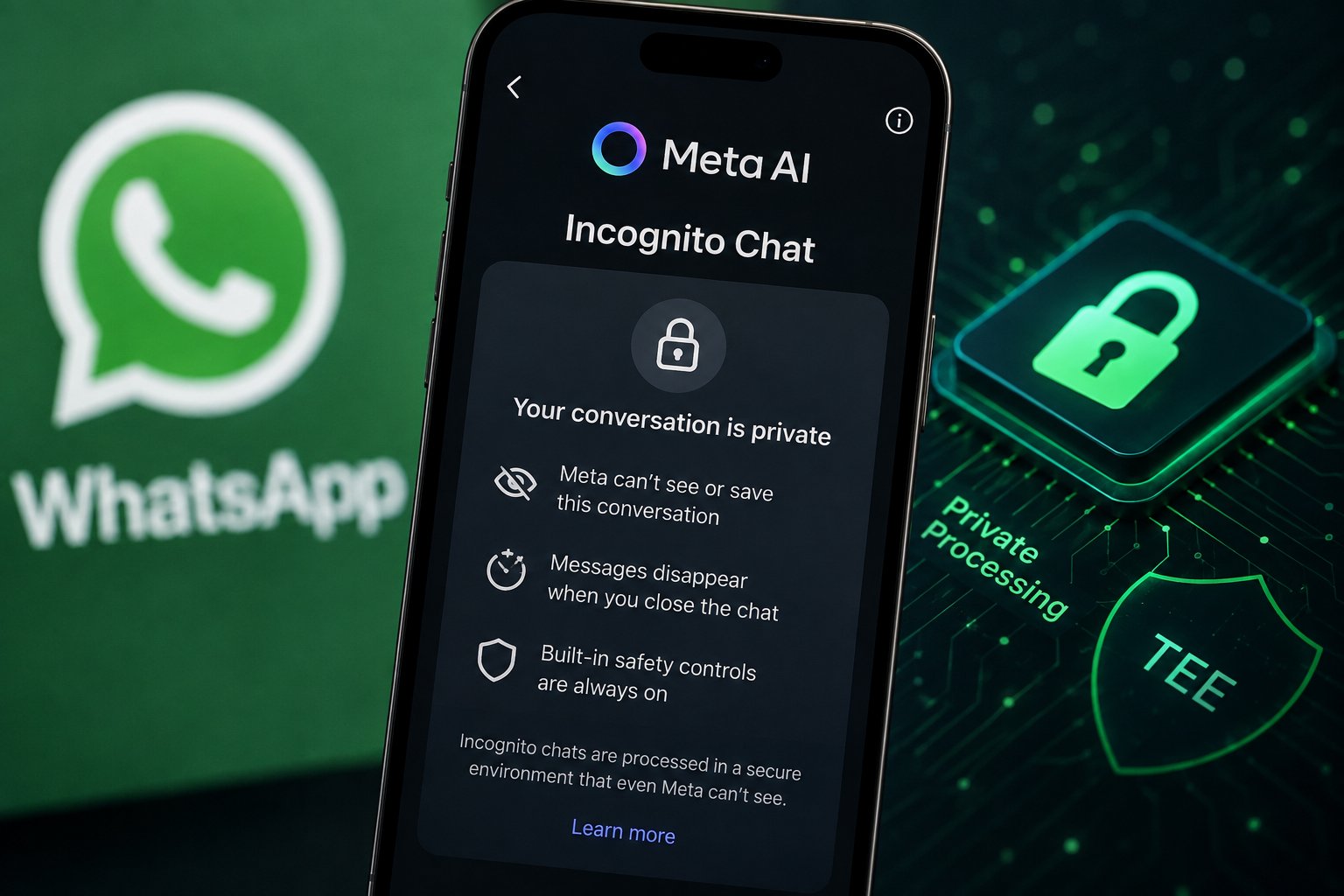
Meta says Incognito Chat gives people a more private way to use Meta AI on WhatsApp and the standalone Meta AI app. Conversations are processed in a secure environment that Meta says it cannot access, are not saved, and disappear by default when the session ends.
That makes Incognito Chat a better fit for sensitive personal questions than a normal AI chat. But it does not settle every privacy or compliance question.
The feature relies on Meta’s server-side Private Processing system, and the transparency mechanism meant to help outsiders verify that system has faced scrutiny.
Meta launched Incognito Chat on May 13 and said it would roll out over the following months. As of August 19, Meta’s public launch page still describes it as rolling out over the coming months, so availability may still vary.
Private Processing uses trusted execution environments, or TEEs, to isolate AI requests while they are processed. Meta says requests are encrypted between the device and the selected TEE, third-party routing helps hide the requester’s IP address, and the system does not retain access to messages after a session ends.
Closing the app or locking the phone ends an Incognito session and removes its context. Meta says the conversations are not saved, and messages disappear by default.
Those protections sit alongside other WhatsApp privacy features, including Strict Account Settings, but Incognito Chat is specifically designed to shield AI prompts and responses from Meta while they are processed.
Meta also says Private Processing should be independently verifiable through Cloudflare-hosted transparency logs. Security firm Secorizon reported in May that 30 of 40 namespaces it examined remained at their initial epoch and 10 were uninitialized.
That questions whether the external verification layer was working as intended at the time; it does not show that Meta could read Incognito Chat content.
What Incognito Chat does not protect and what to verify
Private processing does not control what happens after information reaches the device. Users can still copy, screenshot, or preserve AI output. Questions about WhatsApp data stored locally on devices illustrate why server-side privacy is only one part of protecting sensitive information.
Meta’s public Incognito Chat announcement does not separately state a model-training policy for these conversations or describe enterprise controls such as audit logging, DLP integration, and legal holds. Businesses handling regulated or confidential information should get those answers in writing before changing existing AI-use policies.
For individuals, Incognito Chat is most useful when avoiding a stored AI conversation is valuable. Organizations should confirm availability, retention and metadata handling, training terms, and administrative controls before approving sensitive use.
Meta is continuing to expand AI features inside WhatsApp, so Incognito Chat is best treated as one privacy control rather than a blanket guarantee for every business use case.
Also read: WhatsApp is testing usernames that let people chat without sharing phone numbers, adding another privacy option to the platform.
>

Despite its technological progress, AI’s reputation out in the real world is getting worse. On Wednesday, Axios reported that the National Republican Senatorial Committee sent a memo to top AI companies warning that U.S. data centers are hurting the party’s chances in a key Ohio election. At the same time, Pew Research released a study that found that Americans’ unease about AI is growing — 52% said they’re “more concerned than excited” about the increased use of AI in daily life, up from 37% in 2021.

A recent CNBC poll of 18- to 34-year-olds found that, when given the names of nine top leaders in the AI industry, a majority of the respondents said they don’t trust those people to “act responsibly” when it comes to AI. A May Economist/YouGov poll found that over 70% of Americans think AI is advancing too quickly. The list goes on.

All that discontent is starting to show up on balance sheets. The Wall Street Journal reported this week that tech companies are facing a public relations crisis over their plans to build AI data centers across the U.S., leading them to agree to sweeten the deals — offering job guarantees, clean water investments, and other local perks. (In one case, that even included $50,000 bonuses for teachers in a Louisiana parish.)
The underlying sentiment spanning these stories is that consumers don’t see how AI is making their lives better, but they’re still being asked to absorb the costs. For an industry that has raised hundreds of billions of dollars on the promise of AI’s inevitability, that souring public sentiment is becoming a business problem, not just a PR debacle, and the industry’s own leaders are starting to notice.
Today, many consumers think of AI in narrower terms, like AI chatbots or AI search experiences (like the now AI-transformed Google). They see AI features infiltrating their everyday products, from email to TVs, whether they wanted them or not. They view AI as a tool that’s helping kids cheat in school, including at the college level, raising questions about the value of a degree. They hear of AI bots training on piles of intellectual property belonging to others so AI can be used to create art, videos, music, and writing — things that have historically been the output of humans.

It’s no shock then that AI appears to be facing more consumer backlash than other transformative technologies did, like the iPhone, the personal computer, or even the internet itself, at similar stages of adoption.
Yet there are still those surprised by consumers’ reaction. They assumed AI’s adoption would lead to acceptance, and its ubiquity would ultimately have consumers feeling positively about the technology, as it became a part of the vast majority of tech products and services.
Instead, consumer trends are pointing in the opposite direction. Young people, in particular, are showing interest in adopting retro technology, ranging from dumbphones to point-and-shoot cameras to tape decks and CD players. AI-free, algorithm-free classic iPods are selling for top dollar on eBay. So-called “grandma hobbies” like quilting, knitting, jigsaw puzzles, cards, and games like Mahjong are suddenly everywhere. In-person meetups and activities, like run clubs, are winning out over online dating.

Some in Silicon Valley may think this stems from a messaging problem: that perhaps execs need to explain AI better to consumers, so people can fully understand its benefits.
The reality, however, could be that consumers understand AI well enough as it is, but don’t think the trade-offs are worth it. When the upside offered isn’t automated jobs with increased pay and reduced workweeks, but instead the threat of job loss, paired with AI features consumers find far less compelling — things like summarized web pages, or chatty TVs — that skepticism hardens.
There are those in the industry waking up to this.
On a recent podcast, Airbnb CEO Brian Chesky acknowledged that the AI backlash is real, and that it’s largely tied to the fact that the industry isn’t shipping products that “regular people” like.
“I think part of it’s a narrative issue that we’re not talking about AI correctly,” Chesky said. “But part of it is we need to actually be developing more products that just regular people can use and say, ‘I love AI because AI allows me to have a doctor on demand and I can’t have that. I can’t afford that.’ And so I think we need more regular things.”
Even Anthropic CEO Dario Amodei, one of the industry’s most prominent leaders, admitted in a post on X this week that negative public perception of AI is a “big problem” that’s fundamentally a “crisis of trust.” He said people don’t trust companies, governments, or the tech industry, as they “suspect that we are cooking up some new way to screw them over.”
The solution, he said, was to deliver on AI’s promises — for example, curing cancer.
“I think by far the most accurate criticism of AI companies, including Anthropic, is that we haven’t yet delivered on our big promises to benefit the world. That is totally on us,” he noted.
When you purchase through links in our articles, we may earn a small commission. This doesn’t affect our editorial independence.
>

Google on Wednesday announced a slew of new study tools across Search and Gemini, including AI-generated interactive visuals, 3D simulations, a decided student hub, customized practice quizzes, and more.
The launch of the new study features marks Google’s latest effort to make Gemini the AI assistant that students turn to when learning and studying, as it competes with companies like OpenAI and education startups such as Knowt and Gauth, which are also offering their own learning and practice tools.
On Search, students can now generate custom tools and simulations to help them understand complex topics. For example, if a student is learning about pH levels, they can search for “pH scale” and get an interactive visual in an AI Overview that makes the basics easier to understand.
To go even further, they can ask a follow-up question for something more specialized, like plotting citrus fruits on the pH scale, and AI Mode in Search will then create an interactive experience tailored to the question.

Users can now get customized practice quizzes directly in Search on any subject, including science, math, humanities, foreign languages, and more. For example, users can enter a prompt like, “Create a quiz with the most commonly tested vocabulary words to help me prep for the SAT,” and Search will then generate an interactive quiz.
In the coming weeks, Lens in Search will roll out a new interactive learning experience that will help students work through problems. They can tap the “Lens” camera icon in the Google app and then upload a photo of what they’re working on to get AI to explain the concept, identify potential mistakes, and provide guidance if they’re stuck.
Additionally, students can now ask Search to create study documents based on their uploaded files, including PDFs, docs, slides and more. For example, they can upload a photo of their handwritten notes along with lecture slides to get a one-pager that outlines key concepts.

As for the new Gemini features, Google is launching a feature that lets students launch multi-step research reports in Gemini Live and then discuss the findings conversationally.
Users can ask Gemini to research a topic and then close the chat or do other things while it works in the background. They’ll get a notification when the report is ready and can then can discuss the findings or ask follow up questions using their voice.
The tech giant also announced that Gemini can now generate functional 3D simulations to help users better understand topics, as responses will now include tables, grids, and simulations made specially for the prompt. For example, if you enter a prompt like, “show me how DNA works in 3D,” you’ll be able to interactively rotate and zoom into a 3D DNA structure.
Google is also launching a dedicated hub in the Gemini app that brings its learning tools together in one place. Users will be able to start a study notebook, create flashcards, take practice quizzes, and more within the hub.
When you purchase through links in our articles, we may earn a small commission. This doesn’t affect our editorial independence.
>
Several security researchers say OpenAI suddenly revoked their access to a limited-access program that removes some restrictions on using its AI tools for cybersecurity research, likely because of an error by the company.
On Wednesday, multiple researchers on OpenAI’s official support forums and on X reported having their access to the Trusted Access for Cyber (TAC) program revoked. The people said that when they opened ChatGPT’s Cyber page, a message appeared saying their identity could not be verified or that their account “is ineligible at this time.”
TAC is a special program through which OpenAI offers vetted researchers access to the company’s most advanced AI models with fewer cybersecurity guardrails than the models that regular users can access. Anthropic offers a similar program called the Cyber Verification Program, or CVP.
The idea behind TAC and CVP is to give trusted defenders better models so they can report bugs and vulnerabilities to companies, with the aim of getting flaws patched faster. The goal is also to prevent cybercriminals and malicious hackers from accessing those models and use them to find bugs and develop exploits to hack companies.
To get access to TAC, cybersecurity researchers have to submit an ID and be vetted by OpenAI.
At this point, it’s not entirely clear why these researchers are getting their access to TAC revoked, nor how many people have had this issue.
TechCrunch spoke to five researchers who said they have had this problem. One researcher said OpenAI sent an email saying that their access to Daybreak Blue, the latest vetted tier of TAC, was revoked “due to a technical issue affecting a limited number of users.”
“This was an issue on our end, and not the user experience we want to deliver,” read the message, which the researcher shared with TechCrunch.
In a thread on OpenAI’s forums, a researcher wrote that after they reached out to the official support, the company also cited a “recent technical issue” that caused some users to lose access to Daybreak Blue.
In both messages, OpenAI asked the researchers to reapply and complete the verification process.
All the researchers TechCrunch spoke to said they live outside of the U.S. and Europe, suggesting the revocations may be limited to certain regions.
OpenAI did not immediately comment on the account issues when contacted by TechCrunch.
Daybreak Blue is the latest tier for individual researchers that grants access to “frontier general-purpose models, including GPT‑5.6 Sol, with safeguards tailored to authorized defensive security work,” according to OpenAI, which launched it on August 10. “It is the recommended starting point for most defenders, supporting vulnerability discovery, secure code review, malware analysis, incident response, and patch validation.”
At the same time, the company also introduced a higher tier called Daybreak Red that gives access to models made specifically for cybersecurity research, which allow vetted users to do “authorized vulnerability research, exploit validation, and security testing.”
In recent months, both defensive and offensive security researchers have complained about the guardrails imposed by Anthropic and OpenAI, arguing that the guardrails prevent them from doing legitimate work.
When you purchase through links in our articles, we may earn a small commission. This doesn’t affect our editorial independence.
>

Paradox Inc. Movie From Daniel Roher, Lord Miller, Universal In Works

Seahawks signing former Cowboys CB Trevon Diggs to bolster secondary depth: Source

AI was supposed to win people over by now — it hasn’t
-

 movies3 months ago
Search For Canadian TV Actor Stewart McLean Now Homicide Investigation
-

 Fashion9 years ago
These ’90s fashion trends are making a comeback in 2017
-
Fashion9 years ago
According to Dior Couture, this taboo fashion accessory is back
-
Fashion9 years ago
Model Jocelyn Chew’s Instagram is the best vacation you’ve ever had
-
Fashion9 years ago
Emily Ratajkowski channels back-to-school style
-
Fashion9 years ago
9 Celebrities who have spoken out about being photoshopped
-
Fashion9 years ago
Your comprehensive guide to this fall’s biggest trends
-
Fashion9 years ago
A photo diary of the nightlife scene from LA To Ibiza