
Entertainment
MS NOW Membership Platform Price, Launch Date Revealed


MS Now’s inaugural direct-to-consumer membership product has set a Sept. 9 launch.
The offering, which serves as an additive experience to the network’s television and digital offerings, will offer new opportunities for members to interact directly with its trusted journalists, exclusive community features to engage with each other, a new roster of contributors and experts, original creator content, new verticals that explore how news and politics impact everyday life, and 24/7 access to live streams and television programming.
The membership will be available for $7.99 per month or $79.99 annually. Through Sept. 30 at 11:59 p.m. ET, new members can take advantage of an introductory offer of $39.99 plus tax for the first full year of Membership.
“From the beginning, we’ve approached this deliberately. When we launched MS NOW, our ‘We the People’ campaign was never just a tagline. Our mission has always been to inform, engage and empower our audience,” MS Now President Rebecca Kutler said in a statement. “Our Membership is the first step in a long-term strategy to deepen our relationship with audiences in ways that build on what they already value about MS NOW, while addressing what consumers told us was missing from the news experience. We will continue to research, test, and refine this experience because we want it to be something that our loyal MS NOW fans genuinely love, as well as something that future fans genuinely need.”
More to come…
>
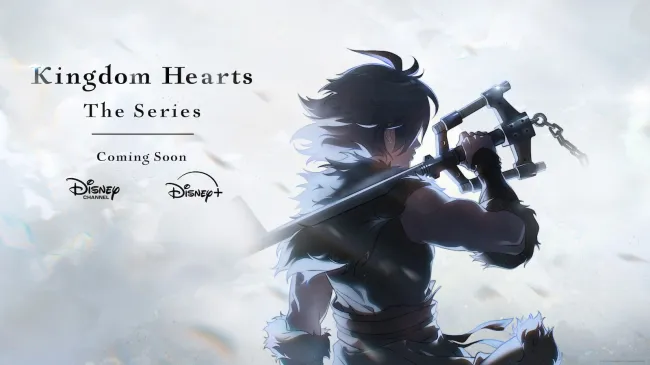
Had I known at age 12, when I was first playing the original “Kingdom Hearts” video game on PlayStation 2, that there would be a Disney Channel anime series based on the game, I would not have been able to contain my glee. For me and many others my age, “Kingdom Hearts” was one of the formative pop culture moments for the Millennial generation.
Well before the MCU or “The Dark Knight,” here was a franchise that married our childhood nostalgia with more mature themes and characters, one in which Disney movies mash-up with the spiky-haired, brooding anime figures of the “Final Fantasy” video games. The gut punch of hearing the game’s soaring anthem “Simple and Clean” over its opening cinematic and closing finale was something that showed me that even kids’ stuff could operate on the grandest canvases of love and friendship, good and evil, light and dark, and still feel profound, moving, and beautiful. That’s the kind of reverence people have for a video game like “Kingdom Hearts,” which speaks to how it has endured across 25 years and a dozen obscure side games, even as fans have waited years in between the main flagship entries.


Despite the passion people have for it, it never really graduated in popular culture to anything beyond just a video game. Any fan of the franchise will tell you that the full lore of the world crafted by Tetsuya Nomura is virtually nonsensical to explain to a layman. The writing, full of hearts, darkness, light, Heartless, Nobodies, light within dark, etc., is often beyond parody, even if we love it anyway. People’s eyes would glaze over if they knew that grown men and women were spending hours inside worlds playing mini-games with Winnie the Pooh, clicking in rhythm to “Little Mermaid” sing-a-longs, or taking selfies with Woody from “Toy Story.” It can be hard to imagine too how such a sprawling narrative — one that literally inserts its hero into Disney classics everyone already knows — could ever be adapted into a short form film or series. The idea that casual audiences on TV — people who weren’t gamers willing to grind to 100 percent completion to unlock an esoteric, secret two-minute cutscene ending — was almost unthinkable.
Disney, despite lending its most iconic characters to the franchise time and again, has (perhaps wisely) kept itself at arm’s distance from “Kingdom Hearts.” You would never see Mickey Mouse wielding a Keyblade running around Disney World. OpenAI named its now defunct AI video model “Sora,” the same name as “Kingdom Hearts’” iconic hero, and nobody blinked. Michael Eisner was even once asked by a gaming journalist if he recalled green lighting the original game and he came up blank.
But 25 years after its release, it feels like Disney has finally recognized “Kingdom Hearts” as one of its true tentpole franchises. Here it is on stage at D23 as a major announcement alongside news about the X-Men, a legend award for Lin-Manuel Miranda, and “Coco 2,” which coincidentally will be a playable world in 2027’s “Kingdom Hearts 4.” D23 gave us not just the series but a new trailer for the game, a target release date, and a reunion panel featuring the voice of Sora, Haley Joel Osment. Sora will soon to be a playable character in “Fortnite,” which is part of Disney’s big ongoing partnership with Epic Games. “Kingdom Hearts” even seeped into larger entertainment news this weekend because one of the franchise’s main characters, Kairi, was long voiced by none other than the late Hayden Panettiere.
All this should be very exciting for fans who have long known one of their favorite games is still unbelievably nerdy and cheesy, but still wanted to see it in the mainstream. But my question to Disney after all this is: do you know what you’re getting into?
Making an anime “Kingdom Hearts” series for streaming and cable is among the lower-risk moves the studio could’ve taken to throw a bone to dedicated fans. Had Disney instead greenlit a live-action movie with a Marvel-sized budget, that suddenly sounds like a way bigger risk for, again, a video game adaptation in which you fight shadow monsters with a giant key alongside Donald and Goofy. (For anyone reading this that has never played or seen these games I promise all this is true.)
Disney didn’t even go as far as to announce anything more than the fact that a series is happening. Nomura and game developer Square Enix are involved, but that’s it. The anime will have a “brand-new story that will expand on the universe of Kingdom Hearts while celebrating the characters,” per the release, which could mean just about anything. In fact, “Kingdom Hearts” is still a working title for the series, so maybe I should scale back a bit about how committed or knowledgeable anyone at Disney+ is about this franchise.
But the fact that something exists or will exist on the flagship streamer — and not, say, stream on Hulu or be licensed to Peacock — still speaks in my mind to the value Disney sees in this IP. CEO Josh D’Amaro comes from the Parks and Experiences division, he clearly values video games as a form of growth for the company, and he’s likely seen some Disney adults running around cosplaying as Riku, Roxas, or Aqua (more real character names for the uninitiated!) and figured out there’s something there to mine.
With all that said, there’s a nagging darkness lurking within me, to borrow some euphemisms from the game, that Disney could still walk away from all of this with a ton of egg on its face and make all of us who love “Kingdom Hearts” look like even bigger dorks than we already are.
I want to back up and do my best to explain in the broadest terms the plot of “Kingdom Hearts.” There are literally hours-long videos on YouTube attempting to explain all the ins and outs of the franchise across the games, and the most passionate will tell you that plot details revealed in many of the side games (often with inscrutable titles involving decimal points and fractions like “2.8 Final Chapter Prologue” and “358/2 Days”) are as important to comprehending the story as playing the main three games, “Kingdom Hearts 1, 2, and 3.”
Truth be told, I’ve actually put an embarrassing amount of thought into what an adaptation should look like, and I took a stab at writing this synopsis:
Sora is a care-free island boy who dreams of visiting other worlds beyond his own. But when his own world vanishes and is consumed by dark, shadow creatures called Heartless, Sora discovers he is the wielder of a mystical weapon called the Keyblade, capable of “locking” the hearts of worlds and saving them from the encroaching darkness. Now teamed with his new companions Donald Duck and Goofy, whose own world is consumed, he sets out on a quest to find his missing friends, Riku and Kairi, bring his own world back, and save the universe from darkness and the evil witch Maleficent.
Frankly, I think most general audiences could at least buy into something like that. This is standard Hero’s Journey stuff. That of course is the bare bones premise of just the first game in the franchise, and explaining the identity of the true villain is where your head starts to spin. It involves an evil scientist of sorts who, in his pursuit to open the title “Kingdom Hearts” and unleash darkness on the entire universe, has himself transformed into a Heartless but also 13 empty shells of himself called Nobodies that each have their own consciousness, all of which dates back to an ancient war involving thousands of these Keyblades. And also Sora in the upcoming fourth game may technically be dead and living in a purgatory that looks like the real world where there are underwater astronauts fighting monsters in hulking, futuristic diving bell armor, and Donald and Goofy are now traveling to the Underworld to talk to Hades from “Hercules” to find out if Sora’s really dead and save him. Get all that?
I’m probably getting something wrong there or leaving out something important, but doesn’t that all sound like mass appeal 4-quadrant stuff good for Saturday morning cartoons with the kids?
Hollywood of course, until quite recently, had a notoriously bad track record of adapting video games, but we’ve seen how people who actually know and love the games are now the ones shaping adaptations and making them meaningful to the fans. My apprehension lies with the fact that “Kingdom Hearts” may be among the most ambitious challenges yet. I may sound like a fanboy, but what we don’t want is something that can irreparably damage the legacy of a franchise we love. This is a fanbase that waited over a dozen years between games 2 and 3 and now another seven years between 3 and 4. Who knows what a setback could do for the future of this brand?
But if playing the “Kingdom Hearts” games has taught me anything, it’s that cynicism and negativity only lead to darkness. Sora famously says, “my friends are my power,” and the announcements of the last weekend show he has a real lot of them.
>
When the board of the Kennedy Center met last week to decide on the future of the complex, they took up a resolution to restore Donald Trump‘s name to the front facade of the complex.
The vote by the Trump-controlled board was not just one designation for the president, but three.
According to a copy of the resolution filed in federal court late on Tuesday, Trump’s name would be returned to the front facade, just below its official name, “The John F. Kennedy Memorial Center for the Performing Arts.” Below that lettering, a new one would be added to read, “Restored and Renovated by President Donald J. Trump.”
That’s not all. The resolution also provides for another Trump designation, just below “Restored and Renovated by President Donald J. Trump.” Once a $100 million threshold is met for an endowment the board set up for the center, per the resolution, a line would be added to read, “Endowed by the Trump Kennedy Center Fund.”
So the facade of the Kennedy Center would read:
The John F. Kennedy Memorial Center for the Performing Arts
Restored and Renovated by President Donald J. Trump
Endowed by the Trump Kennedy Center Fund
There’s more. The board resolution also designated “the physical site and grounds upon which the center sits” as the “President Donald J. Trump Plaza.”
The board is chaired by Trump and which includes administration figures like Sergio Gor and Dan Scavino and Fox News personalities Maria Bartiromo and Laura Ingraham. In December, they voted to add Trump’s name to the center and, the next day, the facade was changed to read “The Donald J. Trump and The John F. Kennedy Memorial Center for the Performing Arts.”
Rep. Joyce Beatty (D-OH), an ex officio member of the board, sued, and in May U.S. District Judge Christopher Cooper ruled that only Congress could make such a change to the center’s name.
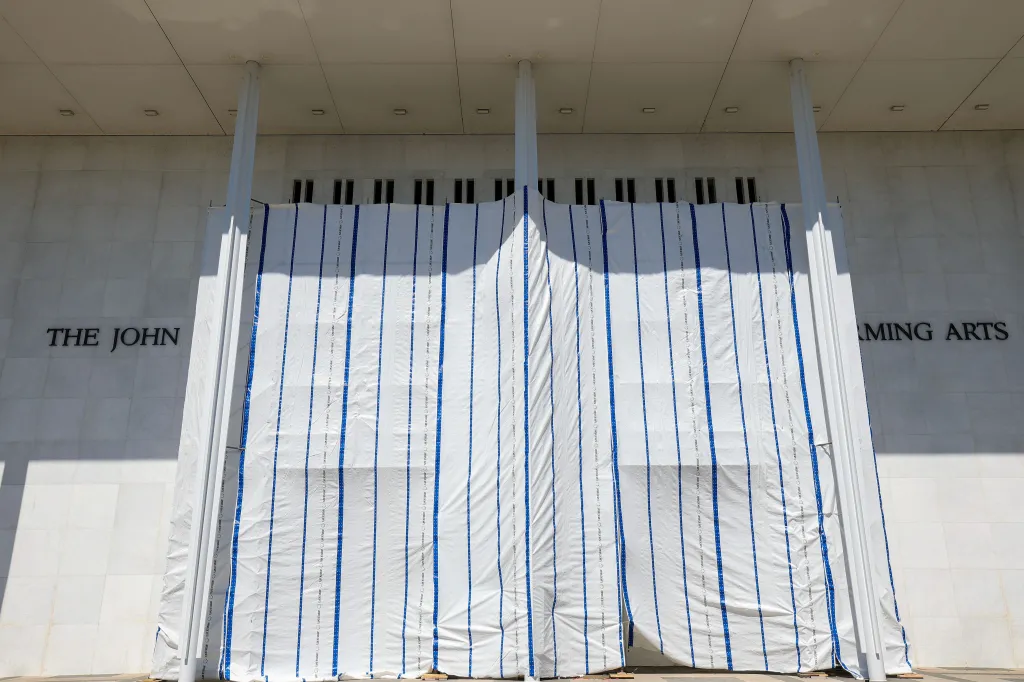
That forced the center to remove references of the “Trump Kennedy Center” from its website and other materials, and, most prominently, from the front facade. On the night of the deadline to remove Trump’s name from the facade, a crowd gathered and watched as workers installed scaffolding and, in the middle of the night, a tarp. That concealed the actual removal of the lettering for POTUS. The tarp has remained there ever since.
In response to the latest effort to return Trump’s name multiple times to the front of the building, Beatty’s attorneys argued that the board seems intent “on defying the court’s decision.”
Her attorneys, Nathaniel Zelinsky and Norm Eisen, wrote, “Adding the words ‘Restored and Renovated by,’ or ‘Endowed by,’ before President Trump’s name, and renaming the ground on which the building sits, provides no lawful basis to ignore this Court’s decision and impose Donald Trump’s name on a memorial dedicated by the Congress exclusively to a different President.”
They cited a statute that “no additional memorials or plaques in the nature of memorials shall be designated or installed in the public areas of the John F. Kennedy Center for the Performing Arts.” The board’s resolution seemed to suggest that renaming the plaza would fall outside of the statute.
The center has committed to forego attempts to install the Trump designations until September 8. Beatty’s attorneys want the judge to rule by then.
As for the tarp, the center’s attorneys cited a declaration from executive director Matthew Floca and wrote that the covering “was and is a necessary element of the ongoing construction activities at the Center—during the removal of the name, it served as a safety barrier for ongoing construction activities and helped safeguard the marble facade of the building in light of reported panel damage.” They added that the center will use the existing scaffolding to “assess, investigate and engineer structural repairs to the overhead soffit.”
“Final removal of the scaffolding and its barrier is contingent upon the scope of any repairs required at present to the marble facade, as well as any other necessary repairs,” the center’s attorneys wrote.
Beatty’s attorneys called the explanation a “pretextual justification.” “Defendants state they intend to use the scaffolding to examine the roof overhang,” the wrote. “But the soffits are some twenty feet or more above the scaffolding. Defendants imply that they will erect more scaffolding around the rest of the Center, presumably to examine other portions of the roof. But Defendants tellingly have not done so for months, leaving only the Center’s iconic name obscured—a strong indication that this structure has nothing to do with the roof and is, instead, meant to defy a return to the status quo.”
In his May ruling, the judge also halted plans to close the center for two years for renovations, concluding that the board had been “derelict” in moving to shutter the complex because they “neglected to consider the full range of its statutory obligations and potential adverse consequences of closure on programming and memorial functions.” He noted that the board could still move to close the complex, but only after there was a fuller consideration of impacts.
Last week, the board again voted for a two-year closure plan, while keeping limited programming at The Reach, an extension that opened in 2019.
In the latest filing, the center’s legal team argued that it had conducted an independent analysis, with Delta Consulting Group presenting two options: the closure plan that was ultimately approved, and another plan for a partial closure. The analysis concluded that the partial closure would take longer — four years — and would mean that the center “would suffer a reduction in both revenue and fundraising ability” and “reputational damage that would result from the proximity of construction activities to performance venues.”
Beatty’s team, though, argued that the board “fell short by a country mile” in its analysis.
“The only materials that purport to examine the costs and benefits of the closure was a 5- slide PowerPoint presentation prepared by the Delta Consulting Group, which was subsequently displayed at the Board meeting,” they wrote. “Excluding two cover slides and one slide describing the lead consultant’s biography, the substance of the presentation deck is just two slides long.”
Beatty’s team is calling for a discovery process rather than an expedited briefing on a motion to grant summary judgment, which the center wants. The center also is appealing Cooper’s May ruling.
>
The New York Comedy Festival has added more than 100 shows to the lineup for its 2026 edition, taking place across NYC’s five boroughs from Nov. 6-15.
Select highlights include Tokyo Kanpai Boys at New York Comedy Club Upper West Side on the 6th, an Anxiety Club Screening and Conversation at The Venue on Music Row at Hard Rock Hotel New York on the 7th, Alfred Robles at The Venue on Music Row on the 8th, a live edition of the podcast Good One with Jesse Fox at The Venue on Music Row on the 8th, Moshe Kasher at The Bell House on the 8th, Sharief Johnson‘s JR Comedy Album Recording at New York Comedy Club Upper West Side on the 8th, Jason Choi Live at New York Comedy Club Midtown on the 9th, WRONG! A F*cked Up Game Show with Jay Light at Caveat on the 9th, Ester Steinberg: Showgirly at New York Comedy Club Midtown on the 10th, Charlene Kaye at The Venue on Music Row on the 11th, Andre DeFreitas: Public Display of Affection at The Stand West on the 11th, Valeria Vulpe at New York Comedy Club Upper West Side on the 11th, Eddie Pepitone at Union Hall on the 10th and 11th, Jake Lambert Live at Union Hall on the 13th, and a screening and Q&A for documentary Funny Money: The Dane Cook Story at The Venue on Music Row on the 15th.
The new additions join previously announced headliners including Ben Bankas, Mojo Brookzz, Comic Relief x The Moth, Dropout Improv, Adam Friedland, Gayme Show! Starring Matt Rogers and Dave Mizzoni, Ilana Glazer, Jess Hilarious, Jordan Jensen, Jordan Klepper, Marc Maron, Joanne McNally, Ms. Pat, Sarah Sherman & Patti Harrison, Daniel Sloss, Ziwe, and more.
Caroline Hirsch, founder and owner of the New York Comedy Festival, commented, “We’re thrilled to continue building out this year’s New York Comedy Festival lineup with an incredible range of shows that showcase the depth, diversity and creativity of comedy being created in New York City and beyond. From established festival favorites and exciting new voices, this expanded programming reflects the extraordinary talent that makes New York such a vital comedy capital. We’re excited to give audiences even more opportunities to discover breakout acts, celebrate their favorites and experience the unmatched energy of comedy in New York.”
See the full lineup of new shows set for New York Comedy Festival’s 22nd edition here.
>

Disney ‘Kingdom Hearts’ Series — Commentary

Kennedy Center Voted To Return Trump’s Name To Three Different Spots

Michigan signs up Coke, Meijer, Google for first in-stadium advertising at Big House
-

 movies3 months ago
Search For Canadian TV Actor Stewart McLean Now Homicide Investigation
-

 Fashion9 years ago
These ’90s fashion trends are making a comeback in 2017
-
Fashion9 years ago
According to Dior Couture, this taboo fashion accessory is back
-
Fashion9 years ago
Model Jocelyn Chew’s Instagram is the best vacation you’ve ever had
-
Fashion9 years ago
Emily Ratajkowski channels back-to-school style
-
Fashion9 years ago
9 Celebrities who have spoken out about being photoshopped
-
Fashion9 years ago
Your comprehensive guide to this fall’s biggest trends
-
Fashion9 years ago
A photo diary of the nightlife scene from LA To Ibiza