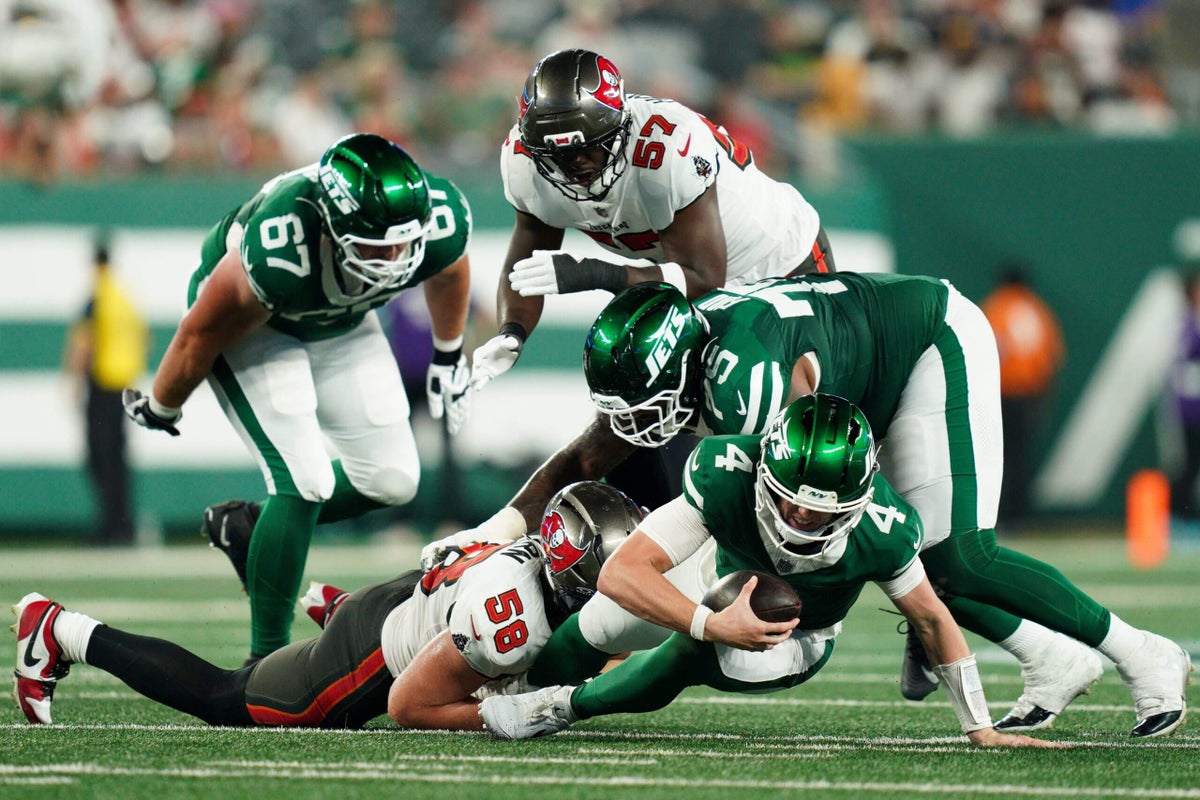
Buccaneers rookie Jack Pyburn recorded two sacks in Tampa Bay’s preseason win over the New York Jets on Friday. Now there’s a chance Pyburn, an undrafted free agent, could return to college football this season, according to a Louisiana court ruling.
Louisiana’s 19th Judicial District Court granted a temporary restraining order on Wednesday that could allow more than 30 college athletes a fifth year of eligibility. It’s the latest in a string of lawsuits against the NCAA related to its recent age-based eligibility rule change. The Louisiana decision is significant because it involves 16 former college football players, including a handful who are currently signed to NFL training camp rosters. The other eligibility suits have featured mostly basketball players.
Wednesday’s order states that the NCAA has until Aug. 31 to show cause why a continuing preliminary injunction should not be granted in this case, which would protect the players’ eligibility as the case moves forward.
In addition to Pyburn, Ole Miss defensive back Wydett Williams Jr. is with the Arizona Cardinals, Ole Miss tight end Dae’Quan Wright is with the Cleveland Browns, and Oregon State running back Anthony Hankerson is with the Seattle Seahawks.
A temporary restraining order in Louisiana allows the athletes — who were in the 2022 high school recruiting class — to enter the transfer portal and be eligible for the upcoming 2026-27 college season. The NCAA, which has fought these lawsuits in court, has rules that prevent athletes from returning to play college after signing professional contracts. However, the order also clears a path for players who signed professional contracts or are currently on a professional roster “so long as they terminate any such contract and repay any money they have received prior to playing in a collegiate game.”
The NCAA will likely appeal the decision, as it has done in other eligibility cases.
“We are asking all courts to put the players back where they would have been if the NCAA had made the rule change earlier. So had these guys known they were going to be eligible this year, they would not have signed with agents, signed non-guaranteed deals or participated in training camp,” said attorney Ryan Downton, who represents the athletes. “In our view, as long as they can get a release from their contracts and give any money back, they should be permitted to play.”
Players voluntarily asking out of NFL deals to return to college would be unprecedented, and the latest twist in the NCAA’s ongoing legal battles and lack of enforcement.
NCAA president Charlie Baker released a statement in December saying that the NCAA “has not and will not grant eligibility to any prospective or returning student-athletes who have signed an NBA contract (including a two-way contract).” That was in reference to Alabama men’s basketball player Charles Bediako’s failed attempt to sue his way back into college hoops.
Pyburn signed with the Buccaneers in May, and like many undrafted free agents, his spot on any NFL roster or practice squad would likely hinge on his ability to contribute on special teams. On Saturday, a day after Pyburn’s two-sack performance, Bucs head coach Todd Bowles said Pyburn “showed up with the lights on.”
“He made us watch him. He made it known, and we want to see what he does going forward, but he definitely made an impression,” Bowles added about Pyburn on Monday.
Former South Carolina linebacker DQ Smith, former SMU running back TJ Harden, former James Madison linebacker Trent Hendrick and former Notre Dame defensive lineman Junior Tuihalamaka are also part of the Louisiana lawsuit.
In June, the NCAA altered its eligibility rules to allow existing and incoming college athletes five seasons of eligibility within a five-year period beginning when they enroll in school (or the academic year following their 19th birthday, whichever comes first). The rule was intended to eliminate redshirting and eligibility waiver requests for injuries and most other circumstances. However, the most recent class of fourth-year seniors was not included in the new rule, sparking more than a dozen lawsuits in recent months. The NCAA has stated it did not want the unexpected return of fifth-year seniors to take away roster spots from incoming freshmen who had already signed with college programs.
Late last month, a Colorado-based federal judge issued a preliminary injunction in a class-action lawsuit that granted a fifth season of eligibility to all college athletes who began in the 2022-23 season. The NCAA is appealing that decision as well. That order does not allow athletes to enter the transfer portal if they had not previously done so during the appropriate portal window, nor does it address professional contracts, which is why so many athletes are seeking separate state-court rulings.
The first of those state-court eligibility decisions, granted in Ohio in early July, was paused by an appeals court this week, blocking it from taking effect. It marked a win for the NCAA, pending a final appeal ruling, but did not seem to impact the Louisiana order on Wednesday.
“The Division I Cabinet, including its student-athlete members, carefully considered whether to make the age-based eligibility rule apply retroactively, and decided that doing so would not be in the best interest of all current and future college athletes,” NCAA chief legal officer Scott Bearby said in a statement earlier this month. “We stand behind and will continue to fully defend the membership’s decision.”
— Ralph Russo and Matt Baker contributed to this report