Connect with us

Sports

Why the Patriots’ red zone play might be the only thing to slow down their offense

Published

on

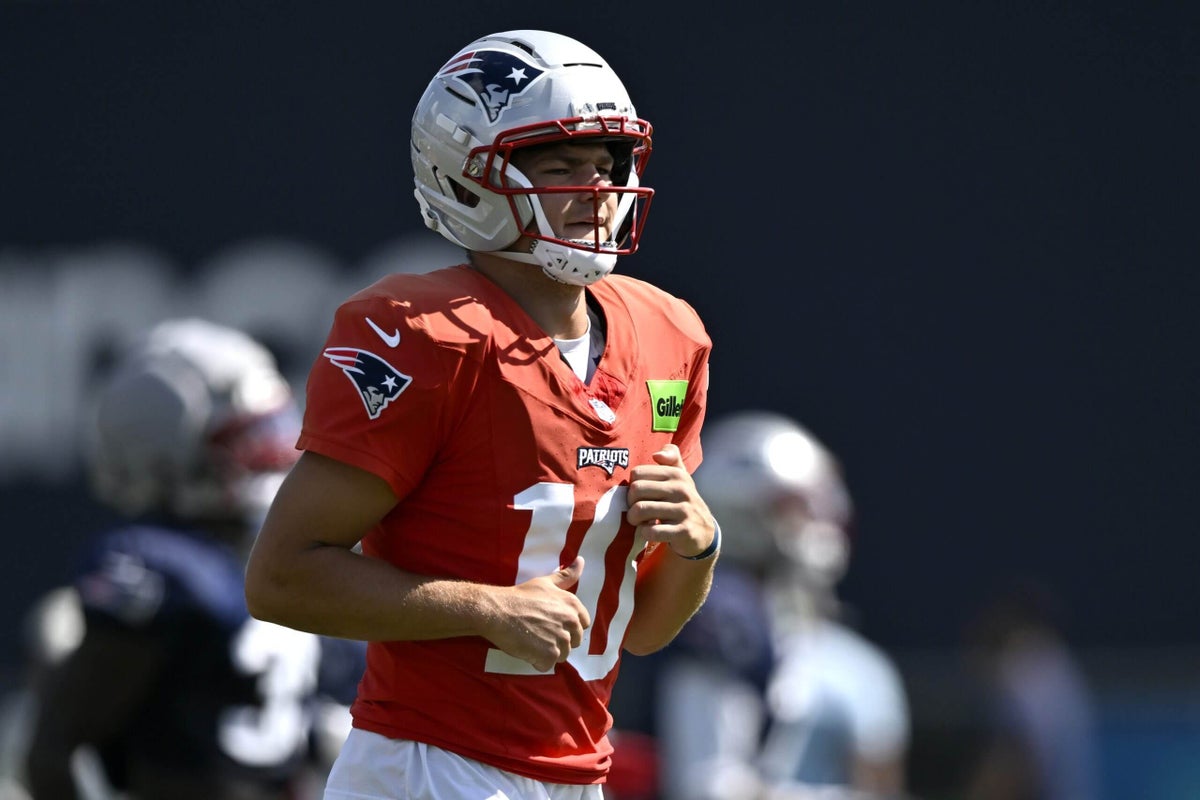
FOXBOROUGH, Mass. — This was the kind of play in the kind of moment that the New England Patriots offense has talked about all summer.

Coach Mike Vrabel hasn’t been shy about discussing the main area in which he wants the offense to improve. Drake Maye and his unit were mostly incredible last year, but that came despite struggles in the red zone. The Pats offense ranked 17th in the NFL in the percentage of its red zone drives that led to touchdowns (57 percent) and 24th in the percent that led to points of any kind (84 percent).

Now, the thinking is this: If New England can replicate the rest of its offensive numbers from 2025 while improving in the red zone, this group could be the best in the NFL. So the Patriots have spent more time than usual practicing inside the 20. They’ve dedicated entire practices to repping plays from there.

After some early success in their second joint practice with the Philadelphia Eagles, it seemed like it might be mission accomplished for the Patriots offense. That’s when, from the 5-yard line, Drake Maye locked in on A.J. Brown on a simple out route headed to the near pylon. Brown was well covered, Maye threw it late and Eagles cornerback Riq Woolen jumped the route and nabbed an interception that would’ve been a pick six during a game.

What the Patriots’ joint practice with the Eagles revealed

Chad Graff

So much of the Patriots’ two practices against the Eagles yielded positives. Brown is still a weapon. The defense produced turnovers in bunches and dominated an undermanned Eagles passing attack. The pass rush even held up better than expected.

But the only concerns for New England were that the two areas in which the team really wanted to improve offensively don’t look dramatically different. There were mishaps in the red zone. And, though it’s tougher to judge this phase of the game when tackling is not allowed, the line struggled to open holes in the running game. The Pats want to get better at running the ball to help set up more success through the air.

After clearly being the better team on Wednesday, Thursday’s session was more of a draw. There were enough Patriots struggles to draw even with an Eagles passing attack that is clearly still trying to sort itself out.

“I feel like we had some good periods that we were attacking them and had some good plays,” Maye said. “Then we had some periods where we’ve got to continue the competitive stamina. That’s the thing about this game. It can’t just be one play here, one play there. You’ve got to string some plays together in a row, and I felt like we did that more yesterday than we did today.

“I know it’s tough down there in the red zone, a lot of bodies in a short amount of space,” Maye continued, “but I feel like we could have done more in the red zone, and I think that is something for us to learn. It’s one of our focuses this year to be better in the red zone, so we’ve got some work to do.”

The issues weren’t with any one position, but it’s worth noting that the offensive line struggled with the Eagles’ front seven more on Thursday than on Wednesday.

There weren’t consistent holes for the team’s running backs. Maye faced a bit more pressure. With less room to operate in the red zone, it led to fewer positive plays.

A year ago, New England’s run-game statistics looked mostly fine because there were enough home runs from TreVeyon Henderson to offset their struggles. But this season, they want to be a more consistent running team that doesn’t go backward as much. Last season, the Patriots ranked 28th in the number of rushing plays that went for 0 or negative yards, a sign of how often they were digging a hole for Maye and the passing offense. That’s largely on the offensive line.

“I think they stood in there and tried to take it on the chin,” Maye said of the O-line’s play on Thursday. “I think the best thing about those guys up front is they never really get the love that they deserve, and I think they really deserved it yesterday. And I think there are some things today, including myself getting the ball out and them standing more firm up front, that we can continue to challenge them. Those guys have a tough job. It’s two consecutive days of getting a good front that has got some good players up there that have made a lot of plays in this league.”

In the big picture, the Patriots offense looks like it’s trending toward being one of the best in the league. When it has room to operate, the passing game is dominant, and Brown has looked great. There’s hope the running game will improve, especially since it can be difficult to fully evaluate in these practices. All of that was on display in this pair of joint practices.

But if this offense has an Achilles heel, it might be in the red zone, where things don’t look a whole lot better than a year ago.

>

Continue Reading

Sports

West Brom striker retrospectively banned for ‘deceiving’ officials in English football first

Published

on

Aune Heggebo, the West Bromwich Albion forward, has been banned for two matches after the Football Association found he had “successfully deceived” a match official in their 2-1 win away to Norwich City in the Championship.

Heggebo, 25, controversially opened the scoring at Carrow Road last Saturday, deflecting a left-wing cross into the net with his outstretched arm.

The FA charged Heggebo on Tuesday with a breach of Rule E3.1 and despite West Brom launching an appeal, a regulatory commission ruled on Thursday that the player must serve a two-game suspension due to him “handling the ball in a direct and successful attempt to score a goal.”

Retrospective disciplinary action has previously been taken against players guilty of simulation but West Brom, who repeated their defence of Heggebo in a statement on Thursday night, are of the belief that this charge is the first of its kind in English football following a rule change two years ago.

West Brom argue that Heggebo was left with “0.1 of a second” to react after the ball had deflected off the hand of Norwich keeper Vladan Kovacevic.  “Given the accidental nature of the handball, the club argued it could not be reasonably viewed as a deliberate act of deception,” a club statement read.

The Championship club also said they would write to the FA requesting further details of the ruling.

Heggebo, a Norway international who signed from Brann last year, will now miss Saturday’s Championship game against Burnley and the EFL Cup tie against Newcastle United on August 26.

The incident reopened the debate over the use of Video Assistant Referees (VAR) in the Championship, with EFL clubs blocking its introduction to date.

>

Continue Reading

Sports

MLS wants every game to matter. Its new expanded playoff format edges it closer to reality

Published

on

During his introductory news conference, MLS commissioner Larry Berg was asked about the potential of promotion and relegation.

While Berg said it wasn’t on the table, the league’s incoming leader insisted they were exploring ways to replicate pro-rel’s competitive jeopardy.

“The great thing about promotion and relegation for fans is the jeopardy is quite severe,” Berg said. “But I think there are other ways to create jeopardy during the regular season, to get into the playoffs (and) during the playoffs, to get to the next round. In the World Cup, we all enjoy knockout games after the group stage. I call those ‘games of consequence’ or ‘games of jeopardy.’ And I think that’s what we’re more focused on than specifically relegation.”

Berg is right. MLS faces the very real problem of a regular season in which games feel like they don’t matter, while its playoff games are competitive and entertaining. The task Berg and owners face is changing the equation to create more games where the stakes and consequences feel present on the day, not in retrospect.

Kristoffer Velde and his Portland Timbers teammates celebrate in front of supporters. (Soobum Im/Getty Images)

MLS has yet to vote on its new postseason structure, but as The Athletic reported in November 2025, it is in the final stages of approving a structure loosely equivalent to Australian Rules Football — “double chance” games for higher-seeded teams and more single-elimination games.

The Athletic can confirm that MLS is finalizing a format that will expand its postseason from 16 to 20 teams — which would seem to run counter to the idea of introducing more games of jeopardy during the regular season. The Guardian first reported details of the expanded format. The hope, though, is that the structure and incentives within that larger postseason field will make regular season games matter more.

Maybe that works, but it will place an enormous onus on the league to sell the benefits of a tiered postseason. Additionally, it will require full buy-in from the fans to learn and acknowledge those advantages.

What’s difficult to stomach, though, is that while the league finally fixes one problem — simplifying rules to allow teams to build better rosters for the money they are spending and more transparency for the fans to follow along and engage with the product — it is building a behemoth of a competition structure that could bog down those same avenues for engagement. (While also continuing to pause league play for Leagues Cup, the MLS-Liga MX commercial production.)

Take a deep breath, because this is when this column gets more complicated by explaining what MLS is doing to fix the very real problem of not enough games of consequence.

First, the regular season will have both a divisional and single-table format. Winners of the regional divisions will automatically qualify as a top-12 seed. The playoff seeding is otherwise determined by the single-table competition.

The new playoff structure — which, again, has not yet been formally approved — would essentially have an upper and lower bracket. The top eight teams in the single-table regular season will advance to the upper bracket, with the top four seeds holding home-field advantage. Those eight teams will play, and the winners automatically advance to the quarterfinals. The losers, however, are not eliminated. As a top-eight seed, they earn a “double chance.”

Simultaneously, a lower bracket will be playing out. Teams 13 through 20 will play a single-elimination play-in game. The winners of those four games will then be re-seeded and advance to face the 9-12 seeds.

The winners of those four games will then advance to face the losers of the upper bracket games — the beneficiaries of that “double chance” in the playoffs. The winners of those games will then advance to the quarterfinals.

From there, it’s single-elimination until an MLS Cup champion is crowned.

Here’s the thing: Maybe the league can actually sell this so that fans see value in August and September games that they don’t see now.

In a way, you can think of it like this: The top eight teams are Champions League teams. The next four are Europa League qualifiers. The final eight are Conference League. There are real, tangible benefits to finishing in the top four, top eight, top 12, top 16 and top 20. Games are re-seeded to ensure that finishing higher in the table continues to benefit teams via home-field advantage. In a single-table format across a continental league, travel starts to factor in and home-field can make a big difference.

That, however, is just a hope right now. Because if you go to an MLS regular season game today and your team loses, it doesn’t feel like it matters. Will this really change that? Will it feel in the moment like a game of consequence? Or will people point to it in the final months to show how much it mattered in hindsight? That’s an important distinction.

The Vancouver Whitecaps celebrate after beating San Diego FC to win the 2025 MLS Cup Western Conference. (Orlando Ramirez/Getty Images)

And it’s not an easy-to-follow format. That means MLS, which handles its own media production as part of the Apple TV deal, must invest in storytelling.

It is going to have to give real time and space for on-air talent to emphasize how important it is to finish fourth instead of sixth. Or eighth versus ninth. Or 12th versus 13th. It’s going to have to commit to that on its own website, too, where it eliminated a popular insider podcast, “ExtraTime Radio,” and jettisoned  Matt Doyle, a popular columnist. Both offered expert opinion meant to cater to exactly that type of audience with nuance.

It’s also going to have to hope that the media covering the league, both locally and nationally, can communicate these stakes properly.

All the while, it’s going to ask its fans — new and old — to pause in the midst of this all-important competition to watch and buy-in to a Leagues Cup competition that was created out of thin air four years ago. The top three teams from that manufactured competition will win the same “ultimate prize” (at least as understood by all fans of global soccer) as the top finishers in the revamped MLS format: a spot in the Concacaf Champions Cup.

Why?

In the name of engaging Liga MX fans, who genuinely turn up to watch their teams wherever they play. While the hope is that those fans will suddenly convert to MLS, the real value for MLS lies in packaging those games as part of the media deal to create a more valuable property. (I continue to wonder why Liga MX sees MLS as a necessary partner in its American ventures. It’s more than capable of succeeding here without MLS.)

The hope is that MLS will be able to keep fans engaged across all of those layers of competition. That they’ll keep all the different tables — the divisional standings, the single-table standings, the multi-faceted postseason and the Leagues Cup standings — straight. And that the regular season will suddenly feel more consequential as teams chase those tiered benefits.

More importantly, the hope is that all of these formats won’t be a barrier to entry for new fans.

“The good news is I do think the things we’re thinking about certainly will move our league forward,” Berg said. “Make it entertaining, make it interesting.”

It’s a big bet, and one the league needs to pay off as it chases audiences with more access to soccer than ever before.

>

Continue Reading

Sports

How to watch Sun vs. Aces: TV channel and streaming options for August 20

Published

on

The Connecticut Sun (9-25) will try to break a five-game road losing streak when they visit the Las Vegas Aces (24-13) on Thursday, August 20, 2026 at Michelob ULTRA Arena. The game airs at 10 p.m. ET on NBCS-BOS and The Spot-Vegas 34.

How to watch Connecticut Sun vs. Las Vegas Aces

Connecticut vs. Las Vegas odds

  • Spread: Las Vegas -13.5 (-120), Connecticut +13.5 (+100)
  • Favorite Moneyline: Las Vegas -1250
  • Underdog Moneyline: Connecticut +750
  • Total: 167.5
  • Total Over Odds: -110
  • Total Under Odds: -110

Injury reports

Aces

Dana Evans: Out (Leg),

Janiah Barker: Out For Season (Leg)

Sun

Brittney Griner: Questionable (Knee),

Aaliyah Edwards: Questionable (Ankle)

Stats to know

  • The Aces score only 3.4 more points per game (90.3) than the Sun give up (86.9).
  • Connecticut’s 79.4 points per game are 8.0 fewer points than the 87.4 Las Vegas allows to opponents.
  • A’ja Wilson posts 26.1 points, 3.1 assists and 9.7 rebounds per contest.
  • Olivia Nelson-Ododa posts 10.2 points, 1.7 assists and 6.3 boards per contest.

This watch guide was created using technology provided by Data Skrive.

Betting/odds, ticketing and streaming links in this article are provided by partners of The Athletic. Restrictions may apply. The Athletic maintains full editorial independence. Partners have no control over or input into the reporting or editing process and do not review stories before publication.

Photo: Julio Aguilar, Ethan Miller, Steph Chambers / Getty Images

Connections: Sports Edition Logo

Connections: Sports Edition Logo

Connections: Sports Edition

Spot the pattern. Connect the terms

Find the hidden link between sports terms

>

Continue Reading

Trending

Copyright © 2017 Zox News Theme. Theme by MVP Themes, powered by WordPress.