
Sports
Is Hearts’ McPake poised to gatecrash Pocognoli’s Scotland squad?

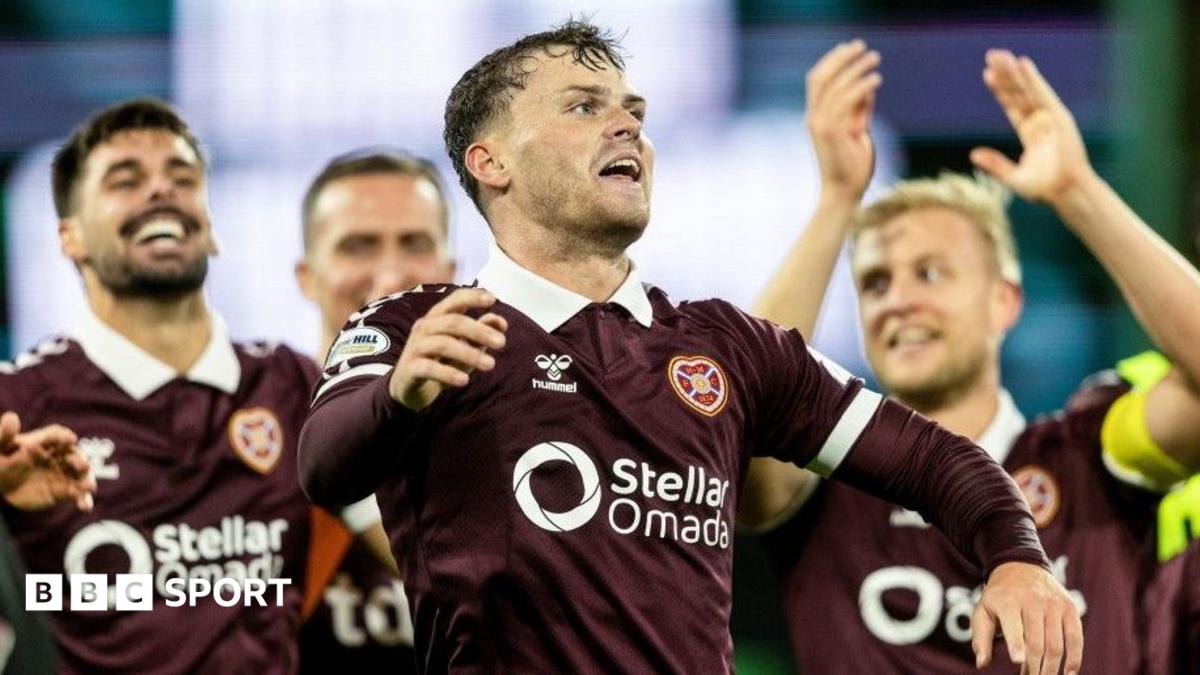
The talk of the toon are the boys in maroon, but the chat in all corners of the country is about McPake. He really is the man of the moment.
In eight games, he has registered two goals and four assists for an increasingly easy-on-the-eye Hearts side, who are emerging as contenders for the campaign’s great entertainers.
In the first 30 minutes at the home of their city rivals, they were magnificent. McPake – along with fellow Scotland hopeful Calvin Miller – was unplayable, hugging the touchline and leaving home full-back Felix Passlack for dust.
He destroyed the former Borussia Dortmund defender before teeing up James Wilson’s opener, with former Hearts striker Ryan Stevenson explaining that was the perfect example of how much of a handful he is.
“It is so hard for defenders when wingers play on the opposite side,” Stevenson said on Sportsound. “They always want to come on the inside, but he is happy to go on the outside and feint and go on his left side.
“One of his biggest attributes is you don’t know which way he will go.”
That was evident again when McPake took a stroll for his superb solo goal, one he was desperate for in his first derby.
“I thought we started the game really, really well,” McPake told BBC Sport Scotland. “Obviously, I got the assist in the first half, but I really, really wanted the goal.”
>

It was one year ago this Friday that Daniel Levy walked into a meeting in London and was told that his long tenure as Tottenham Hotspur chairman was over.
It remains the single most significant event in modern Tottenham Hotspur history, the sudden ending of a 24-year era of personal rule at the club.
For the last year, that September day has cast a long shadow over everything that has happened at Spurs. Or perhaps it is better seen in the negative, not as a presence but as an absence, a space which the Lewis family and club hierarchy have been trying to fill. The analogy of choice inside the club over has been that of a plane which needed to be rebuilt last season while also kept in the air.
Have Spurs had a good or a bad window?
Jay Harris and Rachael Tinde
However you want to think of it, that decision to remove Levy is still the frame through which people look at Spurs.
At the time, it felt almost impossible to judge whether or not it was the right call. The rationale given when Levy was dismissed was that this was ultimately to do with the performance of the football club on and off the pitch, and if we accept that framing, then a judgement on whether it has worked cannot be taken overnight.

Levy in the short time between Spurs winning the Europa League and sacking Ange Postecoglou (Ryan Pierse/Getty Images)
There is a possibly apocryphal story about a conversation between Chinese premier Zhou Enlai and U.S. secretary of state Henry Kissinger in the early 1970s. Zhou was asked — or believed he was asked — whether the French revolution had been a success. His reply? “Too soon to tell.”
It is tempting to follow Zhou, in that legendary moment of fence-sitting, of taking the longest possible view when assessing Levy’s dismissal.
Even in the chaos of last season, it was almost impossible to precisely ascribe responsibility for the mess Spurs found themselves in. There were certainly moments when it felt like the whole thing would fall apart: not least on that afternoon of April 25 when they were staring at the prospect of going four points behind West Ham United with just four games left.
Readers will know, of course, that Joao Palhinha bundled in a late winner at Wolves, Spurs reduced the gap to two and then clambered over West Ham in the final weeks of the season.
But while the danger was unambiguous, the apportionment of responsibility for it was not. Some would argue that the post-Levy hierarchy, still finding their feet after September, were to blame because they did not move fast enough in the January window, they kept Thomas Frank in post for too long, and then calamitously pivoted to Igor Tudor.
Others would argue that it was Levy who appointed Frank in the first place, and who left Spurs with a squad that was no longer fit for purpose in the Premier League. Some voices would praise the hierarchy for landing a top manager in Roberto De Zerbi who rescued Spurs. Others would blame them for not doing so until the end of March.

Roberto De Zerbi was the first of Tottenham’s last 14 permanent managers not hired by Levy (Saeed Khan/Getty Images
The point here is not to re-litigate these arguments in enough detail to reach a conclusion. These debates may not be settled in our lifetimes. The point is simply to show the impossibility of reaching a binary judgement on Levy’s dismissal based on the evidence of last season.
Perhaps it is only from this summer that a clearer picture emerges. Over the last three months, Tottenham have ripped to pieces their traditional transfer window playbook. They have spent bigger fees than ever before, buying three players this summer (Mateus Fernandes, Sandro Tonali and Savio) for more than their previous transfer record.
They have blown apart their old wage structure, committing salaries to new signings (like Tonali) and new contracts (for Pedro Porro and Micky van de Ven) far in excess of their old levels. And they have transformed their attitude to sales, no longer waiting for the perfect deal but pragmatically moving on players who wanted to go.
All of last season, Spurs fans were waiting to see whether the positive words of the new regime would be matched by actions. No one could reasonably say now that they are still waiting for action, still waiting for change, still waiting to see some money committed to the team. There was an injection of £100m at the start of the window and it would be a surprise if there was not more to come.
All of this represents the cleanest possible break with what came before. Of course, transfer policy is only part of the changes that have taken place behind the scenes over the last year. There have been plenty of senior hires, overhauls of performance and medical, and changes in the facilities at the training ground. And even this window, as dramatic as it has been, is only a first step.
But this is now a post-Levy team in a way that was not the case last year. We are moving away from the time when the struggles and failures of this side can simply be attributed to the former chairman. The ghost at the feast is fading from view, and so we are moving towards the point where the Tottenham hierarchy and ownership will be judged on their own decisions, their own record.

Vivienne and Charles Lewis attend Tottenham’s Champions League match against Villarreal last September (Catherine Ivill/Getty Images)
Tottenham have only won eight of their 37 league games in the year since the reset button was pressed. They average 0.94 points per game in that time. And so if the decisions of the Lewis family are to be truly vindicated, and judged a success, then it can only be with an improved record this season. This is the central fact of football: you see who wins on the pitch and work backwards from there.
Even after a slow start, there is still every reason to be bullish about this season. Tottenham begin with a stronger, deeper squad than they have had for years, with proven quality throughout the team. With a top manager in place, and a dressing room united behind him, the building blocks are all there for a good year. No one is expecting miracles either: just clear visible improvement. And then next season, they ought to be even better.
So much of the talk over the last year has been about ‘empowerment’, about getting the right people into the big jobs and backing them. De Zerbi has been unambiguously backed, maybe more than even he expected, and over this season, he must continue to deliver. He is not only defending his own reputation but also the reputation of his ultimate employers.
If De Zerbi builds a good team and this season is a success, then the whole last year, starting with the events of last September, will be wholly justified in the eyes of the fans. People may even stop relitigating all this ancient history and simply look forward with optimism instead. But if Spurs struggle, if their spending does not work out, if the strategy does not land, then the questions about whether all of this was worth it will come flooding back.
>
Sports
Premier League predictions: Arsenal vs Chelsea, Everton vs Manchester United and the rest of GW3

The sound of the transfer window closing always brings a certain relief. Not just on behalf of my colleague David Ornstein, who hasn’t slept since early June, but because it brings the focus firmly back to what happens on the pitch.
In some ways, it feels like the Premier League season starts here. That is certainly the case for players such as Enzo Fernandez and Bradley Barcola, who made moves just before the transfer deadline, but it applies to several teams too.
Those first few weeks, with the window open, are so unsettling. So many teams began the season in a state of turmoil, with key players uncertain over their future and positions unfilled. Some remain in a state of flux after missing out on important targets — Everton perhaps the starkest example with Folarin Balogun — but at least they know how the land lies between now and January 1.
In theory, that should make it a little easier when it comes to predicting results. Players and teams should begin to settle into some kind of rhythm without transfer-based uncertainty hanging over them.
But in our prediction game, The Athletic readers have wasted no time picking up where they left off last season. Last week’s guest subscriber, Manchester United fan Matt from London, predicted six correct results out of 10 to send the readers to the top of the table. That included getting all five of Sunday’s results right.
There were five correct predictions from Wilfred, the seven-year-old boy who, again, has picked up where he left off, not least with an impressively persistent refusal to back his own team, Crystal Palace. The algorithm, Algo to its friends, put a calamitous opening day behind it to the season with a solid four out of 10.
As for The Athletic’s experts — and at this point I feel duty-bound to prefix that with “so-called” experts because I know it’s what you’re thinking — my colleague Andy Jones struggled to build on the platform built by Elias Burke in week one, bringing up the rear with three correct results out of 10.
To be fair to Andy, he was scuppered by a series of late goals: late winners for Hull City and Sunderland, late equalisers for Everton and Leeds United. I know the feeling, Andy. It happened to me all the time last season.
Our predictions game is slightly different this time around, though. Each week, one of our “so-called experts”, on rotation, will preview and predict the 10 Premier League games. By popular request, we will provide a predicted scoreline too.
Our straight result predictions (home win, away win, draw) will go up against those of Wilfred, the algorithm and a weekly guest subscriber — and yours, if you make sure you visit our Pick ’Ems hub so you can pitch your predictions against ours.
It still rankles that the subscribers ended up top of the table last year and, unnervingly, this season has so far followed the same pattern.
This week sees the baton passed to Jay, a 40-year-old Arsenal supporter from Bristol. Good luck, Jay.
Subscriber’s match of the week
Arsenal vs Chelsea
Oliver says: I’ve been struggling to shake off a strange feeling that Chelsea will get something from this game. I know I should ignore it, reminding myself of everything I have said and written on The Athletic about the farcical way in which Chelsea have been run in recent years, and about how the tables have turned since they used to bully a callow Arsenal team in the late 2000s and early 2010s, but they have made more sensible moves this summer. And I keep getting a vision of Cole Palmer, Morgan Rogers and Joao Pedro combining on the counter-attack on Sunday.
But they haven’t beaten Arsenal since September 2021. That’s 11 games in all competitions. I owe it to my colleagues to shake off that strange feeling and play it safe.
HOME WIN
Score: 2-1
Jay says: “Chelsea have started the season well under Xabi Alonso, and seem to be clicking going forward, but with question marks over their defence. Arsenal looked good in their wins over Manchester City (Community Shield) and Coventry, and did what they needed against Villa. We all know how strong Arsenal’s defence is and I’m confident they can keep Chelsea out. Arsenal are the team to beat this season.”
HOME WIN
Our Expert’s other predictions
Ipswich Town vs Liverpool

Can Barcola ignite Liverpool’s attack? (Liverpool FC/Liverpool FC via Getty Images)
Oliver says: I really enjoyed Ipswich’s first-half performance at Manchester United last Sunday, even if they ended up losing 5-2, and they could certainly add to Liverpool’s teething problems under Andoni Iraola. Barcola should bring more spark and incisiveness to Liverpool’s attack, but some of last season’s shortcomings, notably on the right-hand side of the team and in midfield, haven’t been addressed. Unlikely as it sounds, I could see Liverpool drawing 2-2 for the third consecutive game.
DRAW
Score: 2-2
Newcastle vs Bournemouth
Oliver says: Eddie Howe did an excellent job at Newcastle, but not in this fixture. Under Howe, they played eight Premier League matches against his former club Bournemouth and didn’t win any. Indeed, it was a 2-1 Bournemouth win at St James’ Park last April that really heightened the feeling that things were coming to an end for Howe at Newcastle. It has been a highly encouraging start on Tyneside for Howe’s successor Matthias Jaissle, but Bournemouth might test them in ways that Liverpool and Tottenham, both of them half-cooked, did not. Another 2-2? Why not?
DRAW
Score: 2-2
Brentford vs Sunderland
Oliver says: Being beaten to European qualification by Sunderland on the final day of last season might prove a blessing in disguise for Brentford. For one thing, they have a lighter schedule this season. For another, they don’t have to worry about UEFA’s financial regulations, which are more stringent than the Premier League’s (although being such a well-run club, they would have little trouble complying in any case). Brentford’s ninth-placed finish last season was their highest since the 1930s. They could improve on it this time.
HOME WIN
Score: 1-0
Nottingham Forest vs Tottenham
Oliver says: This is not a fashionable opinion, but I quite fancy Liam Delap to prove a few people wrong at Nottingham Forest. Yes, the £50million transfer fee reflects a market that has gone mad, after his lost year at Chelsea, but he has many of the raw materials to develop into a very good centre forward and, in the right environment (which clearly wasn’t Stamford Bridge), he could thrive. It might take a while to settle into a rhythm, but the same can evidently be said of Saturday’s opponents after a summer of upheaval at Tottenham.
DRAW
Score: 1-1
Manchester City vs Coventry

Haaland, as always, is in the mood for goals (Mike Hewitt/Getty Images)
Oliver says: After 25 years away, it has been a tough reintroduction to Premier League life for Coventry — beaten 3-0 at Arsenal and, more painfully, 1-0 at home to Hull City — and it doesn’t get any easier on Saturday. This is exactly the kind of game where, from a Fantasy Premier League perspective, I’m considering the Triple Captain chip for Erling Haaland. He’s in the mood for goals (when is he not?) and Coventry look vulnerable as they try to acclimatise to the top flight.
HOME WIN
Score: 4-0
Fulham vs Crystal Palace
Oliver says: I had a nagging concern for Fulham and Palace after a summer of change and, with both of them losing their first two games, it hasn’t gone away. They have both had one OK-ish performance as well as one concerning game but a third consecutive defeat would put Alvaro Arbeloa or Pierre Sage under genuine pressure. That’s partly why I’m predicting a draw. I’m not convinced either coach will go for broke if the scores are level late on.
DRAW
Score: 1-1
Brighton vs Leeds
Oliver says: It’s hard to know what to expect here. Brighton look so open, with thrills and spills at both ends. Leeds, their defence reinforced by the arrival of Tarik Muharemovic, look like a tough nut to crack. It just depends on who succeeds in turning this into a game played on their terms. I’ll say Brighton.
HOME WIN
Score: 2-1
Hull vs Aston Villa

Nobel Mendy celebrates scoring against Manchester United (George Wood/Getty Images)
Oliver says: Many of us have been amazed by Hull starting so well, winning their first two, but it has happened before. In 2008-09, their first-ever top-flight season, they took the Premier League by storm, winning six of their first nine games, and were third in the table in late October. They barely won again all season and ended up 17th, one point clear of the relegation zone, but survival — even after that flying start — was greeted as a resounding success, as it would be again.
AWAY WIN
Score: 1-2
Everton vs Manchester United
Oliver says: A lot of Manchester United supporters greeted the end of the summer transfer window with a sense of lost opportunity, but these things are relative. Look at Everton, who entered this summer (and indeed several summers before that) with a weakness at centre forward and who, remarkably, ended the transfer window even lighter in that department after selling Beto to Fiorentina and being spurned by Monaco’s Folarin Balogun on deadline day. And that’s after also selling Iliman Ndiaye to Manchester City. A tough few months lie ahead.
AWAY WIN
Score: 0-2
You’ve read about Oli Kay’s predictions for this week; now see what Elias Burke has picked as his Lock, Gamble and Too Close to Call matches.
The Athletic’s Gameweek 3 predictions
Elias Burke
>

After eight rounds of his first world title fight, against Croatia’s Filip Hrgovic last Saturday, Moses Itauma’s legs somehow carried his 241.7lb, 6ft 4in frame back to his corner.
The 21-year-old British heavyweight had the beating of his more experienced opponent – up on all three judges’ scorecards – but he was exhausted. He’d gone for the kill in round eight, unleashing a salvo of punches designed to result in a stoppage. But Hrgovic had soaked them all up and even sent a few back Itauma’s way.
As Itauma sat on his stool, his breathing was fast and heavy. It stayed that way throughout the 60-second break between rounds. As he got to his feet again, he grimaced.
Hrgovic saw his opportunity, and pounced at the start of the ninth round, marching forward and unleashing heavy shots. Itauma retaliated but his body was no longer his own. The punches were wild swings. The force of those that did land had more of an impact on him than his opponent – sending him staggering backwards into the ropes.

Referee Howard Foster intervenes in the Itauma-Hrgovic fight (Richard Pelham/Getty Images)
With 33 seconds of the round remaining, the referee stopped the fight, just as Itauma’s trainer Ben Davison threw in the white towel. Itauma’s bid to become the second-youngest heavyweight champion in history was over. He was carried out of the ring on a stretcher; his body finally succumbing to complete exhaustion.
The diagnosis from seasoned boxing observers was emphatic: Itauma had ‘gassed out’. But what exactly does that mean? What is it that turns the arms and legs of some of the strongest athletes in sport into jelly beyond their control?
“In the world of exercise physiology, you’ve got two components,” explains Dr Andrew Usher, exercise physiologist and British Boxing Board of Control-licensed coach. “You’ve got your heart and lungs, traditionally classed as your aerobic capacity, and the oxidative capacity of your muscles (the maximum rate at which your muscles can use oxygen to produce energy).
“A lot of coaches are training purely for the heart and lungs, thinking that that is going to get them through the fight. But your heart and lungs are only delivering the oxygen to the muscle. The muscle still needs to be able to extract the oxygen.”
If the muscle can’t do that sufficiently during a fight, the boxer will struggle to recover appropriately between rounds, says Usher, and they will start each one in an increasing deficit. “That means things like gross movement skills will start to deteriorate much quicker.”
Usher has conducted research into the physiological demands of boxing and the speed and pattern at which active muscles consume oxygen during physical activity (also called muscle oxygen kinetics). He says that although developing a fighter’s aerobic engine is important, they also need a better way for their muscular system to utilize the oxygen that’s being delivered.
“That has to be trained much more appropriately than it currently is” says Usher. “Especially in big guys like Itauma, who carry a lot of muscle mass – you’re going to have a lot more oxygen debt than a small super bantamweight.”
What sets Itauma apart from most heavyweights is his speed and explosiveness. But that explosiveness becomes expensive if it’s not managed correctly because with every explosion, the muscle is contracting and using oxygen, which it then has to replace.
“For Itauma, that debt is just stacking up and stacking up”, says Usher, “to the point where the muscle can’t extract enough oxygen and it’s not got enough calcium sensitivity so the muscle can’t contract. That’s why you see fighters having to swing the arm because they can’t contract the muscles to put the glenohumeral joint in the right position, to get the hip into the right place – it becomes handbags at dawn. The problem with that is that it burns even more energy.”
There are various ways of training the muscle’s ability to extract and use oxygen. Usher’s preferred method is supramaximal bike sprints as part of a sprint interval training programme. These are short, all-out bursts of exercise performed at an intensity higher than your maximal oxygen uptake (VO₂ max). It can also be done with boxers via targeted and individually tracked intervals on the punchbag.
The purpose of these sessions, says Usher, is to “generate more mitochondria (tiny structures in the cell that generate energy to power cellular functions) in the muscle, so you have a larger oxygen reserve and energy production. At the same time, you’re improving the muscle’s capacity to extract oxygen and, more importantly, to resynthesize it back into the muscle.”
In endurance sports, “bonking” or “hitting the wall” is a widely known danger that can occur when an athlete’s glycogen stores get depleted. Pace, power and various other functions can all suffer as a result.
At the end of the 2019 London Marathon elite runner Hayley Carruthers was approaching the finish line when her legs stopped working. With the help of race marshals, she crawled to an 18th-place finish. “I started counting my steps and my head was gone,” she told the BBC Radio 1 Newsbeat afterwards. “I think I lost sight in one eye. I just couldn’t lift my legs at all. It was petrifying.”

Hayley Carruthers crawls over the finish line at the 2019 London Marathon (Naomi Baker/Getty Images)
Usher says that what happened to Itauma — and there are other examples from heavyweight boxing history, such as Wladimir Klitschko in his first pro defeat against Ross Puritty, or David Haye versus Carl Thompson — is a form of bonking.
The impact of this on a fighter can be devastating, affecting cognitive capacity and increasing the risks of brain trauma. The 60-second window between rounds is a crucial period here, says Usher, and it’s one that’s tricky to manage.
“The bell goes and it could be four to six seconds before that athlete sits down, then you have to look at how they’re sitting – are they closing over the diaphragm or is the diaphragm open? Depending on where you put ice, it could be having an effect or it could be having no effect. And you’re trying to give instructions to that athlete.
“If they’re not recovering until the last three, four seconds of your 60 seconds, everything that’s happened before it is probably not going into their brain.
“Plus, when you’re breathing heavily, you are hyperventilating, so oxygen is not getting to the brain as quickly. That’s when the higher risk of brain trauma and subcutaneous hematomas comes in.”
The reasons why Itauma reached such a point of exhaustion after eight rounds have been debated endlessly since Saturday. For Usher, who was watching the drama play out from his home in Scotland, a couple of factors were clear: the tension with which Itauma entered the ring, and his inability to pace himself.
“There’s been a lot of pressure on that kid,” says Usher, referring to how the fight was framed as Itauma becoming the youngest heavyweight champion since Mike Tyson. “That pressure is going to increase adrenaline levels, so you’re going to start to burn glycogen much quicker than you would normally.”
Usher uses the word “wired” to describe Itauma as he entered the ring – a complete gear change for a fighter whose demeanour had previously been so calm. That can be used to a fighter’s advantage, but Itauma was simply burning through valuable energy stores before the fight had even started.
After the fight, Itauma’s manager Frank Warren acknowledged that Itauma’s adrenaline levels could have been “controlled a bit better pre-fight. Because I think he looked exhausted before he even got in there.”
Usher explains that “stress starts to create a kind of hormonal boiling pot, so you get epinephrine (also called adrenaline) and cortisol levels starting to increase and that all needs energy to facilitate it.
“If you come out wired and you’ve got seven or eight minutes before you actually box, by the time you go through a ring announcement and anthems, you’re already bleeding energy.”

Itauma is on the receiving end of a fearsome punch from Filip Hrgovic (Richard Pelham/Getty Images)
While other sports allow athletes to refuel glycogen stores once competition is under way, boxers are only allowed water, removing any opportunity to restock glycogen as it starts to deplete.
Itauma started fast, taking the centre of the ring and catching Hrgovic with fast, explosive shots to the head and body. By round three, there were signs that his pace was just starting to slow – a result of the dual impact boxing has on the body. “When you think of energy coming out of the body, you’ve got to think about it two ways,” says Usher. “One: heart and lung, and two: from the muscle.
“And the muscle is king because if the muscle can’t get oxygen from the blood supply, it can’t contract, it can’t perform. Effectively, that’s what happened to Itauma. His muscle reached the point where it couldn’t get enough oxygen back in, and at that time the only thing you can do is swing. That’s where efficiency comes in. That’s when it’s a case of: conserve your energy, hold the centre of the ring, just throw out a jab, keep them busy.”
At 21, Itauma has time to learn, train and understand what went wrong last weekend.
“You could give Moses a good engine, but if he drives it around like a Ferrari the way he did in that fight, it’s not going to last too long,” Usher adds. “That’s part of the learning strategy. But at 21, in a huge fight broadcast all over the world, how much goes to your head?”
>

Is Hearts’ McPake poised to gatecrash Pocognoli’s Scotland squad?

A year on, were Spurs right to sack Daniel Levy? It’s probably too early to say…

Premier League predictions: Arsenal vs Chelsea, Everton vs Manchester United and the rest of GW3
-

 movies3 months ago
Search For Canadian TV Actor Stewart McLean Now Homicide Investigation
-

 Fashion9 years ago
These ’90s fashion trends are making a comeback in 2017
-
Fashion9 years ago
According to Dior Couture, this taboo fashion accessory is back
-
Fashion9 years ago
Model Jocelyn Chew’s Instagram is the best vacation you’ve ever had
-
Fashion9 years ago
Emily Ratajkowski channels back-to-school style
-
Fashion9 years ago
9 Celebrities who have spoken out about being photoshopped
-

 Anime3 months ago
Rurouni Kenshin: Hokkaido Arc Manga Takes 1-Issue Break – News
-
Fashion9 years ago
Your comprehensive guide to this fall’s biggest trends