
‘Prince,’ courtesy of Alpha Violet


Andrew Garfield is now in his early 40s, but when he lollops around with his rubber limbs flapping every which way and a happy-go-lucky smile plastered across this face — he’s like a goofy Pied Piper trailed by enchanted tech bros — you might swear he’s a teenager. That makes it diabolically clever of Luca Guadagnino, a gay director never shy about exploring queerness, to cast OpenAI CEO Sam Altman as the “demon twink” archetype. Whatever sorcery the makeup or effects department has performed to put the glint of sociopathic madness in Garfield’s eyes, it works.
But what makes Artificial, a two-decade chronicle of machine learning and technological heedlessness, so riveting is the balance provided by Yura Borisov — more than making good on the promise of Anora — as Soviet-born AI trailblazer Ilya Sutskever. Borisov’s brainy, tender, deeply contemplative performance lends an anchoring humanity to a film that might otherwise have curdled into sourness and despair — though there’s plenty of reason for that. Guadagnino and screenwriter Simon Rich mold the material from dark humor through technocratic giddiness to sobering horror.
Artificial
The Bottom Line
A sneaky gut punch.
Venue: New York Film Festival (Main Slate)
Release date: Friday, Dec. 25
Cast: Andrew Garfield, Yura Borisov, Monica Barbaro, Mark Rylance, Cooper Hoffman, Ike Barinholtz, Jason Schwartzman, Chris O’Dowd
Director: Luca Guadagnino
Screenwriter: Simon Rich
Rated PG-13,
2 hours 20 minutes
Humorist and former SNL writer Rich’s clear-eyed, propulsive script starts in 2003 at the University of Toronto, when Ilya knocks on the door of Geoffrey Hinton (Mark Rylance at his soft-spoken, eccentric best), a professor whose pioneering work on artificial neural networks would earn him the “Godfather of AI” title — and a Nobel Prize in Physics in 2024.
At first Geoff shoos Ilya away, giving him a research paper to study and discuss the following week. But when the 17-year-old Russian returns what seems like moments later with a solution to significantly advance the theories outlined in the paper, the professor finds himself with a new research partner. Within 10 years, Geoff, Ilya and another graduate student, Alex Krizhevsky (Fedor Fedotov), have designed the first image-recognition neural network, which they sell to Google for $44 million, joining the company as part of the deal.
In that early stage of AI development, Professor Hinton is already wary of the potential risks, causing him to cut short a pitch from a Chinese bidder who gets excited about possible defense applications like automatic drones.
Meanwhile, in Silicon Valley, Altman and his buddy Elon Musk (a hilariously weird Ike Barinholtz, even his awkward gait announcing his self-importance) commiserate over losing out to Google, though neither of them will be squeezed out of the AI race so easily. Musk hires AI engineering wiz Mira Murati (Monica Barbaro) at Tesla, while Altman brings Ilya into the fold with a sizeable investment stake. Geoff warns Ilya to moderate his projections, emphasizing the need for safeguards, but the idealistic Russian is swept up in the vast potential of AI — to solve the climate crisis, cure cancer, even save humanity from itself.
The dizzying evolution of AI picks up speed when Ilya gets Sam worked up about next-level AGI, or Artificial General Intelligence, theoretical technology with human-level cognitive capabilities. Sam is naturally seductive as he sells his vision — which is really Ilya’s — on AGI controlled by scientists and not by government or moneymen. Yeah, right. “Don’t you see, we’re the only ones sitting in the future?” enthuses Sam at one point. “It’s exhilarating!”
In 2016, they launch OpenAI out of the San Francisco apartment of Greg Brockman (Cooper Hoffman), a software engineer who is perhaps the most obnoxious — and there’s stiff competition — of a bunch of tech bros constantly fist pumping and popping champagne and shouting triumphantly about every breakthrough. One of the first of those is when their AI program teaches itself to beat the machine in a notoriously difficult video game. (I swear, after repeat exposure to these dudes chanting “Feel the AGI,” I was ready to charge up a flamethrower.)
A reshuffle after they decline Musk’s offer to join Tesla lands Mira at OpenAI, where she wins over Ilya with talk of the benefits to medicine, science and communications, along with the fact that Radiohead’s “Paranoid Android” is her favorite song. Mira believes advancement in their field will come through human-AI interaction. But Sam believes it will come through partnering with Microsoft for funding, overruling Ilya’s ethical concerns with a faux sincerity that you start to believe even he thinks is genuine. “We’re doing this for the benefit of humanity!” he says.
As development accelerates, the neural network reveals the capacity to lie, which leaves Ilya disillusioned more than anything: “I thought we were doing this to make AI smarter and better. But what if it makes it just like us, only worse?” Ilya’s urging to slow down and observe the safety protocols merely result in Sam nudging him aside, along with Mira for a time.
Professor Hinton, who exited Google some years earlier over a philosophical divide, sums up what’s to come when he says, “The question isn’t ‘How can this go wrong?’ It’s ‘How could it not?’”
It’s around this point that Guadagnino begins slowly tightening the screws, almost imperceptibly shifting into a mode adjacent to psychological horror. This is one of the director’s most controlled films, as he works with the same sort of expediency and finesse employed by Altman to win over — and sometimes discredit — doubters. The ultimate effect is chilling.
Garfield plays Sam as a charming villain, capable of talking himself back into the leadership position even after he has been fired by the board for shady dealings. It’s easy to imagine the portrayal of Altman being a key reason Amazon MGM orphaned the film (until Neon snapped it up), given the fraternity among tech billionaires. The $50 billion deal Amazon signed with OpenAI was likely the deciding factor.
Audiences unaware that Altman is gay might pick up on subtle hints in Garfield’s performance, before Musk jokes about it during a dinner scene or a boyfriend is finally seen well into the film. The way he sweetens his voice and shoots the briefest of slutty glances at a hot blond waiter while ordering vodka shots is an amusing tell.
Sadly, we don’t get to see Altman allegedly meeting his future husband in Peter Thiel’s hot tub. But after his sexuality remains in the background for most of the movie, there’s a real eye-opener of a scene in which he returns to his swanky Napa compound, where his partner is clipping shrubs in the garden while various beautiful boys are draped around the pool and downstairs there’s a kind of high-tech bunker with amply stocked gun cabinets. The characterological contradictions in this scene alone speak volumes about who Sam Altman is.
Barbaro is strong as always, though — even if Mira speaks up frequently and seems unintimidated in the phallocentric environment — the actress could have been given more to do. Rylance is a joy to watch, even when indulging in some familiar tics; Barinholtz steals every scene he swaggers into; and an almost unrecognizable Jason Schwartzman has poignant moments as a man who fled the tech industry when he saw the writing on the wall and, judging by his unruly tangle of hair and straggly beard, would now appear to be homeless.
On the craft side, the movie never feels too slick; there’s an agreeable looseness to its pacing, even at its zippiest, and a crisp unfussiness to Malik Hassan Sayeed’s cinematography. Guadagnino has always been skilled in his choice of music (Sufjan Stevens’ alt-pop in Call Me by Your Name, Trent Reznor and Atticus Ross’ pounding EDM in Challengers). Artificial is no exception, with Blur frontman Damon Albarn’s energized electronic score and songs working in concert with Marco Costa’s fluid editing.
This ranks among Guadagnino’s best work, its dry humor lulling us into a relaxed state of enjoyment before the sword comes down on the scary reality we’re now facing. Even if AI developments are coming so thick and fast that no movie could possibly keep up, Guadagnino and screenwriter Rich have made a provocative feature that feels precision-targeted for this moment.
Speaking of swords, Sam actually carries one around his San Francisco apartment while schmoozing with reporters over his blamelessness in the OpenAI ouster. It’s not hard to imagine this guy thinking of himself as being on some kind of valiant crusade. His ego is in exact inverse proportion to Ilya’s, which is part of what makes Garfield and Borisov play so beautifully off each other. Sam maintains that “the future is inevitable,” now that they have opened Pandora’s box, but in the same breath spouts the ultimate in vapid tech-speak: “We’re all just NPCs in this cosmic video game.” If that’s the case, could someone please unplug it?
>

Prince is used to getting the royal treatment. But the award-winning show dog, an Afghan hound, becomes a driver for all sorts of crazy machinations in a cinematic and absurdist battle royal full of black humor that ensues in Uruguayan director and screenwriter Federico Borgia’s solo feature debut, which is simply entitled Prince.
Beyond the best-in-show dog, the movie stars his owner, her butler and their extended family. The setting: the fading seaside luxury of Punta del Este.
Prince, starring Roberto Suárez (The Saint), Maitina De Marco (27 Nights), Esteban Bigliardi (27 Nights) and more, gets its world premiere at the 70th edition of the BFI London Film Festival (LFF) on Thursday, Oct. 8. Alpha Violet is handling sales for the highly stylized film.
Since Prince becomes the main prize in a ruthless custody battle, the festival website describes the Uruguayan-Argentine co-production as a “kitsch comedy about avarice and love.” And class divides also play a key role.
“At the heart of the film is Jaime (Suárez), a former lover turned live-in butler to Isabel (De Marco), an affluent Argentine woman with whom he has shared two decades in an expansive coastal villa,” reads a synopsis. “Their peculiar domestic routine revolves around Isabel’s prize-winning Afghan Hound, Prince. When Isabel dies unexpectedly in her swimming pool, her will reveals an absurd condition: her entire luxury estate has been left to Prince, with Jaime appointed as his guardian. Isabel’s human relatives can only claim the property once the dog dies.”
So when Isabel’s estranged son and granddaughter move in, intent on finding a way to oust the dog, Jaime tries to protect Prince while being forced to confront Diego, his own estranged son, and a past he has long avoided. The resulting tension turns the villa into a claustrophobic pressure cooker.
Borgia, who previously co-directed Clever (2015) and The Champion of the World (2019) with Guillermo Madeiro, talked to THR about how Prince draws on his own experience living in Punta del Este and a childhood fascination with show dogs, as well as the cinematic atmosphere he crafted.
Watch a trailer for Prince right here.
The inspiration for Prince came from the filmmaker’s life. “It was very much influenced because I moved from Montevideo to Punta del Este. It’s a touristic coast town where social classes mix up – there’s this working class and this class that pays for services,” Borgia tells THR. “There is this mix of glamor and decadence that started surrounding me, and I started a game of observation. I started looking at people in different places and writing down things I saw and then started an imaginative game of questions about what was behind what I was seeing.”
The show dog seed was planted at an earlier age, though, he recalls. “When I was a kid, I had this nice dog that was given to me when I was 10,” Borgia explains. “And I remember going, with my mother, to this dog groomer [to trim the dog’s hair]. He didn’t participate in dog shows, but at this grooming place, I saw these pictures of contests with these guys in suits posing. They looked like lawyers, but with a dog.”
The creative started to mesh up these real-life elements with “this story of this inheritance thing,” Borgia recalls.
The character he conceived as a protagonist is in an unusual, some may even say uncomfortable, position. “He’s a worker who met this lady in some kind of service relationship, and then he became her lover, and that started this undefined point between being a lover, partner, butler. It’s really undefined as you start discovering, and then all the other relationships and bonds and all the problems that come with them and family come into the film.”
Finding the cast was a mix of asking people he had long admired and finding faces he wasn’t as familiar with, Borgia tells THR.
‘Prince,’ courtesy of Alpha Violet
“Roberto Suárez, who plays Jaime, is someone I have wanted to work with for a long time, and he accepted really fast,” the filmmaker shares. “I really admire him, not only as an actor, but also as a great theater creator. So I really wanted to work with him throughout the [creative] process. He was reading different versions of the script and throwing out ideas, and they were always brilliant ideas. He’s also a great person.”
To find cast in Argentina, Borgia started exploring opportunities through castings, asking people and watching movies. “So, there were different parts and approaches to the casting process, and I am very happy with the cast I found,” he concludes.
Did the dog actor ever cause any challenges on set? “The dog was always perfect,” shares Borgia. “We never had a problem with the dog.” Except for that one time when things got hairy. “Just one time, he fell into the pool, and we had to dry his hair for two or three hours,” he says.
And no, the director didn’t choose an Afghan hound for its reputation for trainability but its aesthetics, its look. “I actually started investigating on the internet how to train a dog,” Borgia says. “And the Afghan hound was really low on the list of trainable dogs, well below the Border Collie, the German Shepherd and others.”
But the creative team met a man who lives with eight Afghan hounds. “There’s another film in that,” Borgia tells THR with a smile. “But he told us that Afghans are difficult, but he has one dog who is really young and different. He said he is like a Labrador in the body of an Afghan. He was really social and really calm.”
‘Prince,’ courtesy of Alpha Violet
For Borgia, the story of Prince may unfold in a specific setting, but he expects audiences in various parts of the world will recognize key themes and issues that the movie explores. “The story itself is universal, but the most important thing for me was the characters and their relationship, and the tone of the film. I felt I could make it different. The original thing is how an author can make the premise of a film different.”
What’s next for Borgia? “I want to talk about it, but I have no clue,” he tells THR. “Every time I finish a film, I really don’t know if I’m going to make another one. Or at least that’s how I feel. But I know I will because it’s like an addiction. You know you’re going to fall into it again.”
>

EXCLUSIVE: Smart-TV maker Vizio, which was acquired by Walmart in 2024, is bringing to market an original holiday movie and more programming from premium suppliers and creators in a major content expansion.
The initiative, unveiled Wednesday during Advertising Week in New York, is designed to re-introduce brands to Vizio, which is now the top smart TV operating system thanks to Walmart‘s massive retail scale.
The film, Jingle Bells Wedding Bells, starring Rachel Bilson and Scott Foley and produced by ITV America Nashville and Happy Accidents, will premiere exclusively on Vizio’s WatchFree+ platform this holiday season. Geico is presenting sponsor of the premiere.
“As viewing habits continue to evolve, partnerships like this give us new ways to connect with audiences,” Arianna Orpello, Geico’s chief marketing officer, said in a statement.
WatchFree+, a free, ad-supported live and on-demand streaming destination, has more than 45,000 film and TV titles along with more than 400 live and local channels. The platform said Wednesday it is deepening its ties with MGM, NBCUniversal, Disney, A&E and A24, adding programming titles this fall like The Good Doctor, Chicago Fire, Law & Order, Property Brothers, Little House on the Prairie.
Another key component of the expansion is creator content. Also bound for the platform are more than 40 creator-led FAST channels spanning comedy, food, gaming, family, lifestyle, sports and travel. Creators fronting the channels include MrBeast, Celine Dept, Hot Ones, The Royalty Family, Ben Azelart, Ryan Trahan, Nick DiGiovanni, Preston Playz, Rebecca Zamolo, Sam and Colby, and Uncle Roger.
A creator-led series, Holiday Chocolate Workshop, will center on chocolatier Amaury Guichon. The series follows Guichon and his team of expert chocolatiers as they craft “ambitious, larger-than-life holiday masterpieces for a season-ending reveal,” according to the official logline.
Originals and channels with creators enable WatchFree+ to retain more viewers before they fall into YouTube, which doesn’t provide the same level of advertising returns for stakeholders.
Since it ceased being a public company and becoming part of Walmart, Vizio has not regularly released data on viewership. Along with the programming news, the company and its corporate parent said the Vizio OS now reaches 32 million yearly active devices, up 20% year-over-year. Viewing hours of WatchFree+ is up 58% year-over-year, according to internal data.
>
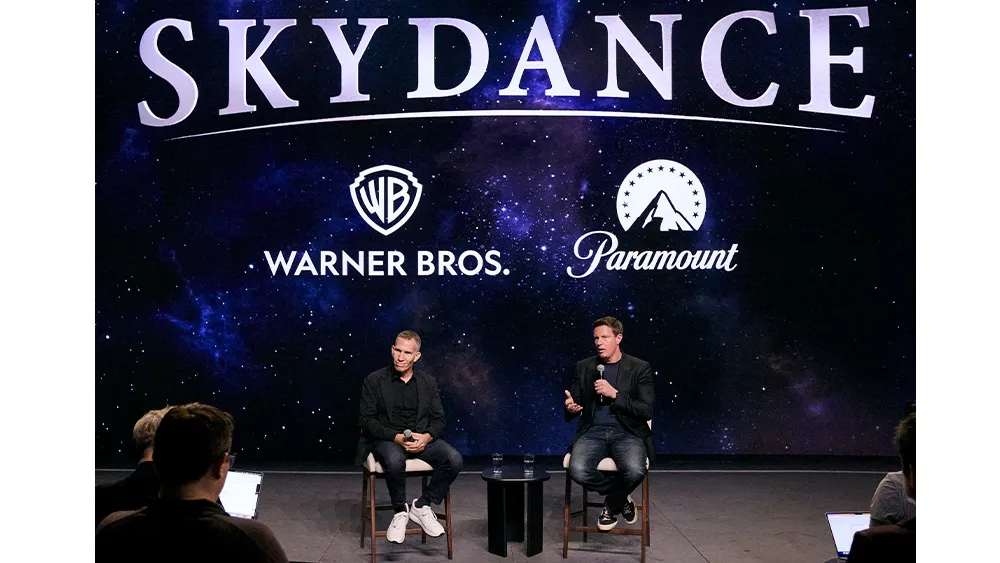
David Ellison and Ynon Kreiz spent a big chunk of their first day as CEO and co-CEO of Skydance, respectively, being interviewed.
First by CNN’s Anderson Cooper at the company town hall on the Warner Bros. lot in the morning and then by reporters in the afternoon at a press conference held on the other studio lot owned by the new Skydance, Paramount.
Ellison and Kreiz, following the trend of co-CEOs dressing alike, met with press on Stage 3, a fitting setting for a company driven by technology, as Ellison always stresses. Its manager Craig Weiss described it as “the first of its kind virtual production stage, utilizing laser projection.”
That was a major upgrade from the August 2025 post-merger Paramount press conference on the lot, which took place in an empty room nearby. (In another change, two of the senior Paramount executives who took questions alongside Ellison back then, Jeff Shell and Cindy Holland, are no longer there.)
The Skydance team utilized the immersive projection equipment for a Day One sizzle reel promoting the Paramount and Warner Bros. titles that are coming together. Despite the event taking place on a TV stage, the video was very film-focused, largely ignoring television for the majority of it until a sequence of series highlights in the final seconds.
Ellison and Kreiz were asked to elaborate on the language from the press release announcing Kreiz’s appointment as co-CEO, which stipulated that all business units report to both of them, and explain how they divvy up CEO duties.
“There will be natural delineation between us in terms of our respective experience and concentration, which we believe are highly complementary,” Kreiz said. “Where David will focus on creative, technology, long-term strategy, including especially as it relates to the creative part of the business, I will focus more on the operations and the day-to-day management of the business, including integration, particularly the first phase.”
The duo, who will take their message to investors next, were asked to explain how Skydance, which has $79B in debt, can commit to $30B – $40B on producing new content.
“We have a business plan,” Kreiz said. “There’s a complete financial envelope to how we’re going to run the business, and content is is a spend, but you can also see it as an investment because it’s also going to drive growth. And as a whole, yes, we have debt, but we expect to reduce the leverage.”
Ellison pointed to Paramount’s balance sheet for the last year.
“We’ve over delivered on synergies, $2.7 billion basically by the end of this year, from an initial announcement of $2 billion, we did that while doubling the film slate at Paramount, from eight films to 15, greenlighting four new and returning series, and growing even significantly year over year. So you actually can do both things simultaneously.”
Other tough questions Ellison faced included his family’s cozy relationship with President Donald Trump (“I think it’s important to talk to everybody on on both sides of the aisle” & “We believe in complete editorial independence”) and how he plans to rehabilitate his image and regain the trust of those in Hollywood who opposed the merger (“I do genuinely believe this is the the best outcome for the industry. I think we will deliver for the creative community. We will deliver for our shareholders. And the best I can say to our detractors is, give us time, and we’ll prove it.”).
There weren’t specifics on a number of topics — from the timeframe to merge the company’s streaming platforms HBO Max and Paramount+, to a possible consolidation of the three TV studios down the road, to the plan for Skydance’s 30+ cable networks as well as how film and TV operations will be split between the Warner Bros. and Paramount lots, how the Paramount and Warner Bros. studios will get to the 30 movies a year goal and the status of Barbie 2.
As Ellison and Kreiz noted repeatedly, it was Day One after all.
>


Search For Canadian TV Actor Stewart McLean Now Homicide Investigation


These ’90s fashion trends are making a comeback in 2017
According to Dior Couture, this taboo fashion accessory is back
Model Jocelyn Chew’s Instagram is the best vacation you’ve ever had
Emily Ratajkowski channels back-to-school style
9 Celebrities who have spoken out about being photoshopped


Rurouni Kenshin: Hokkaido Arc Manga Takes 1-Issue Break – News


HIDIVE to Stream English Dubs for The World Is Dancing, The Forsaken Saintess and Her Foodie Roadtrip in Another World, The Dangers in My Heart: The Movie Anime – News