
‘Prince,’ courtesy of Alpha Violet


It’s been an encouraging year for South Korea’s Busan International Film Festival (BIFF), which has received recognition from the International Federation of Film Producers Associations (FIAPF) and also been designated a pathway to an Oscars’ nomination.
FIAPF announced in March that BIFF has been added to its list of “A-list festivals” joining the ranks of festivals such as Berlin, Venice and Cannes. A few months later, the Academy of Motion Pictures Arts and Sciences (AMPAS) announced that the top prize winners of six international festivals, including Busan, will automatically qualify for submission to the Best International Feature Film category of the Oscars. This places BIFF in a select gathering alongside Cannes, Berlin, Venice, Sundance and Toronto.
Jung Hanseok, who took up the post of BIFF festival director last year, says these developments are already “having a positive effect on both the number and quality of submissions to the festival. They give filmmakers a meaningful additional incentive to submit their work to BIFF.”
BIFF only introduced a fully-fledged competition section last year, handing out awards in six categories, including Best Film, which has become the pathway to the Oscars, along with Best Director, Special Jury Award, Best Actor, Best Actress and an Artistic Contribution Award.
Last year, Gloaming In Luomu, from Korean-Chinese filmmaker Zhang Lu, was awarded Best Film, with Taiwan’s Shu Qi taking Best Director for Girl. The festival also has a Vision Awards ceremony – recognising films across both the ‘Vision – Korea’ and ‘Vision – Asia’ sections – in which a wide range of independent juries hand out prizes.
“Compared with the competition sections of longer-established festivals, BIFF’s Competition is still very new,” Jung cautions. “So one of our early challenges was to communicate its value and build confidence in the section as quickly as possible. I think the FIAPF recognition and the new Academy pathway have helped accelerate that process.”
Jung cites China as one territory where filmmakers’ interest in BIFF has risen, due to the fact that filmmakers invited to A-list festivals are more likely to receive attention when applying for public support.
“We’ve seen similar changes in Japan, where key industry figures have been noticeably more proactive and receptive towards BIFF’s Competition than they were last year,” he says. “Some filmmakers may now be able to envision a longer-term path that begins with winning the Busan Award for Best Film and continues into an Oscar campaign.”
He adds that Korean filmmakers are also waking up to this possibility. Korea’s Oscars committee has already submitted Lee Chang-dong’s Possible Love as its official entry, which is currently receiving an Oscars-qualifying run in Korean theatres before streaming on Netflix. In theory, a Best Film Award win from Busan could make a second Korean film eligible.
However, BIFF’s Competition section embraces the whole of Asia and this year’s line-up of 14 titles also spans films from China, Taiwan, Japan, Uzbekistan, Indonesia and Iran (see here for the full line-up), so the field is wide open. Chinese director Zhang Yimou is heading the seven person jury that will decide on the awards.
Jung says he didn’t really appreciate the impact of the new Competition section last year, until he was planning this year’s festival: “We’ve sensed a much more positive and receptive atmosphere around the Competition section than we did in its first year. For that reason, our main priority this year has been the stability and consolidation of the Competition,” he says.
“In the longer term, BIFF intends to remain grounded in an Asian perspective and in values that emerge from within Asia when operating the section. At the same time, we want to continue asking ourselves what exactly ‘Asian’ should mean in that context.”
When asked about the competition selection criteria, Jung says it’s “quite simply, the quality of each individual film”. He adds that the 14 selected titles, when look at together, “should form a compelling cinematic landscape that reveals something of contemporary Asian cinema as it exists today. One notable difference this year is that the quality is more consistent across the Competition, while the overall standard of the line-up has also risen.”
The festival opens tonight (Tuesday, October 6) with a screening of Kim Jong-kwan’s The Table: Day And Night, and with Kim Minha (Pachinko) hosting the opening ceremony. Other talent attending the festival includes Michelle Yeoh, who is being honored as Asian Filmmaker of the Year; Hong Kong filmmaker Ann Hui, who is receiving the Camellia Award; Maggie Gyllenhaal, presenting her short film Flesh Impact in Special Screenings; and French actress Isabelle Huppert, who will meet local audiences with her latest film, All About Corinne.
The stacked talent list also includes Iranian filmmaker Majid Majidi, who has Midday Meal in competition and will be making his first visit to the festival; Japanese anime master Rintaro, who worked in the same era as the legendary manga artist Tezuka Osamu; and Alfonso Cuaron, in town for a special IMAX screening of Gravity and the Asian Premiere of Jonás Cuarón’s Campeón Gabacho.
In total, BIFF is screening 246 films – five more than last year and marking the festival’s largest lineup since 2019 – and is opening one day earlier than in previous years. Jung explains that BIFF has also increased the number of screenings from Thursday through Sunday, when attendance is at its highest. “These were all practical improvements intended to give audiences greater convenience and more opportunities to see films,” he says. “The response so far has been very positive. Even before on-site ticket sales begin, online bookings alone suggest that this year’s total attendance could surpass last year.”
In addition to the Competition and Vision selections, the festival’s major sections include Gala Presentation, which is showing six titles including Hirokazu Kore-eda’s Look Back and Yeon Sang-ho’s Paradise Lost; and Icons, which this year is showing 16 titles including Ira Sachs’ The Man I Love, Ryusuke Hamaguchi’s All Of A Sudden, Pedro Almodovar’s Bitter Christmas, Christian Mungiu’s Fjord and Lav Diaz’s Let Us Through, Dear Ancestors.
On Screen is world premiering initial episodes from three highly anticipated series: Netflix’s The Blue Road and Dead-End Job and Disney’s The Remarried Empress. The Blue Road director Han Jun-hee will be on hand during Netflix’s Creative Asia day to present a masterclass entitled “Making Unexpected Stories Resonate”.
BIFF’s popular Open Cinema section, which offers free open-air screenings at its iconic Busan Cinema Center, is showing eight films including Look Back, Banjong Pisanthanakun’s Inherit, and Ervin Han and Raúl García’s Annecy award-winning animation The Violinist.
This year’s special programmes include ‘Those Beautiful Years, Ahn Sung-ki’, focusing on the late Korean actor, and a Japanese animation special: ‘Masterpieces of Madness, Exhilarating Prospects 12+1’. The annual ‘Carte Blanche’ programme invites prominent figures from the world of cinema to personally select films that have profound influenced them. This year’s guests include Korean filmmaker Kim Jee-woon, Chinese actress Fan Bingbing, and Korean cinematographer Hong Kyung-pyo.
The Flash Forward section for non-Asian first and second-time filmmakers is screening eight titles include Stephanie Ahn’s Bedford Park and Javier Calvo and Javier Ambrossi’s La Bola Negra. Other major sections include A Window On Asian Cinema, Korean Cinema Today, World Cinema, Wide Angle, focusing on short films and documentaries, and Midnight Passion.
While BIFF prides itself on showcasing cinema from across the Asian continent, it’s also the case that many public audience members, not to mention press and industry, are attending the festival to catch up with the latest Korean cinema. In this respect, BIFF is also riding a positive trend as local cinema began to revive at the beginning of this year, following a long period of declining box office and audience apathy that held back post-pandemic recovery.
Starting from the Lunar New Year holiday in February, Korea has enjoyed a string of domestic hits including historical drama The Kings Warden, Yeon Sang-ho’s Colony, Na Hong-jin’s Hope, and horror film Salmokji: Whispering Water.
Also climbing up the 2026 Top Ten chart is Hur Jin-ho’s political thriller The Assassin(s), which premiered at Toronto International Film Festival and has so far grossed nearly $18M since its release over the recent Chuseok holiday. However, the film had to withdraw from its planned BIFF participation due to the huge row that erupted when right-wing critics accused the film of historical inaccuracy. The Directors Guild of Korea has recently come out in support of the film.
Controversy aside, however, Korean cinema currently has a lot to celebrate, and the recent success of The Odyssey and Spider-Man: Brand New Day in this market have also brought relief to the territory’s beleaguered cinema operators. Jung welcomes this return of Korean audiences to physical theatres, although he cautions there’s still work to be done to return the local industry to full health.
“The fact that cinema attendance is increasing compared with last year suggests that there are encouraging signs of recovery,” he says. “In particular, several Korean films and major Hollywood releases have helped younger audiences – who make up an important part of Korea’s cinema-going public – become accustomed once again to the experience of going to a movie theatre to watch a film.
“At the same time, it remains very difficult for small and mid-budget films both to secure financing and to obtain theatrical releases,” he continues. “Government policy in this area is becoming more active, but we will need more time before we can judge its effects.”
Busan International Film Festival is taking place October 6-15 at Busan Cinema Centre and multiple venues across the city. The festival’s industry platform, Asian Contents & Film Market (ACFM), kicks off on Saturday, October 10 and runs until Tuesday, October 13.
>

Prince is used to getting the royal treatment. But the award-winning show dog, an Afghan hound, becomes a driver for all sorts of crazy machinations in a cinematic and absurdist battle royal full of black humor that ensues in Uruguayan director and screenwriter Federico Borgia’s solo feature debut, which is simply entitled Prince.
Beyond the best-in-show dog, the movie stars his owner, her butler and their extended family. The setting: the fading seaside luxury of Punta del Este.
Prince, starring Roberto Suárez (The Saint), Maitina De Marco (27 Nights), Esteban Bigliardi (27 Nights) and more, gets its world premiere at the 70th edition of the BFI London Film Festival (LFF) on Thursday, Oct. 8. Alpha Violet is handling sales for the highly stylized film.
Since Prince becomes the main prize in a ruthless custody battle, the festival website describes the Uruguayan-Argentine co-production as a “kitsch comedy about avarice and love.” And class divides also play a key role.
“At the heart of the film is Jaime (Suárez), a former lover turned live-in butler to Isabel (De Marco), an affluent Argentine woman with whom he has shared two decades in an expansive coastal villa,” reads a synopsis. “Their peculiar domestic routine revolves around Isabel’s prize-winning Afghan Hound, Prince. When Isabel dies unexpectedly in her swimming pool, her will reveals an absurd condition: her entire luxury estate has been left to Prince, with Jaime appointed as his guardian. Isabel’s human relatives can only claim the property once the dog dies.”
So when Isabel’s estranged son and granddaughter move in, intent on finding a way to oust the dog, Jaime tries to protect Prince while being forced to confront Diego, his own estranged son, and a past he has long avoided. The resulting tension turns the villa into a claustrophobic pressure cooker.
Borgia, who previously co-directed Clever (2015) and The Champion of the World (2019) with Guillermo Madeiro, talked to THR about how Prince draws on his own experience living in Punta del Este and a childhood fascination with show dogs, as well as the cinematic atmosphere he crafted.
Watch a trailer for Prince right here.
The inspiration for Prince came from the filmmaker’s life. “It was very much influenced because I moved from Montevideo to Punta del Este. It’s a touristic coast town where social classes mix up – there’s this working class and this class that pays for services,” Borgia tells THR. “There is this mix of glamor and decadence that started surrounding me, and I started a game of observation. I started looking at people in different places and writing down things I saw and then started an imaginative game of questions about what was behind what I was seeing.”
The show dog seed was planted at an earlier age, though, he recalls. “When I was a kid, I had this nice dog that was given to me when I was 10,” Borgia explains. “And I remember going, with my mother, to this dog groomer [to trim the dog’s hair]. He didn’t participate in dog shows, but at this grooming place, I saw these pictures of contests with these guys in suits posing. They looked like lawyers, but with a dog.”
The creative started to mesh up these real-life elements with “this story of this inheritance thing,” Borgia recalls.
The character he conceived as a protagonist is in an unusual, some may even say uncomfortable, position. “He’s a worker who met this lady in some kind of service relationship, and then he became her lover, and that started this undefined point between being a lover, partner, butler. It’s really undefined as you start discovering, and then all the other relationships and bonds and all the problems that come with them and family come into the film.”
Finding the cast was a mix of asking people he had long admired and finding faces he wasn’t as familiar with, Borgia tells THR.
‘Prince,’ courtesy of Alpha Violet
“Roberto Suárez, who plays Jaime, is someone I have wanted to work with for a long time, and he accepted really fast,” the filmmaker shares. “I really admire him, not only as an actor, but also as a great theater creator. So I really wanted to work with him throughout the [creative] process. He was reading different versions of the script and throwing out ideas, and they were always brilliant ideas. He’s also a great person.”
To find cast in Argentina, Borgia started exploring opportunities through castings, asking people and watching movies. “So, there were different parts and approaches to the casting process, and I am very happy with the cast I found,” he concludes.
Did the dog actor ever cause any challenges on set? “The dog was always perfect,” shares Borgia. “We never had a problem with the dog.” Except for that one time when things got hairy. “Just one time, he fell into the pool, and we had to dry his hair for two or three hours,” he says.
And no, the director didn’t choose an Afghan hound for its reputation for trainability but its aesthetics, its look. “I actually started investigating on the internet how to train a dog,” Borgia says. “And the Afghan hound was really low on the list of trainable dogs, well below the Border Collie, the German Shepherd and others.”
But the creative team met a man who lives with eight Afghan hounds. “There’s another film in that,” Borgia tells THR with a smile. “But he told us that Afghans are difficult, but he has one dog who is really young and different. He said he is like a Labrador in the body of an Afghan. He was really social and really calm.”
‘Prince,’ courtesy of Alpha Violet
For Borgia, the story of Prince may unfold in a specific setting, but he expects audiences in various parts of the world will recognize key themes and issues that the movie explores. “The story itself is universal, but the most important thing for me was the characters and their relationship, and the tone of the film. I felt I could make it different. The original thing is how an author can make the premise of a film different.”
What’s next for Borgia? “I want to talk about it, but I have no clue,” he tells THR. “Every time I finish a film, I really don’t know if I’m going to make another one. Or at least that’s how I feel. But I know I will because it’s like an addiction. You know you’re going to fall into it again.”
>

EXCLUSIVE: Smart-TV maker Vizio, which was acquired by Walmart in 2024, is bringing to market an original holiday movie and more programming from premium suppliers and creators in a major content expansion.
The initiative, unveiled Wednesday during Advertising Week in New York, is designed to re-introduce brands to Vizio, which is now the top smart TV operating system thanks to Walmart‘s massive retail scale.
The film, Jingle Bells Wedding Bells, starring Rachel Bilson and Scott Foley and produced by ITV America Nashville and Happy Accidents, will premiere exclusively on Vizio’s WatchFree+ platform this holiday season. Geico is presenting sponsor of the premiere.
“As viewing habits continue to evolve, partnerships like this give us new ways to connect with audiences,” Arianna Orpello, Geico’s chief marketing officer, said in a statement.
WatchFree+, a free, ad-supported live and on-demand streaming destination, has more than 45,000 film and TV titles along with more than 400 live and local channels. The platform said Wednesday it is deepening its ties with MGM, NBCUniversal, Disney, A&E and A24, adding programming titles this fall like The Good Doctor, Chicago Fire, Law & Order, Property Brothers, Little House on the Prairie.
Another key component of the expansion is creator content. Also bound for the platform are more than 40 creator-led FAST channels spanning comedy, food, gaming, family, lifestyle, sports and travel. Creators fronting the channels include MrBeast, Celine Dept, Hot Ones, The Royalty Family, Ben Azelart, Ryan Trahan, Nick DiGiovanni, Preston Playz, Rebecca Zamolo, Sam and Colby, and Uncle Roger.
A creator-led series, Holiday Chocolate Workshop, will center on chocolatier Amaury Guichon. The series follows Guichon and his team of expert chocolatiers as they craft “ambitious, larger-than-life holiday masterpieces for a season-ending reveal,” according to the official logline.
Originals and channels with creators enable WatchFree+ to retain more viewers before they fall into YouTube, which doesn’t provide the same level of advertising returns for stakeholders.
Since it ceased being a public company and becoming part of Walmart, Vizio has not regularly released data on viewership. Along with the programming news, the company and its corporate parent said the Vizio OS now reaches 32 million yearly active devices, up 20% year-over-year. Viewing hours of WatchFree+ is up 58% year-over-year, according to internal data.
>
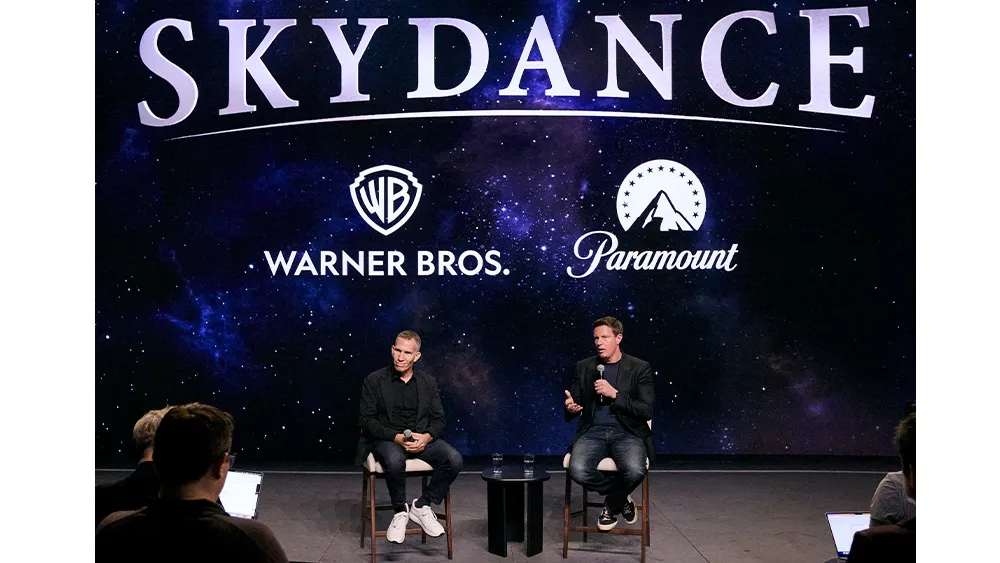
David Ellison and Ynon Kreiz spent a big chunk of their first day as CEO and co-CEO of Skydance, respectively, being interviewed.
First by CNN’s Anderson Cooper at the company town hall on the Warner Bros. lot in the morning and then by reporters in the afternoon at a press conference held on the other studio lot owned by the new Skydance, Paramount.
Ellison and Kreiz, following the trend of co-CEOs dressing alike, met with press on Stage 3, a fitting setting for a company driven by technology, as Ellison always stresses. Its manager Craig Weiss described it as “the first of its kind virtual production stage, utilizing laser projection.”
That was a major upgrade from the August 2025 post-merger Paramount press conference on the lot, which took place in an empty room nearby. (In another change, two of the senior Paramount executives who took questions alongside Ellison back then, Jeff Shell and Cindy Holland, are no longer there.)
The Skydance team utilized the immersive projection equipment for a Day One sizzle reel promoting the Paramount and Warner Bros. titles that are coming together. Despite the event taking place on a TV stage, the video was very film-focused, largely ignoring television for the majority of it until a sequence of series highlights in the final seconds.
Ellison and Kreiz were asked to elaborate on the language from the press release announcing Kreiz’s appointment as co-CEO, which stipulated that all business units report to both of them, and explain how they divvy up CEO duties.
“There will be natural delineation between us in terms of our respective experience and concentration, which we believe are highly complementary,” Kreiz said. “Where David will focus on creative, technology, long-term strategy, including especially as it relates to the creative part of the business, I will focus more on the operations and the day-to-day management of the business, including integration, particularly the first phase.”
The duo, who will take their message to investors next, were asked to explain how Skydance, which has $79B in debt, can commit to $30B – $40B on producing new content.
“We have a business plan,” Kreiz said. “There’s a complete financial envelope to how we’re going to run the business, and content is is a spend, but you can also see it as an investment because it’s also going to drive growth. And as a whole, yes, we have debt, but we expect to reduce the leverage.”
Ellison pointed to Paramount’s balance sheet for the last year.
“We’ve over delivered on synergies, $2.7 billion basically by the end of this year, from an initial announcement of $2 billion, we did that while doubling the film slate at Paramount, from eight films to 15, greenlighting four new and returning series, and growing even significantly year over year. So you actually can do both things simultaneously.”
Other tough questions Ellison faced included his family’s cozy relationship with President Donald Trump (“I think it’s important to talk to everybody on on both sides of the aisle” & “We believe in complete editorial independence”) and how he plans to rehabilitate his image and regain the trust of those in Hollywood who opposed the merger (“I do genuinely believe this is the the best outcome for the industry. I think we will deliver for the creative community. We will deliver for our shareholders. And the best I can say to our detractors is, give us time, and we’ll prove it.”).
There weren’t specifics on a number of topics — from the timeframe to merge the company’s streaming platforms HBO Max and Paramount+, to a possible consolidation of the three TV studios down the road, to the plan for Skydance’s 30+ cable networks as well as how film and TV operations will be split between the Warner Bros. and Paramount lots, how the Paramount and Warner Bros. studios will get to the 30 movies a year goal and the status of Barbie 2.
As Ellison and Kreiz noted repeatedly, it was Day One after all.
>


Search For Canadian TV Actor Stewart McLean Now Homicide Investigation


These ’90s fashion trends are making a comeback in 2017
According to Dior Couture, this taboo fashion accessory is back
Model Jocelyn Chew’s Instagram is the best vacation you’ve ever had
Emily Ratajkowski channels back-to-school style
9 Celebrities who have spoken out about being photoshopped


Rurouni Kenshin: Hokkaido Arc Manga Takes 1-Issue Break – News


HIDIVE to Stream English Dubs for The World Is Dancing, The Forsaken Saintess and Her Foodie Roadtrip in Another World, The Dangers in My Heart: The Movie Anime – News