
Tech
Mirror Particle is building a ‘world model’ of human behavior

Startups that promise to predict how humans will behave are having a moment. Over the past year, Simile raised $200 million at a $2 billion valuation; Aaru raised $88 million at a $1 billion valuation; and humans&, an AI startup that announced a massive $480 million seed round in January at a $4.48 billion valuation, launched Persimmon to model human behavior.
The status quo for human behavior prediction today relies heavily on large language models (LLMs) that are prompted or fine-tuned to roleplay as a target demographic. But two-year-old, San Francisco-based Mirror Particle thinks that approach is fundamentally broken.
“It’s like bringing a super soaker to Niagara Falls,” says Abhivyakti Ahuja, co-founder and CEO of Mirror, which sells brands an AI engine that predicts consumer behavior and the reasons behind it. “LLMs have been trained on hundreds of billions of data points. How much can you influence its behavior by [fine-tuning] with such a small amount of data? It’s still stuck in the past.”
Ahuja doesn’t think LLMs see the world the way a human does. “LLMs are modeling written language, but humans are made of visual perception, spatial reasoning, social intelligence.” Relying on them, she says, means getting insights based on what humans don’t notice, which is beside the point when trying to predict human behavior.
Mirror Particle is taking another approach: building a foundation model, or as Ahuja describes it, a world model built from scratch that simulates why humans do what they do and how human behavior changes over time.
“We don’t want to capture the static person,” Ahuja said. “We want to capture the changing person. That means capturing the longitudinal data on how people are changing, what triggers are changing them and to what degree.” If they aren’t changing, she added, “that’s also a signal.”
Mirror Particle has already raised an angel round and says it’s close to closing its first venture round. The company is also competing next week in Startup Battlefield, TechCrunch’s renowned startup competition.
The startup relies on a proprietary combination of data that includes its clients’ customer data, current events, pop culture, social media, and more to model a demographic segment, thinking of it as a system that evolves over time and tracking how motivations shift as it moves through experiences. Much of the focus is on “revealed behavior” — what people actually do rather than self-reported survey answers.
Like its rivals, Mirror Particle’s initial go-to-market strategy focuses on where budgets already exist for these kinds of insights: market research and brand and product strategy. Mirror might, for instance, help a beauty brand not just write better ad copy for makeup that would appeal to Gen Z, but also determine if that demographic even wants that product.
“What if [the target demographic] doesn’t want eyeshadow palettes?” Ahuja said. “Maybe blush is a better option to go for if you want to sell a product to this market.”
Mirror Particle’s prediction engine also provides customers with the “why” behind current or future behavior — the motivations, constraints, and additional context that justify its recommendation, helping brands make smarter decisions.
In one early pilot, a well-known pet food brand wanted to know what imagery to put on the packaging to boost sales. Chicken? Beef? Vegetables? Mirror’s technology found that the brand was asking the wrong question. The imagery didn’t matter. The problem was that the brand was so recognizable that it was considered mass market and cheap, and sales would plateau until it addressed that perception issue.
“The way we see our model evolving is like how a baby learns about the world,” Ahuja said, noting that babies move from vision to language to body awareness to social intelligence.
That fundamental interest in modeling the human brain comes from Ahuja’s background studying neuroscience and computer science. Originally from India, she ended up studying at the University of Toronto, where she became inspired by AI pioneer Geoffrey Hinton’s contributions to neural networks.
After school, Ahuja ended up at Amazon Robotics building robots that build other robots. That’s where she met her co-founders, Will Song and Thomson Yen. Song has spent a chunk of their career building sales personalization engines, and Yen focused on using deep learning to learn about how AI agents understand human behavior.
The startup’s long-term vision is to be the “general layer for anticipating human behavior” and moving from broader population-level analyses to individual-level insights.
“We just need a better model of humans if we’re going to work alongside AI and with each other,” Ahuja said.
Check out Mirror Particle and dozens of other innovative startups that have been vetted by TechCrunch’s editorial team next week at Disrupt in downtown San Francisco. The winner of this year’s Startup Battlefield will be decided by our slate of VC judges on the afternoon of Thursday, October 15.
When you purchase through links in our articles, we may earn a small commission. This doesn’t affect our editorial independence.
>

On Thursday, at the Golden Age of American Innovation Summit, President Trump awarded Elon Musk, Jensen Huang, Sergey Brin, and AMD’s Lisa Su the National Medal of Science, the nation’s top science prize. Dell Technologies’ Michael Dell and Microsoft’s Satya Nadella also received the National Medal of Technology and Innovation.
Together, the awardees have donated nearly $6 billion to efforts tied to Trump and his administration, according to The New Republic. Alphabet and Microsoft, for example, donated to the president’s inauguration fund and White House ballroom. AMD gave to a pro-Trump Super PAC and Michael and Susan Dell pledged $6.25 billion to help fund the Trump Accounts, the administration’s savings program for children.
Trump said the honorees individuals had helped “pioneer an incredible future for America,” and that because of them, “we will always be on top. No one else can compete with us.”
Nadella received his medal right after the administration indefinitely suspended Microsoft from the H-1B program, which lets U.S. companies hire skilled foreign workers.
>
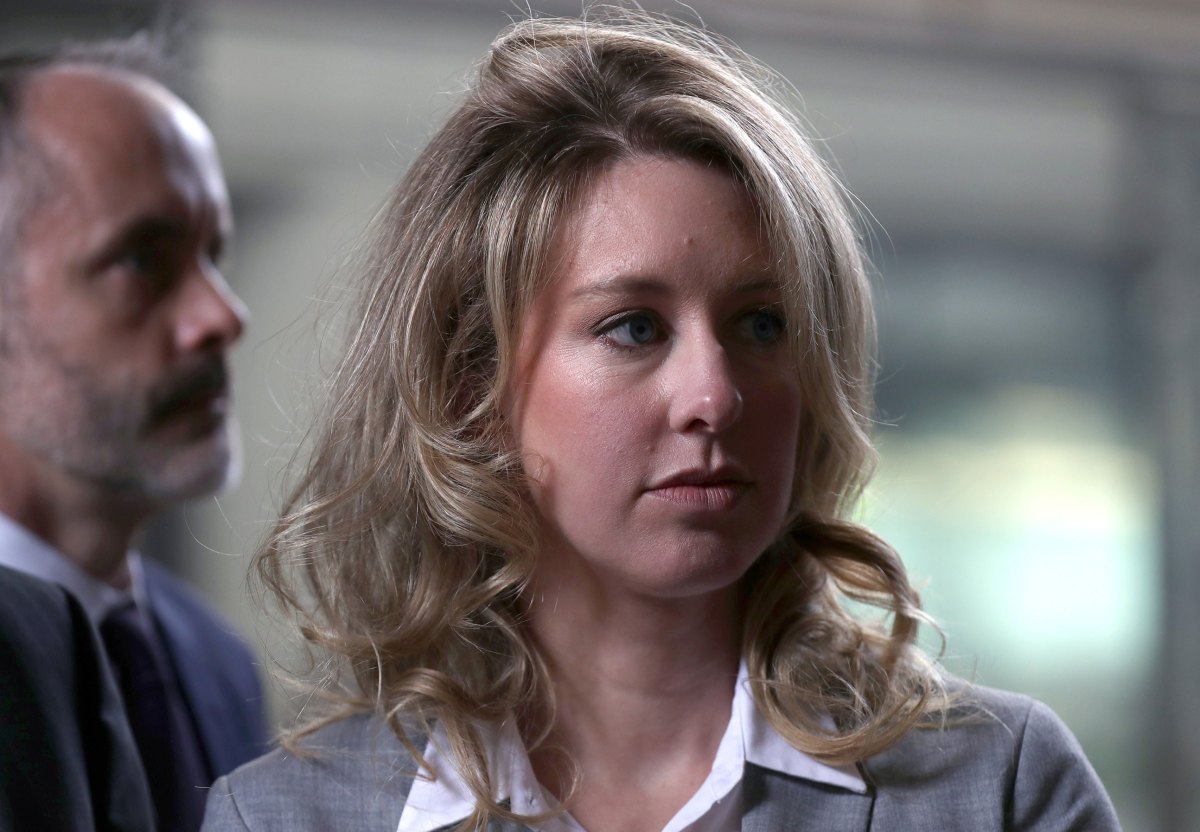
With over a thousand emails, slides, texts, and documents unveiled during the United States v. Elizabeth Holmes trial, Extend engineer Bo Lau created a website that simulates what it might have been like to be the chief executive of Theranos before everything came crashing down.
(Every day, I am grateful to the American legal system for making the discovery process public.)
The environment that Lau created is ambitiously detailed, taking you right back to 2016, a time when iPhones had home buttons, and you had to slide your finger across the screen to unlock it. Even the MacBook Air is running OS X El Capitan.
You can click around the environment, which lets you look through the documents made public from the court case on Holmes’ iPhone and laptop screens. You can even run the Theranos Edison machine, the company’s ill-fated device that was supposed to be able to extract large amounts of health data from one drop of blood.
The project seems like it was mostly made for laughs, but it’s actually an interesting way to peruse the documents from one of the most infamous court cases in tech history — it’s a lot easier to navigate this than to source thousands of PDFs from court websites.
There’s another agenda, though. Lau is promoting a watch party that her company is throwing for Nathan Fielder’s upcoming documentary about Elizabeth Holmes, “You Can See Everything.”
Also, of course, she’s promoting the company itself. So, what exactly does Extend do? Apparently, it can “parse, extract, and split your hardest documents with unmatched accuracy.” (I’m not really sure what that means, but if it makes something like this Holmes desk simulator possible, then I guess that means I’m bullish on b2b SaaS.)
When you purchase through links in our articles, we may earn a small commission. This doesn’t affect our editorial independence.
>
Samsung Wallet is adding USDC transfers to compatible Galaxy phones, allowing eligible US users to send stablecoins to crypto wallets or bank accounts abroad.
The post Samsung Wallet USDC Transfers: How the New Feature Works appeared first on TechRepublic.
>

Swiss Darts Trophy 2026: Schedule, draw, dates as Stephen Bunting defends his title and European Championship race hots up | Darts News

DP World Tour: Scotland’s Connor Syme and Grant Forrest amongst leaders after first round of Open de España with Sergio Garcia one back | Golf News

Ben Affleck Campaigned For Mayor In LA As ‘Animals’ Character
-

 movies5 months ago
Search For Canadian TV Actor Stewart McLean Now Homicide Investigation
-

 Fashion9 years ago
These ’90s fashion trends are making a comeback in 2017
-
Fashion9 years ago
According to Dior Couture, this taboo fashion accessory is back
-
Fashion9 years ago
Model Jocelyn Chew’s Instagram is the best vacation you’ve ever had
-
Fashion9 years ago
Emily Ratajkowski channels back-to-school style
-
Fashion9 years ago
9 Celebrities who have spoken out about being photoshopped
-

 Anime4 months ago
Rurouni Kenshin: Hokkaido Arc Manga Takes 1-Issue Break – News
-

 Anime3 months ago
HIDIVE to Stream English Dubs for The World Is Dancing, The Forsaken Saintess and Her Foodie Roadtrip in Another World, The Dangers in My Heart: The Movie Anime – News