
Sports
Bucs vs. Cowboys odds, picks, predictions for Thursday Night Football


England did not want to go through the play-offs but were given an unkind draw in the qualifying groups when they met world champions Spain.
However, Wiegman’s side are in a strong position for the play-offs and will fancy their chances against Greece, who sit 55 places beneath them in the Fifa world rankings.
England also beat potential round two opponents Ukraine in both matches in the qualifying group stage, with an aggregate 9-1 score.
Northern Ireland face a tricky tie against a talented young squad from Portugal in round one. Portugal twice beat Northern Ireland in Euro 2025 qualifying.
Their task gets even harder if they make it through to round two, with potential opponents Iceland proving to be difficult to break down in their matches against England this year.
Scotland are hoping to reach just their second Women’s World Cup finals, after a 2019 appearance. They failed to qualify in 2023 but have performed well this year, including drawing with Belgium, showing that they can compete with Europe’s strongest teams.
They would need to produce their best in round two if they meet big-hitters Sweden, who have been semi-finalists in the past two Women’s World Cups.
Wales have never beaten a top-20 ranked nation in a competitive fixture and are likely to need to do so to qualify.
There is optimism, though, as Rhian Wilkinson’s side thrashed play-off opponents Albania 4-0 in their qualifying group.
Elsewhere, having performed superbly in qualifying, the Republic of Ireland have a tough play-off route with Belgium potentially waiting in round two.
First, Carla Ward’s side will have to navigate a 3,100-mile trip to Kazakhstan, to tackle relatively unknown opposition.
>
MLB’s 12-team postseason field has now been shrunk even further, with three teams, including both NL clubs, advancing to the CS round.
>
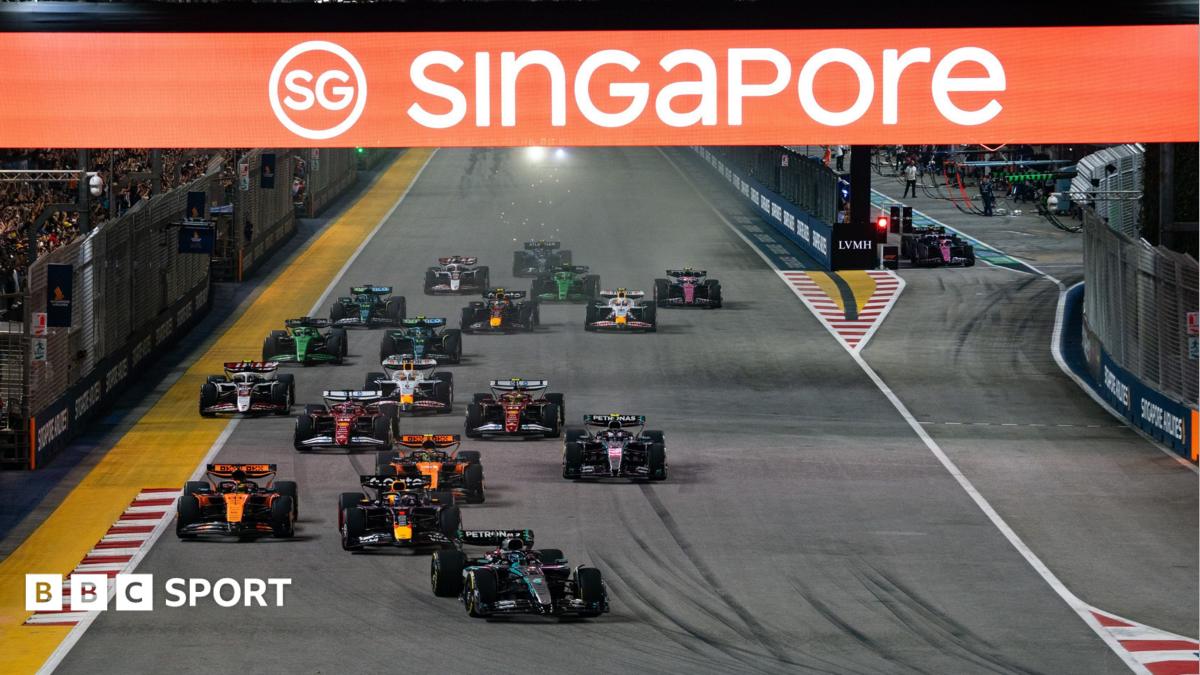
The Singapore Grand Prix has been declared a heat-hazard race, the second weekend in a row that the designation has been used in Formula 1 and the fourth time this year.
The definition allows teams to fit cooling devices to their cars that pump liquid through a vest worn by the driver to manage temperatures in the cockpit.
A heat hazard is an official status for an event where it is forecast that temperatures will exceed 31C at some point during the race. It was first introduced in 2025.
Singapore is close to the equator and has long been known as one of the most demanding for drivers – in 2024, Mercedes drivers George Russell and Lewis Hamilton were treated for heat exhaustion after the race.
Temperatures in the city are always in the 31-33C region across the race weekend, with high humidity and a chance of rain every day.
The race is held at night, but temperatures remain in the region of 30C even after dark.
A cooling kit is not mandatory, but any driver who chooses not to use it has to carry 5kg of ballast in their car to ensure he does not have a competitive advantage.
The system uses a cooling tank and pump, usually situated in the car’s nose, that delivers a cooled liquid, such as glycol, through a system of pipes in a fireproof top worn under their overalls.
Some teams and drivers prefer not to use the system because of two key compromises.
It is difficult to keep the liquid cool enough for long enough so that it lasts for an entire grand prix – a problem exacerbated in Singapore because it is the longest race of the year.
And some drivers find the cooling top uncomfortable in the tight confines of the cockpit.
If the liquid cannot be kept cool, it reverts to car temperature, which is considerably higher than ambient. It is not unusual for temperatures in an F1 cockpit to rise above 40C.
Mercedes are one of the teams who have decided against running the system because they preferred to devote the resource that would have been involved in making it robust enough to last a race into car performance.
Governing body the FIA has granted teams an allowance under the cost cap of $50,000 (£38,000) if they can make a system that keeps the liquid cool for an entire grand prix, and a further $75,000 (£57,000) if they could make the top comfortable.
Mercedes deputy team principal Bradley Lord described the allowance as “small”, adding: “We didn’t believe that allowance was sufficient for us to be able to develop a solution that would be robust enough to last for the entire race.”
Singapore follows the Austrian, Italian and last weekend’s Bahrain Grand Prix in Malaysia in being declared a heat-hazard race this year.
>

Women’s World Cup 2027: How can England, Wales, Scotland and Northern Ireland qualify?
Bucs vs. Cowboys odds, picks, predictions for Thursday Night Football
MLB Division Series results: Scores, highlights and playoff takeaways from Wednesday
-

 movies5 months ago
Search For Canadian TV Actor Stewart McLean Now Homicide Investigation
-

 Fashion9 years ago
These ’90s fashion trends are making a comeback in 2017
-
Fashion9 years ago
According to Dior Couture, this taboo fashion accessory is back
-
Fashion9 years ago
Model Jocelyn Chew’s Instagram is the best vacation you’ve ever had
-
Fashion9 years ago
Emily Ratajkowski channels back-to-school style
-
Fashion9 years ago
9 Celebrities who have spoken out about being photoshopped
-

 Anime4 months ago
Rurouni Kenshin: Hokkaido Arc Manga Takes 1-Issue Break – News
-

 Anime3 months ago
HIDIVE to Stream English Dubs for The World Is Dancing, The Forsaken Saintess and Her Foodie Roadtrip in Another World, The Dangers in My Heart: The Movie Anime – News