
Daniel Craig and Javier Bardem in ‘Skyfall’
Everett


In 2010, “The Social Network” arrived in theaters on a wave of anticipation. Two of the biggest names in movies, director David Fincher and writer Aaron Sorkin, were joining forces to explain the age of interconnectedness.
The timing was perfect. Twitter was gaining steam, YouTube was transforming the way people watched stuff, and Facebook, the subject of “The Social Network,” had established itself as a social media juggernaut, leaving MySpace and other pretenders in the dust. But six years after it launched, Mark Zuckerberg, Facebook’s geeky, 20-something founder, remained an enigma, one that Fincher and Sorkin were determined to unravel.


And the film‘s marketing campaign could not be ignored. Its initial teaser, set to a choir mournfully singing Radiohead’s “Freak” as dozens of Facebook profiles flashed across the screen, is still startlingly innovative, as is its poster, a shot of Jesse Eisenberg (as Zuckerberg) with the words “You Don’t Get to 500 Million Friends Without Making a Few Enemies” superimposed on his face (today, Facebook has 3 billion users).
The film delivered on its promise. Fincher’s cool, penetrating camera captured the shadowy, morally compromised world of Silicon Valley and Harvard’s old-money elitism, while Sorkin’s crackling dialogue kept the film’s deposition-heavy plot humming. And the script grounded the story in themes that were immediately recognizable, despite its exotic settings.
“What attracted me to [the film] had nothing to do with Facebook,” Sorkin explained in an interview with the Writers Guild of America. “The invention itself is as modern as it gets, but the story is as old as storytelling; the themes of friendship, loyalty, jealousy, class and power.”
“The Social Network” was a box office and success, as well as Oscar winner and it is considered to be one of the greatest films of the 21st century. That won’t be the fate of its follow-up, “The Social Reckoning,” which bombed in its opening weekend, collecting a mere $5 million. Its predecessor earned $22.1 million in its debut and closed out its run with $225 million globally. Sony wisely kept “The Social Reckoning’s” budget at $30 million, meaning it won’t face losses on the scale of a “Digger” (ousted Warner Bros. chiefs Michael De Luca and Pamela Abdy probably should have taken a page from Sony’s Tom Rothman, who greenlights ambitious movies while keeping costs low).
“The Social Reckoning” isn’t just a financial failure, it’s a critical one too. The reviews were blistering, with many critics bemoaning the fact that Fincher had passed on directing the film, leaving it to Sorkin to slide behind the camera.
“Sorkin doesn’t look beyond the words on the page, and the film itself appears made with heads down,’ The New Yorker’s Richard Brody lamented.
Eisenberg also opted to sit this one out, reportedly because he was worried about glamorizing the tech mogul. He’d become disturbed after fans approached him quoting lines of dialogue from “The Social Network” or asking him to sign cards that read “I’m the CEO bitch.” Instead, he was replaced by Jeremy Strong. That made the film more difficult to market. With only one member of its creative team was returning, Sony Pictures shied away from selling it as a sequel, but the studio still sprinkled bits of “The Social Network’s” DNA into promotional materials. There was the title, an obvious nod to the first Zuckerberg film, and ads used bits of Trent Reznor and Atticus Ross’s score. Posters also referenced the “The Social Network’s” marketing campaign, noting “We’re Way Past Making Friends” in similar, blocky script.
But there wasn’t the same urgency in the story being told. “The Social Reckoning” focuses less on Zuckerberg, and more on data engineer Frances Haugen’s decision to blow the whistle on how Facebook’s algorithms were promoting political content that radicalized users, as well as the company’s awareness of how its products were contributing to a rise in bullying and teen suicide. Haugen’s decision was courageous and the public had a right to know about the darker side of the tech giant, but “The Social Reckoning” arrives as a much greater threat has emerged from Silicon Valley. Artificial intelligence is dominating the headlines, as fears mount about the economic disruptions it will unleash when millions of jobs are replaced by machines, and, graver still, its potential to trigger a world-ending event. It seems like every day a new Cassandra emerges warning of a potential apocalypse, be it an AI mogul or a disillusioned executive. And it’s not like Haugen’s testimony led to lasting change at Facebook. We’re still drowning in a sea of misinformation, with a federal government that has put the lazy in laissez-faire with its regulatory approach.
As IndieWire’s Ryan Lattanzio put it, “‘The Social Reckoning’ argues that the aftermath of their whistleblowing is still somehow felt today. In actuality, living as we do in 2026, it pretty much feels like… no one cared, and nothing changed?”
Instead, two other films may emerge to spark the kind of urgent debates that “The Social Reckoning” thought it would inspire. “Musk,” which opened in limited release this week earning $22,000 across four locations, and “Artificial,” a look at Sam Altman and OpenAI that was one of the breakouts of the New York Film Festival. The four-hour documentary about Elon Musk probably won’t be a blockbuster, but it should factor into the awards conversation with its scathing look at the world’s richest man. As for “Artificial,” it already generated controversy after its original distributor Amazon MGM Studios abruptly dropped it days after the company signed a $50-billion deal with OpenAI. It was later acquired by Neon, which will release it at Christmas. The idea that “Artificial” was too hot to handle could make it irresistible to audiences worried about the way that AI is reshaping our world. Or maybe it will cut too close to home. Sometimes we just go to the movies to escape, not to be reminded of how technology that was designed to connect us instead drove us farther apart.
>

Filmmaker James Gray told a London Film Festival audience this morning during a career Q&A that he believes Two Lovers, his fourth feature, starring Joaquin Phoenix and Gwyneth Paltrow, was the first time he successfully executed his artistic vision as a director.
“This movie was very important to me. It was the first time I had creative control. The work took on another character,” Gray said after the LFF crowd was shown a clip from the 2008 film.
“I don’t regard the films I made before this very highly. I hope people like them, but I don’t think of them as truly mine. I was still trying to do something. Two Lovers was the first film that felt like who I was trying to be, if that makes sense, because I had total freedom.”
Gray added that Two Lovers was a relatively “cheap movie,” costing around $9.5 million.
“I was left alone. The actors were great. I made exactly what I wanted,” he said. “I don’t know if the film is great, good, or terrible, but my emotional connection to it is profound because it was a beautiful time in my life.”
Directed by Gray from a screenplay he co-wrote with Ric Menello, Two Lovers tells the story of Leonard (Phoenix), an aspiring photographer and introvert who has moved back into his parents’ home following a recent heartbreak. His concerned parents try to set him up with Sandra (Vinessa Shaw), the daughter of a family friend. But Leonard meets Michelle (Paltrow), the beautiful but volatile mistress of a wealthy married man who has recently moved into an apartment in his family’s building. He becomes caught between the two women.
Gray is at the LFF with his latest feature, Paper Tiger. The film screened last night in London.
Adam Driver, Scarlett Johansson and Miles Teller star in the pic set in 1986 Queens, NY, in which two brothers become entangled in a scheme that ends up involving the Russian mafia, putting their family at risk. The film premiered at the Cannes Film Festival in May. Neon will release the film theatrically on November 13.
The LFF runs until October 18.
>

Spanish star Javier Bardem thanked a BFI London Film Festival crowd for getting out early on Sunday morning to attend a Screen Talk session with him.
Bardem, whose other half, Penelope Cruz, is also enjoying some time in the spotlight this year (thanks to a trifecta of buzzy films: La Bola Negra, The Invite and Bunker), is in the British capital promoting his and Cruz’s Bunker as well as The Beloved, in which he co-stars with Victoria Luengo.
During the talk, Bardem reflected on a glittering career, from his early life growing up in one of Spain’s most prestigious acting families to winning an Oscar and, this year, finally conquering his fear of the stage.
In one of the session’s lighter moments, Bardem, known for roles in Vicky Cristina Barcelona (2008), Pirates of the Caribbean: Dead Men Tell No Tales (2017) and the Dune franchise, spoke about initially declining one of his most iconic roles, as the villainous but sexually magnetic former agent of Judi Dench’s M, Raoul Silva, in 2012’s Skyfall.
The actor said about turning down the part at first: “I guess I was nervous. Like, ‘What am I doing in the James Bond movie? What can I do?’ But then we sat down. Sam Mendes is a genius, and we went through the reading of it, and he was so open to what I was proposing, which had to do with the sexuality of the guy.”
Bardem was thinking outside the box when it came to his depiction of Silva, and pitched this to the filmmaker. “I said, ‘Listen, all the villains have done everything to destroy the world, but what about becoming personal? What about something besides destroying the world? [Like] he wants to have sex with Mr. Bond?’ And [Mendes] said, ‘I’ll talk to the studio and get back to you,’” said Bardem, erupting into laughter, before referencing one of the movie’s standout scenes where Bardem’s character suggestively strokes the thighs of a tied-up Daniel Craig.
Daniel Craig and Javier Bardem in ‘Skyfall’
Everett
“The studio was very brave,” continued Bardem. “And I think that scene lasts in the memory of the audience… Because we went a little bit further with it. It’s a way to say, ‘Okay, how do you really put Mr. Bond out of his place with a situation that he hasn’t been there before?’ And the way he comes out of it is brilliant.”
Bardem expressed his disbelief, to this day, that he shared the screen with Dame Judi Dench, and even confessed to forgetting his lines when Mendes first called action because he realized where he was. “[Mendes] said, ‘Cut! Javier, what’s going on?’ [I said], ‘Well, sorry, I just realized that I’m in a James Bond movie. Excuse me, I just saw Judi Dench and James Bond looking at me and said, ‘Fuck! I’m in a James Bond movie! Sorry, let’s do it again.’ I was absolutely taken by the joy of it.”
Unfortunately, the Bond franchise star was not probed on who he thinks would make a good Bond for Denis Villeneuve’s upcoming movie for Amazon MGM Studios, as rumors continue to swirl around who might next don the tuxedo of Ian Fleming’s beloved spy.
Bardem took the crowd through a prolific filmography, particularly some impressive Spanish-language projects such as Jamón jamón (1992) and Biutiful (2010). When the discussion came to his Oscar-winning turn in the Coen brothers’ No Country for Old Men (2007), the audience was shown the nail-biting coin toss scene between Bardem’s terrifying killer Anton Chigurh and supporting actor Gene Jones.
“Half of the Oscar I have is his,” said Bardem about Jones, who only appears in that single, four-minute scene. “Because he plays fear, the insecurity and uncertainty so beautifully that he makes the scene,” explained the star. “I do my part, but he does the horror. He’s fantastic. That’s what I mean: You are not working alone. You need your partners. You need to create a moment of commonality.”
Toward the end of the session, when Bardem was asked about what advice he has for aspiring actors just making their start in the industry, he joked: “Choose another job. Why would you do that to yourself?” He then continued: “No, it’s a great profession. And in this world of AI, where many other professions are going to go, unfortunately, down, to be able to be a person who shows emotions and has a connection with the audience, it’s an important job to have and to preserve, because it creates a connection between us.”
Florian Zeller’s Bunker, also starring Stephen Graham, Paul Dano and Patrick Schwarzenegger, follows a renowned architect offered the chance to secretly design a survival bunker for a billionaire who is convinced that the end of the world is near. As he lets himself be seduced by this morally ambiguous project, his wife begins to question their marriage.
Rodrigo Sorogoyen’s The Beloved, meanwhile, stars Bardem as a two-time Oscar-winning filmmaker who casts his estranged daughter in his new period piece.
The 70th BFI London Film Festival runs Oct. 7-18.
>
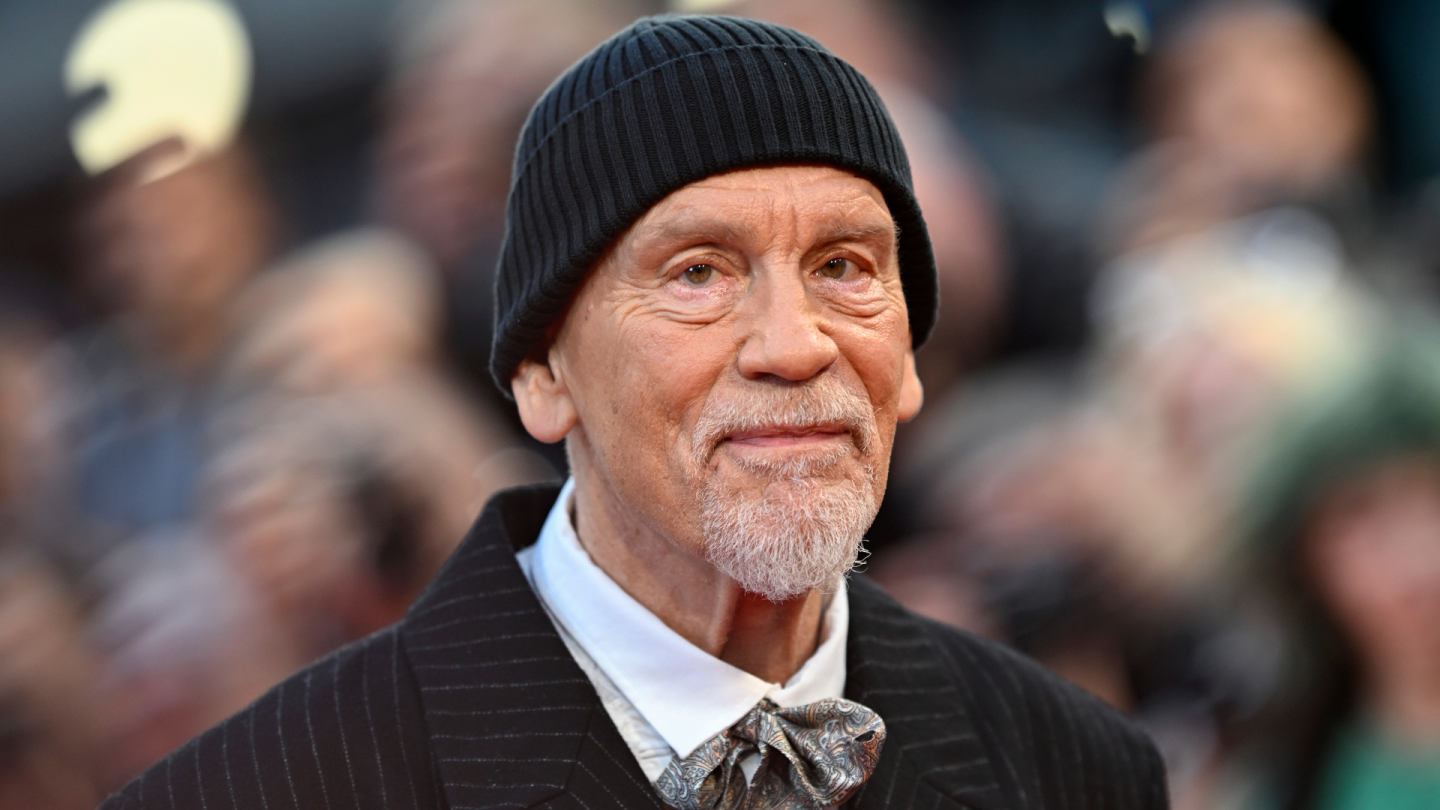
John Malkovich is well aware of his current awards momentum, even if the “onslaught” of attention doesn’t quite suit his “native personality.”
The U.S. star has hit the festival circuit with Martin McDonagh’s tragicomedy Wild Horse Nine, his performance in which is being hailed as potentially the best of his career and almost certainly an Oscar nomination lock. It isn’t the first Academy Award nod he’ll have earned — he’s been recognized before in 1985 and 1994 for Places in the Heart and In the Line of Fire, respectively — but at a BFI London Film Festival talk on Sunday afternoon, the actor conceded the awards campaign is an entirely different beast in 2026.
“[I feel] probably different [about awards consideration] than I did [when In the Line of Fire came out] because the movie business existed [and] it maintained, undeservedly in my opinion, a very high position in the culture. And when I say undeserved, [I] mean there weren’t that many Chinatowns or Godfathers or Godfather IIs,” he began. “Now, [the awards trail] is the only way to get people to go to the theaters, the whole thing, and that’s months and months and months.”
He recalled being nominated for Places in the Heart and going to his first and only Oscars in 1985. He was in the car and asked his “a little bit bossy” manager, Phyllis, if he could go in through a side door. “‘Honey, it’s the Oscars,’” she clicked in his face. “There is no side door!” The entire room of attendees burst into laughter at Malkovich’s story. “So that’s my native personality in the face of that onslaught,” he said about embarking on another campaign for Wild Horse Nine. “But also, I’m a grown-up. It’s a part of the business now.”
He remembered that his early films made their money even before the big Oscar night. “Now, [winning an Oscar] seems to be the only way you get people to actually go to a theater.” When asked if it broke his heart after Malkovich admitted he’s unsure his daughter would consider going to the theater these days, Malkovich simply said: “No, because I’m 72 years old. Things change. I don’t really like thinking, ‘Things aren’t what they used to be.’ They just change, and you either change with them or die. And I prefer to change with them.”
Wild Horse Nine stars Malkovich and Sam Rockwell as Chris and Lee, longtime CIA partners stationed in Santiago, Chile who are dispatched to Easter Island by their bureau chief (Steve Buscemi). Against the surreal backdrop of the island’s monumental Moai statues, the pair begin reckoning with their murky shared past. At the same time, Chris forms an unexpected bond with two rebellious Chilean students, played by Mariana di Girolamo and Ailín Salas — an encounter that threatens to unravel the agents’ friendship and the conspiracy in which they have become entangled.
The BFI London Film Festival premiere of the film took place on Friday night, where Malkovich, Rockwell and McDonagh made an appearance at the glitzy red carpet event.
Naturally, Malkovich was asked about a running theme in many of his movies — the Kennedy assassination — particularly because his character in Wild Horse Nine is implied to have played a major part in the death of the former U.S. President. When asked about his personal opinion on the matter, the actor replied: “I know what didn’t happen is what they said happened.”
Malkovich described McDonagh as a “great writer” and a “direct, kind” filmmaker. “He can give great notes,” he continued. “He told me about one of the scenes with big heads… He just came over and said, ‘More David Attenborough,’ which I just thought was one of the greatest notes, and which I didn’t do very well.”
He likened his co-star Rockwell to “a trainer at SeaWorld feeding fish to a shark.” Confused chuckles from the audience had Malkovich explaining: “If you watch him 20 times, you get a good idea of how good he is at that… He’s such a great colleague, such a wonderful actor, and so fantastic in this, everything he does is perfect, and he can go any which way at any second.”
Malkovich confessed he is “not a political person,” but said Wild Horse Nine is wildly existential and evocative when it comes to themes of grief and mortality.
He covered the milestones of a vast and vibrant career across Sunday’s session, from Dangerous Liaisons and working with Clint Eastwood to the West End and how he came to star in 1999’s Being John Malkovich, a set on which Malkovich admitted to “having a moment” and “being an asshole” when filming on a particularly hot day. He even discussed a little of his ancestry — Malkovich recently discovered he is 43 percent Romanian — and the rarity of reading a genuinely brilliant script.
“It’s so rare to read a great screenplay and make a really excellent film. And you can work as hard as you like. You can give a really interesting performance, and if the film isn’t very good, it’s absolutely meaningless,” said Malkovich. “It doesn’t mean anything. It’s totally waste of your time in the public.”
To end, Malkovich was probed on his film set to be released next century, 100 Years, from director Robert Rodriguez. To his knowledge, the movie currently sits behind bulletproof glass in a vault and will open in the year 2115. “I have tickets,” the actor joked. “I don’t think I’ll be at the opening night. You know, my grandchildren won’t even be here as well.”
The 70th BFI London Film Festival runs Oct. 7-18.
>


Search For Canadian TV Actor Stewart McLean Now Homicide Investigation


These ’90s fashion trends are making a comeback in 2017
According to Dior Couture, this taboo fashion accessory is back
Model Jocelyn Chew’s Instagram is the best vacation you’ve ever had
Emily Ratajkowski channels back-to-school style
9 Celebrities who have spoken out about being photoshopped


Rurouni Kenshin: Hokkaido Arc Manga Takes 1-Issue Break – News


HIDIVE to Stream English Dubs for The World Is Dancing, The Forsaken Saintess and Her Foodie Roadtrip in Another World, The Dangers in My Heart: The Movie Anime – News