
Hiradoumi waits in the wings moments before stepping out for a bout. Courtesy of Kohjiro Kinno.


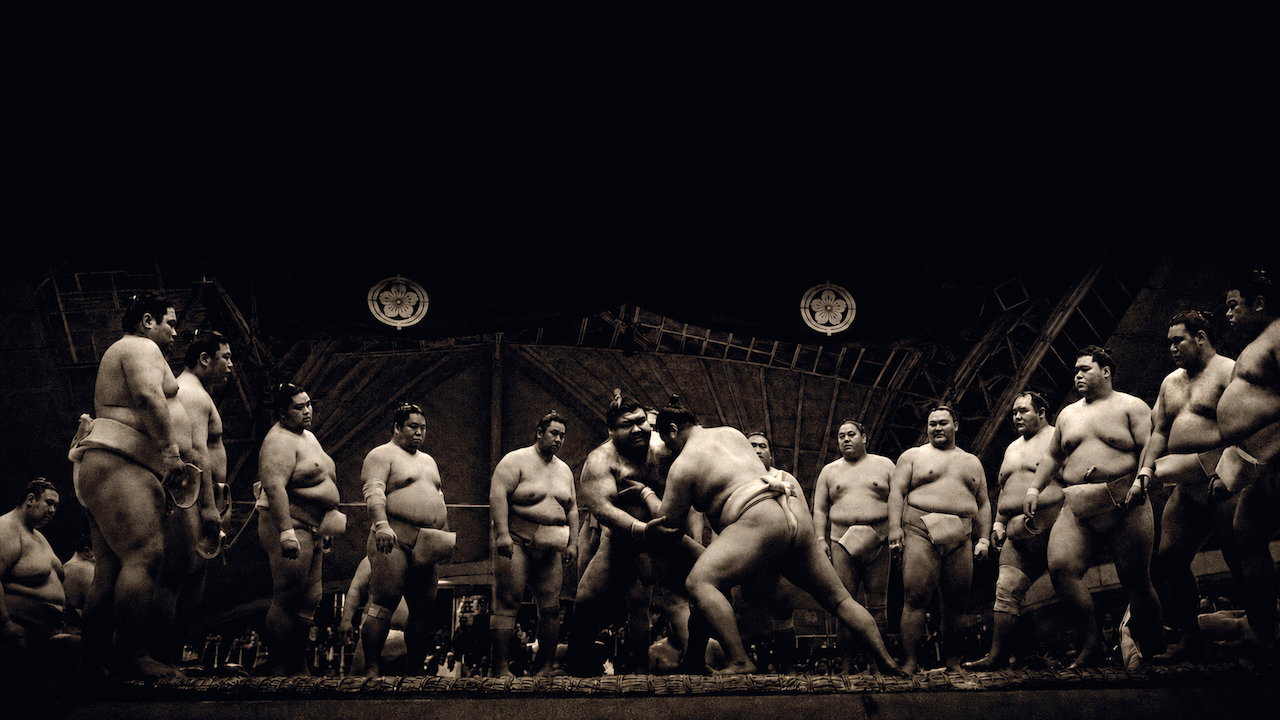
You may not realize how much you want to know about sumo until you go behind the scenes by experiencing Erik Shirai’s immersive Sumo: Spirit Weighs Nothing. The documentary, which world-premiered at Venice and is now screening at the 70th edition of the BFI London Film Festival (LFF), starting on Oct. 13, takes audiences inside the notoriously private world of sumo, from the grueling training and the rituals to the pain and sacrifice.
The cinematic film follows a number of wrestlers in different stages of their careers, including a yokozuna, a title denoting the highest rank in professional sumo, over the course of a year. They are Terunofuji Haruo, Hiradoumi Yuki, Yonezawaryu Daiki and Kosei Motomura. One key takeaway is the importance of fighting spirit. Or as a synopsis puts it: “True strength is measured not in flesh, but in the refining of the spirit.”
The doc, for which Shirai and Hiroshi Harahandled cinematography, with Frederick Shanahan as editor, mixes intimate vérité with poetic observation to reveal more about a sport that often seems particularly foreign to those outside of Japan. Presented by ESPN Film, the movie is a Rise Films production, in association with Real Lava and Generation11.
Japanese-American filmmaker Shirai previously took a cinematic deep dive into another Japanese institution in The Birth of Sake. Ahead of the London debut of Sumo: Spirit Weighs Nothing, he talked to THR about why he wanted to take a closer look at sumo and its spiritual dimension, how he got access and what audiences can take away from the doc.
Before you read on, THR can now exclusively premiere a new clip from Sumo: Spirit Weighs Nothing, in which the yokozuna shares just how much his life expectancy is reduced by his decision to dedicate his life and focus to sumo wrestling. He is making big sacrifices to “live boldly.”
For filmmaker Shirai, sumo was always in the background before he decided to explore it on a deeper level. “I would always hear or see it on TV when we’d be making dinner or waiting for dinner,” he recalls. “But it wasn’t really until I became an adult that I became curious about the whole tradition and the culture. I always felt that the top knot [sumo wrestlers wear their hair in] was almost fake. I thought they were wearing a wig. So, it was really interesting to dive into it.”
And he soon realized that there was much to disentangle and explain. “As I got deeper and deeper, making the film, I realized that there are so many misconceptions about sumo,” Shirai tells THR. “I think that partly why I gravitated towards it was because growing up Japanese in America, I felt like there were a lot of misconceptions about Japanese culture and traditions. So I thought this would be a perfect opportunity to realign some of those misconceptions that people in the West often have and feel about Japan.”
Shirai even found that he had misconceptions himself. “The big thing for me was that this idea of strength was so different from the way that I grew up,” he recalls. “The idea of strength, especially in America, is about men pounding their chests and saying, ‘I’m the best. I’m the greatest. I’m the GOAT.’ They are talking about themselves almost in a way to make their opponents fear them. In Japan, and in particular with sumo, strength is completely built differently. There’s humility built into it.”
No wonder then that Shirai puts one of his key takeaways this way: “One of the biggest things I learned from sumo is that a lot of the things that they talk about in terms of strength are things that you can’t see, particularly your resilience, your dedication. Even if you’re small, you’re agile. And there’s this idea that you have to build your spirit, refine the spirit. So, sumo is just like any other craft. It’s a sort of vessel to better understand yourself and to refine your spirit.”
Hiradoumi waits in the wings moments before stepping out for a bout. Courtesy of Kohjiro Kinno.
Getting access to sumo stables, wrestlers, their traditions, rituals and thinking and struggles can’t have been easy. “That was the biggest challenge we had,” Shirai shares. “It took three to four years to get that access from the Sumo Association. They are just notoriously secret, and they have had things happen in the past, so they’re very, very cautious and very, very skeptical about letting outsiders in. So we were very fortunate.”
Building the necessary trust was a process that took a lot of time and patience. “There’s no fast-forward button,” the director says. “A lot of times, I would go there with no cameras, and we would just hang out with the sumo wrestlers, watch them train, talk with them.”
And his team took the athletes out to eat. “One of the agreements that we made with one of the stable masters was that we would have to take the whole stable out for yakiniku, grilled meat,” Shirai explains. “We had to take the whole stable out, and basically they closed out and ate out the entire restaurant. It was unbelievable. I remember seeing the receipt from my producer. He had to pick it up, and he’s a tall guy, but he held it up, but it still rolled on the ground. That’s how long the receipt was. But that was a great way to build this relationship with them, and eat and drink with them.”
Sumo: Spirit Weighs Nothing has an immersive and even philosophical or lyrical quality, and that is by design. “I feel that with any film you have to bring out the humanity in it, and the more you can bring that out, the more people can relate and connect,” Shirai tells THR. “That was especially important with sumo. I think everybody thinks it’s a sport made for fat people, but you really quickly understand that getting fat is the biggest challenge in sumo, especially for these young guys, especially if you’re Asian.”
Erik Shirai
His hope is that the film can change how audiences feel about sumo: “People may think of it as a spectacle with these big guys and this wardrobe, so there’s an opportunity for people, as they watch the film, to realize that these guys are just normal dudes, and there’s a lot about them that I can relate to.”
The yokozuna, for example, is shown in the doc with his wife and kid, and he discusses his diabetes and other health challenges, which may come as a surprise to many viewers. “In Western culture, we don’t want to talk about our vulnerabilities,” notes Shirai. “But because the yokozuna was at the end of his career, I think he really wanted people to understand the dedication and the sacrifices it took to be in sumo, especially for someone that’s been in it for 15 years. So, he talks about giving up parts of his life, giving up his personal life and having physical ailments that will last for the rest of his life. But when you see that, you understand that he’s doing it for something beyond himself. That’s something that I always found very fascinating about sumo. It’s not about the individual. It’s always about the bigger collective and what you can give to it to keep the tradition and culture going.”
Shirai is leaving it to viewers to make up their minds on what they see as key takeaways from Sumo: Spirit Weighs Nothing. “I’m hoping that they will understand more about what it means to be Japanese, because a lot of sumo is about the pride of the Japanese people,” he tells THR. “It’s bigger than yourself, and it’s about keeping this tradition going. It’s been around for 1,500 years, but it feels kind of obsolete in this modern world. There are no giant or jumbo screens for replays. And everything is so primitive, manual and analog. I hope that people can take away that this is a beautiful tradition and culture and how hard it is to continue that in this modern world.”
Yonezawryu and fellow students at sumo school perform the chirichozu, or hand-clapping ritual, as part of their training in Tokyo. Courtesy of Erik Shirai.
Sumo: Spirit Weighs Nothing has a different title in Japanese. “The Japanese title means using one’s craft to refine one’s spirit,” he explains. “So, sumo is about refining yourself and refining your spirit.”
Shirai is looking to switch things up for his next film, even if the title may, on the surface, sound like a continuation of his look at how challenging eating so much that they gain a lot of weight is for sumo wrestlers. After all, the title of his next movie is How to Feed A Hungry Ghost.
“I’m finishing up another film that is completely different,” Shirai tells THR. “Literally, there’s nothing further from sumo. It’s a story about a Vietnamese chef who goes back to Vietnam after 10 years away and is feeding her hungry ghosts.”
“My last few films have been really dominated by a lot of male collectives and male energies,” he concludes. “I was attracted to that in some ways because it was exotic to me to explore this male energy and these male groups, because I grew up raised by women. So, my next film is specifically following this female journey. It’s a very different film and a very emotional one, and it’s something I’m very proud of.”
Terunofuji performs the yokozuna ring-entering ceremony at the Kokugikan Arena in Tokyo. Courtesy of Erik Shirai.
>
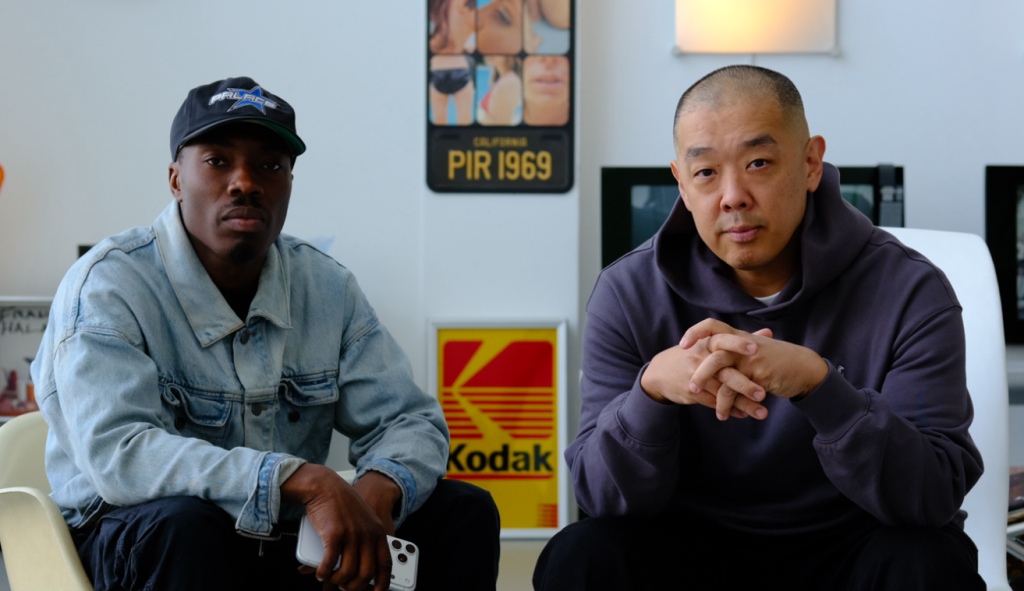
EXCLUSIVE: FREEAgent, the podcast series hosted by creative entrepreneur Kenny Annan-Jonathan, returns today for its second season.
In its first run, the pod became known for its high-profile guests, with names across fashion, business, and sports joining Annan-Jonathan to discuss their careers. Guests included Naomi Osaka’s longtime agent Stuart Duguid and veteran executive Rich Kleiman.
FREEAgent season two launches today with an episode featuring streetwear pioneer Jeff Staple.
“Everyone knows Jeff as ‘the Pigeon Dunk guy,’ but his story is much deeper than that,” Annan-Jonathan said of Staple. “He’s a trailblazer and one of the forefathers of global streetwear. He’s celebrating 30 years of STAPLE.”
Staple is one of the most influential designers and creative execs of his generation. He launched STAPLE, an independent streetwear brand, in 1997. Over its decades-long run, STAPLE has collaborated with companies like Nike, Google, New Balance, Timberland, Puma, and LVMH. Staple is perhaps best known for creating the iconic Nike SB “Pigeon” Dunk — one of the most influential sneakers of all time. Staple is also the founder of Reed Art Department, an influential creative and marketing agency.
Annan-Jonathan continued: “The real substance of our conversation centres on his redesigned agency and what it means to bridge the gap between the corporate and creative worlds. He’s a cultural translator who understands both sides. Most creators are raw. They don’t always know how to convert their creativity into revenue or communicate their message commercially. Jeff’s story gives you details about the projects he pursued, the times he was turned down, and what he had to do to make things work.”
FREEAgent episodes will once again drop weekly. The guests are predominantly high-profile figures working between sports and creative arts who rarely speak publicly, yet still wield widespread influence in their industry.
“Season one was really good. I think it was a powerful introduction,” Annan-Jonathan said, adding that he is simply aiming to “widen the knowledge pool” and “build on the conversations that came before” in his second season.
“You might listen to Rich Kleiman and learn one part of the story. Then, when you hear one of his counterparts within the same space, you get a clearer picture of the wider ecosystem,” Annan-Jonathan explained.
“Then you can hear from someone in an adjacent business or on the brand side, and you gain more insight into how brands work with law and legal teams. From there, you understand how talent managers and the people behind the businesses work.”
He added: “My goal is to cover the ecosystem of sports, entertainment, and media—from the point of inception, whatever that may be, all the way to the end.”
Annan-Jonathan added that the FREEAgent podcast also gives him the opportunity to celebrate important cultural figures who are rarely championed publicly for their work.
“Season two is about continuing to stand on the shoulders of giants while celebrating people doing amazing things,” he said. “I think people should be given their flowers.”
Annan-Jonathan is the founder of the marketing and talent management agency The Mailroom and media house Trnsmission. In 2023, he was appointed Creative Director of English Premier League side Crystal Palace, the first such role established at a professional English club. He is also Sports Director at the Cannes Lions International Festival of Creativity.
FREEAgent podcast episodes drop weekly. The Jeff Staple episode is live now.
>

EXCLUSIVE: SC Films International has started production on Gnome Alone: Game of Gnomes, the sequel to its animated family movie from 2017.
Peter Lepeniotis (The Nut Job) is returning to write and direct. SC Films is producing and will launch worldwide sales at the American Film Market next month.
The film marks the first collaboration under a multi-picture, multi-year deal between SC Films International, SiXiTZ Studios and Magieva.
In the sequel, “Chloe and Liam travel back in time to save mankind from warring families and the dreaded Troggs, with their gnome allies Quicksilver, Zook and Zamfeer at their side”.
Simon Crowe and Matthew Joynes produce for SC Films alongside Lepeniotis, Kevin Hicks, Nathaniel Hunter and Euan Macdonald. Production is being split between California and Toronto. Animation is being produced by SiXiTZ Studios, the animation and media studio founded and led by Macdonald, using workflows and technologies built in partnership with Magieva. Hunter and Macdonald have built film and animation pipelines for Disney, Lucasfilm and Apple, and won an Emmy together in 2022 for the animation studio they co-founded.
The original Gnome Alone played theatrically worldwide, with Netflix taking North America. The Nut Job grossed $120M worldwide.
“Gnome Alone is one of our most successful titles, and we’ve always wanted a sequel,” said Crowe. “Peter has built a whole new world full of great characters, fun and action.”
“This time we’re sending Chloe and the gnomes back in time,” said Lepeniotis. “It’s the biggest canvas this world has had.”
SC Films’ AFM slate also includes the animated features Girl in the Clouds and Zsazsa Zaturnnah, and the live-action features Breeder (IFC) and Cotton Eye Joe (in post).
>
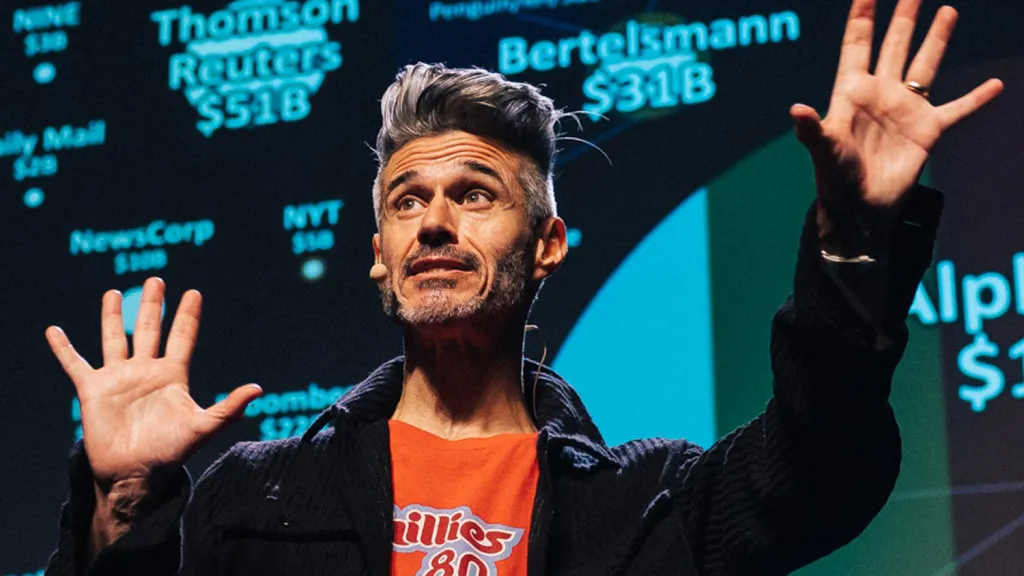
EXCLUSIVE: The new-look Skydance is worth just $29B due to its huge debt pile, according to media analyst Evan Shapiro.
The former NBC, Participant Media and IFC exec, who now maps the media landscape through his ESHAP business, said the valuation was down to both the $81B debt that Skydance assumed on day one of trading and its links to major shareholder Oracle, which is has long-term debts of over $160B due to investments in AI.
Shapiro is talking at MIPCOM Cannes this week, where he will unveil the latest edition of his Media Universe Map, which will be the first that is interactive and allows users to compare entertainment and tech ecosystems of the past to 2026.
“One of the puzzles we needed to solve in making this map was figuring out what the name of Paramount/WBD would be and, more importantly, WTF Skydance is actually worth,” he said ahead of his talk. “No one in their right mind would buy the $81B in debt they are carrying and no one who isn’t high as a kite would buy Skydance for the $111B price that was just paid for WBD.
“One of the biggest reasons for that is that the fortunes of Skydance and Oracle are now intrinsically intertwined, and combined they have $240B of debt, a good portion of which is either junk or a millimeter above junk. To put that in perspective the Ellisons now carry more in debt than all of Disney is worth.”
Shapiro claimed this meant his team had to determine a net asset value for Skydance, which came in at just $29B, far below the value David Ellison’s Paramount paid for WBD.
We have reached out to Skydance for comment.

The latest Media Universe Map highlights the dominance of tech companies, with Nvidia’s value the largest at $5.3T, followed by Apple ($4.9T), Alphabet ($4.3T), Microsoft ($3.8T), Amazon ($2.8T) and Meta ($1.8T). Larry Ellison’s Oracle, which is a major shareholder in the American version of Chinese social platform business Bytedance, was valued at $429B.
Of the pureplay media and entertainment businesses, Netflix was the largest with a valuation of $293B, ahead of Disney ($187B). Comcast was at $73B, while Fox was just $25B, though this is set to almost double when it completes its deal for Roku, which is valued at $23B.
India’s Reliance, which houses Disney-backed streamer JioHotstar, was at $164B, Sony came in at $144B. Both companies have assets well beyond the media space.
Shapiro, who describes his role as a media cartographer, has been rolling out his media maps for six years and is unveiling the first interactive version this week in Cannes. As he has described in the past, he claims there had been a fundamental shift in media ownership in recent years, which the map demonstrates.
“The biggest change in the Media Universe since I started mapping it is the shift from an industry controlled by C-suites to an ecosystem controlled by the consumers,” he said. “We are now in the ‘user-centric era,’ so I felt it was only fitting to put control of my map in the hands of the users. This new Media Universe Map App does just that – allowing you to drive the map yourself, on desktop or mobile, and double click on anything and everything you want more of.”
He added that the functionality would allow users of his program to compare today’s landscape with those of yesteryear.
“One of the things I get asked for most in my map, is a way back machine to compare years past to today’s map,” he said. “This new user-driven map does just that – we’ve included a time machine to allow you to compare and contract the media universe from years and eras gone by to the latest landscape.”
>


Search For Canadian TV Actor Stewart McLean Now Homicide Investigation


These ’90s fashion trends are making a comeback in 2017
According to Dior Couture, this taboo fashion accessory is back
Model Jocelyn Chew’s Instagram is the best vacation you’ve ever had
Emily Ratajkowski channels back-to-school style
9 Celebrities who have spoken out about being photoshopped


Rurouni Kenshin: Hokkaido Arc Manga Takes 1-Issue Break – News


HIDIVE to Stream English Dubs for The World Is Dancing, The Forsaken Saintess and Her Foodie Roadtrip in Another World, The Dangers in My Heart: The Movie Anime – News