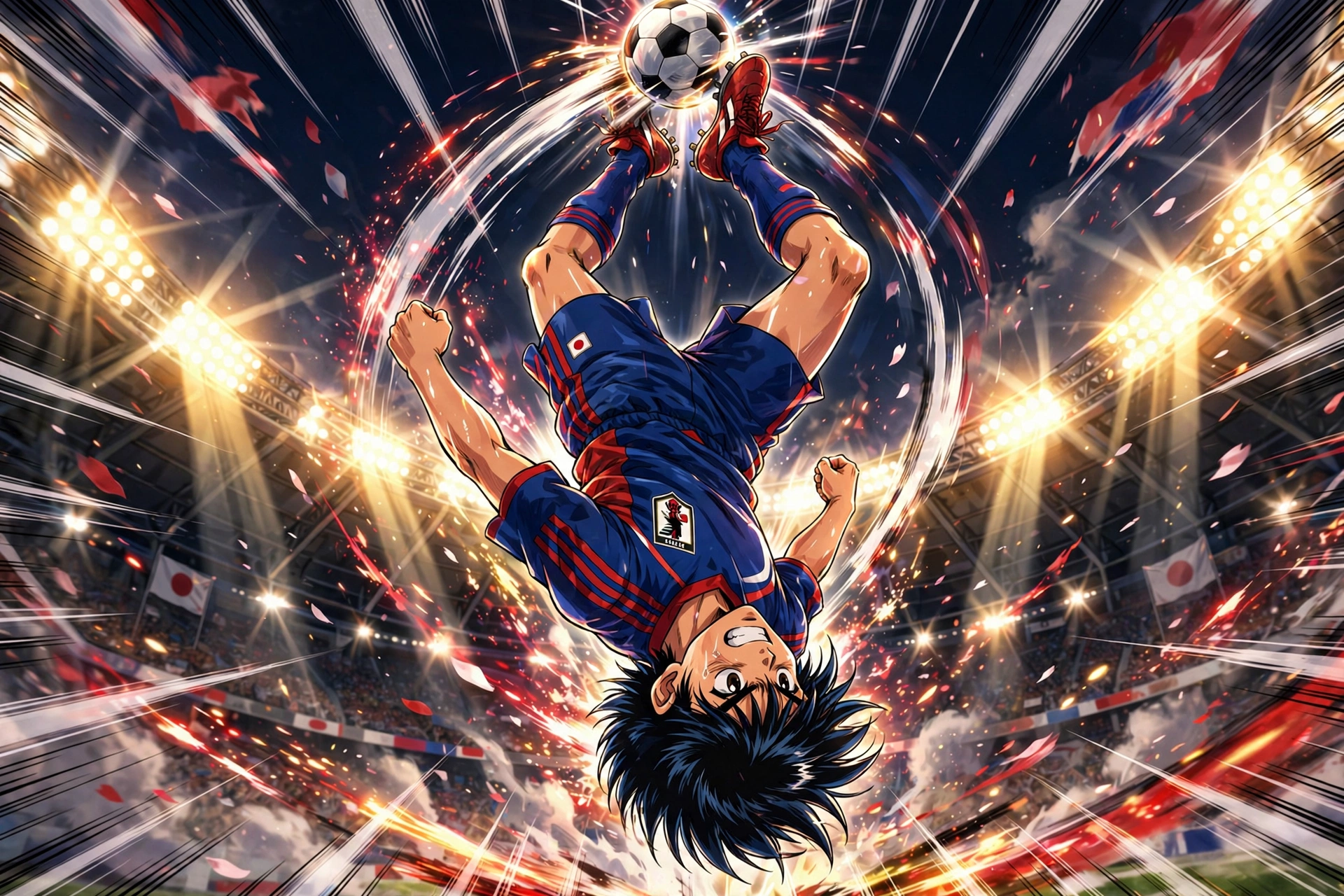
Yoichi Takahashi, the man who taught Japan to love football, has opened up in a rare interview about the origins of Captain Tsubasa — revealing that his hero was almost named Tsubasa Taro, why he refused to write a demon coach, and which real-life superstar comes closest to the real Tsubasa.
Captain Tsubasa (Credits: AnimeCorner)
Few manga can claim to have changed a country. When Takahashi, then a high-school student in Tokyo’s Katsushika ward, watched the 1978 World Cup in Argentina on television, football barely existed in Japan. Three years later, Tsubasa Ozora kicked his first ball in Weekly Shonen Jump, and a generation of kids followed him onto the pitch. Forty-five years, more than 80 million copies, several anime adaptations and one real football club later, the series continues in storyboard form on the Captain Tsubasa WORLD app, with Captain Tsubasa 2: World All-Stars out since August.
The World Cup Match He Dreamed of for 40 Years
Takahashi spoke at San Diego Comic-Con Málaga about a milestone: this summer, the thing he had been drawing toward since chapter one actually happened — Japan met Brazil in the round of 32 of the 2026 World Cup. “Playing Brazil at a World Cup is something special,” he said. “Tsubasa himself admired Brazilian football above everything else. He turned professional in São Paulo, and Roberto Hongo, his mentor, was a Japanese-Brazilian who had played for the Brazilian national team.” Seeing it happen for real, he added, made him very happy: “We lost, yes, but it was a wonderful match. I’m satisfied.”
“The Ball Is My Friend”
Takahashi also traced the story of the line that became almost a proverb in Japan. “I never set out to create a famous line,” he explained. When Tsubasa is very small, Roberto teaches him a little football, and the idea is that if you are always together with the ball, you will get better. “Always being with the ball, I thought, is the same as being friends with it. The words simply grew out of that.”
Joyful Football, Not Suffering
Asked about Tsubasa’s rare optimism in an era of genius-and-ego sports stories like Blue Lock, Takahashi said the choice was deliberate from day one. The dominant genre when he started was supokon — “sports guts” manga of brutal training, a demon coach, and a hero who becomes strong through suffering. “My idea was the opposite. Sport is supposed to be fun. Kicking a ball is fun, kicking a ball with your friends is fun, and that is why you play,” he said. “I wanted to remove the feeling of being forced, of being made to do it, and show a boy who plays joyful football because he chooses to. That was the starting point of everything.”
Also Read: Crunchyroll Launches English Dub for The Apothecary Diaries Season 3 This Friday
Source: AnimeCorner — read the full story there.