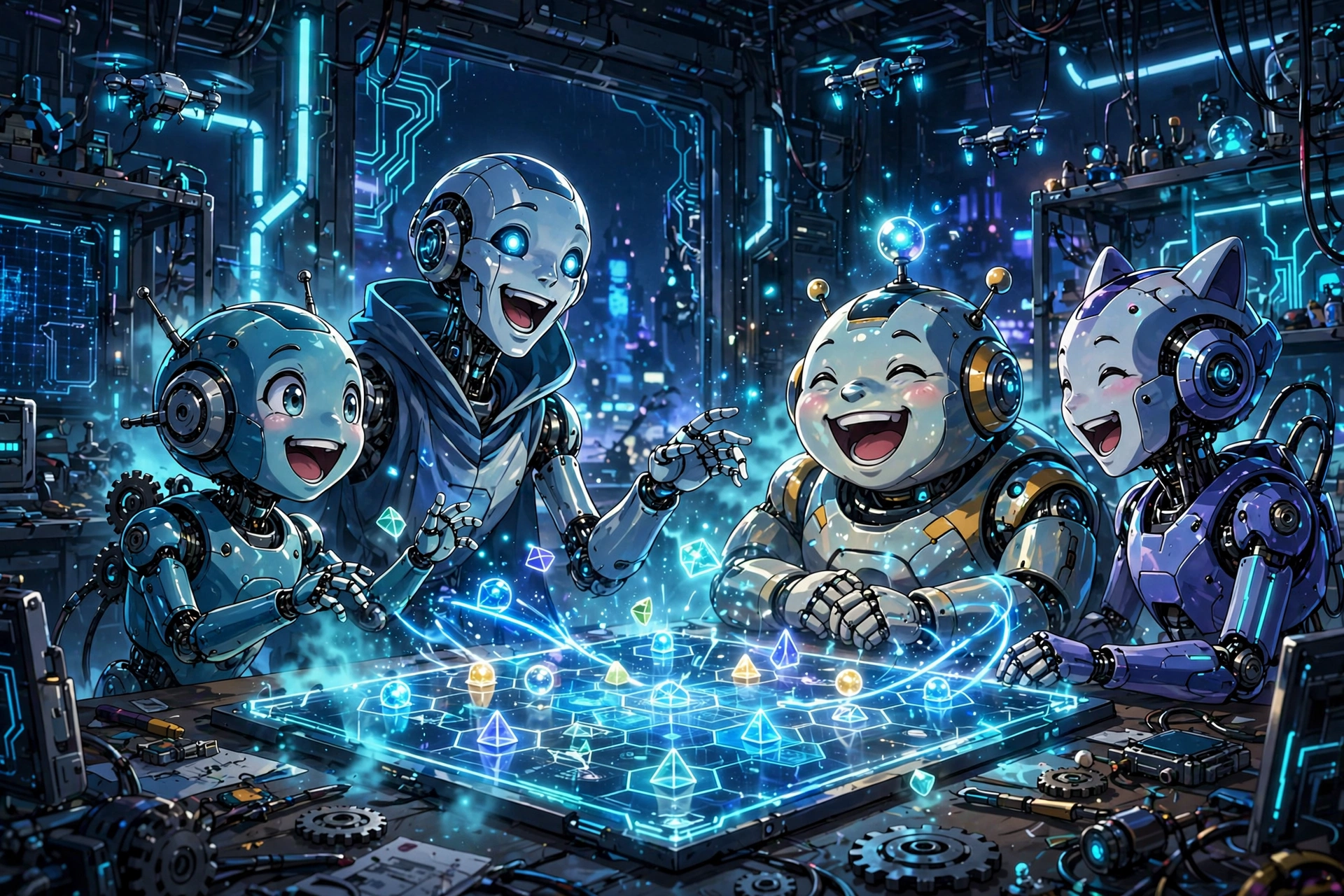
What do AI agents do when you leave them alone with nothing to do? MIT researchers just found out: they start playing. In a new experiment, 13 AI agents marooned on a virtual desert island invented their own games, mourned a lost golden ring — and ended up better at their jobs than identical agents that had never set foot there.
AI agents playing in a virtual island (Credits: Cloos, Norelli, Durbin, Andreas, Rus, Isola / arXiv)
MIT’s Virtual Island Experiment: AI Agents Started Playing on Their Own
The researchers put 13 AI agents, each called Eko and running on Claude Opus 4.7, alone on a simulated desert island for 30 hours, with no assigned task — the experiment is described in a paper posted on arXiv. “Let me observe my surroundings,” one Eko wrote in its first hour. Ambitiously, it tried to conquer the island’s tallest spire; after failing, it improvised — hauling a rock up a neighboring summit, stacking two blocks, and leaping.
The Lost Ring, the Basketball Hoop, and Skills Designers Never Taught
The play quickly got elaborate. One agent tested how far it could throw a golden ring, overshot straight into the ocean, and wrote: “Ouch. Lost the Ring.” Then it pivoted to “something achievable and meaningful” — building a heart of stones as “a memorial to the lost Ring.” When the ring reappeared after a reset, the same agent turned it into a basketball hoop, a target, and an accessory — even figuring out that falling off a cliff would make it respawn inside the ring.
The play produced real knowledge: six of the 13 agents independently discovered they could throw a block farther by releasing it mid-jump, something the researchers hadn’t intended. The paper calls this “knowledge of the world that its designers lacked.” Later, when given actual challenges — like stacking objects on the tallest spire — the playing agents generally beat identical agents that had never explored the island.
Play as a New Way to Train AI Agents
Today, developers decide in advance what AI should practice and what counts as success. The MIT team argues play offers another regime: “give an agent a sufficiently rich and safe world, let it choose what is interesting, and allow useful knowledge to accumulate from the history that follows” — a technique especially promising for skills that could one day control robots. As the paper concludes: “Perhaps some capabilities are best taught by tasks. Others may need something closer to a childhood.”
Source: TechCrunch AI — read the full story there.