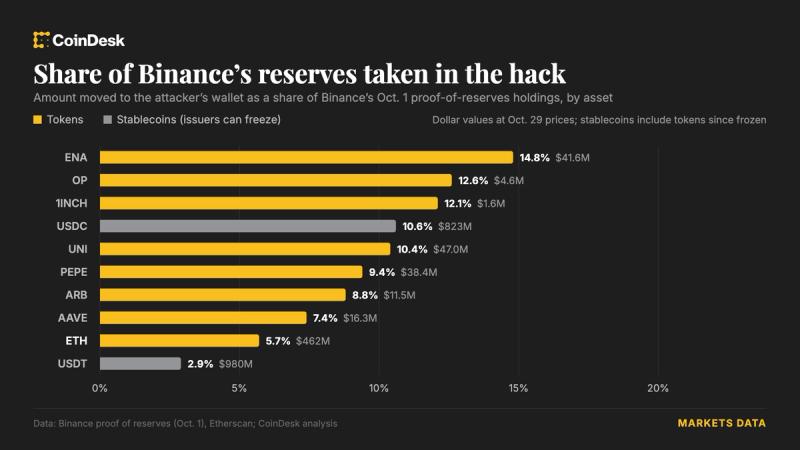
New reporting on the suspected Binance hack reveals a deeper problem than first feared. According to CoinDesk’s review of Binance’s own reserve data, the wallets emptied in Thursday’s attack are the same wallets the exchange lists as proof that customer crypto is fully backed — meaning Binance’s 1:1 backing of some assets, ether in particular, has likely fallen below 100% until the exchange replaces what was taken.
Binance (Credits: CoinDesk)
Binance Hack Reserve Data: Why ETH Backing Dropped to ~94%
Every month, Binance publishes the wallets it controls and compares those totals against customer balances. Its most recent report, dated October 1, includes a wallet labeled “Binance 14” — the wallet at the center of the attack — which held $1.26 billion USDT and 89,475 ETH, among 37 assets.
The attacker reportedly used the Ethereum feature EIP-7702, which lets a wallet hand control to a piece of software. After getting Binance 14’s key to sign that permission, the attacker turned the wallet into a sweeper that forwarded incoming funds to their own address. On-chain data shows 167,464 ETH moving from Binance 14, followed by 28,005.6 ETH from Binance 16 — roughly 204,500 ETH in total, about 5.6% of Binance’s ETH reserves.
That loss lands on a thin cushion: on October 1, Binance held exactly enough ETH to cover customer balances, so the theft leaves ether backing near 94%, CoinDesk reports. The attacker also took smaller positions in ENA, UNI, PEPE and AAVE, representing 7% to 15% of Binance’s reported holdings of each.
Stablecoin Issuers Freeze the Haul as Binance Says Funds Are Safe
The industry response was swift. Tether froze more than $1.567 billion USDT, Circle froze around $823 million USDC, Ripple froze roughly $200 million, and World Liberty Financial froze $27 million of its USD1 stablecoin. Binance co-founder Changpeng Zhao said he expects all customer losses to be covered, and co-CEO Yi He said user funds are safe — though Binance’s SAFU emergency fund holds roughly $1 billion in bitcoin, and the exchange hasn’t confirmed whether it will deploy it.
Binance’s next reserve snapshot on November 1 will show whether the exchange has replaced the missing assets and restored full backing. As ever, this is a fast-moving story — figures cited here come from CoinDesk’s reporting and on-chain analysis, not from Binance itself.
Also Read: Binance Suspected Hack: Up to $3.5B Drained, Tether and Circle Freeze $1.8B
Source: CoinDesk — read the full story there.