
Tech
Can ‘super intelligence’ and a non-binding safety pact solve AI’s image problem?


President Donald Trump hosted many of the biggest names in artificial intelligence this week — in part to announce that the U.S. government isn’t calling it artificial intelligence anymore. Now it’s super intelligence.
On the latest episode of TechCrunch’s Equity podcast, Kirsten Korosec, Sean O’Kane, and I discussed the motivation behind the meeting and what effect it might have on the AI industry. We were all pretty skeptical that the “Joint Commitment on Frontier Responsibilities” that the executives signed will amount to much, especially since — as Sean noted — it’s “deeply non-binding,” at least from a legal prospective. (Instead, Trump said he considers it “morally binding.”)
Kirsten suggested that the meeting’s real significance may have been as “a rebranding effort around AI.” (An effort that continued this weekend with Trump’s announcement of a new Super Intelligence Force.) For her, the big message was, “AI is going to kill us, it’s scary, it is going to take jobs — but super intelligence is not.”
Keep reading for a preview of our conversation, edited for length and clarity.
Anthony Ha: Officially, by order of the president of the United States, it’s not artificial intelligence anymore, it’s super intelligence. We were talking about this last week, because this is something [Trump has] been hinting at — he doesn’t do hints, he’s been saying [it] for a while. But now it’s signed into executive order. If you’re an official U.S. representative, you are supposed to say super intelligence, not artificial intelligence.
And this was also part of this broader announcement around AI safety, which I think is both interesting for this pact that was announced, but also the fact that it happened at all. It seemed to have come together fairly quickly, because just two weeks ago, a week ago, President Trump was saying, “We don’t need any of this, we need to lead in AI, we can’t constrain it in any way, we don’t need any regulation, anyone who’s saying that there’s any danger from AI is essentially a Chinese or Democratic plant.” And yet all these AI CEOs got together with him earlier this week and signed this pact.
Kirsten Korosec: Leading up to that, we should say, not only was there pushback on regulation, and we can talk about whether this executive order even does any of that — I would say no, there’s a little bit of theater there — but the important and interesting thing is that just days ago, Anthropic was really in the doghouse, if you will, in terms of what was happening behind the scenes with President Trump.
That all changed when [Anthropic CEO] Dario Amodei was invited to a 10 p.m. dinner. He had this sit-down, and then just days later, we had this luncheon, and at this luncheon, we have pretty much every tech power broker from every major tech company that exists. So Mark Zuckerberg was there, Jeff Bezos was there, Elon Musk was there, Dario of course was there, they were all there.
I’m wondering if any of you watched the press conference that happened afterwards, which there’s been many, many memes about, because of the interesting, funny behavior when you bring a bunch of tech CEOs together.
But I guess my bigger question for both of you is: What does this all mean? And does it mean anything?
Sean O’Kane: How much time do you have? First off, sure, they had dinner, Trump and Dario. If you read the Time magazine interview that Trump just did, your guess is as good as mine as to how informed he was that that dinner was even going to be happening, which is a strange reality to live in, but it’s just the one we inhabit.
I will also say one other thing that makes me skeptical — surprise, surprise — of how repaired the relationship is between the administration and Anthropic, is that for as much as there are clearly people trying to put those two groups together, the Defense Department is still very adamant that Anthropic is terrible and woke and and a national security risk. Emil Michael goes off on Anthropic every other day on X, it seems. I think there’s still some distance there despite Dario showing up to this thing.
As far as the agreement and all of that, let’s be real, they misspelled the United States on the agreement that they all signed. It is also just deeply non-binding. I mean, it is completely voluntary. I think my favorite aspect about it was that Trump described it as quote “morally binding,” which is just a level of abstraction and terminology that I’ve never heard of before.
Anthony: In terms of Anthropic and their relationship with the Trump administration, there’s been a sort of a lot of reporting, especially during that big blow up with the Defense Department, that different parts of the White House had different relationships with Anthropic. The Treasury Secretary seemed to be a big fan, whereas the Defense Department — definitely not big fans, or at least unhappy with some of the conditions that Anthropic were trying to put on the use of their technology.
In that sense, it feels like nothing has necessarily changed. There are people in the White House who want to use Anthropic’s technology, want them involved in these decisions, and others who really, really, really, really don’t.
In terms of the agreement, it seems not super meaningful. What is meaningful is just the fact that they felt that this was something worth doing. As indicated by the fact that they misspelled United States, it seemed like they rushed to put all of this together. [But] the fact that this kind of gesture was needed seems significant, even if I don’t think the agreement itself is going to lead to any major changes.
Kirsten: I do think that there was one important thing that happened. And to me, this is the point of it, which was a rebranding exercise around AI. “AI is going to kill us, it’s scary, it is going to take jobs, but super intelligence is not.” This isn’t my personal belief. To me, that was the message.
When you purchase through links in our articles, we may earn a small commission. This doesn’t affect our editorial independence.
>
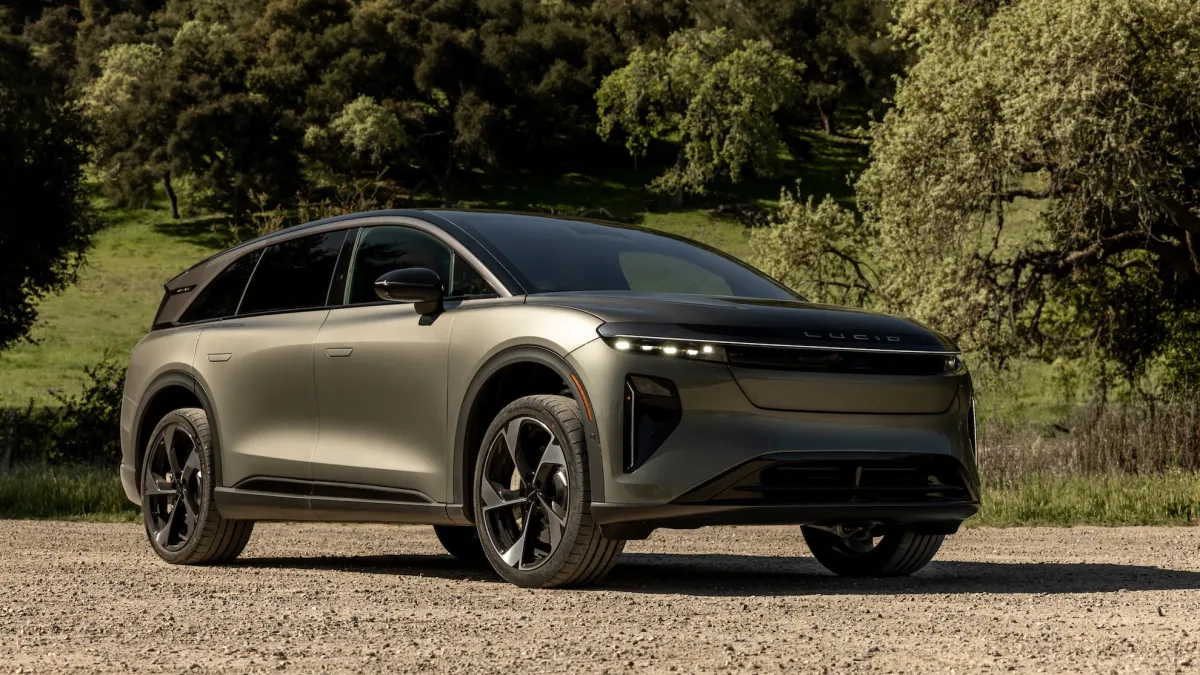
Lucid Motors built 2,954 electric vehicles (EVs) in the third quarter of this year, a 54% drop from a year ago, as the company purposely limits production to better meet demand for its EVs.
This was the third straight quarter in which the number of EVs Lucid built has declined. It’s also the lowest quarterly output since the first quarter of 2025, which was just after Lucid Motors started production of its second EV, the Gravity SUV.
Lucid delivered 3,806 EVs in the third quarter, roughly flat with the second quarter and down about 200 vehicles from the third quarter of 2025. The company has struggled to find buyers for either of its first two luxury EVs. In five of the last six quarters, it built more vehicles than it delivered.
Lucid’s new CEO, Silvio Napoli, has spent the last few months leading an effort to “simplify the company.” That effort has included laying off around 1,500 employees, streamlining the company’s leadership, and eliminating a second shift at its factory in Arizona in a bid to reach cost savings of $1.4 billion. Lucid also delayed the release of its third EV, the Cosmos. That model is supposed to be much cheaper, starting at under $50,000.
The third quarter figures, released Monday afternoon, come just a few days after rival EV upstart Rivian posted its best quarter in history on the back of the R2, its new, more affordable SUV. Although Rivian didn’t break out specific delivery figures for the R2, the company shipped nearly 20,000 vehicles in the third quarter, the first full quarter with the R2 in production, up from 12,194 in the second quarter.
Lucid’s failure to find a large market of buyers for its EVs is even more stark when compared with the promises the company made when it went public in 2021. That year, Lucid Motors merged with a special purpose acquisition company and estimated it would ship as many as 90,000 EVs in 2024 alone. The company raised $4 billion in the transaction.
On Lucid’s second-quarter earnings call in August, Napoli spoke about why he thinks the company has failed to make a dent in the EV market.
“While there is no question that Lucid brought leading innovations and outstanding products to the market, we have disappointed on several fronts, and for far too long,” he said. “We have not executed consistently. We missed commitments, launched products before they were ready, underinvested in service, responded too slowly to quality issues, and allowed complexity to slow decisions down.”
The Cosmos’ lower price could, in theory, let Lucid access a wider market, but Napoli cautioned shareholders that rushing the new EV out could create more trouble.
“We will not repeat the mistakes of the past by bringing a product to market before it is ready,” Napoli said on the call.
When you purchase through links in our articles, we may earn a small commission. This doesn’t affect our editorial independence.
>
OpenAI will start adding an invisible watermark to text generated by ChatGPT and Codex in the European Union to comply with the EU AI Act, the company said Monday in a blog post.
The EU AI Act’s transparency rules, which took effect on August 2, require AI companies to mark AI-generated content in a way other systems can identify.
OpenAI said the watermark will roll out over the coming weeks to eligible ChatGPT and Codex users on all plans, but only in the EU. Developers using OpenAI’s API anywhere in the world can turn it on for select models starting today; it’s off by default. OpenAI said it is not making text watermarking a global default at launch.
The watermark is not an actual symbol, but works by subtly shaping the model’s word choices, leaving a pattern readers can’t see, but a detector can pick up. Because it lives in the words themselves, it travels with the text when it’s copied and pasted. OpenAI said the watermark doesn’t identify the user, and that it saw no meaningful change in its models’ performance with it switched on.
OpenAI also published a technical report for its method, called textGrain, alongside the announcement. Co-written with researchers from the University of Pennsylvania and Yale, it walks through an example of using a secret key to sort next-word predictions to finish the sentence. Add hundreds of these nudges together, and the detector can spot AI-generated content using only the text and the key.
Can the watermark be removed by editing? OpenAI’s tests suggest yes. In one test, replacing 10% of words with synonyms dropped detection from about 92% to 66%. The company also said short passages, math answers, and translated text are harder to detect.

“These limitations contribute to our decision to provide initial detector access only to approved researchers and expert organizations, who can help us evaluate reliability and responsible uses,” said the company.
OpenAI also cautioned that a missing watermark “does not prove human authorship.” The text could be too short or too heavily edited, or it could come from another company’s AI.
“[Watermarks] can indicate that an OpenAI system generated or processed part of a passage, but not how much human judgment, editing, or creativity went into it,” the company said.
The announcement comes two months after Anthropic said it would watermark text generated by Claude, a move it’s applying worldwide. That decision drew backlash from some Claude users, who argued they had supplied “the instructions, context, decisions” while Claude was just “the tool.”
OpenAI had built a text watermark before but held off on releasing it, partly over concerns that users would switch to rivals that didn’t watermark, The Wall Street Journal reported in 2024.
Anthropic, Google, Meta, Microsoft and OpenAI are among the companies that have committed to following the EU’s code of practice on AI-generated content.
When you purchase through links in our articles, we may earn a small commission. This doesn’t affect our editorial independence.
>
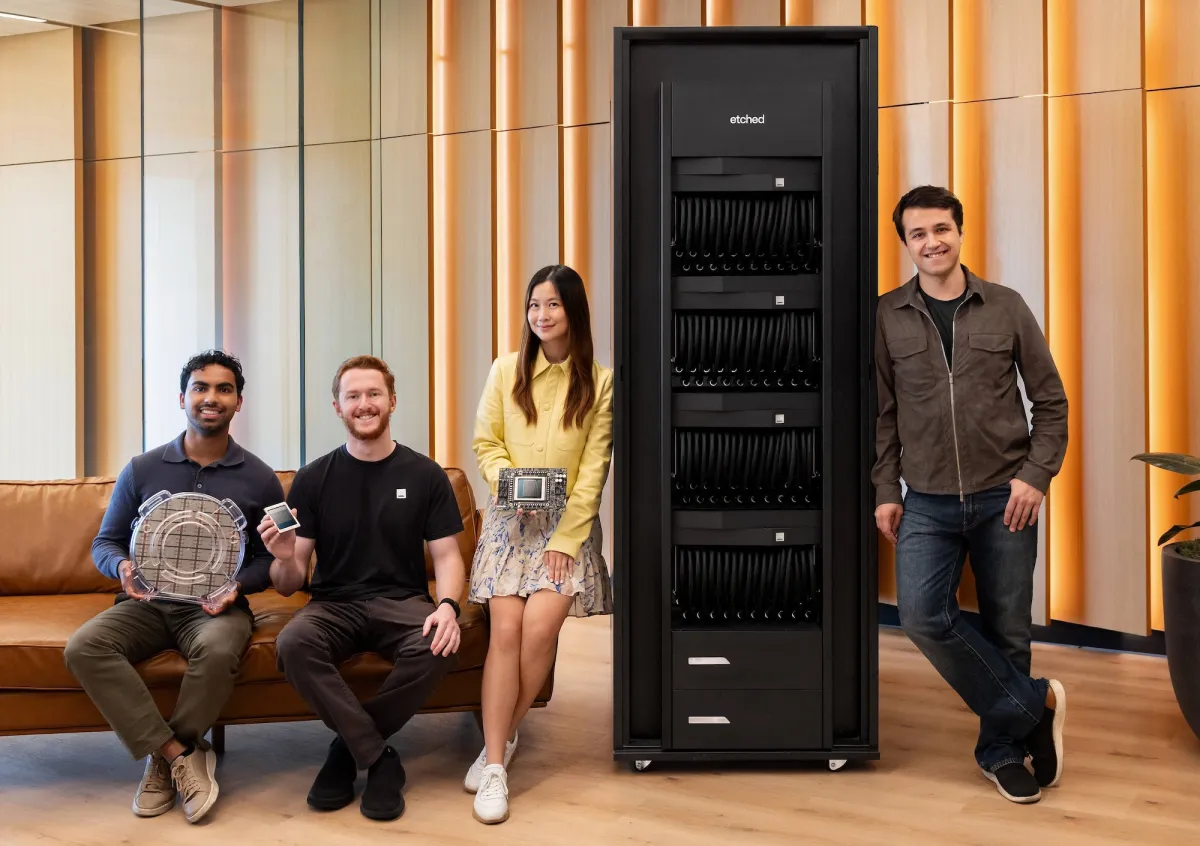
Although it’s only been a couple of months since Etched raised $700 million at a $21 billion valuation, the AI chip startup is already being plied with investment offers at double or more its value, according to people familiar with the company.
Etched is reviewing incoming bids that range from $40 billion from top-tier investors to $50 billion from lesser-known backers, one person said. These fundraising talks are early, so terms of any deal, should one happen, may change. Etched declined to comment.
While this may seem like a fast time-table to raise another mega round, Etched is pursuing a particularly expensive segment of the AI industry: building full AI hardware systems powered by its own proprietary chips. The person familiar with these offers said that if it raises as much as its last round, this could give Etched a cushion of as much as 3.5 years of runway.
There are reasons why VCs are hot to own a piece of Etched. The four-year-old startup shows promise of challenging Nvidia. Not only did quant trading firm Jane Street lead the last $700 million round, it is also a customer that took delivery of an early system. Etched said in July that it had already secured $1 billion in customer orders, including the one from Jane Street, after manufacturing its test chip at a TSMC factory this summer.
Co-founder and COO Robert Wachen previously told TechCrunch that investors are so enthusiastic because Etched has designed two new components from scratch to speed up inference — the computing process that happens after a user submits a prompt.
The company claims its chips can process more tokens faster and at a lower cost than Nvidia’s. That’s the reason its processors have been so attractive to Jane Street for whom a microscopic advantage in speed can yield massive profits.
The startup has also impressed investors with its ability to attract engineers from Nvidia, with roughly 15% of Etched’s 400-person workforce having previously worked at the chip giant, according to the Wall Street Journal.
Etched also operates a new 10-megawatt datacenter in Silicon Valley and established a facility in Taiwan to coordinate production near TSMC.
Co-founders Gavin Uberti and Chris Zhu famously met in an advanced math course at Harvard, while Wachen was Uberti’s roommate and they dropped out to pursue the company.
In terms of fast rounds at big leaps in valuations, Etched already has a history of them. The startup announced a $300 million round at a $10.3 billion led by Sequoia in July. It announced the $700 million round at a $21 billion valuation in September. Back-to-back funding rounds, which essentially act as a single financing split into two tranches with separate valuations, are increasingly common among the buzziest startups.
When you purchase through links in our articles, we may earn a small commission. This doesn’t affect our editorial independence.
>

Hasan Piker Defends Ms. Rachel After Fox News Issues Parental Warning

Luke Humphries hoping to face Luke Littler in World Championship final after ending major drought at World Grand Prix | Darts News

The Social Reckoning Reactions Mixed on ‘Decent Journalism Drama’
-

 movies5 months ago
Search For Canadian TV Actor Stewart McLean Now Homicide Investigation
-

 Fashion9 years ago
These ’90s fashion trends are making a comeback in 2017
-
Fashion9 years ago
According to Dior Couture, this taboo fashion accessory is back
-
Fashion9 years ago
Model Jocelyn Chew’s Instagram is the best vacation you’ve ever had
-
Fashion9 years ago
Emily Ratajkowski channels back-to-school style
-
Fashion9 years ago
9 Celebrities who have spoken out about being photoshopped
-

 Anime4 months ago
Rurouni Kenshin: Hokkaido Arc Manga Takes 1-Issue Break – News
-

 Anime3 months ago
HIDIVE to Stream English Dubs for The World Is Dancing, The Forsaken Saintess and Her Foodie Roadtrip in Another World, The Dangers in My Heart: The Movie Anime – News