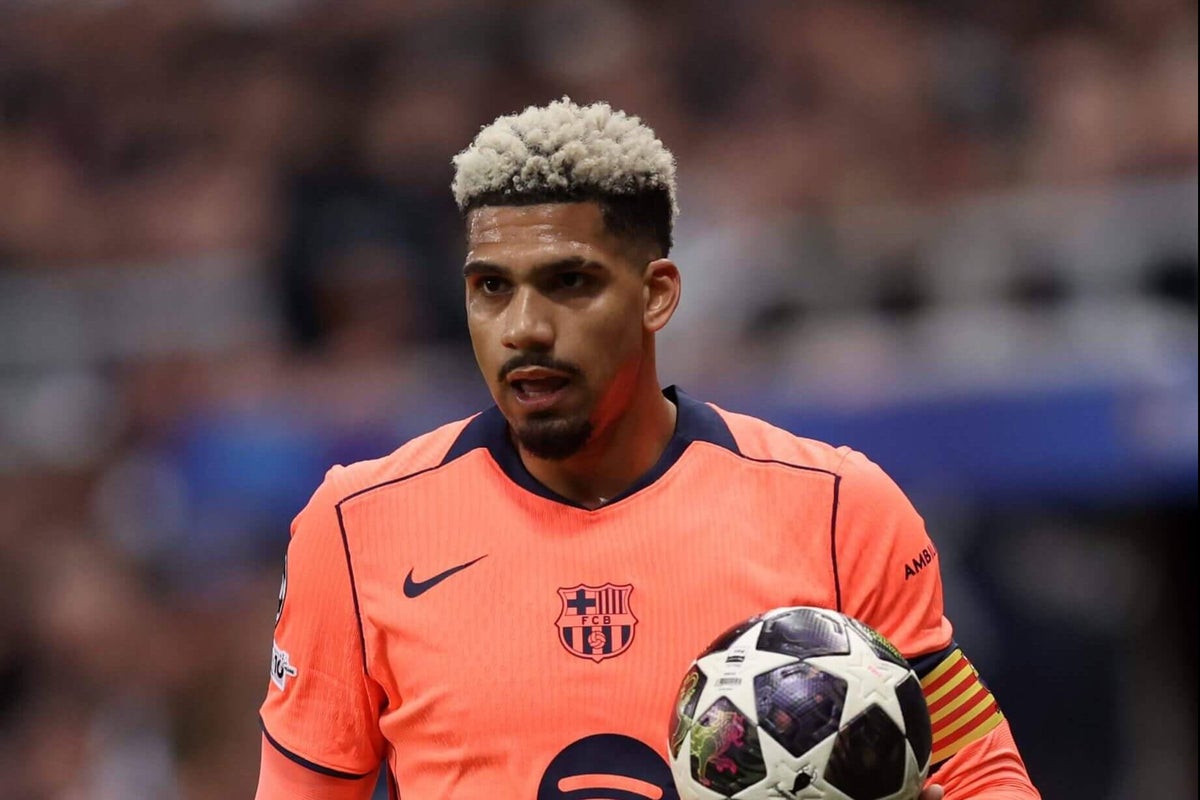
Liverpool fans may have been a little more excited by the prospect of signing Ronald Araujo in the not-so-distant past.
But the last few seasons at Barcelona have not been too kind to the 27-year-old. He has gradually lost his place in the heart of defence amid persistent injury troubles, a managerial change, and the emergence of Pau Cubarsi, whose quality on the ball has not allowed Araujo back into the team.
Across eight years at the club, Araujo has racked up 213 appearances — including 35 in the Champions League — in addition to 27 for his country. He is vastly experienced, but his confidence has seemed to dwindle as game-time has become more inconsistent and he is too often at the scene of the crime in the handful of high-profile games he has been able to play under Hansi Flick.
But there is a feeling Araujo has more to give in a system that does not leave him quite as exposed.
“Ronald is a great guy and a great player,” said Flick this week. “But our style of play is different from what he prefers.”
“He is a powerful and fast player. It is a shame for me, and it’s been difficult, as I haven’t been able to count on him as much as I would have liked.”
Though not without his flaws, Araujo can reinforce an area of the pitch in which Liverpool are lacking, and brings characteristics that could help him adapt to Andoni Iraola’s style.
Above all, Araujo is a strong and aggressive centre-back. Sturdy and 6ft 4in (1.91m), he catches the eye when he hits full speed, both happy to stomp his way down the flanks from his secondary full-back role and to attack set pieces with all of his might. It is little wonder he has scored seven set-piece goals since he joined Barcelona, and won over two-thirds of his aerial duels.
Such physicality makes him a difficult player to shake off once he catches sight of the ball, capable of defending high up the pitch in much the same way Iraola demanded from his centre-backs at Bournemouth and Rayo Vallecano before.
Here he is against Elche, after Barcelona are caught up the pitch after a quick attack breaks down. The opposition look to counter-attack with a pass into Aleix Febas, but Araujo is alert to step out of the defensive line, shepherd the midfield away from goal, and nip in with a well-timed challenge to keep his team on the front foot.
His next pass into Fermin Lopez is an example of the untidiness that can creep into his in-possession game.

Just over 20 minutes later, Araujo is making a similar intervention, this time spotting a forward pass into centre-forward Alvaro Rodriguez.
When the ball does come, Araujo is ready to step up, blocking the striker’s ability to turn on the ball and even reaching around to poke the ball away.

That sense of anticipation and awareness is a crucial skill for Iraola’s centre-backs.
He demands that his players pick their moments to lock on to a man-to-man press, a sequence of movements that requires buy-in from the whole team. If a midfielder presses, a teammate should be on hand to pick up the man he has just left behind, starting a chain of pressures that often stretches back to the centre-backs to ensure that no opposition player is left unmarked.
Last season, Marcos Senesi was the centre-back with the most interceptions and tackles attempted in the middle third across the Premier League. Araujo should expect to be similarly busy, particularly given that Virgil van Dijk is a much more passive defender who prefers to sit off and sweep up.
Here is a more extreme example from international duty, where Araujo played under the intense methods of Marcelo Bielsa for Uruguay.
As Federico Valverde pushes on to apply pressure to the ball, he leaves a free Argentina midfielder. Araujo spots the spare man, and tears out of defence to ensure he doesn’t have time to turn.
Although it doesn’t lead directly to a ball recovery, it helps Uruguay to maintain their aggressive shape and swarm bodies around the ball. Araujo’s athleticism to cover the ground is impressive, not least in the 94th minute of a demanding game away at the defending World Champions at the time.

Channelling that aggression will be key — Araujo was frequently caught out at Barcelona under Flick, tasked with holding an adventurous high line. Any misjudgement made it easy to play around Araujo, with plenty of space in behind to exploit.
It was an unforgiving role, and although Araujo didn’t always get it spot on for Flick, he has the physical capacity to play as a front-footed defender, while offering moments of world-class last-ditch defending with big blocks and clearances closer to goal.
Given his experience, and the fact that Liverpool are so light in that position, signing Araujo on loan represents a solid start.
Araujo’s limitations with the ball at his feet came into sharper focus following Cubarsi’s ascendancy, coupled with a viral clip of Paris Saint-Germain manager Luis Enrique appearing to target the centre-back with their press.
But while Araujo is not a natural when it comes to fizzing passes through the lines, sometimes guilty of overhitting his passes, his distribution is still good enough for a top side.
As we can see from his play-style wheel below, he scores highly on the attributes mentioned above — aerial threat, loose-ball recoveries, tackle success — while he is also able to keep possession relatively well and bring it forward via carries into midfield.

Araujo’s size means that he is difficult to stop when he spots a gap to run into up ahead, while he strikes through the ball and gets distance on his clearances when he goes long.
Here is an example away to Alaves, where he gets the opposition backpedalling with a 65-yard pass to get out of pressure, eventually leading to an Ilkay Gundogan goal.

Iraola does not usually mind when his centre-backs search for long passes upfield. Across his two La Liga seasons in charge of Rayo Vallecano, both starters in the centre of defence, Alejandro Catena and Florian Lejeune, ranked inside the top three players for launched passes.
The idea was to stretch the opposition back line vertically, to open space for his team to flood into and for his own attacking midfielders to get on the ball from half-clearances. It is a system that worked at Rayo and then at Bournemouth, as he looked to make the game frenetic and unstructured, not allowing the opposition — often with superior technical quality — to box them in.
As we can see from the scatter plot below, Iraola’s central defenders — from Senesi to Dean Huijsen, James Hill to Ilya Zabarnyi — went long more frequently than most across his Bournemouth tenure, while all falling below the average passing accuracy for centre-backs across that time.

The question is whether Iraola will continue to play to such extremes. While it worked at underdog teams, his Liverpool will be expected to control a little more possession and territory with the quality at their disposal.
Either way, a system that places slightly less emphasis on precise passing and risky build-up from the back will help to cover some of Araujo’s weaknesses, allowing him to focus on the sides of his game that make him stand out.
Another benefit to Araujo’s arrival is his ability to cover at right-back. He has played around eight per cent of his La Liga minutes there, and often defends the flanks well with stomping recovery runs and his ability to block crosses and force wingers down the line.
His power and stature have also seen him perform as an emergency striker late in games, notably scoring the winner against Girona last October with a smart run and bundled finish at the last.
All in all, Araujo represents a much-needed step in Liverpool’s defensive recruitment drive, but he will not plug all of the gaps at Liverpool himself.