Connect with us

Sports

Why Rafael Jódar’s shoelaces are at the center of a debate over dark arts in tennis

Published

on

Welcome back to the Monday Tennis Briefing, where The Athletic will explain the stories behind the stories from the past week on court.

This week, there was a drama over footwear, a champion hit back at her critics and a sobering message from an all-time great.

If you’d like to follow our fantastic tennis coverage, click here.


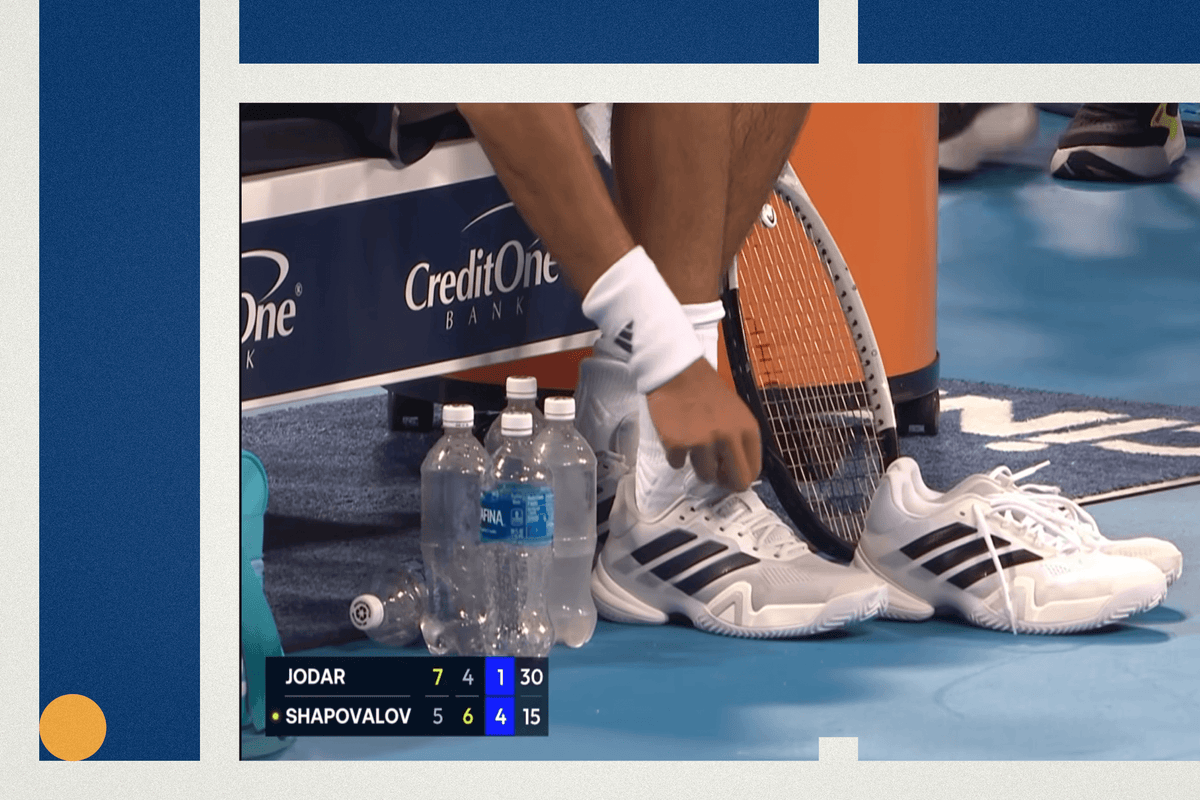
Why did broken shoelaces take over a match?

As Rafael Jódar dropped his racket to the ground and pointed to his ears, fans at the Cincinnati Open rose to acclaim a stunning comeback.

Jódar, the 19-year-old Spaniard who has cut a swath through the ATP Tour this year, recovered from 5-1 down in the deciding set of his second-round match against Canada’s Denis Shapovalov to record a thrilling 7-5, 4-6, 7-5 win. He had been cramping. He had appeared physically spent.

But most controversially, he had changed his shoes — twice.

Jódar’s shoelaces broke when he was 4-1 and 5-3 down in the final set. On the first occasion, Shapovalov was serving. On the second, Jódar was serving. The first stoppage was relatively quick, as Jódar slipped an insole into a fresh shoe and then laced it up, but the second took much longer, to Shapovalov’s chagrin, because of an issue with an insole that Jódar’s father and coach, Rafael Sr., ended up having to insert at the side of the court.

Why do tennis players change their rackets so often?

Tifo Sports

Equipment timeouts are allowed and playing on with a broken shoelace can be dangerous for players. If they slide on hard courts, the design of some shoes — Jódar’s are Adidas Adizero Ubersonics — means that the laces can scrape over the surface and thus wear down and then break. Jódar, who drags the side of his back foot when he slides forward, has a sliding technique that can exacerbate this.

But equipment timeouts also exist in the realm of tennis dark arts, because the sport is so subject to shifts in momentum. Slowing a match down, whether to fix a lace or some other damaged article of clothing or equipment, can be seen as breaking an opponent’s rhythm. Shapovalov was unimpressed not just by Jódar’s second shoelace change, but by the fact that he was towelling his face and drinking water while doing it, which is not permitted.

He then discussed the incidents with Jódar at their handshake — though any shoe-related controversy should not overshadow losing six games in a row against a tiring opponent.

Jódar is also a serial lace breaker, with the same issue happening at the D.C. Open against Taylor Fritz and the Canadian Open against Brandon Nakashima. After the win over Shapovalov, he pledged to have more shoes with fresh laces ready in the future, but it’s unlikely to stop the noise after the next incident.


— James Hansen


How did a champion answer her critics — and a couple of memes?

The eye-test and the numbers say that since 2022, when she is on, Iga Świątek is better at tennis than any woman on earth. Good luck to the rest of the field when she’s spotting her serve and not rushing to try to slam every ball and end every point as quickly as possible.

That was the version of Świątek that showed up at the Canadian Open last week. She took some time off after a tough third-round loss at Wimbledon to Alex Eala, and arrived on the practice court with her coach, Francisco Roig, ready to try to find her best tennis self once more.

“I came back on courts much fresher and much more open to trying new stuff,” Świątek said during a roundtable with journalists at the Cincinnati Open Friday afternoon.

We had like, two weeks I would say and then I came to Toronto and the work that we’ve done there for sure was a key to play better at this tournament and to play a game that is more patient.  I was able to grind more, be more solid, and at the end, that’s what paid off.”

It certainly did. Świątek mostly eased to the title, but when she faced adversity against Marta Kostyuk and Elina Svitolina — two of the form players of 2026 — she found her solidity and let her opponents make mistakes, rather than making them herself by trying to be more aggressive.

Świątek commemorated her title with a number of social media posts, one of which saw her play along with a meme that the WTA Tour and Tennis Channel had deployed on social media last week. The tour and broadcaster used “kinda chic to …”, the online phrase of the summer, to celebrate women’s players, including Coco Gauff’s two Grand Slam titles and Aryna Sabalenka’s world No. 1 ranking.

In the case of six-time Grand Slam champion Świątek, who has more weeks at world No. 1 and more titles than either player, Tennis Channel wrote: “Kinda chic to be a Swiftie”, in relevance to Taylor Swift. The WTA chose to highlight Świątek’s use of “jazda”, the Polish version of “allez”, “vamos” and “let’s go.”

Świątek’s version was a little different:

Świątek, who is one of those players with so many weapons at her disposal and an ability to play so many different ways that she can have hard time figuring out the best way to win, has been trying to bring back the controlled aggressiveness that defined her early domination on the WTA Tour since late 2024, when she hired Wim Fissette as her coach.

They spent their time together trying to get her to play with more spin, shape and patience. Grind a little more, open up the court, and go for the high-margin targets. The strategy peaked last year at Wimbledon. Then, too, Świątek was open to a different approach because she had had so little success on the grass before.

She listened. It worked. But she and Fissette also went through the hardest part of changing style — trying to override ingrained habits and instincts under pressure — and it resulted in some difficult losses. Roig came in early in 2026, and has built on the work between Fissette and Świątek even further.

— Matt Futterman


What makes Ben Shelton a force to be reckoned with in Canada?

Brandon Nakashima earned himself some major brownie points with the Canadian Open crowd in Montreal Thursday, by saying in his runner-up speech that he prefers the French-speaking city to Toronto.

Ben Shelton has no such partiality. As the back-to-back champion, he’s perfectly happy to beat up on his competition in either city.

Shelton said Canada suits his game because as far as hard courts go, they’re fairly slow in both Toronto and Montreal (the cities alternate hosting the men and women’s events of the tournament every year) which makes his lefty serve particularly troublesome way for his opponents. They also give him more time from the baseline, but Shelton said after defeating Nakashima that during his win last year in Toronto, he didn’t feel like he had that time.

This year in Montreal felt much more like a step toward where he wants to be.

“I think last year I definitely won the tournament the hard way. I wasn’t focused the whole time. I had ups and downs throughout the week, throughout different matches. Had my back against the wall a lot of times. I found a way to scrap it out. I was doing a lot of running back at the back fence,” he said in a news conference Thursday.

“This win is a lot more satisfying. Obviously last year, to fight the way I did was pretty crazy to end that tournament with a title. I’m not exactly sure how it ended up that way. But to do it the way I did it this year, without a shadow of a doubt, feels a lot better.”

The cornerstone of Shelton’s game is his cracking serve, but he knows that in order to one day win Grand Slam titles, he has to become a better returner. In Montreal, he returned better than he has all year thanks in part to a more aggressive baseline position and, according to Shelton, better focus.

He won 33 percent of his return games in Montreal according to analytics compiled by Courtside Advantage, a whopping improvement compared to 14 percent over the last 52 weeks (the ATP tour average is 19 percent). He won 41 percent of his return points, up from 35 percent on the rest of the year and 34 percent of return points against his opponents’ first serves, up from 23 percent.

That was in large part because he was taking a bigger cut at his opponents’ serves and hitting more returns deeper into the court than usual. That helped him in another category — he won 51 percent of break points compared to 37 percent on the year, which is also the tour average.

As for his groundstrokes, Shelton did more damage from the back of the court while staying true to his all-court game, winning 56 percent of points where both players were standing on the baseline at the end compared to his 48 percent average for the year.

The field in Montreal was softer than what he’ll face at a Grand Slam — the highest-ranked player Shelton played was then-No. 17 Jakub Menšík — but in a situation where conditions were perfect for Shelton to dominate, he did, and he did so playing exactly the game he wanted.

Shelton hadn’t been able to do that all year, despite the three trophies he’d won before arriving in Canada. That should be a big boost of confidence with the U.S. Open looming.

— Ava Wallace


And how will Novak Djokovic arrive at this year’s U.S. Open?

Novak Djokovic knows opportunities when he sees them.

Carlos Alcaraz hasn’t played since April because of an injured wrist. Jannik Sinner’s knee forced him to pull out of the Cincinnati Open. This could be a wide-open U.S. Open.

So there was Djokovic in southern Ohio last week for the first time in three years. The last time he played Cincinnati, he won it — and also won the U.S. Open — defeating Carlos Alcaraz in a sweat-soaked endurance test for the ages in the former final.

 “As far as my preparation goes for New York, this is great. Being able to participate at least in one tournament — a strong tournament — play one or more matches, hopefully more than one, get myself going,” a tanned and rested Djokovic said in a roundtable Thursday afternoon. 

Well, that didn’t go so well.

Djokovic started strong Saturday, but world No. 50 Thiago Tirante of Agrentina came back and got the better of him, winning 2-6, 6-4, 6-4. Djokovic appeared to vomit twice, with a service hold that took nearly 18 minutes early in the second set sapping much of his energy,

After the match, Djokovic, 39, said that an unspecified “health condition”has been exacerbating the impact of heat stress on his body and on his tennis in recent years.

Now what? It’s doubtful Djokovic will rush into a spot at the ATP 250 Winston-Salem Open in North Carolina next week. He’s scheduled to play mixed doubles with Sabalenka in the U.S. Open competition, which starts on Aug. 25. That might just be the best place to get going.

— Matt Futterman

Shot of the week

The revving forehand that defines Iga Świątek’s best tennis was on full display at the Canadian Open, including during the final against Elena Rybakina. This looping winner caught the world No. 2 by surprise …

But for sheer artistry, Mattia Bellucci’s no-look underarm serve against Jakub Menšík is the winner. The Italian did it with such sprezzatura that his Czech opponent didn’t even move:


🏆 The winners of the week

🎾 ATP: 

🏆 Ben Shelton (5) def. Brandon Nakashima (28) 6-3, 7-6(4) to win the Canadian Open (1,000) in Place. It is Shelton’s fourth title of 2026.

🎾 WTA:

🏆 Iga Świątek (7) def. Elena Rybakina (2) 6-2, 6-3 to win the Canadian Open (1,000) in Place. It is Świątek’s 26th tour title.


📅 Coming up

🎾 ATP 

📍Mason, Ohio: Cincinnati Open (1,000) featuring Alexander Zverev, Félix Auger-Aliassime, Rafael Jódar, Arthur Fils.

📺 UK: Sky Sports; U.S.: Tennis Channel 💻 Tennis TV

🎾 WTA

📍Mason, Ohio: Cincinnati Open (1,000) featuring Aryna Sabalenka, Elena Rybakina, Iga Świątek, Coco Gauff.

📺 UK: Sky Sports; U.S.: Tennis Channel

Tell us what you noticed this week in the comments below as the men’s and women’s tours continue.

>

Continue Reading

Sports

Za’Darius Smith coming out of retirement to join Falcons: Source

Published

on

Za'Darius Smith, wearing a white No. 52 Eagles uniform, smiles and carries his helmet in his right hand.

Za’Darius Smith played five games for the Eagles in 2025 before abruptly retiring. Jay Biggerstaff / Imagn Images

Three-time Pro Bowl edge rusher Za’Darius Smith is coming out of a brief retirement to join the Atlanta Falcons, according to a team source who was granted anonymity because the deal is not yet official.

Smith, who turns 34 in September, spent five games with the Philadelphia Eagles last season, collecting 1.5 sacks and three QB hits, before abruptly retiring in October. He worked out for the Cleveland Browns on Thursday.

A fourth-round pick by the Baltimore Ravens in 2014, Smith will be joining his seventh NFL team. He blossomed after leaving Baltimore as a free agent in 2019, collecting 25 sacks and 60 QB hits over his first two seasons with the Green Bay Packers, earning Pro Bowl honors both seasons and a second-team All-Pro selection in 2020. He missed all but one game of the 2021 season with a back injury, then rebounded with 10 sacks, 24 QB hits and a Pro Bowl nod with the Minnesota Vikings in 2022.

Before joining the Eagles last season, Smith spent 25 games with the Browns, who traded him to the Detroit Lions at the deadline in 2024.

This story will be updated.

Connections: Sports Edition Logo

Connections: Sports Edition Logo

Connections: Sports Edition

Spot the pattern. Connect the terms

Find the hidden link between sports terms

>

Continue Reading

Sports

Matt Cullen’s journey to the Gophers alongside his sons: ‘The game has been great to us’

Published

on

Matt Cullen knew the exact moment he stopped being his sons’ favorite player.

It was around the end of his two-decade NHL career, when he joined the Pittsburgh Penguins for the 2015-16 season.

“Until then, the boys would always wear my jersey,” Cullen said, laughing. “Then we got to Pittsburgh and they wanted a (Sidney) Crosby jersey. One wanted an (Evgeni) Malkin. I’m like, ‘I’m out now.’”

Brooks, Wyatt and Joey Cullen had very unique childhoods, growing up around NHL dressing rooms. Matt, 49, said his sons were at the right age during the Penguins’ 2016 and 2017 Stanley Cup runs to be part of the pre-scout video when he was at home. They did online school while at Pittsburgh’s practice facility.

“If any of them got in any trouble, the teacher would make them run a lap around the rink,” Matt said. “(Penguins coach) Mike Sullivan would say, ‘Oh, Joey is in trouble today, he’s taking a lap.’”

Now, Cullen will get more than a front-row seat in helping his boys chase their own NHL dreams — it’ll be a hands-on role. Cullen was named director of player development for the University of Minnesota hockey team this past summer, joining new coach Brett Larson’s staff.

All three of Cullen’s sons have committed to the Gophers, with Wyatt and Brooks incoming freshmen this fall, and Joey, the youngest and a top prospect for the 2028 NHL Draft, to join after some time at the United States National Development Program.

It feels like a full-circle moment for Matt, whose father, Terry, coached him and his two brothers growing up in Moorhead, Minn. That experience helped shape how Matt navigated his own path with his boys.

“We grew up in a hockey house,” Cullen told me on a recent episode of the “Fellowship of the Rink” podcast. “My dad loved the game, teaching the game. We talked hockey a lot, had a backyard rink. Growing up in the background and the kids growing up in NHL locker rooms and being around playoff runs and watching everything I was doing and studying my teammates and living or dying with every season with every team I was on, they had some unique experiences.

“I was always happy they loved the game because that was all I could teach. They love the game, they love talking and watching hockey. It reminds me of my childhood, watching the boys grow up together and train together in the summer like I did with my brothers. The game has been great to us — I love being part of it with them.”

Cullen played 21 NHL seasons with eight teams, including his hometown Minnesota Wild. He won the Stanley Cup three times: twice with Pittsburgh and once, in 2006, with the Carolina Hurricanes. He’s been busy since his retirement, spending seven seasons as a development coach with the Penguins (and learning from different management groups) and then having a stint as an assistant coach at his old high school, Moorhead.

When Larson took over for Bob Motzko at Minnesota in March, he reached out to Cullen to see if he’d be part of his staff in some capacity. Cullen knew Larson from their connection at St. Cloud State, where Cullen played and Larson coached. Larson recruited Cullen’s sons Brooks and Wyatt, so he knows the family well.

Cullen said he first wanted to make sure it was okay for his boys if he was so active in the program, and they were “100 percent” behind it. And the role seemed like a great mix of what Cullen enjoys: one-on-one coaching and teaching with players, from on ice to in the video room.

“I’ve had a lot of different experiences since I retired, from coaching and managing and sitting in the player development group with the Penguins,” Cullen said. “So when this came up, it gave me the opportunity to use all the experiences I’ve had in the game, through playing and the other side of coaching. It gives me a breadth of experience to share with the guys. They’re all on a path, all want to make the NHL and maximize their time at the U and win a national championship. All these things are exciting to me.”

Cullen experienced a bucket-list moment in June when Wyatt heard his name called at the 2026 NHL Draft, getting picked No. 10 by the Nashville Predators. It brought Cullen back to his draft day 30 years ago, in 1996, when he was taken in the second round by Anaheim in a packed arena in St. Louis. Wyatt didn’t have to wait nearly as long to get picked, and that it was by one of Cullen’s former teams made it extra sweet.

“It was really cool,” Cullen said. “It was a lot bigger than I expected. It hits you pretty quickly — all of a sudden you’re in Buffalo. You go through that and it gives you an appreciation for how much goes into it. As a parent you see your kid go through a lot of ups and downs, and for Wyatt there’s been a lot of struggles the past couple years, being his first year playing against USHL competition as a 5-foot-8, 140-pound kid … You get to see everything they do behind the scenes.”

The three Cullen boys sit on a couch with part of an arena and 2026 NHL Draft in Buffalo signage in the background.

The Cullen family joined Wyatt, right, at the 2026 NHL Draft, where he was selected by the Nashville Predators. (Courtesy of Matt Cullen)

When asked about the strategy on recruiting son Joey, Cullen laughed: “Does he want dinner?”

Cullen said he gave his son some space when it came to choosing his own path, but his overall message to Joey is what he would tell any incoming recruit about coming to Minnesota.

“We talk about what we have and what we have planned from a development standpoint,” Cullen said. “What we’re trying to implement in Minnesota. We’re trying to make this as close to the NHL as you can make it at the college level. Yes, there are elements of school and guys take that seriously, but the rest of the time we’re trying to develop you into NHL players. Every player that comes to Minnesota, that’s their goal. My biggest job is to make sure the guys know they’ll get everything they need to go as far as they want to go. That’s the sell.”

The Gophers, just three years removed from losing in the national title game in overtime, are coming off a down season in which they went 11-22-3 and missed the NCAA tournament. That led to the departure of their long-time coach in Motzko. The program hasn’t won a national title since 2002.

While blue-blood programs like Minnesota in the past might have bet on most of the best players from their state coming there based on their reputation, the landscape is changing in the NCAA, especially with the transfer portal, NIL and eligibility of CHL players. Cullen said the NIL is a “whole other element,” and it’s “honestly like managing an NHL team — you have a little bit of a salary cap you’re working with and you have to be intelligent about how you go about it.”

Cullen knows the Gophers must adjust their recruiting philosophy if they want to reach that elite level.

“You have to,” Cullen said. “That’s one of Larson’s directives, is we have to do more. We want to be more active all over. The hockey world is more competitive now for players than it’s ever been. It starts at the junior hockey level. There are options for kids. It’s a great time to be a player because there are a lot of options.

“To compete at the college level now, teams are everywhere — they’re in Canada, they’re in Europe, they’re in Minnesota. For us to continue to be successful and take the next step, we have to be really active and I think that’s one thing Larson has really pushed. We have to put in a lot of work to get players. Probably years ago, when I was coming through, it was assumed you’d get the Minnesota kids. We have to put in the work to get them.”

>

Continue Reading

Sports

Hockey World Cup: Ireland women’s hopes alive after win over New Zealand

Published

on

Ireland’s women looked no further than the success of the country’s athletes and swimmers over the past 10 days to inspire them to a first Hockey World Cup pool win in eight years.

Tuesday’s 3-2 victory over New Zealand was the first since a 1-0 win over India in 2018, a tournament in which Ireland progressed to the final and took home a silver medal.

Sarah Hawkshaw, Roisin Upton and Katie Mullan were on target in Wavre, Belgium as they secured a narrow win.

As they prepared for this World Cup, the squad were keeping a keen eye on the likes of Kate O’Connor, Mark English, Mona McSharry and Ellen Walshe who all brought back medals from the European Athletics and Swimming Championships.

“It’s been unbelievable. This squad is sports-mad, so we’ve been cheering on every evening, watching how unbelievable it’s been,” explained Upton.

“Even out here, all the fans must have come from the athletics in Birmingham over here because the place is packed with green again, and the Irish support has been fantastic.

“I think Irish sport is pretty unique. We’re able to compete across so many different sports at such a high level, and you always take a lot from it.”

Mullan echoed those sentiments.

“I think one of the most special things about Irish sport being so small sometimes is that we know those athletes personally,” she said.

“We get to train with them, we get to sit and have coffees with them, we share experiences, and we learn from one another.

“If you looked at us at any point in time, whether we were out having a pre-match meal or we were supposed to be in bed, we’re all huddled around the TV watching those special moments in Irish sport. And they definitely motivate us.”

After losing narrowly to Spain in their opening game on Sunday, this was a must-win for Ireland, as it was for New Zealand who had been beaten by co-hosts Belgium.

The deadlock was broken in the second quarter when Niamh Carey’s cross was deflected in by captain Hawkshaw.

Emelia Surridge equalised for the Black Sticks Women from a penalty corner after half-time to set up a vitally important final 15 minutes.

In the fourth quarter, Upton held her nerve to convert a penalty stroke that gave Ireland a 2-1 lead.

“I think this past weekend, watching Kate [O’Connor] hold her nerve in the 800m gave me all the inspiration I needed,” she added.

It was Upton again, this time with a drag flick from a penalty corner that set up Mullan to add to the Irish lead.

While New Zealand scored a last minute consolation through Katie Doar, it did not detract from an important victory for Ireland in which the outstanding Sarah McAuley was voted player of the match.

>

Continue Reading

Trending

Copyright © 2017 Zox News Theme. Theme by MVP Themes, powered by WordPress.