
Tech
Warp’s new system is an out-of-the-box software factory for AI development

Companies are still grappling with exactly how software development should work in the AI area, but one early answer is the so-called software factory. Essentially an agent loop that’s built around the traditional stages of software development, the software factory approach has become a popular way for companies to remake their engineering organizations for the AI era.
Now, a system from Warp could make that transition a lot easier. On Tuesday, the AI coding company introduced Warp Factories, a new system designed to make building and operating AI software factories as easy as possible.
Operating as an infrastructure layer, Warp Factories gives companies a simple environment for deploying agents and a roadmap for how to use them.
To be clear, many companies are already having success with the factory model without any help from Warp. Stripe has been particularly public about its technical progress, developing a “minions” system to automate development within its own codebase. Ramp has made similar progress, developing a background agent that can monitor its own code after it is deployed.

As Warp CEO Zack Lloyd sees it, the target market for Warp Factories will be smaller companies without the resources to develop a system from the ground up.
“[If you look at] things like running your agents in the cloud and steering those agents as they run, or bringing the work that they’re doing into your local environment, or setting up memory that goes across those agents, or setting up evals that go across those agents — it’s actually a huge infrastructure undertaking to do this right,” Lloyd told TechCrunch.
In Warp Factories, the architecture is already built out of the box, with many of the most difficult decisions already made. Warp’s system is based on the standard phases of software development (triage, specification, implementation, review, and verification) but the agentic approach means any of those steps can be automated.
Users can choose their own coding model and harnesses as necessary; the system works as well with Codex as Claude Code. It also integrates with ticketing systems like Linear and Jira, and messaging systems like Slack and Teams, in an effort to plug in seamlessly to existing workflows.
Beyond just shipping code, Warp Factories will also give managers the tools to track how well the factory is performing. With all the agents running in the same environment, it’s easy to compare performance metrics for different configurations, and to keep an eye on the overall token spend. Warp Factory also allows for self-improvement loops to optimize the overall system, automating management of the process itself.
Even so, Warp Factories is not built to completely replace software engineers — just give them an easier way to collaborate with the new agentic workforce. In Lloyd’s own experience, there are still a lot of tasks that require a human at the wheel.
“We automate like 30% of our tasks, 30 to 35% on a weekly basis,” Lloyd told TechCrunch, “and as models improve, as the context improves, as the harness improves, I think that that number is going to go up over time.”
When you purchase through links in our articles, we may earn a small commission. This doesn’t affect our editorial independence.
>

For blind users, AI is becoming more than a chatbot; it can be a window into the world around them.
That is the idea behind ScribeMe, an app created by 20-year-old Egyptian entrepreneur Mark Morad after he struggled with tools that could read text but could not adequately explain charts, diagrams, and other visual material in his schoolwork.
ScribeMe uses AI and computer vision to turn camera footage into spoken descriptions through a smartphone or Meta smart glasses, allowing blind and low-vision users to identify objects, understand their surroundings, and ask questions about what is in front of them.
ScribeMe started with a problem in the classroom
ScribeMe grew out of a problem Mark Morad and his sister encountered after losing their sight: the accessibility tools available to visually challenged people could read text quite well, but they could not always explain the visual information around it.
That became especially difficult in school, where charts, diagrams, and equations were often just as important as the written material. According to Reuters, the need to find a solution prompted him to write to developers, but he received no response.
Morad then taught himself how to code using YouTube tutorials. He developed a working version of ScribeMe by 2023, solving his immediate problem with schoolwork.
ScribeMe scores another utility win for AI
What started as a way for Mark to understand his schoolwork has since grown into an app that can help users interpret the world around them.
ScribeMe uses a smartphone camera to capture visual information, then AI processes what the camera sees and turns it into spoken descriptions. Users can ask questions about their surroundings, identify objects, and learn what is happening in front of them, giving visually challenged users a way to access visual information without relying on another person.
Reuters cited a June 2026 trip to Kenya as an example of how that works in practice.
Mark’s sister Karen used ScribeMe through Meta’s smart glasses during a safari, with the system describing the animals around her, including what they were doing and how far away they were.
The Meta glasses integration pushes that utility further. Instead of holding a smartphone up to whatever they want the AI to examine, users can use the glasses’ camera to capture their surroundings hands-free.
For Meta’s smart glasses, which have recently faced privacy scrutiny, ScribeMe illustrates another side of camera-equipped wearables: the same hardware that raises concerns about recording and surveillance can also support accessibility applications.
In this case, AI interprets that visual information and converts it into audio, giving blind users access to parts of the physical world they cannot see, just as live translation helps users break language barriers with ease.
More must-read AI coverage
Availability and pricing
ScribeMe is available for free download on iPhone and Android and, per Reuters, currently has thousands of users in 140 countries.
The free version gives users access to the app, while more advanced features sit behind a subscription. Reuters reports that ScribeMe charges $20 per month or $200 per year, putting the annual plan at roughly $16.67 per month when paid upfront.
ScribeMe is a relatively small example of a broader shift in accessibility technology: multimodal AI can increasingly interpret information that traditional screen readers were never designed to handle. For blind and low-vision users, that could make AI most useful not as a chatbot, but as an interface to the physical world.
Other News: Apple may be preparing camera-equipped AirPods that use Visual Intelligence to give Siri greater awareness of a wearer’s surroundings, according to a demo discovered in a leaked macOS update.
>

China could soon disappear from Google’s Pixel manufacturing map. The company reportedly plans to move production of all Pixel phones, smartwatches, and wireless earbuds out of China starting in 2027.
Nikkei Asia reported that Google has told suppliers to prepare for the shift, with Vietnam and India expected to take on the work. Google has not publicly confirmed the plan, which would expand both countries’ roles in its years-long effort to reduce Pixel manufacturing dependence on China.
Vietnam lays the groundwork for Google’s China exit
Google has spent years expanding Pixel production outside China. Nikkei reported that the company plans to move all Pixel device production out of the country starting in 2027.
The technical groundwork accelerated in January 2026, when Nikkei reported plans to shift new product introduction work for flagship Pixel phones to Vietnam while development of the lower-cost A-series remained in China at the time. New product introduction, or NPI, includes the process development, verification, and refinement required before mass production.
Google has already mass-produced high-end Pixel phones in Vietnam, according to the January reporting. The latest report says successful development and production there, including investments in testing equipment and tooling, increased Google’s confidence that it could move additional manufacturing out of China.
Vietnam is also taking on more advanced electronics work. Samsung Display reportedly began producing foldable OLED panels in Vietnam for Apple this year, adding to the country’s role in higher-value electronics manufacturing.
Google’s relatively small Pixel volumes could make the transition easier. Nikkei reported that the company shipped about 12 million Pixel phones in 2025 and asked suppliers to prepare for an 8% to 10% increase in 2026. The report also noted that Google does not officially sell Pixel phones in China.
India’s Pixel manufacturing role is already growing
Google announced plans in October 2023 to manufacture Pixel phones in India, starting with the Pixel 8 and working with international and domestic manufacturers.
By August 2024, Google had confirmed Made-in-India Pixel 8 production was underway. India has since become increasingly important to global electronics manufacturing, with suppliers such as Tata Electronics expanding their role in device production despite operational risks highlighted by a major supplier data breach in June.
The latest reporting does not specify how Google would divide Pixel phones, watches, and earbuds between India and Vietnam. Moving final device manufacturing out of China also would not eliminate every China-linked dependency, because components and materials can still flow through regional supply chains exposed to concentration around critical hardware inputs.
For hardware procurement and supply-chain teams, the shift could reduce geographic concentration in Google’s manufacturing network without eliminating upstream exposure to China. It also reflects the growing ability of India and Vietnam to handle more strategically important electronics production rather than basic assembly alone.
Google’s confirmation is the key missing piece. Until the company details its 2027 timetable and country-by-country production plans, the move out of Chinese Pixel manufacturing remains a reported strategy rather than a confirmed schedule.
Read more: Google’s manufacturing push comes as its hardware ambitions expand with the new Pixel 11 lineup and deeper Gemini integration, raising the stakes for the supply chain behind its flagship devices.
>
Nuclear power startups have been pitching themselves as the antidote to what ails AI data centers: power that’s always available. Bill Gates-founded TerraPower is one of the latest to throw its hat that into that ring, with Bloomberg reporting that the startup plans to announce its first data center project this year.
TerraPower did not say who the customer will be, though in January, it announced that Meta had agreed to buy eight of its Natrium power plants. The data center project, expected to break ground in 2027, would be the company’s second power plant, with its first already under construction in Wyoming.
Not every nuclear reactor is suited to data center duty, but TerraPower possesses one key advantage — energy storage — that promises to give it an edge over competitors. And it’s all thanks to renewable power sources like wind and solar.
Nuclear reactors, TerraPower’s included, work best when they’re running at full tilt. Of all the different types of power plants, nuclear reactors have the highest capacity factor — 92.5% of the time, they generate at maximum power in the U.S. But in a way, they need to be. Existing reactors are slow to ramp up and down, capable of increasing or decreasing only about 5% of their total rated output per minute, according to the National Laboratory of the Rockies.
New small modular reactors (SMRs), which many startups are pursuing, can react faster, about 10% of their rated output per minute, per NRL. But running at reduced capacity isn’t ideal — it’s hard to make money when you’re not generating electrons.
That’s true of any power plant, but it’s especially true of nuclear, which has the highest capital expenditures of any generating technology. Startups are hoping that mass manufacturing of SMRs will bring capex down, but that has yet to be proven. And if it does work, it could take a decade or more to reap the benefits. Every startup acknowledges that its early power plants will be expensive, so it makes sense to operate it them at peak capacity as often as possible.
For data centers, especially those that rely on behind-the-meter power, that poses a challenge. Their loads, especially when training AI or responding to prompts, can sink and soar quickly as GPUs respond to the tasks. The swings are so demanding that natural gas turbines have been breaking under the stress. To smooth the curve, they need to use large banks of batteries, which increase costs further.
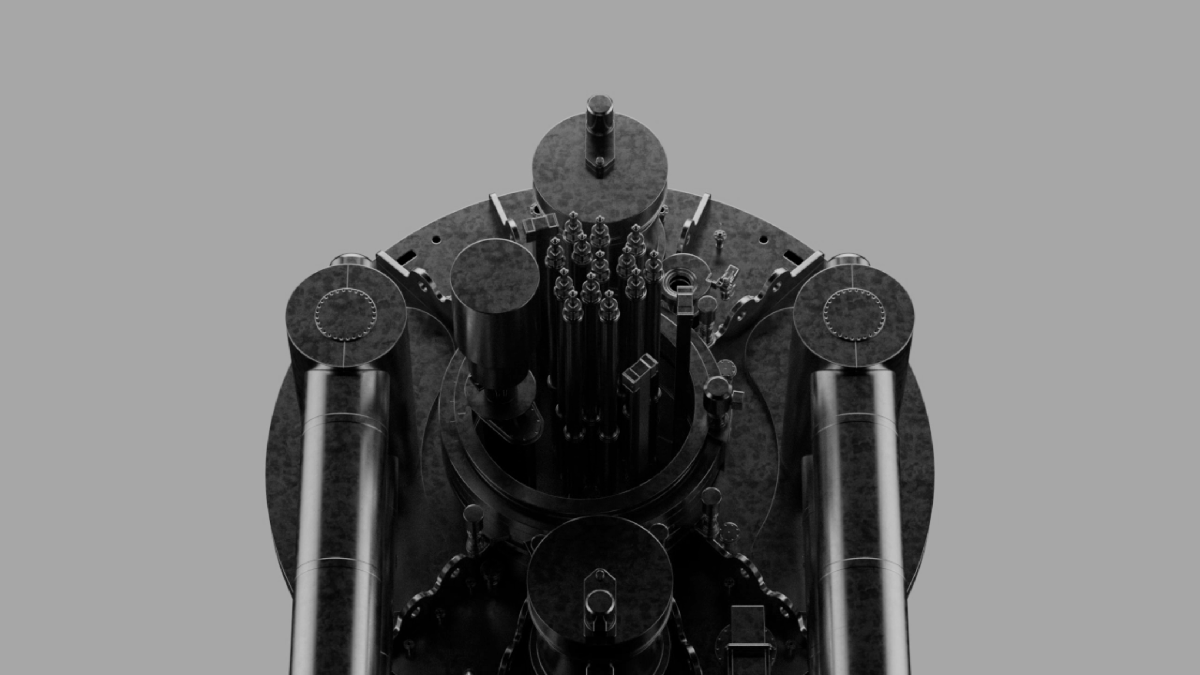
TerraPower designed its 345-megawatt molten salt-cooled reactor to work around those challenges. One of the key considerations was ensuring the reactor could complement intermittent sources of electricity like wind and solar — the power plant needed to ramp up and down quickly. While TerraPower had renewable power, not data centers, in mind when it sketched its plans, the two are similarly intermittent, just on different sides of the equation.
To ramp quickly, TerraPower doesn’t increase or decrease the power output of its reactor. Rather, it keeps on splitting atoms, and the extra heat gets stored in a giant vat of molten sodium. When power demand spikes, the power plant can tap that reservoir to generate more steam to spin the turbines. The expensive equipment keeps working even when demand is low, allowing the company to amortize its investment over more operational hours.
The approach takes the best of nuclear power — high capacity factor — and pairs it with an energy storage technology that allows TerraPower to play nicely on a renewable-heavy grid or when connected to an data center. It’s a flexible approach that could give the startup an advantage in the race to power AI.
When you purchase through links in our articles, we may earn a small commission. This doesn’t affect our editorial independence.
>

Tijjani Reijnders: Dutch midfielder joins Al-Qadsiah from Man City in £52m move

AI App Helps Blind Users Understand Their Surroundings

Nielsen Makes Key Changes to Provide More Accurate Ratings
-

 movies3 months ago
Search For Canadian TV Actor Stewart McLean Now Homicide Investigation
-

 Fashion9 years ago
These ’90s fashion trends are making a comeback in 2017
-
Fashion9 years ago
According to Dior Couture, this taboo fashion accessory is back
-
Fashion9 years ago
Model Jocelyn Chew’s Instagram is the best vacation you’ve ever had
-
Fashion9 years ago
Emily Ratajkowski channels back-to-school style
-
Fashion9 years ago
9 Celebrities who have spoken out about being photoshopped
-
Fashion9 years ago
Your comprehensive guide to this fall’s biggest trends
-
Fashion9 years ago
A photo diary of the nightlife scene from LA To Ibiza