
Anime
cocoon Wartime Anime Streams English-Dubbed Trailer – News

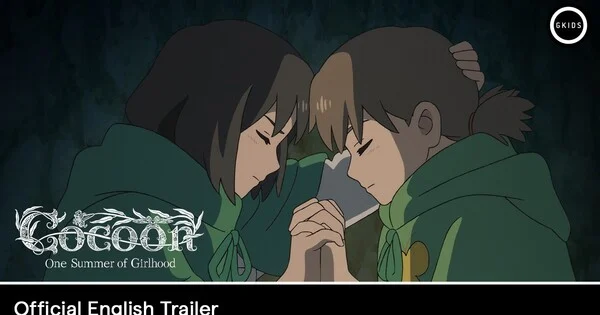
GKIDS began streaming on Tuesday an English-dubbed trailer for cocoon – One Summer of Girlhood (cocoon Aru Natsu no Shōjo-tachi Yori), the anime of Machiko Kyō‘s Cocoon manga.

© Machiko Kyo (AKITASHOTEN) / NHK, NEP
GKIDS will begin screening the anime in theaters in North America on September 4 in Japanese with English subtitles and with an English dub. GKIDS will also release the anime on home video.
This year’s JAPAN CUTS event screened the anime’s North American premiere on July 10. The 30th annual Fantasia International Film Festival is screening the Canadian premiere.
The anime debuted on BS-NHK in March 2025, before airing on NHK General that August.
The anime stars Hikari Mitsushima as Mayu and Marika Itō as San.
Yukimitsu Ina (animation director for Tatami Time Machine Blues) directed the anime, and kensuke ushio (A Silent Voice, Chainsaw Man, DAN DA DAN) composed the music. Hitomi Tateno, a veteran Studio Ghibli animator, was the animation producer, with the studio Sasayuri producing the anime.
The manga is set in a tropical southern island, and centers on San and her best friend Mayu, who go to the island’s top all-girls school. War soon comes to their country, and the students of the school soon become embroiled in the war effort, and soon enough, the rear-line care of the wounded. One by one, San and Mayu lose their friends in the ever-worsening war.
Kyō released the manga in 2010, 65 years after the end of World War II. The anime’s 2025 release came 80 years after the end of World War II.
Kyō published the Mitsuami no Kami-sama manga in Shueisha‘s now-defunct Jump X (Jump Kai) magazine in 2013, and Shueisha published the manga’s first and only compiled book volume in the same year. The manga won an award in the 18th Annual Osamu Tezuka Cultural Prize in March 2014. The manga inspired Production I.G‘s Pigtails 28-minute short anime film. The short made its international debut in April 2016 at the WorldFest Houston International Film Festival, where it won the Platinum Remi Award in the Classic Cel Animation Category. Pigtails has won multiple awards, including the Diamond Award in the Animated Film category at the 2016 California Film Awards.
Source: Press release
>
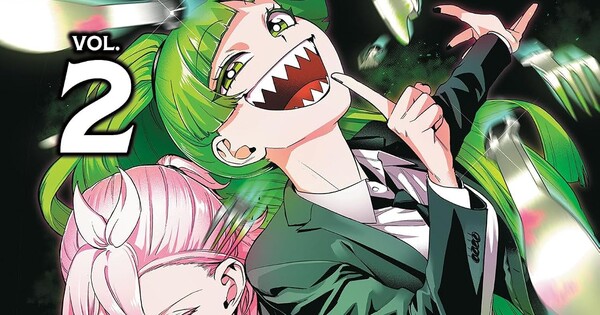
Welcome to Demon School! Iruma-kun: IruMafia Edition has certainly taken some dark turns for a series that started as “what if everyone wore suits?” Not that the suits aren’t still impressive – seriously, Azz looks good – but with these three volumes, the series really comes into its own. While there are still elements that are perhaps more fun if you’re already familiar with and a fan of Osamu Nishi‘s original, such as Balam as a back alley doctor, this has come into its own.
Largely that happens because of the expansion of the cast. These volumes bring us Asmodeus, Clara, Ameri, Balam, Robin, and a few other familiar faces, all with at least tenuous links to their original selves. Clara is the closest to the ram-horned demon girl we know and love; in Irumafia, she’s a circus performer, which suits her very well. But her backstory is grim: her family was their own circus group, but they were separated and sold off. Clara was bought and forced to perform night after night, living in a cage when she’s not on stage. She’s desperate to find her family, and has made herself little beanbags with their faces to keep her company. It’s horrifically tragic, and while Iruma can free her and vows to find the rest of the Valac clan (thus kicking off a black market auction and human trafficking plotline in volume four), this darkening of Clara’s backstory is intense.
It’s also par for the course for most of the characters. Asmodeus, who primarily goes by “Alice” in this series, possibly to differentiate from his normal self, has an equally difficult situation involving police corruption. By volume four, he has to do some major self-interrogation about what “justice” actually means and whether it matters who dispenses it and how. In an afterward, Nishi comments that she’s pretty sure original Azz would be horrified by his Irumafia character, and that’s probably true, but it also makes it clear that this is not just a reimagining of the original series. This is its own story, replete with violence, tragedy, and random use of Italian words.
That’s not a bad thing, for the record. Once you leave your regular Iruma-kun expectations at the door, there’s a lot to enjoy here. The plots are fast-paced, and even when they’re serious, like in the power struggle for control of the slums between Ameri’s street gang and the Babel Famiglia, there’s fun to be had. In this particular case, which occurs in volume three, Ameri’s gang (made up of the student council members from the original series) challenges Iruma, Alice, and Clara to a game of capture-the-flag-paintball. This is as madcap as you might expect while still adhering to the violence present in the rest of the story. Iruma’s solution to not wanting to actually shoot anyone (although he does carry a gun on the regular) is both ingenious and very recognizably Iruma…even if not everyone appreciates his approach.
Ameri is another highlight. The new story and setting allow her to be as badass as she possibly can, and it’s a good look on her. (So is her street punk aesthetic.) Her status as Iruma’s childhood friend who believes Sullivan kidnapped him gives her more leeway to express her feelings than she typically gives herself in the main series, and she’s also clearly the smartest woman in the room, even if her emotions sometimes run away with her. She and Clara form a surprisingly good team when things go down in volume four and serve as foils to Opera and Alice, who are either mad or very, very conflicted. The character dynamics are a highlight of this spinoff, and it is interesting to see how they play out – Kalego, for example, gets to be more overtly concerned with Iruma’s well-being, even if he’s still a grumpy fussbudget about it.
And of course there are the suits. hiroja isn’t as good at drawing the female characters, especially around the hips, but overall this looks very good, and not just in terms of Hot Alice. The art is very dynamic, which is particularly important for Clara, who’s always in motion, and the backgrounds are detailed with a firm sense of place. The settings are gritty but look like places where people actually live, except Sullivan’s huge, immaculate house – and that’s almost certainly on purpose.
Irumafia truly comes into its own with these volumes. New/old characters allow the plot to veer off into its own directions separate from the original, and although dark and filled with gun violence, it’s a story worth reading. Don’t go into this expecting more of what you’re used to, but for a very different take on some old friends, it’s a very interesting series.
>
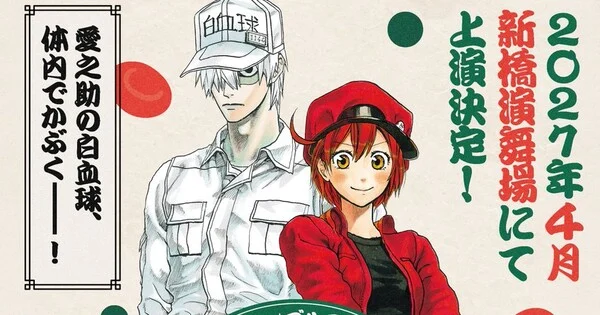
A new official X/Twitter account opened last Friday to announce that Akane Shimizu‘s Cells at Work! (Hataraku Saibō) manga is getting a kabuki stage play adaptation at the Shinbashi Enbujō in Tokyo in April 2027. The account lists that it is a “scramble kabuki” play, a new style that casts a mix of traditional kabuki actors and other actors.

© 清水茜/講談社
Kensuke Yokouchi is directing and writing the play.
Ainosuke Kataoka, who played Pneumococcus in the series’ live-action film, stars as White Blood Cell in the play. The cast also includes Kazutarō Nakamura, Ryoga Ishikawa, Mandy Sekiguchi, and Ichikawa Chusha.
Shimizu launched the original Cells at Work! manga in the March 2015 issue of Kodansha‘s Monthly Shonen Sirius magazine, and ended it in January 2021. Kodansha USA Publishing is releasing the manga in English.
The first television anime of the original manga premiered in July 2018. The second season premiered in January 2021, alongside the anime of the Cells at Work! Code Black spinoff manga.
The live-action film adaptation opened in Japan in December 2024 and ranked at #1. The film sold a total of 612,000 tickets and earned a total of 844,768,310 yen (about US$5.74 million) in its first three days. Netflix began exclusively streaming the film in June 2025.
Kodansha USA Publishing is also releasing the following spinoff manga in English: Cells at Work: Bacteria!, Cells at Work!: Neo Bacteria!, Cells at Work! White Brigade, Cells at Work! Baby, Cells NOT at Work!, Cells at Work! Code Black, Cells at Work and Friends!, Cells at Work! Lady, and Cells at Work: Platelets!.
Several other spinoffs exist such as Kae Hashimoto‘s Hataraku Saibō Illegal (Cells at Work! Illegal), Yū Maeda‘s Hataraku Saibō Muscle (Cells at Work! Muscle), Choko Aozora and Meku Kaire‘s Hataraku Saibō Neko (Cells at Work! Cat), and Koma Warita and Ryō Kuji‘s Hataraku Saibō Okusuri (Cells at Work! Medicine).
Sources: Cells at Work! kabuki play’s X/Twitter account, Comic Natalie
>

© 久保帯人/集英社・テレビ東京・dentsu・ぴえろ
When I was 12, all I wanted from my battle shonen anime was cool, hype moments. As I got older, I wanted more: A good story, characters I could root for, and if the whole thing had layers of metaphor to peel through to get to the messaging, all the better. But now, in my 30s, while the latter will make a battle shonen anime better to me every time, I’ve landed right back at, “If it at least has cool, hype moments, that means it’s doing its job, and that’s fine.” And while it’s not to say Bleach has nothing going on in the story and character departments, it’s very obvious where Thousand-Year Blood War is by far the most concerned: If I’ve said it once, I’ve said it a thousand times, and it’s spectacle. And episodes like this one really epitomize that.
This feels like the kind of episode that would’ve altered a generation’s brain chemistry if it had come out 20 years sooner. Imagine going back to the 2000s and telling Bleach fans that they were eventually going to be in for a fight involving Kenpachi, Byakuya, and Hitsugaya. Excellent idea on paper, but in practice? It could be a lot better—and certainly the three of them could synergize far, far better—but I’m not mad at the results. I wish Byakuya were doing more, but any time we get to see any of these three powerhouses fight is a treat. And new powers for Kenpachi and Hitsugaya? Yes, please.
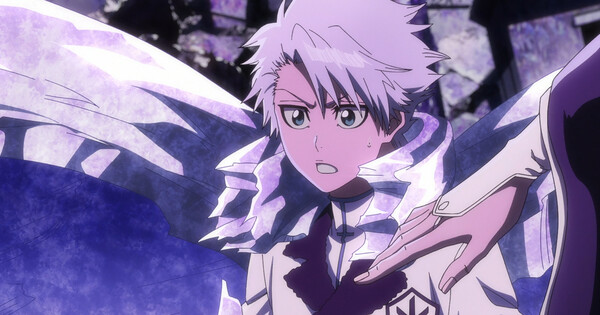
Speaking of which, dear Haruhi. When I say, “If this episode had come out 20 years earlier it would’ve changed brain chemistries,” I’m also referring very much to grown-up Hitsugaya, who’s voiced in Japanese by Yūki Kaji (very curious if they’ll cast someone else in the dub, and if so, who it will be). I’ve never been the biggest Hitsugaya fan out there, but I’m no Hitsu-hater, either. And certainly I’ve been into Bleach long enough to know that especially once upon a time, this was a character with a veritable army of fans. The fujoshi, the fan artists—everyone would’ve had a field day with grown-up Hitsugaya if he were around during the height of Bleach‘s popularity. And rightfully so, to be clear; that his power does that to him very obviously feels arbitrary, and like it’s something Kubo added for fan service. And especially this late in the game, sure. Nothing wrong with that, and again, it really feeds into the spectacle of it all that this series has been all about.
You may have already guessed it, but to me, Kenpachi was the star of the episode. Always the unkillable badass, obviously he still has more tricks up his sleeve—although this one seems to have a bit more to it than his others do. It’s not even entirely clear whether or not Kenpachi himself seems fully aware of what he’s doing, though I lean toward believing that he has no idea what precise manner of thing is happening to him. I’m sure next week, or sometime otherwise soon, we’re in for a more detailed explanation. But in the meantime, I’m happy to sit back and enjoy the ride. Even just within Thousand-Year Blood War, Kenpachi has had some A+ fights, and this one, if it continues at its current pace, might join its ranks.
Again, I only wish Byakuya would do more. So far he’s just been sitting on the sidelines, doing little more than pretty minimal support such as encouraging Rukia and Renji to go help Ichigo. He’s not doing anything, but especially considering how much we know he’s capable of, one can’t help but want to scream, “JUST DO SOMETHING” at him every time he’s on screen.
In the midst of all this, we only barely got to see any of the developing fight between Ichigo and Yhwach. But that didn’t make me scream any less when the old music kicked in with Ichigo going Hollow-mode. Is the pacing for this fight very obviously being impeded by the series weirdly insisting on only drip-feeding it to us thus far? Yes. Is it frustrating? To a certain extent, also yes. And yet, I can’t deny that it gets me hype every time. Still, I’m definitely looking forward to after the series wraps up, and people edit the pieces of the fight together into one continuous fight, rather than the fragments we’ve been given.
Rating:
Bleach: Thousand-Year Blood War – The Calamity is currently streaming on
Hulu and Disney+.
The views and opinions expressed in this article are solely those of the author(s) and do not necessarily represent the views of Anime News Network, its employees, owners, or sponsors.
>
Starz’s #TakeTheLead Writers Program Returns for 5th Year

‘Hidden Heroes’ Descendants Movie Adds Darren Criss, Sherry Cola, More

cocoon Wartime Anime Streams English-Dubbed Trailer – News
-

 movies3 months ago
Search For Canadian TV Actor Stewart McLean Now Homicide Investigation
-

 Fashion9 years ago
These ’90s fashion trends are making a comeback in 2017
-
Fashion9 years ago
According to Dior Couture, this taboo fashion accessory is back
-
Fashion9 years ago
Model Jocelyn Chew’s Instagram is the best vacation you’ve ever had
-
Fashion9 years ago
Emily Ratajkowski channels back-to-school style
-
Fashion9 years ago
9 Celebrities who have spoken out about being photoshopped
-
Fashion9 years ago
Your comprehensive guide to this fall’s biggest trends
-
Fashion9 years ago
A photo diary of the nightlife scene from LA To Ibiza