
Entertainment
‘Insidious: Out of the Further’ Review: Time to Kill This Franchise?

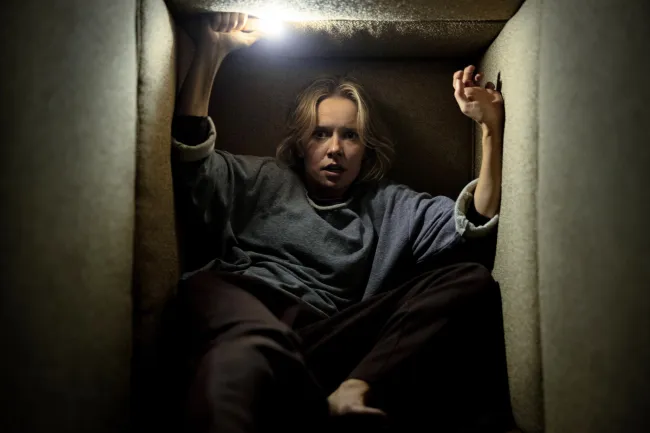
Un-scary and uninspired, the creaky sixth entry in the “Insidious” series will make you want to send this franchise to the realm of the dead. The permanently dead. The best thing I can say for Jacob Chase’s crack at Blumhouse-Atomic Monster lore titled “Insidious: Out of the Further,” another soporific retread of the horror movie as grief metaphor, is that it doesn’t require you to do any homework.
This fifth sequel to 2011’s James Wan-directed “Insidious,” perennially viral because of its Darth Maul-like poster child known as the Lipstick-Faced Demon, jumpstarts the franchise’s backstory with new characters and grindingly by-the-numbers obstacles. Take a nap, look at your phone, order another bev, because endless exposition requires scarce attention. Personally, I’ve come and gone from the series about the collision of a purgatorial spirit world with our mortal one, which has proven sizably profitable for Blumhouse relative to its budgets despite patchy receipts from critics.


Here, British actress Amelia Eve (“The Haunting of Bly Manor“) stars as a what-else-but traumatized dental hygienist who is being stalked by the otherworldly ghouls of the Further — a kind of limbo holding cell where demons and restless ghosts convene — due to her apparent psychic ability to traffic objects and beings from one plane to the other.
Despite a coughed-up effort at mythology refresh to hopefully welcome newer audiences into the franchise’s long-running fray, “Insidious: Out of the Further” winds up another gumbo of cliches and tropes drowned in overexplanation: astral planes, material planes, mothers and daughters, cross-generational trauma, white facepowder, hypnotism, mediums, sunken places, hags, red doors, gravelly distorted voices, peeled fingernails, more hags, rictus grins, old people, grief, and mercilessly constant jump scares. Chase seems more fascinated by extreme close-ups of toweringly bad gingivitis and gooey-sticky plaque formations on dental implants than by narrative ingenuity, especially when one of Gemma’s (Eve) patients at the Second Smile clinic happens to be a ghastly dispatch from the Further itself.
This sixth entry indeed takes us further into the Further, where a limp-haired Marilyn Manson-type entity called Cyrus Lam has its eyes on Gemma in the present day. But the movie begins in Pittsburgh, 1999, when young latchkey kid Gemma (Charli Penton) arrives home from school to her emotional absentee mother Ingrid (Laura Gordon). Visible signs of body-hijacking mental illness drive Ingrid to a grisly suicide in the bathroom that her daughter is forced to witness.
A quarter of a century later — but only a few weeks after the events of 2023’s Patrick Wilson-starring “Insidious: The Red Door,” as we’ll later learn courtesy of a certain loony clairvoyant — and single-mom Gemma has a nine-year-old daughter of her own, Maya (Island Austin). She’s also got a superhot copy boyfriend (“Nope” breakout Brandon Perea) whom Gemma keeps at a remove, uneasy and unready to welcome a new man into Maya’s life. (It’s heavily implied the small girl never knew her father; same went for the young Gemma.)
Increasingly, ominous presentiments start to appear before Gemma, like a visibly dead-looking old-timey family of three with mirthlessly toothy grins pasted across their pallid faces, jarringly out of place in a contemporary suburb but observed mostly with a “huh.” Or a flashlight Gemma hasn’t seen since she was a little girl. Or a spiked talisman that could prove a conduit between our world and the land of the Further. One nifty sequence in a movie almost perversely lacking in them: Gemma crawls into one of Maya’s world-famous pillow forts, only to end up contorting herself through a liminal space of endless couch cushions to evade a Further-sent elderly demon. But does this sequence only work because it harks back to the very recent chills and thrills of Kane Parsons’ empty-spaces-as-existential-horror movie “Backrooms“?
Whatever’s going on, a sleepless, nerve-fried Gemma surmises through ramblings that concern her boyfriend that it has something to do with her mother. Someone who might have the answers is fan-favorite franchise staple Elise (Lin Shaye), a medium who commutes between both worlds, here via the body of a tattoo artist (Maisie Richardson-Sellers) endowed with paranormal gifts. Gemma’s ability to teleport objects from the Material Plane to the Further — such as a burned-out TV set playing images of Cyrus Lam vaguely overseeing some kind of occult ritual sacrifice — may also extend to transporting entities. And to closing for good the Red Door that is so perilously open right now, allowing demons to come and go from Gemma’s dream and waking states.

Gemma’s increasing frailty and the newfound demands of being a spiritist courier now tasked with the most important job of all provide star Eve a fine enough base to play. That’s despite a screenplay also written by Chase (the writer/director of the dull mommy-daughter thriller “Come Play“) that prioritizes jump scares coming at you from the screen rather than three-dimensional human beings. And jump scares are abundant throughout “Out of the Further,” in place of any psychological complexity beyond ambiguous brushes with how we try to organize our grief around past traumas seeping into the fabric of our present.
Gemma’s astral-projecting capabilities, as an overwritten script leaps lumpily throughout timelines to explicate, were likely inherited from Ingrid, who maybe wasn’t actually mentally disturbed and in serious need of a wellness check but instead was being haunted by the classic troupe of “Insidious” villains: Spirit Halloween-grade, “Carnival of Souls”-like specters in dusty evening wear, caught dead in a fancy party that never stopped. And if Gemma caught her mother’s psychic disease, what does that mean for little Maya?
A late-August release date for a horror title is typically the kiss of death, a summer dumping ground only occasionally revitalized by movies like 1999’s “The Sixth Sense” — whose, for millennials anyway, childhood-scarring shot of a bathrobe-clad ghost with slit wrists gets a lazy shout-out here. No need to reiterate how much the stakes of the horror genre have been upped this year, so much that “Insidious: Out of the Further” needs to seriously justify itself for being so bad. The function of the jump scare, which is I know I know integral to the genre’s machinations, has changed, too: Its purpose now is to get people in the audience to look up from their smartphones, especially helpful if you’re sitting in an Alamo Drafthouse. Perhaps the jump scares here also helped shake the filmmakers out of their lethargy in post-production. Something to live for, something to do.
There’s also the issue of the dank-blue, drained-of-all-life filter painted over the film‘s coverage shots, here overseen by cinematographer Dave Garbett. That Amelia Eve’s breakout credit came courtesy of a Mike Flanagan joint disappointingly reminds of how much the filmmaker/TV creator’s signature aesthetic — often underlit to the point of incoherence, and ever a steely gray-blue to convey an uncanny inner awfulness — now defines the genre’s visual palette in 2026. If everything is already imbued with the pallor of the dead from the start, then nothing is scary or unexpected.
Direly, dreadfully boring, “Insidious: Out of the Further” has money on the brain. So do most things, but this time, it’s way too conspicuous and underserving of the epochal year Blumhouse-Atomic Monster is having between “Backrooms” and “Obsession.” And the comparisons will only stop when the slop stops being poured.
Grade: D
Sony releases “Insidious: Out of the Further” in theaters starting Friday, August 21.
>
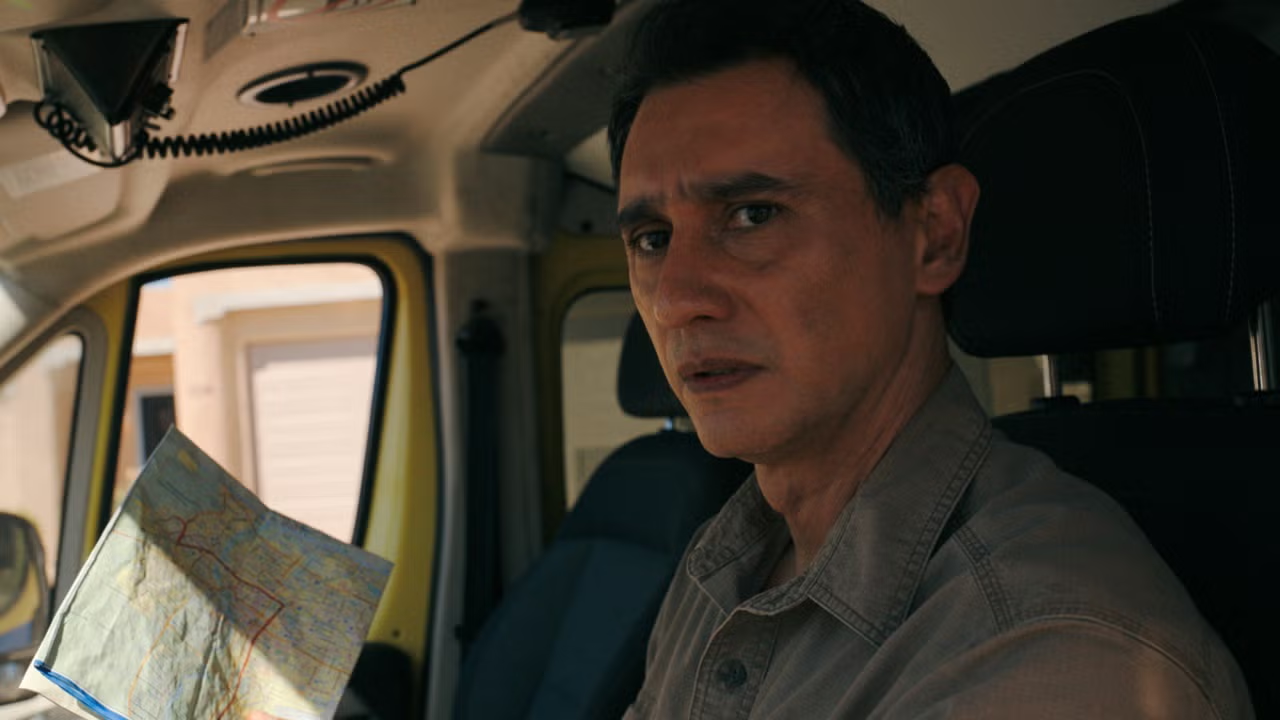
The supporting-actress and supporting-actor nominations for Karolina Wydra and Carlos-Manuel Vesga aren’t just two of the most deserved honors of this Emmy season; they’re also plaudits for two performances that embody how gloriously odd and thought-provoking “Pluribus” is. While Wydra may be the first person nominated for playing 8 billion people at once, Vesga is one of only a handful of actors to be nominated for playing a nearly silent role.
“The show fulfills every role that you would expect from a TV series,” Vesga said. “But also it really goes beyond entertainment and starts to walk the territory of art, which is a different thing from entertainment. Art is about presenting the audiences with different angles on human existence. Hopefully, those new angles and perspectives are going to invite audiences to question their own existence and maybe better that existence.”
Wydra’s Zosia and Vesga’s Manousos sit on opposite sides of the moral dilemma that plays across Vince Gilligan’s Apple TV drama. “Pluribus” starts with a virus that quickly spreads across Earth, infecting all of humanity in hours and turning most of the world into a connected hive mind. The only people not controlled by
“the Joining” are a handful of survivors who are immune to this virus as well as to the Others’ control. Rhea Seehorn’s Carol is a rare survivor, a romance author who resents her fans, is mourning the death of her wife and is now one of the last remaining defenders of what’s left of human free will.
Most of the conversations about the importance of that autonomy happen between Carol and Zosia, a member of the Others who serves as Carol’s chaperone and eventually her love interest. As Zosia argues that the Joining has eliminated racism, mass pollution and poverty from the world, Carol argues that everything worthwhile about being a person — aspects like love, passion, art, family and friendship — relies on people having their own thoughts and opinions.
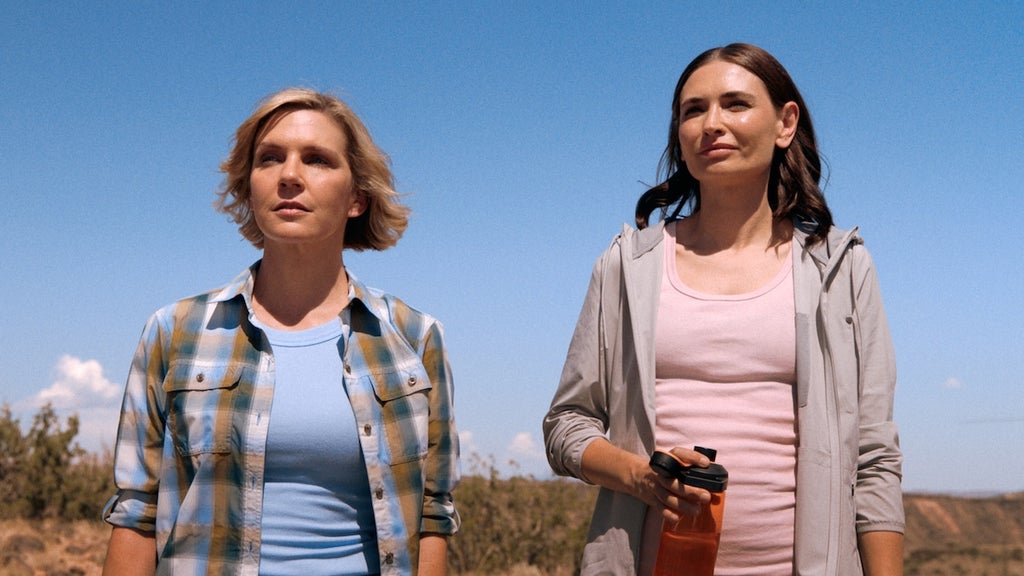
“I feel so incredibly grateful to be part of something that makes people talk and makes people sit and actually be present,” Wydra said. “[The show] pressures you to have the conversations about what it means or what resonates with you.”
To construct the role of Zosia, Wydra worked closely with Gilligan and the rest of the “Pluribus” team to determine how exactly a hive mind of 8 billion connected people works. While Zosia does experience emotions like happiness, anger and grief, they’re all felt as if they’re a faded memory. That distant politeness is crucial to how Wydra portrays Zosia.
“You can compare it on some level — and I’m not saying that that’s what Vince had in mind — but definitely to AI,” Wydra said. “They don’t have the same emotional consciousness on some level that a normal human being does, but they can perform everything and anything to the best of their ability — actually at the best of all humanity.”
In contrast, Vesga’s Manousos, another of the few immune survivors, spends most of Season 1 refusing help from the Others and cutting himself off from the rest of the world.

Heading into “Pluribus,” Vesga knew only that Manousos was an immigrant who had moved from Colombia to Paraguay. That detail was all he needed to conceive a deeply complicated character.
“It does inform the way he approaches the Joining,” he said. “The fact is that this guy had to leave his home country and lose his roots, his identity, his loved ones, probably, to try to build a new world for himself in a different country. That’s why he’s so black and white about [the Joining]. He knows what loss is, and he knows what losing one’s identity is.”
As the season progresses, Manousos’ role becomes a far more physical one, especially once he decides to find Carol without relying on the Others. But for Vesga, it wasn’t traversing the notoriously dangerous Darién Gap on the border of Colombia and Panama that was most difficult. Far more challenging were Manousos’ quieter scenes in his office, moments when Vesga had to construct and communicate his character’s entire personality while barely saying a word.
“His inner world and his inner tensions, for me, were the most important part,” he said. When Manousos did talk, Vesga worked closely with the directors and producers to ensure that the meaning of his words transcended his short lines. “How do you express through a line like ‘Today is Monday’ the stress, anguish, pain and physical pain — everything that this guy is going through?” he said. “Though those lines seem disconnected from the emotion and state he’s in, I would have to use them to complete the whole picture.”
This story first ran in the Down to the Wire Drama issue of TheWrap’s awards magazine. Read more from the issue here.


>
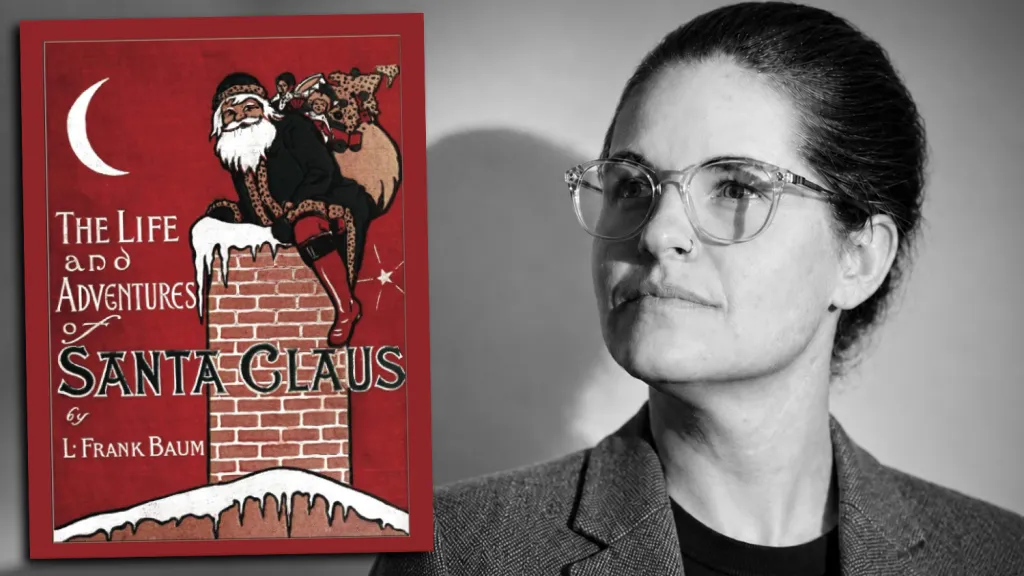
EXCLUSIVE: Monarch Media has enlisted Kali Bailey to adapt the screenplay for The Life and Adventures of Santa Claus, a live-action feature adaptation of the children’s book by L. Frank Baum.
First published in 1902, Baum’s book follows Santa Claus from an abandoned baby in a magical forest near Oz, to his beloved role of spreading peace, love and lots of toys at Christmastime. Recognized as one of the greatest fantasy writers of the 20th century, Baum is best known for his 14-book series, The Wonderful Wizard of Oz, which of course inspired the 1939 film classic The Wizard of Oz.
Monarch principals Steve Barnett, Alan Powell and Vicky Patel will produce the new movie.
This isn’t Bailey’s first time working with the Monarch Media team, having co-written the company’s coming-of-age film A Week Away, which spawned the Angel Network series of the same name. She went on to co-direct multiple episodes of the spinoff series and also wrote and directed the Angel Network sci-fi film The Lightning Code.
Speaking to the origins of the Life and Adventures movie, Monarch’s Barnett said: “I’ve been obsessed with the origins of Santa Claus for a long time, so discovering that the incredible L. Frank Baum had explored that backstory was really exciting. Santa is one of the few fictional, global icons, and this story taps into that shared mythology. Kali has created a sweeping, four-quadrant adventure that feels timeless yet fresh—a big, emotional ride that will connect with everyone around the world, across cultures and generations.”
Monarch’s credits include producing the Richard Linklater film Hit Man, starring Glen Powell, and the animated feature Tangles, starring Julia Louis-Dreyfus, Bryan Cranston, Seth Rogen and others, which premiered to critical acclaim at this year’s Cannes Film Festival. Their comedy Babies, directed by Lauren Miller Rogen, and starring Seth Rogen, Anna Kendrick, David Strathairn, Sharon Stone, Ed Helms and Issa Rae, is slated to premiere at the upcoming Toronto Film Festival and will be released theatrically this fall.
Monarch is also producing an untitled Nick Jonas holiday rom-com for Netflix, to be directed by Ari Sandal, and is currently prepping a remake of coming-of-age film A Walk to Remember.
Bailey is repped by First Story Entertainment and attorney Joshua Lastine of Lastine Entertainment Law.
>
Zach Roberts still remembers seeing 1998’s “The Mask of Zorro” for the first time as a child. As he watched the film’s daring stunts and swashbuckling action, he realized that his ambition was to do that.
“I guess I just never really let that go,” Roberts said. “At school, I went to a careers evening and they said, ‘What do you want to do?’ I said I wanted to be a stuntman and they said, ‘Go join the Army or become a bricklayer. It’s never going to happen.’”

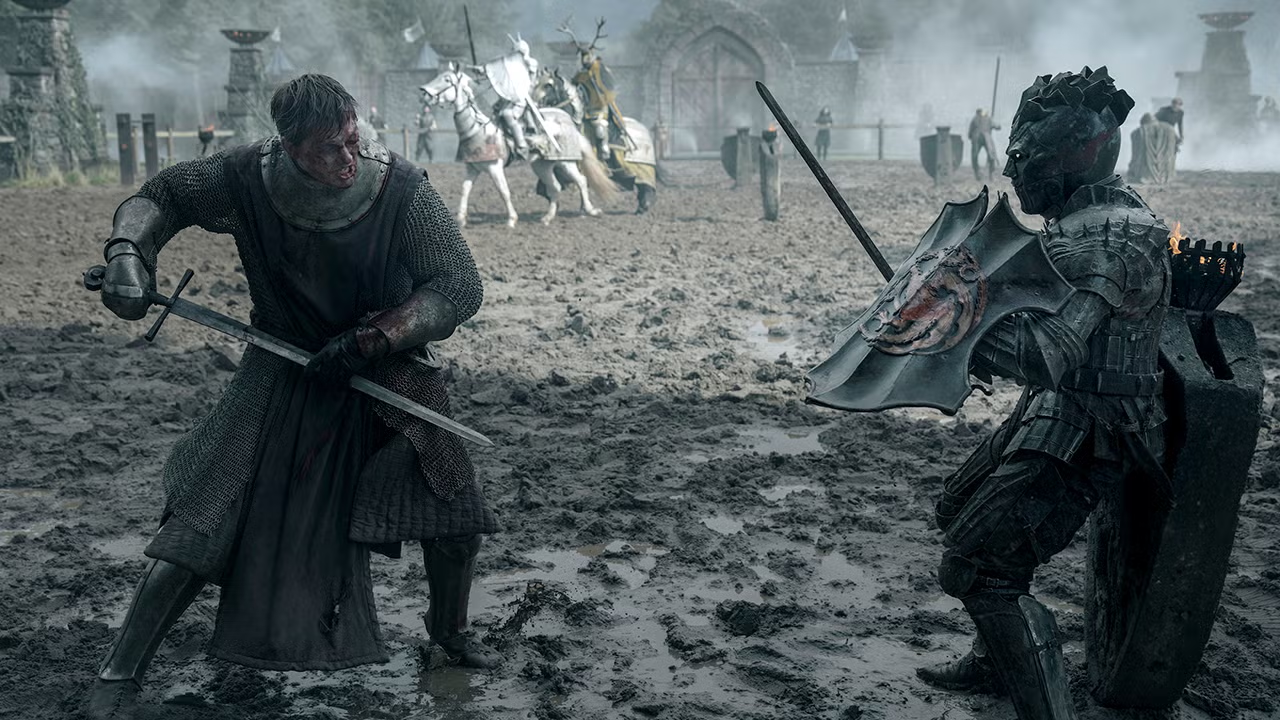
But happen it did. Roughly 30 years later, Roberts picked up his first Emmy nomination for Outstanding Stunt Performance, alongside Gyula Tóth, Chris Cox and Jake Cox, for “A Knight of the Seven Kingdoms.” They’ve been recognized for the fifth episode of HBO’s “Game of Thrones” prequel, which includes a massive seven-on-seven skirmish led by Ser Duncan “Dunk” the Tall (Peter Claffey) on one side and Prince Aerion Targaryen (Finn Bennett) on the other.
The sequence is bloody and brutal, filled with flying weapons, rogue horses
and intricate choreography. Roberts took over as Aerion from the moment the
prince dons his ostentatious headgear: “As soon as the helmet went down, that
was all me,” he said. The four-man team (plus 10 riders for the jousts) worked
closely with stunt coordinator Florian Robin and second-unit director Rob
Inch for a sequence that took around 10 days to shoot, after heavy rehearsals.
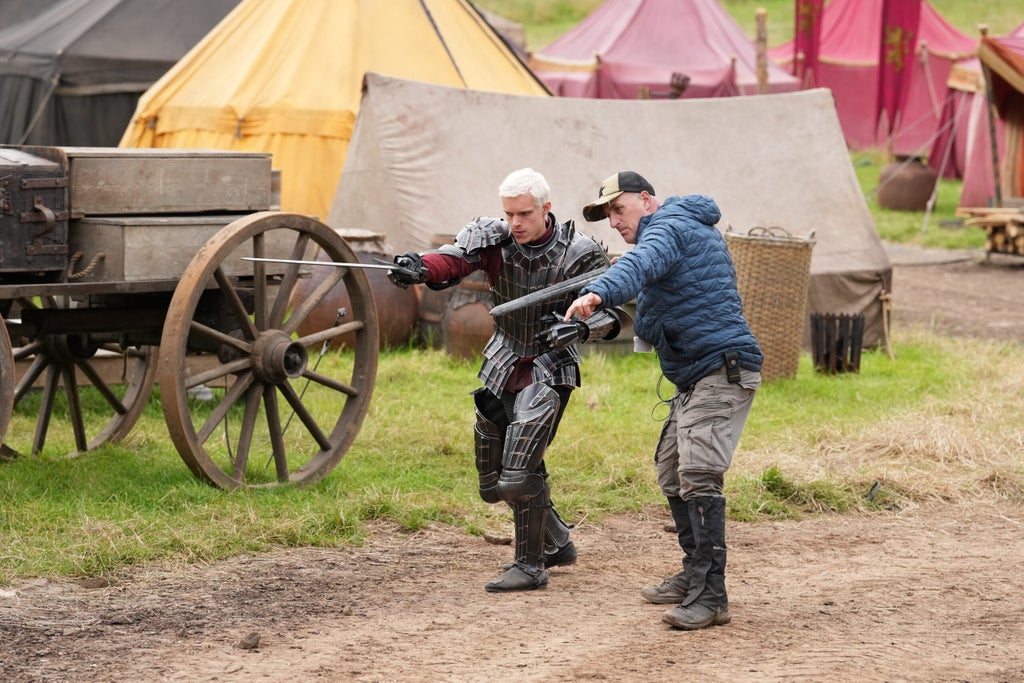
“When we got there on the day, they really knew the target for each day, and it meant we had freedom,” Roberts said. “Where can we push a little bit to get those elements that are the magic?”
Though the arena was built for a dry fight, Roberts said “A Knight of the Seven Kingdoms” creator Ira Parker pushed for the brawl to take place in mud. It added an element of chaos and grounded the sequence, but it also made things heavier, slower and more slippery.

At the same time, Roberts had to work while wearing his character’s intricate armor. As a nobleman of the realm, Aerion sports spike-covered shoulders and a helmet modeled after his own face. But the helmet lacked peripheral vision and limited Roberts’ visibility, while the shoulders created their own challenges.
“What can look amazing can impede us,” he noted. “Originally, a lot of the spikes were metal. Smashing into somebody or falling, you’re on metal spikes, so then you have to negotiate: Is there any way we can rubberize them or cut them to make them safer, so we can have that amazing look without it actually being a danger?”
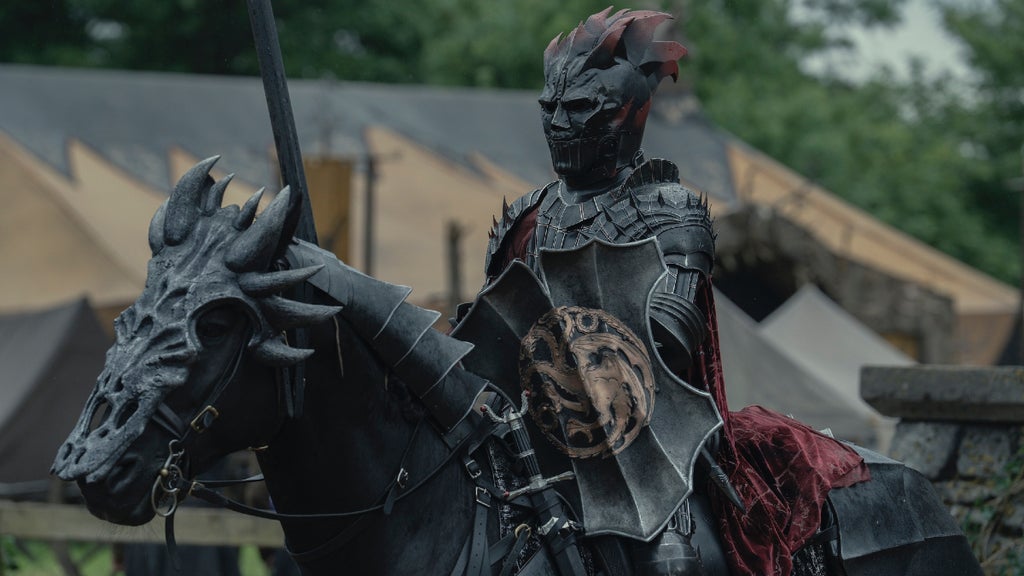
In the end, the spikes were rubberized. But Roberts still had Aerion’s long, flowing cape to contend with. “We fought to have that cut down,” he said. “If you remember ‘The Incredibles’ when Edna Mode says, ‘No capes!’—there is a really strong reason why. I might try and run forward and a horse stands on it.
The negotiations, Roberts said, are at the heart of a stunt performer’s career—looking at every variable to find the best way to safely render action on screen. With Roberts now serving as the assistant coordinator on Season 2, it’s safe to say his childhood swashbuckling dreams have been realized.
“A lot of people think that stuntmen are crazy or take all these risks, but it’s actually very calculated because it needs to be repeatable,” he said. “So you just learn the parameters. How have we made everything safe? If we communicate well, we’re limiting the chance of risk or something happening, knowing that it is possible. It’s not that you don’t feel alive or on the edge in those moments. You just get into the zone where you feel everything happening.”
This story first appeared in the Down to the Wire: Drama issue of TheWrap’s awards magazine. Read more from the issue here.

>

Hollywood Reporter: Live-Action Naruto Film in Talks to Cast Charles Melton as Kakashi – News

Why the Patriots’ red zone play might be the only thing to slow down their offense

MLS wants every game to matter. Its new expanded playoff format edges it closer to reality
-

 movies3 months ago
Search For Canadian TV Actor Stewart McLean Now Homicide Investigation
-

 Fashion9 years ago
These ’90s fashion trends are making a comeback in 2017
-
Fashion9 years ago
According to Dior Couture, this taboo fashion accessory is back
-
Fashion9 years ago
Model Jocelyn Chew’s Instagram is the best vacation you’ve ever had
-
Fashion9 years ago
Emily Ratajkowski channels back-to-school style
-
Fashion9 years ago
9 Celebrities who have spoken out about being photoshopped
-
Fashion9 years ago
Your comprehensive guide to this fall’s biggest trends
-
Fashion9 years ago
A photo diary of the nightlife scene from LA To Ibiza