
Sports
Against a World Series contender, Braves’ Bryce Elder gives reason for hope

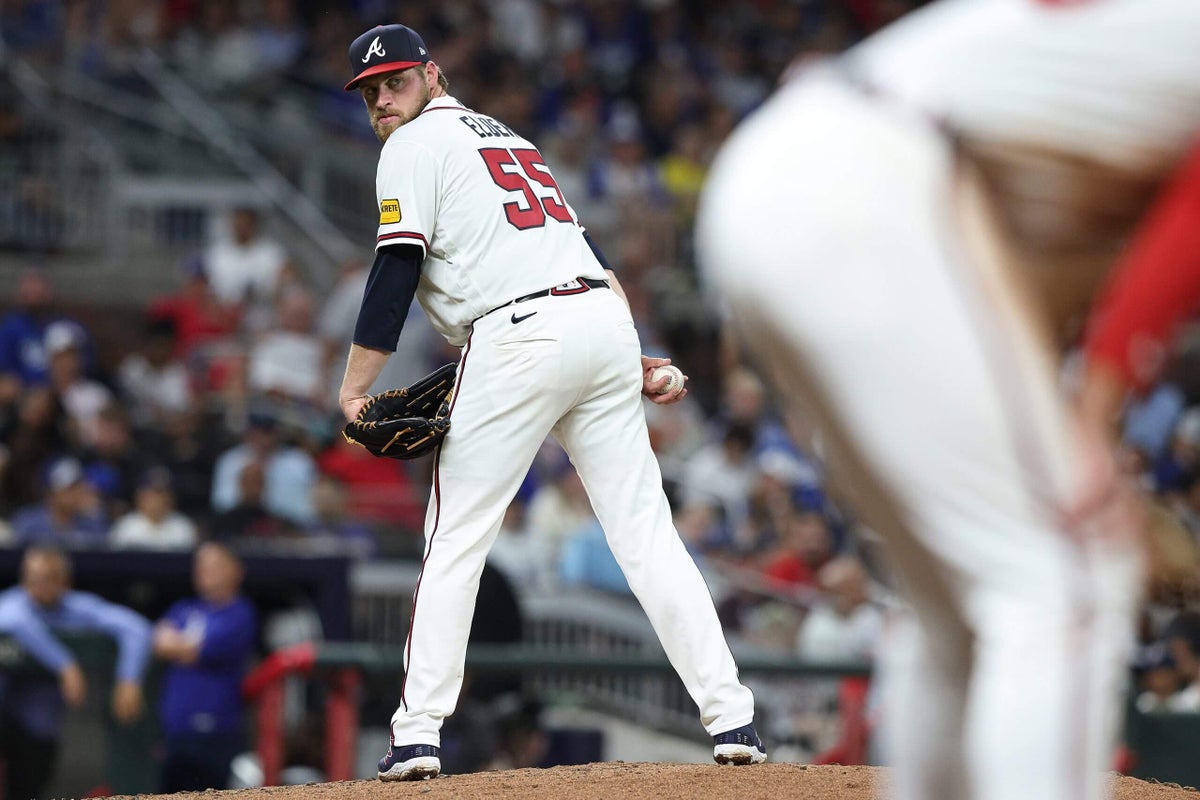
ATLANTA — After striking out Los Angeles Dodgers superstar Shohei Ohtani to strand two runners in the second inning, Atlanta Braves right-hander Bryce Elder shouted and was visibly fired up. The result of his successful ABS challenge showed on the stadium screen behind him.
It may only be late August, but Tuesday night’s outing against the reigning back-to-back champions tested whether Elder has enough in the tank to pitch against a World Series contender.
The right-hander gave up three runs on eight hits and struck out five in six innings, giving the Braves a chance to push the go-ahead run across late to beat the Dodgers 4-3. It was a crucial series-opening win to begin a three-week stretch that includes back-to-back weekend series against the surging Philadelphia Phillies and a home series against the Tampa Bay Rays, who currently have the best record in the American League.
Now, Elder needs to show that he can be consistent. After looking like one of the best pitchers in baseball through the first two months of the season with a 1.97 ERA, the 27-year-old struggled. He gave up 32 runs over 34 innings from May 27 to July 9.
However, he’s bounced back in the second half. Not including a seven-run implosion against the lowly New York Mets on Aug. 10, he has a 2.25 ERA.
“Me and (pitching coach Jeremy Hefner) have been working on some things,” Elder said. “Just moving down the mound and getting the ball coming out better again.”
Elder wasn’t as efficient Tuesday as he was when he faced the Dodgers in May, when he was sporting one of the lowest ERAs for starters on what was then MLB’s best team. Still, he gave the Braves confidence, holding the Dodgers’ first three hitters — Ohtani, Freddie Freeman and Mookie Betts — hitless in three turns through the top of the lineup.
It wasn’t just keeping the top of the Dodgers lineup in check; another big moment for Elder came in a tie game with runners on first and second. Rather than turn the game over to lefty Dylan Dodd, who was already warming in the bullpen, manager Walt Weiss afforded Elder the chance to work himself out of the sixth-inning jam, and it paid off with Elder striking out Alex Call and Alek Thomas to escape.
“I never, ever worry about Elder’s composure,” Weiss said. “His demeanor never changes. … That’s a great strength to have.”
If the Braves are going to make it past the first round of the playoffs, they’ll need Elder to channel what he showed Tuesday night into the remainder of his starts. They don’t have the luxury of relying on the returns of Spencer Strider or Hurston Waldrep, who aren’t progressing quickly enough from elbow injuries. And AJ Smith-Shawver, who is scheduled to start Wednesday, isn’t yet battle-tested.
A surge from Elder, paired with continued consistency from trade deadline acquisition Tyler Mahle, can go a long way toward carrying the team into the playoffs and past whoever they face in the National League Wild Card Series, if they can’t secure a first-round bye.
“We’re really prepared,” Elder said. “With the (recent 6-10) stretch we had, it kind of sucked for a little bit. But like I said about tonight, something about playing good teams — you look at it on paper and you’re like, ‘Ooh, it’s it’s going to be tough.’
“But at the same time, most of the team’s been around so long that sometimes we need the better team to get guys ready to go.”
>
Sports
UEFA Champions League 2026-27 draw: When it is, and the new rule affecting Arsenal and Liverpool
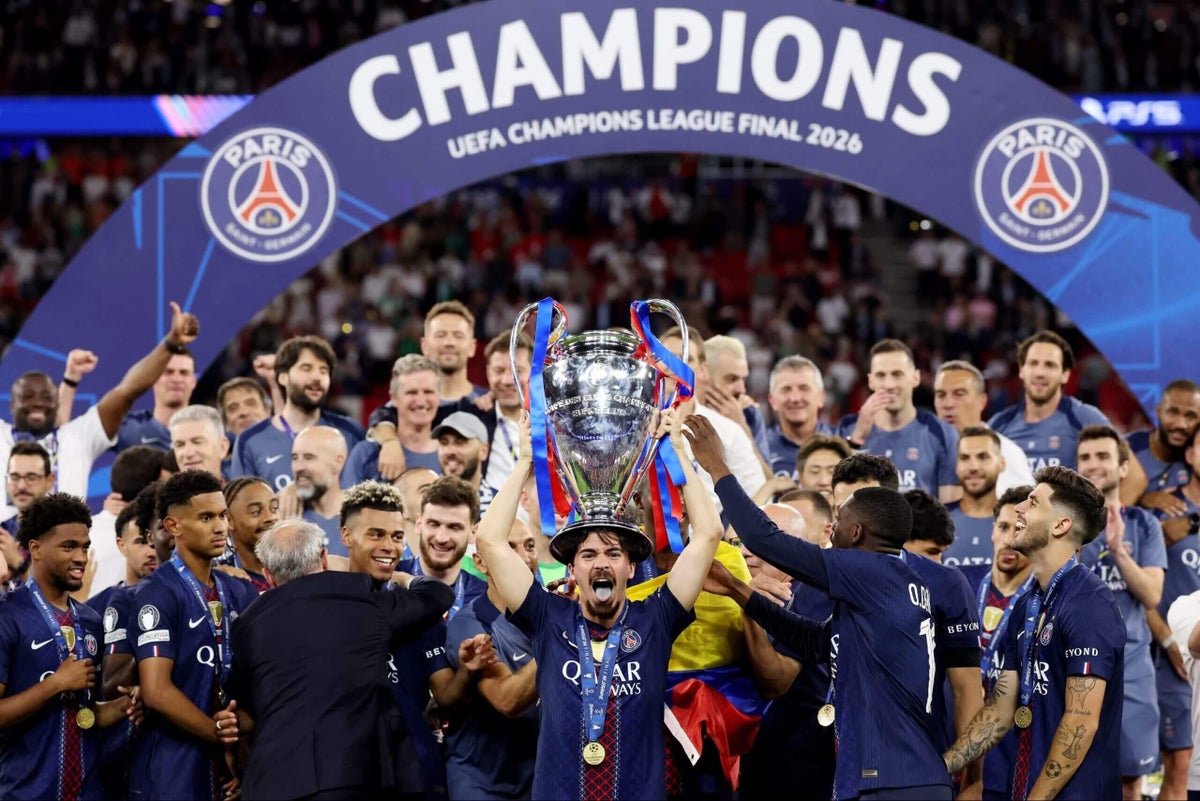
It’s been a long summer of football thanks to the 2026 World Cup, but now the UEFA Champions League is back. Almost, anyway.
With four rounds of qualifying now over, the league-phase draw will take place today (Thursday, August 27), with the competition proper’s initial stage kicking off on Tuesday, September 8.
Last season’s final was one to forget for Arsenal fans as Paris Saint-Germain won their second successive Champions League title, beating the Londoners 4-3 on penalties after a 1-1 draw in Budapest.
All 36 qualified teams will be dreaming of reaching the 2026-27 final, which will be played in June at the Metropolitano stadium in Madrid. The league-phase draw will determine how that path unfolds, so let’s have a refresher on how it will all work.
When is the Champions League draw?
The draw for this year’s league phase is happening today (Thursday, August 27, from 5pm BST/12pm ET) at Grimaldi Forum in Monaco. This follows the final round of qualifying games that concluded the night before.
As for the equivalents in the second-tier Europa League and third-tier Conference League, they will take place a day later, starting at 12pm BST on Friday, August 28.
To watch the draw, you can find it on UEFA’s website, UEFA.com. For readers in the United Kingdom, it will also be available on TNT Sports 1 and the TNT Sports YouTube channel.

(Harold Cunningham/AFP via Getty Images)
How does the Champions League draw work?
The 36 teams are divided into four pots of nine based on their UEFA club coefficient rankings, which are determined by performance over the past five years, with Pot 1 being for the highest-rated sides and Pot 4 containing the lowest.
Starting with Pot 1, balls representing each club will be drawn out individually, usually by former or current football stars who are special guests of the ceremony. UEFA’s supercomputer then automates the team’s league-phase opponents, who will consist of two from each of the pots — making eight matches in total, with four of them to be played at home and four away. However, no sides from the same country can meet in this initial stage.
Which pot is each team in?
Arsenal, Liverpool and Manchester City are in Pot 1, along with back-to-back European champions PSG plus Bayern Munich, Real Madrid, Barcelona, Atletico Madrid and Inter.
Manchester United and last season’s Europa League winners Aston Villa, both in Pot 2, are the only English teams not in Pot 1.
In Pot 4 are Champions League debutants Como (Italy), Sabah (Azerbaijan), LASK (Austria), Viking (Norway) and Slovan Bratislava (Slovakia).
Pot 1
- Paris Saint-Germain (France)
- Bayern Munich (Germany)
- Real Madrid (Spain)
- Liverpool (England)
- Inter (Italy)
- Manchester City (England)
- Arsenal (England)
- Barcelona (Spain)
- Atletico Madrid (Spain)
Pot 2
- Borussia Dortmund (Germany)
- Roma (Italy)
- Sporting CP (Portugal)
- Aston Villa (England)
- Porto (Portugal)
- Manchester United (England)
- Club Brugge (Belgium)
- Real Betis (Spain)
- PSV (Netherlands)
Pot 3
- Feyenoord (Netherlands)
- Lille (France)
- Bodo/Glimt (Norway)
- Napoli (Italy)
- RB Leipzig (Germany)
- Villarreal (Spain)
- Shakhtar Donetsk (Ukraine)
- Galatasaray (Turkey)
- Fenerbahce (Turkey)
Pot 4
- Slavia Prague (Czech Republic)
- Stuttgart (Germany)
- LASK (Austria)
- Como (Italy)
- Lens (France)
- Sabah (Azerbaijan)
- Viking (Norway)
- Slovan Bratislava (Slovakia)
- AEK Athens (Greece)
When are the fixtures announced?
According to UEFA’s website, all match details, including dates and kick-off times, will be announced by Saturday, August 29.
The league phase starts on Tuesday, September 8, and concludes with an 18-match bonanza, when all 36 teams play simultaneously, on Wednesday, January 27.
Who could each club play?
Each team could play any two opponents from each of the four pots — except any from the same country as them.
A new rule being introduced for 2026-27 places further restrictions on potential opponents, too. Two clubs cannot play the same individual league-phase fixture for three consecutive seasons.
Found in paragraph 16.03 of last season’s Champions League regulations, the rule kicks in now that we are into year three of the tournament’s current format.
“The UEFA Club Competitions Committee has determined an additional condition that may be applicable to the UEFA Champions League draw for the 2026-27 season, deciding that any individual fixture between the same two teams may not be repeated in the same competition with the same home team for three consecutive seasons,” the regulation states.
This affects two of the five English clubs: Arsenal and Liverpool.

Arsenal have played Inter at Milan’s San Siro in the league phase of the Champions League in each of the past two seasons (Carl Recine/Getty Images)
Arsenal have met Inter at Milan’s San Siro in the previous two league phases, a 1-0 loss in November 2024 and a 3-1 victory in January this year. That means they cannot play the reigning Serie A champions away for a third time in a row in the coming league phase, so they will definitely be drawn against one of the other non-English Pot 1 sides — PSG, Bayern, Madrid, Barca or Atletico — away from home, but can still face Inter at the Emirates Stadium in north London.
In the previous two league phases, Liverpool have hosted Madrid and won both matches, 2-0 in November 2024 and 1-0 12 months later. So their Pot 1 opponents at Anfield this time will be PSG (who have visited in the knockout rounds in successive seasons), Bayern, Barca, Atletico or Inter.
>
Test your ball knowledge against today’s Who Am I?, Five in Five and Brainteaser.
>

NEW YORK — The 2026 U.S. Open has its first champions.
Karolína Muchová and Jakub Menšík, the maroon-clad Czech team that got a last-minute wild-card entry into the mixed doubles competition, walked away with the title late Wednesday night at Arthur Ashe Stadium.
The Czechs overpowered Belinda Bencic of Switzerland and Flavio Cobolli in a match tiebreak to win the $1 million first prize as the clock ticked toward midnight — when most of the capacity crowd of 24,000 had gone home. With a 6-3, 1-6, 10-6 win, the Czechs took home their maiden Grand Slam titles, the status the U.S. Open’s reimagined mixed doubles retains despite its divergence from just about every norm of tennis from start to finish.
“Our outfits made a difference tonight,” Muchová said when it was over.
For a second consecutive year, the new event delivered a mix of successes and shortcomings.
The crowds that flooded the grounds of the Billie Jean King National Tennis Center the past two days lapped it up, especially Day 1. So many of the biggest stars in the sport were in the field then, led by Serena Williams, Novak Djokovic, Carlos Alcaraz and Aryna Sabalenka.
They were joined by some of the best doubles players in the world, setting up the compelling matchups that fans wanted to see.
How do fans feel about Serena Williams’ comeback
Lauren Morales-Jones and Johnny Sweet
The USTA even got its overriding wish for the event this year. All four teams that made the semifinals Wednesday featured top singles players, after Sara Errani and Andrea Vavassori, the Italian doubles stars who won the title in its original form in 2024, last year took down singles pair after singles pair to retain their title.
This year, the Italians went out in the first round. That said, the singles A-listers were gone after the quarterfinals this time round.
The sentimental favorites, the husband-and-wife duo of Elina Svitolina and Gaël Monfils, fell in the semifinals Wednesday evening, losing a match-deciding tiebreak to Cobolli and Bencic, who came back from a set down.
Muchová and Menšík saved 2 match points in their own semifinal-deciding tiebreak to topple Mirra Andreeva and Andrey Rublev, whose vigor and vibes won the crowd but not the match.

Belinda Bencic and Flavio Cobolli could not complete a comeback from a set down. (Caleb Bowlin / Getty Images)
Menšík, the 20-year-old serving machine, used his size and wingspan to take over the court down the stretch. He and Muchová, the 30-year-old who reached the Wimbledon final last month, did the same early against Bencic and Cobolli.
But just as he did in the semifinal against Monfils and Svitolina, Cobolli sloughed off some early errors and came alive, roping forehands across the court like the player who plowed into the French Open singles final in June.
As Cobolli lifted his game, Bencic lifted hers. She ripped a forehand return on a deciding point to get her team back into the match. They reeled off the next three games, and all of a sudden the evening had its third match-deciding tiebreak in as many matches.
Just like last year, the two semis and the final lasted five hours. Most of the packed crowd that had created so much of the buzz early in the evening had decided more than an hour before they had seen enough.
There seems to be a flaw in a schedule that has the fewest people watching the most important match. When it’s done, there are another 10 minutes spent on setting up a stage in the middle of the court to prepare for an awards ceremony. By then, all but a few hundred of the fans were gone or heading for the exits.
Don’t tell that to Muchová and Menšík, though. This setup suited them just as well as their singles games suit doubles, Menšík with his ripped serve and Muchová with her control at the net. With a blasted ace from Menšík on championship point, the trophy was just a short wait away after a long night.
>

UEFA Champions League 2026-27 draw: When it is, and the new rule affecting Arsenal and Liverpool

Flex your football brain with our daily quizzes

U.S. Open mixed doubles final sees Karolína Muchová and Jakub Menšík take $1M prize
-

 movies3 months ago
Search For Canadian TV Actor Stewart McLean Now Homicide Investigation
-

 Fashion9 years ago
These ’90s fashion trends are making a comeback in 2017
-
Fashion9 years ago
According to Dior Couture, this taboo fashion accessory is back
-
Fashion9 years ago
Model Jocelyn Chew’s Instagram is the best vacation you’ve ever had
-
Fashion9 years ago
Emily Ratajkowski channels back-to-school style
-
Fashion9 years ago
9 Celebrities who have spoken out about being photoshopped
-
Fashion9 years ago
Your comprehensive guide to this fall’s biggest trends
-

 Anime3 months ago
Rurouni Kenshin: Hokkaido Arc Manga Takes 1-Issue Break – News