
Anime
Monster Eater: A Delicious in Dungeon Board Game Board Game Review – Game Review


The rules of the game are as follows: You and other players have to travel down two levels of a dungeon, slay some monsters along the way, and then, in true Delicious in Dungeon fashion, cook ’em up real nice, all for some victory points. You are dealt a hand of five dungeon cards at a time that can be used to progress through the dungeon, force other players to fight monsters via “encounter” dungeon cards, escape from vicious monsters, and more. The first dungeon level has one boss to slay in the form of Chimera Falin, then the second level’s got the Lunatic Magician Sissel. Once Sissel is slain, you count up your victory points. Whichever player gets the most victory points wins. It’s all a giant race to the bottom of the dungeon to see who can rack up as many points as possible.

Some RPG mechanics are simple enough, with each player getting a party consisting of different classes, all based on Delicious in Dungeon characters fans know and love. The “Laios” party, for instance, has our leads Marcille (magician class), Senshi (warrior class), Chilchuck (locksmith class), Izutsumi (ninja class), and, of course, Laios (another warrior). There’s also the “Kabru” party, the “Shuro” party, the “Tansu” party, and the “Canaries” parties, consisting of different varieties of magicians, warriors, and whatnot. Falin herself appears as an extra magician that you can add to any party, should you wish. There’s also an optional rule saying that you can mix different characters from different parties as well.

Every turn starts with an attempt to progress, given that there isn’t a monster blocking your path. Should there be, you can let your characters attack it via their attack or magic points and/or a roll of up to six dice. The characters don’t have HP, so instead of getting attacked, they become “exhausted” upon use, meaning they’re unable to do anything until you revive them with a food token at the end of your turn. If you defeat a monster, you then have to cook it. You roll two dice to cook them, and success in rolling a number equal to or greater than the monster’s required cooking level wields you food tokens and the victory points needed to win the game. If you’re unable to fight the monster, you have to “procure” cards by exchanging cards in your hand for some in the deck, but you’ll be unable to progress through the dungeon as a result. On the flip side of the coin, should you attack and slay a monster but fail to cook it, you can still explore a dungeon at the expense of earning zero victory points or food tokens.
The way you progress the dungeon is by using dungeon cards with specific percentages (10%, 20%, 30% etc) of the dungeon explored. You play these cards until they add up to 100% progression, and whoever reaches that number has to fight the boss of the floor on their next turn. After exploring the dungeon, you can play an encounter card that forces an opponent to fight a monster in the hopes of slowing down their progress. At the end of the turn, players can “rest” by drawing more cards and then go about reviving exhausted characters with food tokens.
If this sounds like a lot, it’s not. The gameplay is complex enough to sink your teeth into while not feeling the slightest bit overwhelming. Really, each turn is done in four phases (three if you procure cards, since you can’t explore the dungeon). If it helps any, every player gets a card detailing how each turn is supposed to play out. When I played with my friends, we mostly kept track of the game by keeping one eye on the card explaining all of the phases, and another eye on the progress points. And because the RPG mechanics boil down to a literal roll of the dice (first to determine damage dealt to enemies, then a second to see if you can cook them), there is no big ol’ list of stats or percentages that turn everything into math homework.

Another bonus is that the rules are loose enough that the game can be easily adjusted. You get coins, where every three coins you earn one victory point, but since these coins are technically money, you might as well allow a rule stating that you can spend them on an item card that can grant you an advantage when exploring the dungeon. You can have seven characters in your party, six, or even three if you’re feeling bold enough. For those who are in a real pinch for time, players can reduce the game in half by ending it once Chimera Falin of the upper level has been defeated. And for the fiercely competitive, you can reduce all of the progress cards by half (5% instead of 10%, for instance) for an even longer game.
There are some additional rules that I have not mentioned, although most everything is explained in the twenty-six-page rulebook that comes with the game. Some details are a bit vague, though. Since the real goal is to earn victory points, does that mean you don’t want to progress too far into the dungeon if you haven’t earned enough points yet? Doesn’t that slow the game down a little? Also, do you always have to place an encounter card during the third phase of your turn? Suppose you’re in a position where you can’t place an encounter card down; maybe everyone, including yourself, is fighting a monster, or you just don’t have encounter cards in your hand. The instruction booklet reads that “you may place an encounter card,” and the wording makes it sound like an optional move. Obviously, these are just tiny nitpicks and probably just something that comes with the learning curve.
Monster Eater: A Delicious in Dungeon Board Game is actually a part of another Japanese board game franchise, Monster Maker, hailing all the way back to 1988, and created by Ginichiro Suzaki. It’s apparently a cult hit in Japan, and based on what I’m seeing from the
official website, Board Game Geek, and the National Museum of Play had several board game sequels plus a handful of video game tie-ins. However, it’s relatively unknown in America—I didn’t even know about the game until it fell into my lap. According to Monster Eater‘s official handbook, some of the features here are tweaks made from the original game for a simpler and more compact game. Looking at the original game’s instruction manual further reveals this. In the Delicious in Dungeon version, you are dealt five cards per hand, while in the original, you draw eight. You go from the upper level of the dungeon to the lower level in the Delicious in Dungeon game, whereas the original has you entering the cave for treasure and then escaping it. And of course, there’s no cooking in the original Monster Maker, so once an enemy’s slain, the battle’s over.
It was a wise move on the part of Monster Maker‘s company, Arclight, to create a Delicious in Dungeon variation of the game. As well as the game being fun to play overall, the dungeon crawling and monster cooking feel very true to Delicious in Dungeon‘s style, and the artwork is just plain ol’ gosh dang adorable. It makes sense that this game would go for that cute design, since Monster Maker always sported a chibified anime look to it. I have to give designer Seiji Kanai props for melding both Monster Maker and Delicious in Dungeon‘s designs together in a manner that doesn’t stray too far from both sources’ respective designs.

Even if it’s not without a few shortcomings, Monster Eater makes for a fun play on board game night, especially once you understand the basic ebb and flow of things. All in all, this is a fun dungeon crawler all the way through, with just the right blend of monster slayin’ and exploration guaranteed to charm gamers across the board.
>

An X (formerly Twitter) account opened on Monday to announce that a television anime of Kashiko Amane‘s Everyone’s Darling Has a Secret (Hōkago no Idol ni wa Himitsu ga Aru) manga will premiere next April.

© あまねかしこ・白泉社/藍色インパルス・StarryCube
The main cast members are:
Hikaru Sato (The 100 Girlfriends Who Really, Really, Really, Really, Really Love You, Dropkick on My Devil!) is directing the anime at Gekkō, and Fumihiko Shimo is overseeing and writing the series scripts. Kibidango 14-gō (Azuma Tozawa) is designing the characters. Satoru Kōsaki and monaca are composing the music. Ryō Aizawa (Starry Cube) is producing.
Yen Press publishes the manga in English, and it describes the story:
Hizashi Hiruno, a freshman at a super-elite high school, has just finished his first academic proficiency test of the year. He anxiously awaits the results, which will set the tone for his next three years at school. But due to a mistake on his answer sheet, he receives an abysmal score and gets sent to remedial lessons! If there’s one silver lining, he’s not the only one—and his comrade could be the girl of his dreams?!
Amane has been serializing the manga on Hakusensha‘s Young Anime Web site. Yen Press published the fourth manga volume in June.
Source: Everyone’s Darling Has a Secret anime’s X/Twitter account, Comic Natalie
>

If you thought a Kamehameha from one Son Goku from Dragon Ball Z was powerful, what about four? That very moment was captured by Mexican voice actor Georgina Sanchez last week. As four of the voices behind Son Goku, Masako Nozawa (Japanese, front and center), Mario Castañeda (Spanish, left), Sean Schemmel (English, center back), and Ankur Javeri (Hindi, right) performed the move before the Tokyo X convention in Houston.
Nozawa, Castaneda, Schemmel, and Javeri appeared at the Tokyo X convention at the Reliant Center in Houston, Texas between September 26 and 27.
Dragon Ball Z was the second anime series to adapt Akira Toriyama‘s Dragon Ball manga. The anime series premiered in April 1989 and continued until January 1996. It spawned several feature-length films and the truncated Dragon Ball Kai anime series in 2009.
Nozawa holds the Guinness World Record for “voice actor who voiced the same character in a video game for the longest period” and “longest video game voice acting career,” for her work as Son Goku. She won one of the 71st Kan Kikuchi Prizes “as a traiblazing representative of Japanese voice actors” in 2023. In her acceptance speech, she confidently stated she will continue voice acting until she is 182 years old. The Japanese government honored her as a Person of Cultural Merit in 2025. She released a new line of merchandise in late August 2026 in celebration of her 90th birthday.
Sources: Georgina Sánchez’s Instagram account, Tokyo X’s website (link 2, link 3)
>
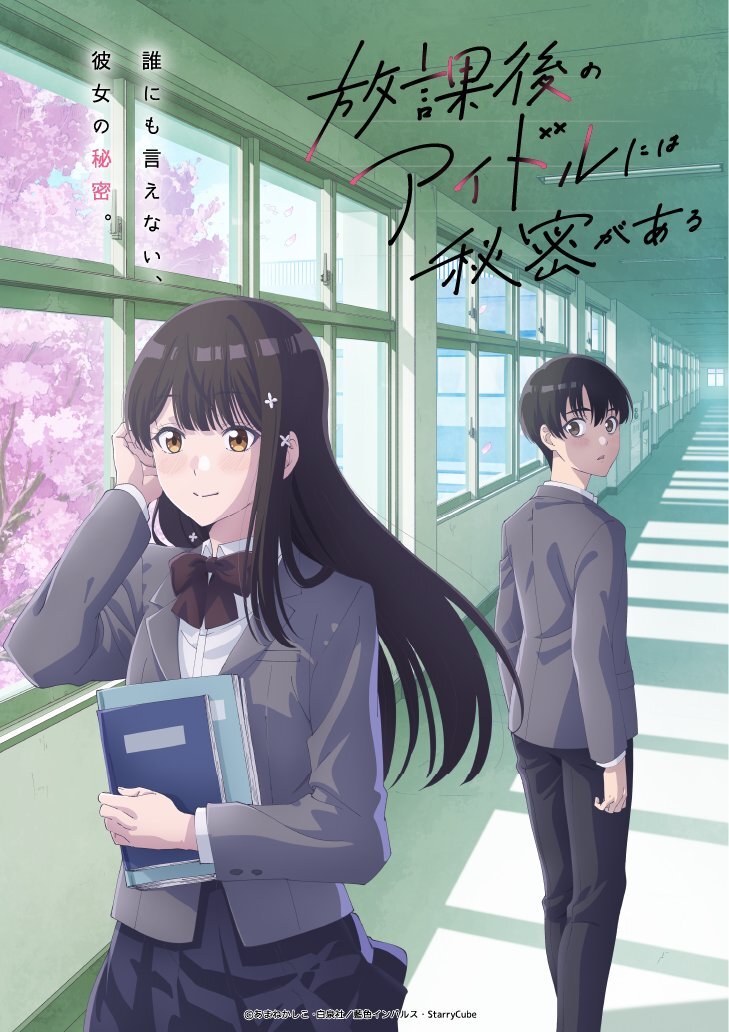
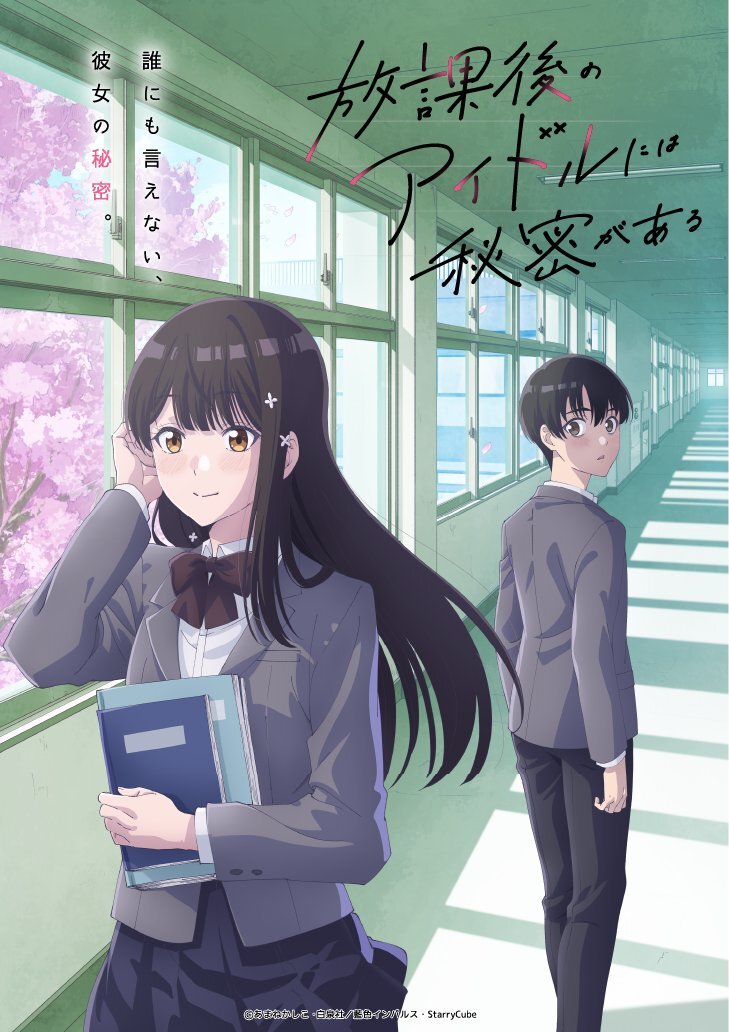 Production company Starry Cube opened an official website for a television anime adaptation of Kashiko Amane‘s Houkago no Idol ni wa Himitsu ga Aru (Everyone’s Darling Has a Secret) web manga on Monday, revealing the main cast, staff, and a teaser visual (pictured). The anime series will premiere in April 2027.
Cast
Hiruno Hizashi: Reiji Kawashima (Fumetsu no Anata e)
Rei Kuromiya: Hikaru Tono (Make Heroine ga Oosugiru)
Sakura Akai: Iori Noguchi (=LOVE) (Hashiri Tsuzukete Yokatta tte.)
Sora Konno: Ami Maeshima (BanG Dream! 2nd Season)
Staff
Director: Hikaru Satou (Lycoris Recoil animation director)
Series Composition, Script: Fumihiko Shimo (Clannad)
Character Design: Azuma Tozawa (Kirei ni Shitemoraemasu ka.)
Music: Satoru Kousaki (Kusuriya no Hitorigoto), MONACA (Summertime Render)
Studio: Gekkou
Producer: Ryou Aizawa (Starry Cube) (Yuusha Party ni Kawaii Ko ga Ita node, Kokuhaku shitemita.)
Amane originally launched a preview serialization of the comedy romance manga in Young Animal magazine from July to August 2022. The series later began regular serialization on the Manga Park and Young Animal web service in September 2022. Hakusensha published the ninth volume on July 29.
Yen Press licensed the manga in English in August 2024. The fourth volume went on sale on June 9.
Synopsis
Hiruno Hizashi, a freshman at a super-elite high school, has just finished his first academic proficiency test of the year. He anxiously awaits the results, which will set the tone for his next three years at school. But due to a mistake on his answer sheet, he receives an abysmal score and gets sent to remedial lessons! If there’s one silver lining, he’s not the only one—and his comrade could be the girl of his dreams?! (Source: Yen Press)
Official site: https://idol-afterschool.com/
Official X: @idolafterschool
Source: animate Times
>

England cricket: Brendon McCullum proposes 50-over warm-ups – how are side shaping up for World Cup?
Aesthetically-pleasing things in football: 'Proper' bicycle kicks, perfect trophy lifts and boot-sock cohesion
Wake up. This is not a drill. Joao Felix looks really good again
-

 movies4 months ago
Search For Canadian TV Actor Stewart McLean Now Homicide Investigation
-

 Fashion9 years ago
These ’90s fashion trends are making a comeback in 2017
-
Fashion9 years ago
According to Dior Couture, this taboo fashion accessory is back
-
Fashion9 years ago
Model Jocelyn Chew’s Instagram is the best vacation you’ve ever had
-
Fashion9 years ago
Emily Ratajkowski channels back-to-school style
-
Fashion9 years ago
9 Celebrities who have spoken out about being photoshopped
-

 Anime4 months ago
Rurouni Kenshin: Hokkaido Arc Manga Takes 1-Issue Break – News
-

 Anime3 months ago
HIDIVE to Stream English Dubs for The World Is Dancing, The Forsaken Saintess and Her Foodie Roadtrip in Another World, The Dangers in My Heart: The Movie Anime – News