
Politics
Politics Home | Labour Ruling Body Approves Andy Burnham Standing For Selection In Makerfield By-Election



1 min read
Andy Burnham has received approval from Labour’s ruling body to run for selection in the Makerfield parliamentary by-election, bringing the Greater Manchester mayor one step closer to being able to run in a leadership contest to replace Prime Minister Keir Starmer.
The National Executive Committee (NEC) has announced it is allowing Burnham to run for selection in the Makerfield by-election, potentially giving him a route back to Parliament. The by-election will reportedly take place on 18 June.
If he wins the by-election and returns as an MP, this would make him eligible to launch a leadership challenge against Starmer.
The current Labour MP for Makerfield, Josh Simons, announced on Thursday that he was stepping down to make way for Burnham. However, the Manchester mayor will still have to win the selection to stand in the seat, and then win the by-election itself in an area where Reform UK has been polling strongly and performed well in last week’s local elections.
The NEC had previously blocked Burnham from standing in the Gorton & Denton by-election earlier this year, which the Green Party’s Hannah Spencer went on to win.
The timeline for the selection contest for the Makerfield by-election has also been announced by the NEC. Applications will close on Monday 18 May, and a selection meeting will take place on 21 May.
>
Politics
The House | Fit For Service? Royal Navy Fitness Test Pass Rates Fall Sharply Over Last Decade

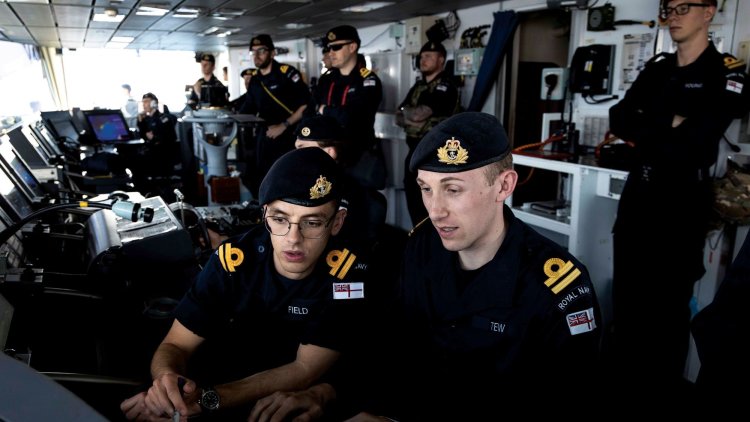
Officers at work on the bridge of HMS Dragon as it sails into Limassol, Cyprus, 27 April 2026 (Photography, LPhot Helayna Birkett. UK MOD © Crown copyright 2026)
6 min read
The Iran conflict has drawn attention to gaps in Royal Navy capability but, as Tom Scotson finds, it’s not just its ships that need to get into better shape
In the early days of the Iran conflict, as UK allies in the Gulf – and even Cyprus – were being hit by drones and missiles, Keir Starmer pledged to send a warship to help defend them.
The only problem was the only available vessel, HMS Dragon, was undergoing a refit in Portsmouth. The effort to get the ship ready was extraordinary but there was no escaping the embarrassment.
The Royal Navy has been the object of ridicule from US secretary of war Pete Hegseth and, repeatedly, Donald Trump himself. It is widely acknowledged that the UK has an inadequate number of warships currently available, with new frigates only coming into service at the end of the decade.
But a navy is about more than its vessels – and data uncovered by The House suggests that not all is well with its personnel.
On the face of it, the health of the Royal Navy is improving after decades of cuts. By January 2026, it was reported that there had been a 14.5 per cent uptick in the numbers of people joining the navy, with the fleet boasting a strength of around 32,160 personnel.
But according to a Freedom of Information request made by The House, the number of personnel who passed their fitness tests between 2014 and 2024 fell dramatically.
Between 2014 and 2015, 96.6 per cent of both men and women in the fleet passed their fitness tests on first attempt. However, 10 years later only 77 per cent of people passed the exams initially – a drop of almost 20 percentage points.
The number of Royal Navy personnel who failed their fitness tests at the first time of asking but passed within a year increased from 21 people to 1,219, 10 years later. Meanwhile, the same data found that Royal Navy personnel who failed their fitness tests on their first attempt then passed more than a year later rose from six people in 2014 to 86 a decade later.
As the navy grapples with falling standards and recruitment shortfalls, how can it restore and improve standards within its ranks?
Fred Thomas, Labour MP for Plymouth Moor View and a former Royal Marines officer, tells The House why he believes the numbers have declined.
“The overall offer was eroded year by year under the Conservative Party when they heavily cut funding,” he says. “The combined total of: how enjoyable is the job, what does it pay, what perks do you get including housing and medical benefits, how much status does it confer in society? How proud are you of your work for the navy and what sacrifices are you willing to make for the job?
“This will sound political but they hollowed out the military and it’s in a bad place now. It’ll take many years to turn it around. And at the same time we desperately need to modernise our capabilities.”
Many of the navy’s problems do not emanate from just cash flow problems either. Experts argue that in an increasingly competitive job market there are more careers out there which attract people’s interest – whether they be easier or more glamorous.
Commodore (Ret’d) Steve Prest, Rusi associate fellow, says people join the navy for one reason and that is it is better than the alternatives.
He adds: “Now it is different because young people, especially, often don’t want to be away and disconnected. A recent patrol had submariners away for 205 days under water, where they don’t have the ability to send information off the submarine. In the modern era, people expect to remain connected; when they see a blue tick, they expect a response instantaneously.
“It’s not to say a career in the Royal Navy is not rewarding. I know of people who were recently on that trip and thought it was one of the best things they ever did. It’s just harder to persuade people to go into the navy when everywhere else is so connected.”
Prest admits numbers have gone up a little, as recruitment has improved – despite the trained strength in the fleet having dropped. This means that the overall experience in the navy has reduced, with experienced staff leaving faster than the experience which can be grown in newcomers.
This will sound political but they hollowed out the military and it’s in a bad place now. It’ll take many years to turn it around
“With limited opportunities for people to gain sea experience, owing to the paucity of seagoing vessels, this is a real concern,” Prest tells The House.
“It means the ships’ companies bringing the new-build frigates into service will be vastly less experienced than their predecessors.
“We need a more balanced pipeline. The new recruits all need time at sea and interesting places to visit. There are no shortcuts to learning under those who know the ropes.”
The navy has also been affected by falling wages, which have cut across the public sector.
From day one, new officer recruits earn £34,676 per year. This will increase to £41,456 after their first promotion, followed by £52,815 as a lieutenant. The highest captain within the fleet will earn £122,849.
With a healthy pension and access to subsidised accommodation, the offer on the face of it looks good. Yet the problem is two-fold: talented people can earn far more in the private sector, in blossoming careers such as software engineering and coding; secondly, experts say demand is still depressed from cuts inflicted during austerity.
Admiral Lord West, former first sea lord and chief of the Naval Staff from 2002 to 2006, says: “Part of the problem is there was no pressure to recruit more people, the manpower was cut. When you depress something it’s difficult to try and bring it up to the same level again.”
He tells The House that the bottom line is that there is not enough money for the MoD – like most government departments.
And without greater investment, existing naval talent is going to waste, warns Prest: “If we don’t have enough ships to get them out on missions, then we can lose some of the best recruits as they idle ashore – that’s not what they joined to do.”
>


5 min read
After chancing upon an old parliamentary board game, Daniel Brittain persuaded two hereditary peers to join battle
There was something about it that wasn’t quite like the other chess boards piled in a corner as if hiding. It was the day after Boxing Day and I was idling in a favourite shop in the town of Corbridge, between Newcastle and Hexham. With little else to do, I investigated and so stumbled on an artefact at once trivial and timely. For instead of the regulation black and white squares, this board carried slogans such as One Man One Vote, Home Rule and Abolition of the Lords.
What was this? The front of the board proclaimed it to be House of Commons – The New Parliamentary Game. New it might once have been: the packaging suggested that it had not been new for at least a century.
Delight at unearthing this piece of parliamentary ephemera was tempered by the fact that were no playing pieces – and no rules. Further investigation was needed. I handed over my £3 and embarked on the quest.
The first point of inquiry after the Christmas recess was Patrick Vollmer, chief librarian of the Lords. Did this game exist in the parliamentary archives, a virgin copy kept in one of its vaults?
No, but he did pass on some leads to chase. A website for board game geeks gave the rules (extraordinarily complicated), and more surprisingly a link to the Bodleian Library, surely the repository of historic and valuable manuscripts? True, but also it turns out the home of 1,600 games and pastimes gifted this century. And there it was, on the Bodleian website, a photo of five of the eight required playing pieces, featuring pictures of prominent Liberal and Conservative MPs and peers from the game’s 1896 creation.
Jo Maddocks, the Bodleian’s curator of ephemera invited us (my wife Clare had by now joined the quest) up to Oxford to take a look, where we discovered that although the library has some of the playing pieces it doesn’t possess the rules or the board. We reunited them all for photos. Asquith, Campbell-Bannerman, Rosebery, Devonshire and Chamberlain re-emerged into the limelight. Turned out we were the first people to have requested a view.
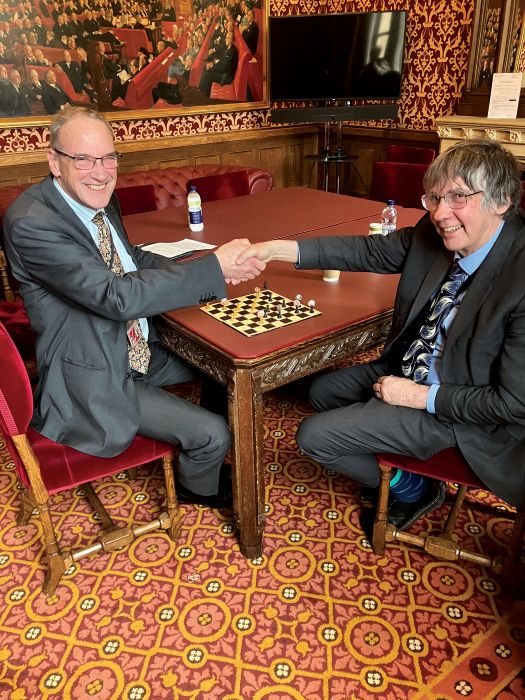
Back in Parliament, a plan was hatched to play the game, possibly for the first time in 100 years. Given that ‘Abolition of the Lords’ (in its all hereditary form) is one of the squares on the board, two hereditaries were my obvious target.
While Clare brilliantly copied the Bodleian pieces and made the required additional three, I went on the trail of game hereditary peers. Fortuitously, the Earl of Clancarty was enthusiastic, and he was about to meet up with the Earl of Lytton. A brace of earls, result!
A week later we gathered in one of the splendid rooms formerly part of the Lord Chancellor’s flat. For Lord Lytton, Parliament’s foremost expert on Planning and Building law, it was a special day (his last in the Lords), having decided a year ago to retire at 75. The minister, Baroness Taylor of Stevenage, had paid tribute to him. Opposite: Lord Clancarty a prominent champion of the arts and the creative industries. He’s just discovered that he is to be one of the few outgoing hereditaries to receive a life peerage. Both crossbenchers, Lord Clancarty gamely took the governing Tories’ side, Lord Lytton the opposition Liberals. Shaking hands, the game commenced.
Poor old backbench pawns move just one square at a time
Of course, the object of the game is for the government to pass acts on the subjects depicted on the board by landing a player on each of the two similarly named squares. The opposition’s job is to prevent that. According to the rules, the PM and what the board refers to as the Chief Opposition Spokesman can move in all directions across the board, while his cabinet and their shadows (a term formalised in the 1920s) rather fewer. Poor old backbench pawns move just one square at a time.
Let battle commence. First bill? Abolition of the Lords of course. Lord Lytton scored an early victory in saving the House; on the rematch Lord Clancarty got it abolished. Soon a whole radical manifesto was laid before them: licensing laws, payment of MPs, Home Rule, disestablishment and voting rights. It’s a fun game, perhaps the parliamentary shops should bring out a new edition?
Having reached an honourable draw, the two earls went their way. Lord Clancarty to a meeting, Lord Lytton heading off for a last stint in the Chamber, say his goodbyes and clear his desk after some 30 years. As the politician playing pieces were packed away, I noticed that all the measures on the board have been tackled since the game’s creation. All except one: Disestablishment of the Church of England. That thorny question has even managed to outlive the hereditaries in the House of Lords.
>
Politics
Politics Home | Burnham Expected To Be Allowed To Stand Despite Labour Fears Of “Bankruptcy”


Andy Burnham, 2025 (Alamy)
3 min read
Senior Labour figures are concerned that the party will be dragged towards “bankruptcy” if Andy Burnham successfully stands as its candidate in the Makerfield by-election, triggering a mayoral by-election and possibly a leadership contest.
Former minister Josh Simons announced on Thursday that he would be giving up his Makerfield constituency – after being elected for the first time just two years ago – to allow the Greater Manchester mayor a shot at re-entering Parliament via a by-election.
The Labour Party is now expected to open up its candidate selection process for Makerfield imminently, at which point Burnham will formally ask for the waiver to stand despite being a mayor.
The core group of Labour’s national executive committee (NEC) officers will then meet to discuss the waiver – a meeting sources expect to take place this weekend. It is widely expected that Burnham’s request will be granted, after Downing Street briefed that it would not block Burnham as it did in January.
NEC officers will either make the decision themselves or refer it to a meeting of the full NEC, which next meets on Tuesday.
Views still vary on whether to refer the decision, with concerns that doing so would set a precedent. On the other hand, it is understood that reprieve from the scrutiny the nine officers have received on their decisions around Burnham would be welcomed by some on a personal level.
NEC officers are expected to meet this weekend and, while it is possible that the vote is not unanimous, they are likely to approve Burnham’s waiver.
While Burnham’s bid is highly likely to be approved, senior figures have reservations over the costs incurred his potential return. If successful, it would trigger a mayoral by-election in Greater Manchester and potentially a subsequent leadership contest.
One Labour NEC member told PoliticsHome these costs would be “bankruptcy territory” for the party.
It is understood that the by-election will involve sending a number of Labour HQ staff door-knocking in the seat, which will involve acommodation and travel costs.
Makerfield comes after the Gorton and Denton by-election, which a Labour source said was the costliest in the party’s history, as well as the May 7 elections.
If Burnham wins the by-election, the party will also be faced with a mayoral election in Manchester, which is expected to cost the party hundreds of thousands of pounds and the public likely more than £4m.
Others rejected claims of anxiety over party finances, however, in anticipation of a Burnham leadership attracting new party members. One minister said:“We will get a lot of new members with Andy – we will be fine.”
Labour has already put on a large number of canvassing sessions in Makerfield, and on Friday dozens of activists and MPs made the journey to the constituency to join the effort.
Deputy leader Lucy Powell told the FBU conference on Friday morning that she had it on “good authority that absolutely no attempt” to block Burnham would be made. She also revealed she would be the political lead in the by-election.
“None of the concerns have changed, but the party would explode if he wasn’t allowed to apply,” said one Labour MP.
“He’s got a better chance than anyone else, but Reform will be very strong there – it’s like a 100 per cent Denton seat with no Gorton-type voters.”
PoliticsHome understands that Burnham allies have been eyeing Makerfield as a potential constituency for weeks, as it is next door to where the Manchester mayor lives in Leigh.
The seat will be a tough test for Burnham after Reform UK had success in the wards of the constituency at the recent local elections.
In its eight wards, Reform won 50.4 per cent of the vote while Labour secured just 22.7 per cent. Burnham supporters point out that at the 2024 Manchester mayoral election Burnham won 62 per cent in Makerfield.
The Labour Party has been contacted for comment.
>

I See Buildings Fall Like Lightning Wins Directors’ Fortnight

URC: No excuses for Cardiff against Stormers in Cape Town

The House | Fit For Service? Royal Navy Fitness Test Pass Rates Fall Sharply Over Last Decade
-

 Fashion9 years ago
These ’90s fashion trends are making a comeback in 2017
-
Fashion9 years ago
According to Dior Couture, this taboo fashion accessory is back
-
Fashion9 years ago
Model Jocelyn Chew’s Instagram is the best vacation you’ve ever had
-
Fashion9 years ago
Your comprehensive guide to this fall’s biggest trends
-
Fashion9 years ago
A photo diary of the nightlife scene from LA To Ibiza
-
Fashion9 years ago
Emily Ratajkowski channels back-to-school style
-
Fashion9 years ago
9 Celebrities who have spoken out about being photoshopped
-
Fashion9 years ago
The tremendous importance of owning a perfect piece of clothing