
Sports
World Matchplay Darts: Luke Humphries shocked by Cameron Menzies in first round at the Winter Gardens in Blackpool | Darts News


Cameron Menzies produced a massive upset to defeat 2024 champion Luke Humphries 10-7 at the World Matchplay on Monday night.
World No 2 Humphries took centre stage against one of the most entertaining and unpredictable players in the game in Menzies.
And it was the Scot who raised the Empress Ballroom roof with an inspired 170 checkout to stun the former world champion and seal his first win on the Winter Gardens stage.
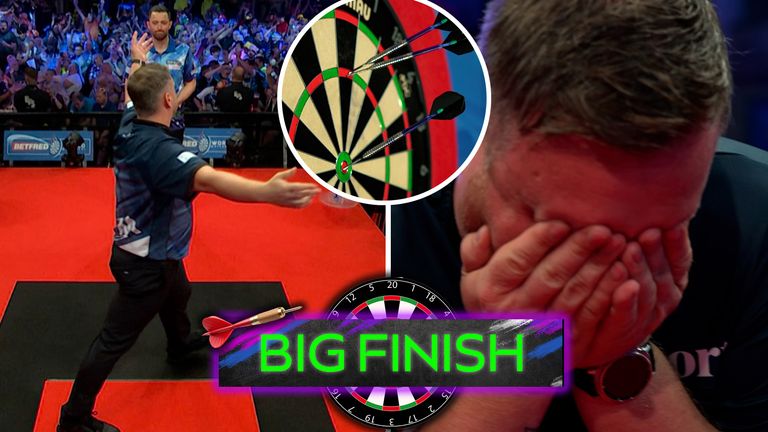
Cameron Menzies lands ‘The Big Fish’ to stun Luke Humphries at the World Matchplay
Menzies produced a brilliant double-double 129 finish to lead Humphries 3-2, but ‘Cool Hand’ made it six consecutive breaks of throw with a magnificent 167 checkout to level straight after the first interval.
Menzies then went on a blistering four-leg burst to race into a 7-3 lead but could only win one out of the next five legs as Humphries went on a charge.
However, Menzies landed an inspired 170 checkout to cause a mighty shock as he set up a second-round clash with Ross Smith.
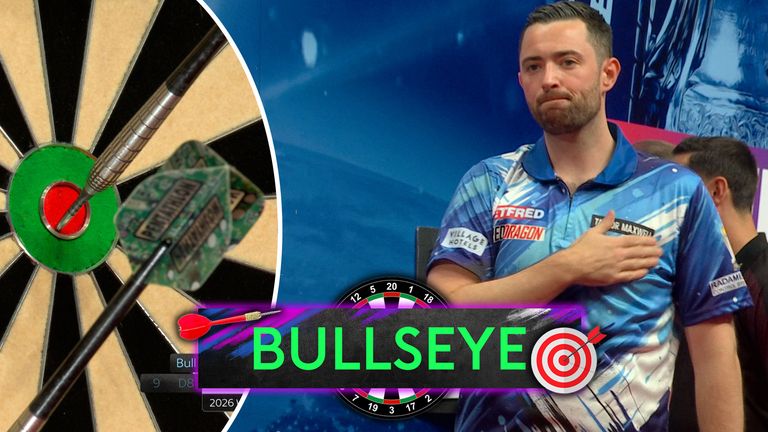
Humphries pinned this stunning 167 on the bull
“No one gave me hope! I didn’t give myself hope but I finally won a game at the Winter Gardens,” said a delighted Menzies.
“Luke Humphries is a great guy, a great player. At 7-3 I was just trying not to think of that finishing line but the nerves kicked in. To beat Humphries, I know he will be disappointed. He gave me a lot of stress at doubles but that’s my biggest win.
“I show a lot of emotion and I hate that I do that. I’m trying to keep myself intact. Try to keep myself composed because I know he was going to have a spell and batter me and he had a little spell but lucky enough I had that lead.
“I know that’s not Humphries but I’ll take it any day of the week.”
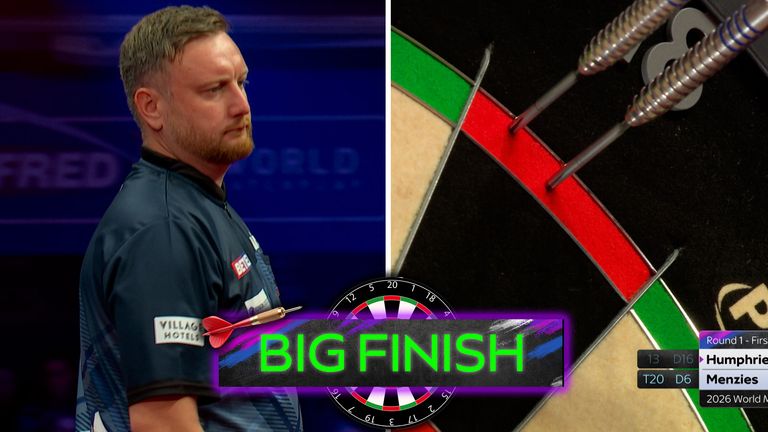
Menzies hits this HUGE double-double finish against Humphries
Mardle: Menzies’ greatest moment – he knows he can handle anything now
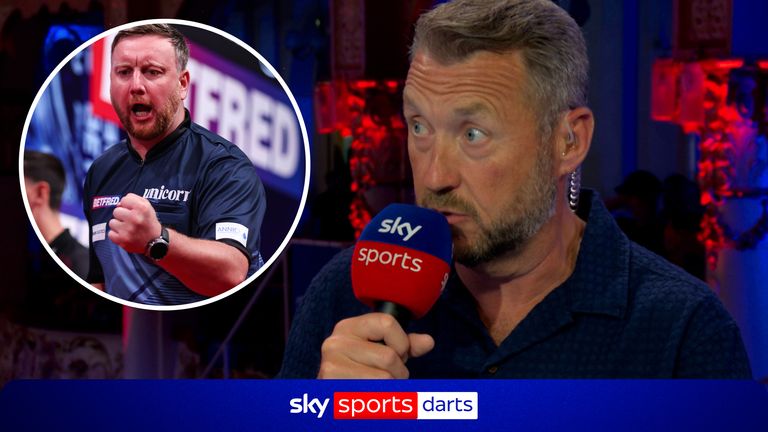
Hear from Menzies and Wayne Mardle after the Scotsman claimed a famous win over Humphries
“It’s his best ever win, and he mentioned that,” said Wayne Mardle, speaking to Sky Sports.
“With Cameron Menzies, everyone mentions his emotions, but it’s the way he had to win that game.
“Nothing went according to plan. He was broken back early twice, that’s up-and-down emotions. The high of breaking to being broken back.
“Then he went on a run, and got pegged back. There was a lot happening in that game, but he held it all together beautifully.
“Humphries had an amazing spell of four legs, but then Menzies found a level again, and that’s something we don’t see enough.
“What he should take away from tonight was the way he handled this situation. It was like he was there a million times before.
“He knows he can handle anything now.”
Humphries vs Menzies: Tale of the Tape
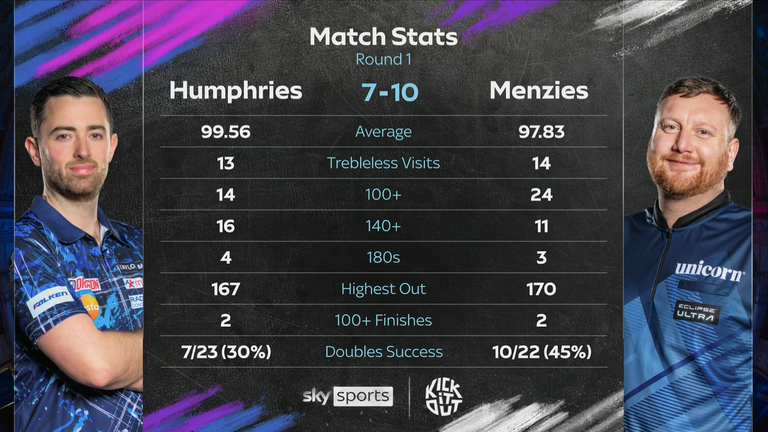
Menzies to face ‘Smudger’ next
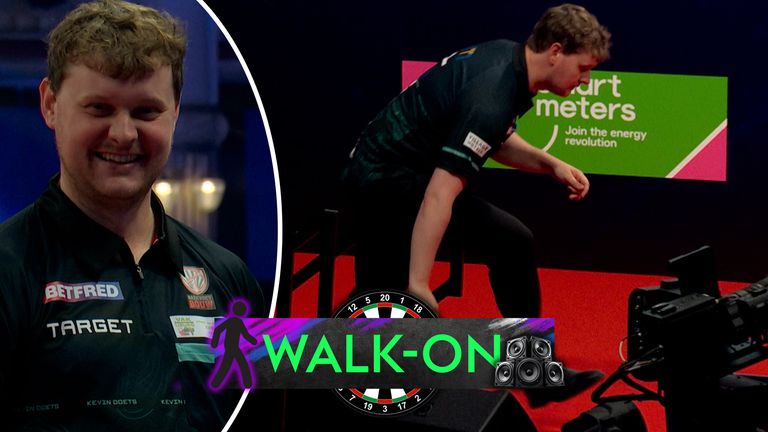
It was very nearly a debut to forget for Kevin Doets as he came close to taking a tumble on the stage
Ross Smith came through a fantastic encounter as he defied a 104.19 average from debutant Kevin Doets – taking out 160 and a match-winning 120 – to reach the second round.
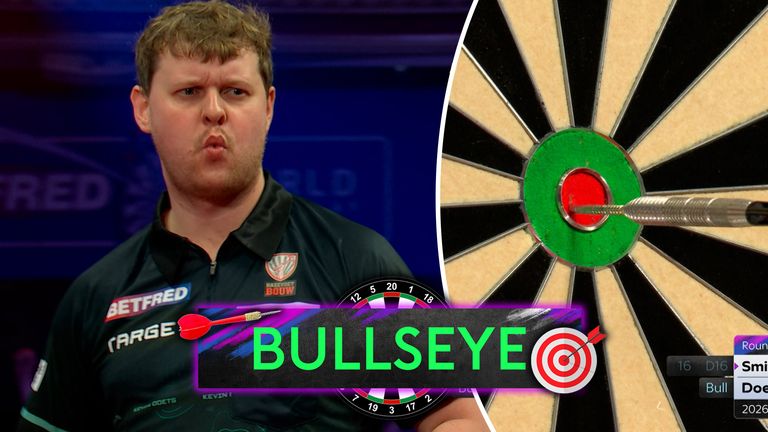
Doets hiit this 161 finish on the bullseye – just in time to save the match!
‘Hawkeye’ saved the match with a stunning 161 checkout but Smith held the Dutchman at arm’s length.
After storming out of the gates to a 5-0 lead ‘Smudger’ kept his composure through a mid-session scrap before sealing victory – signing off with a spectacular 120 Shanghai finish.
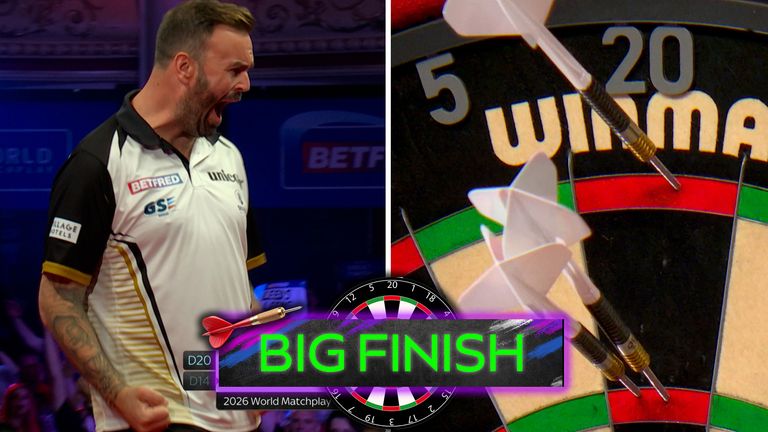
Smith nailed this magnificent 160 checkout on his way to victory
Price wins in extra time to set up Cross showdown
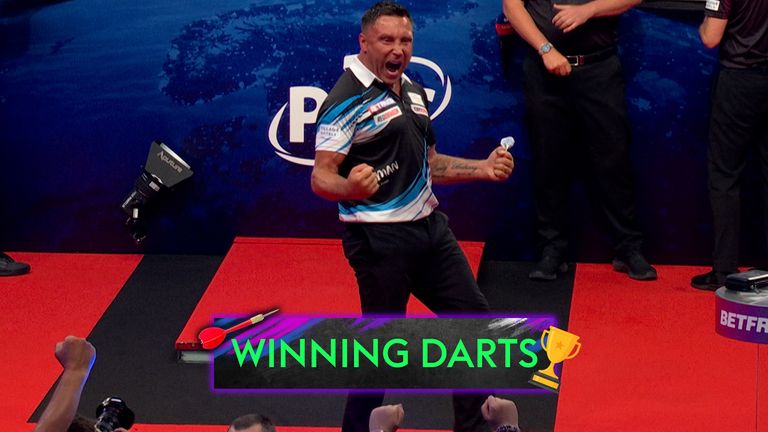
Gerwyn Price nails the ton checkout to sink Martin Schindler
Former World Matchplay finalist Gerwyn Price survived a huge scare against German No 1 Martin Schindler to book his spot in the second round.
‘The Iceman’ trailed 4-0 and 6-2 before roaring back and punishing Schindler for errors on the outer ring to win 11-9.
“It doesn’t usually happen. Without the crowd, I would have lost today,” admitted Price. “That was the worst I’ve played all season.
“It goes to show, throwing sheep about instead of darts about, it doesn’t help! It was a tough one for me. I’ve got no confidence at the minute because I haven’t played a lot.
“To battle through it. Martin was just as rubbish as me, thankfully.
“That was one I should have lost, but I’ve won and I’m still in the tournament – I can’t be any worse!”
Price will take on Rob Cross next after ‘Voltage’ kicked off his campaign with a convincing 10-3 win over Danny Noppert.
The 2019 champion led 5-0 at the break and never relented, averaging 97.41, pinning a 128 checkout, and ending with an impressive 52.6 per cent on the doubles.
What’s happening at the World Matchplay on Tuesday?
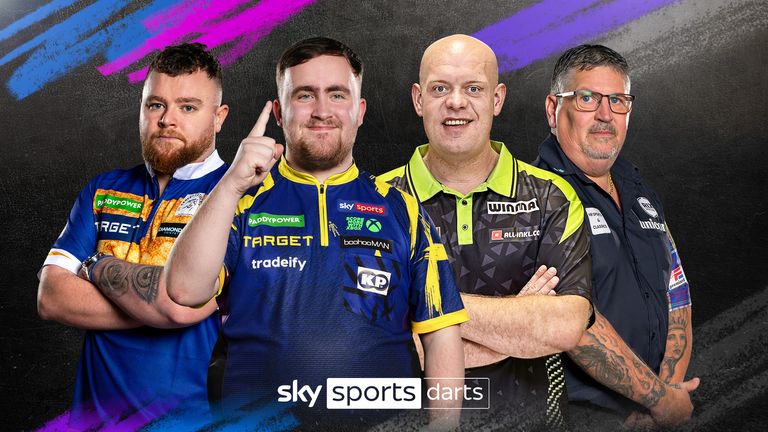
Luke Littler and Michael van Gerwen headline the World Matchplay action on Tuesday
The 2026 Betfred World Matchplay continues at the iconic Winter Gardens from July 18-26, as a 32-player field compete for the prestigious Phil Taylor Trophy.
Two-time world champion Luke Littler takes on Nathan Aspinall in a blockbuster clash after opening his defence of the Phil Taylor Trophy with a sensational 10-6 win over Niko Springer on Day One in Blackpool.
Stephen Bunting takes on Josh Rock after winning through a Winter Gardens classic against debutant Niels Zonneveld, surviving three match darts to edge past the Dutchman 13-12.
Three-time World Matchplay winner Michael van Gerwen faces fellow Dutchman Dirk van Duijvenbode, while Gary Anderson – the 2018 champion – goes up against 2023 runner-up Jonny Clayton having recorded the eighth-highest average in World Matchplay history, averaging 109.96 in his 10-2 demolition of Ryan Joyce.
Who will win this year’s World Matchplay Darts? Luke Littler will be defending his title and you can watch all the action on Sky Sports. Stream darts and more top sport with NOW.
>

What happens when the greatest of all time moves on?
The body of the 2026 World Cup is not yet cold, and Argentina are in the early stages of coming to terms with their defeat against Spain in Sunday’s final.
There might be something even bigger for them to adjust to, though, in the near future. Lionel Messi has given little indication about his international future, but despite his brilliance throughout most of the tournament, at 39 years old he probably doesn’t have long left at this level.
You wouldn’t rule out Messi continuing, and there is the sentimental pull of the next World Cup having at least one game in Argentina. If Gianni Infantino’s wheeze to expand the tournament to 64 teams comes off, then there might be a whole group there. Is that enough to keep him going?
Perhaps. But Argentina have to at least consider the possibility that Sunday was his last game. They’ve had to confront this concept before… although admittedly only for two months, in which time they didn’t play any games: he retired after the Copa America in June 2016, but reversed his decision before the World Cup qualifiers in September that year.
This time, though, presumably a decision will be more permanent. So how will they cope without him? The evidence of Sunday’s final suggests the answer will be ‘not well’, but it’s worth looking at examples from sporting history of when a team’s greatest player has left them, and how well they dealt with it.
First, ‘the greatest’ is obviously subjective. Some of the examples we use here will not necessarily be exactly, definitively the greatest to ever play their particular sport. They are more generational players around which teams were built, after which those teams had to figure out how to do things.
It’s also worth pointing out the ‘correlation is not necessarily causation’ caveat: none of this is to say that what happened to these teams after their greatest left is because they left.
How Lionel Messi has defined this World Cup
Asli Pelit and Rachael Tinde
The logical place to start is Argentina. The parallels between this team and the ones in 1986 and 1990 are clear: a genius No 10 took them to glory, then an increasingly aggressive and self-destructive side reached the final four years later, only to be defeated by a single goal. Diego Maradona wasn’t nearly as much of a factor in 1990 as Messi was in 2026, but the sense that they still depended on him was strong.
To a point, it reached the state of national delusion: when Argentina were beaten 5-0 by Colombia in World Cup 1994 qualification, the public demanded Maradona’s return, even though by that stage he was long past his peak. It was even stranger considering they had won the Copa America in 1991 and 1993 without Maradona: admittedly, in the latter case at least, they actually won only two games in standard play, getting through the quarter and semi-finals on penalties.
That slice of history brings good news and bad news for Argentina: the good news is those teams showed it was possible to win without their talisman. The bad news is they didn’t win anything of any consequence again until the 2021 Copa America, losing five finals along the way.
Similarly, it took Brazil quite a while to get back to their previous heights after the retirement of Pele. They won the World Cup three times during his era, but after his last victory in 1970 they had to wait 19 years to win another Copa America, and 24 to lift the World Cup again. They did go on a hell of a run after that, admittedly: between 1989 and 2007 they won the Copa America five times and the World Cup twice, reaching three other finals. So perhaps Argentina need to brace themselves for an immediate fallow period, but sit tight for a couple of decades and the trophies will come.
The U.S. women’s team is an interesting case: Abby Wambach is generally regarded as their greatest ever, but she was surrounded by so many other all-time greats, both team-mates in her peak years and in the generation that came immediately after her, that the impact of her departure was mitigated. She had a reduced role at the 2015 World Cup, which the U.S. still won, as they did without her completely in 2019. It remains to be seen whether their failure in 2023 is a blip or the sign of a deeper malaise, but whatever it is, it is tough to trace it to Wambach.
Best 2026 World Cup fan moments
In other sports, the Chicago Bulls are not an example to follow. After Michael Jordan left in early 1999, it took them six years to even have another winning season, and they haven’t reached the NBA finals since, never mind won a title. They have only won their division twice since then, and haven’t won a play-off series since 2015, the longest drought in team history.

The Chicago Bulls struggled to adapt to life without Michael Jordan (Vincent Laforet/AFP via Getty Images)
Talk to different people and you’ll get different answers as to why, from terrible ownership to awful luck, notably when Derrick Rose tore his anterior cruciate ligament in the 2012 play-offs, leading to the top-seeded Bulls losing to the Philadelphia 76ers. But the shadow of Jordan must be a factor, even if it is one you would expect a club to get over in the best part of three decades.
Let’s not delve too deeply into the debate about who the best quarterback of all time is, and this example might be more of a player-coach combination. But no NFL team has won the Super Bowl more often than the New England Patriots. They won all of their six Super Bowls with Tom Brady under center (coached by Bill Belichick). They had only reached the Super Bowl twice before their time, and once since. But won it none of those times.
They came close in 2025, so it would be hard to say they have been a complete disaster without Brady (and Belichick), but again: they have never won a Super Bowl without them. For the record, Brady won the seventh Super Bowl of his career in his first season away from New England with the Tampa Bay Buccaneers.

Bill Belichick and Tom Brady celebrate the fourth of their six Super Bowl wins with the Patriots in Glendale, Arizona (Christian Petersen/Getty Images)
The Edmonton Oilers coped slightly better in the post-Wayne Gretzky era, famously winning the Stanley Cup in 1990, two years after ‘The Trade’ which took Gretzky to the Los Angeles Kings. That said, it took them another 16 years to win another conference championship, and they haven’t lifted the big one since.
In motorsport, Ferrari reacted to Michael Schumacher’s departure in 2006 by resting their hopes on younger drivers, specifically Kimi Raikkonen and Felipe Massa. It worked initially, as Raikkonen won the drivers’ championship in 2007 and they took the constructors’ crown in 2008, but haven’t won either since.
Sometimes teams take it upon themselves to ‘freshen things up’ and move on from the greats. After Stuart Broad retired from international cricket in 2023, England’s response a year later was to drop the other half of their greatest bowling partnership, record wicket-taker Jimmy Anderson, in the name of progress. The theory was that they needed younger, faster bowlers for the Ashes tour of Australia in 2025-26. They lost 4-1. Since Anderson was eased out, England have won 13, drawn one and lost 13 Test matches.
All of these are broadly negative examples, where teams have floundered upon the departure of their great star. But there are some success stories: sticking with cricket, after Don Bradman — by consensus the greatest batsman in the history of the game — retired in 1948, Australia won the next three series they played, and lost only four of the next 22.
Returning to football, Real Madrid sold Cristiano Ronaldo to Juventus in 2018 and unlocked the best football of Karim Benzema’s career, regenerated their squad and won three league titles and two Champions Leagues in the next few years.
Then there’s the San Francisco Giants: they didn’t win a single World Series during the 14-year tenure of Barry Bonds, but after he left in 2007 they won three, in 2010, 2012 and 2014. If you want to go further back, Babe Ruth leaving the New York Yankees in 1934 didn’t slow them down particularly, winning titles in 1936, 1937, 1938, 1939, 1941 and 1943 over the following decade.
There will be countless other examples of successes and failures, in sports wide and varied. Argentina won’t want to lose Messi, but there are enough examples to suggest it might not be the end of the world.
>
Sports
Man City to top World Cup player payouts, with Barcelona, Arsenal, Man Utd and Palace in top 10

Manchester City are likely to top the list of distributions to clubs under FIFA’s Club Benefits Programme (CBP) for the third World Cup in succession, calculations from The Athletic have found.
To go alongside the largest World Cup in history, FIFA will also share out more money than ever before to clubs that release players for participation. The CBP pot for 2026 sits at $355million (£265m), a 70 per cent increase on the $209m paid to clubs whose players competed in each of the past two World Cups, in Russia in 2018 and Qatar in 2022.
Of that $355million, $250m will be allocated in respect of players who performed at this summer’s engorged, 48-team finals. Unlike in previous iterations, FIFA are also rewarding clubs that released players for qualifiers, too, with $100m allocated there. The remaining $5m, or whatever is left after administrative costs related to implementing the programme, will “be allocated to the benefit of club football”.
The Athletic’s calculations cover that primary $250million tranche of payments and find, just as in 2018 and 2022, Manchester City come out on top. We estimate their representation at the 2026 finals has earned them $4.4million (£3.3m).
FIFA pays out on the basis of how many days finals participants are at the competition, with clubs entitled to roughly $5,000 per day, per player, between the mandatory release date of May 25 and the day after their national team’s last match in the competition. City benefited from six players making it to the World Cup’s final weekend: Rayan Cherki, Marc Guehi, Nico O’Reilly, John Stones and James Trafford were each present in Miami for Saturday’s third-place play-off between France and England, while Rodri started in Spain’s 1-0 win against Argentina in the final on Sunday.
The world’s already richest clubs pepper the top of the list — Barcelona, second four years ago, are also second in our estimate — which stands to reason given it is their players who are most likely to feature on the world stage.
By our reckoning, City earned over $1million more than the next highest-earning English club, Arsenal, though that was impacted by the latter reaching the Champions League final. That took place on May 30, five days after the mandatory release date; clubs playing in cup finals were, quite rightly, allowed to release players later, though that naturally reduced their CBP earnings. We reckon Arsenal’s figure would have been almost $500,000 higher in other circumstances, but of course, they earned much more than that from reaching European club football’s showpiece.
We found it was not just the usual English suspects high up the list. Crystal Palace, with 12 players at these finals, were the Premier League’s third-highest earners ($2.7million) by our calculation; Sunderland, whose players scored eight goals this summer, a mark only four clubs topped, were the sixth-highest in England and 13th-highest overall ($2.2m).
Premier League clubs contributed around 13 per cent of this summer’s 1,248 players, more than any other division in world football and, correspondingly, hoovered up more money than anywhere else. We estimate the 2026-27 Premier League crop will receive $34.2million from the CBP, well ahead of the next-highest: Germany’s Bundesliga, with $18.8m.
Yet even as the richest clubs enjoy the largest share of the spoils, the amounts they receive will pale in comparison to the cost of employing the same players who’ve generated those sums. City’s $4.4million might top everyone else, but it is a fairly paltry sum when set alongside a full club wage bill in 2024-25 of around $608m (£468m).
In 2018, The Economist found the biggest clubs were significantly underpaid by the CBP relative to the cost of employing players over the time they were away at the World Cup.
The Athletic’s calculations should serve as a good guide, but are unlikely to be perfect.
One complicating factor is those instances where players moved clubs during the tournament. Take England winger Anthony Gordon. He completed a move to Barcelona, which was announced on May 29, meaning Newcastle United held his registration for less than a week after the mandatory release date. We have adjusted allocations for several high-profile transfers during this World Cup, but The Athletic’s figures will not have captured them all.
A further muddying of matters arises from players who did not feature in this World Cup but were intended to. Players initially released but then replaced, usually by injury, will generate money for the clubs, as will their replacements. Arsenal’s Jurrien Timber, replaced by RB Leipzig’s Lutsharel Geertruida in the Netherlands’ squad, was one such instance. Again, we’ve adjusted wherever possible but, with fees paid out based on dates and it not always clear when a player was replaced, there’s every chance our estimate isn’t 100 per cent accurate.
And, of course, there’s that $100million qualifying pot.
As mentioned, FIFA has introduced significant nuance to the programme this time around, rewarding clubs not just for their players’ participation in this summer’s finals in the United States, Canada and Mexico but also for any player who was selected in a matchday squad for any of the 905 qualifying games that determined the 48 participating teams this June and July. On top of that, clubs of those who were named in squads for the three host countries in their 10 friendlies before this summer’s finals will also receive payment.
That translates to 42,320 individual allocations to be made across pre-finals games alone, with the $100million of that $355m CBP pot apportioned to qualifying participation working out at $2,362 per player, per match. Due to limitations on available data, The Athletic has not been able to generate a reliable estimate of how that $100m will be apportioned.
FIFA have disclosed a full breakdown of payments following each of the last two World Cups, and are expected to again in 2026. That will, however take some time; clubs have until September 10 to review a preliminary list of relevant players on FIFA’s own platform, which must then be reviewed by member associations by October 31. Thereafter, FIFA will conduct its own review before paying out.
Wherever the full $355million winds up, it is a safe bet that, just as before, the lion’s share will go to European clubs. UEFA teams earned 76 per cent of each of the 2018 and 2022 pots, and we project they’ll take home the majority of the $250m allocated on the back of this summer’s finals too.
Our estimate puts the European take at 70 per cent which, while still far beyond any other confederation, is a noticeable drop from four years ago.
The fall is explained in large part by FIFA’s expansion of this summer’s tournament to 48 national teams. In comparison to Qatar 2022, just three of this year’s extra 16 sides hailed from Europe, meaning 13 were drawn from other confederations, including five from CAF in Africa.
While that doesn’t mean individuals for the new entrants all play for club sides in their home nation’s confederation, it has brought more clubs into the fold than previously. We count 451 clubs among those due a payout from this summer, up from 440 in 2022. A total of 175 of the clubs we believe are in line for a 2026 CBP payment are from non-UEFA confederations, with the Asian Football Confederation leading the way (73 clubs).
That number will surely grow once the $100million qualifier pot is divvied up, though so too will the take of the elite clubs, whose players were plenty present in the two-year build-up to this summer’s extravaganza.
The scale of the 2026 World Cup and the revenues it has generated meant FIFA had to increase the amounts payable to clubs whose players ultimately produced the product on the pitch. The already rich reap the most, though the thin spreading of payments means the payouts are relatively miserly for the game’s elite. Not least when their players have generally had to spend even longer away than usual due to the enlarged tournament, and in often soaring temperatures too.
Europe’s big five divisions, as ever, top another monetary list, but there is at least a spread of recipients beyond that. We estimate $149million of the $250m finals pot will go to 784 different clubs across 100 different leagues.
For some, even at what look like low levels, the money will make a difference. Braintree Town, currently playing in England’s sixth tier, were placed under a transfer embargo as recently as May due to financial troubles, but will be one of the lowest-ranked beneficiaries of this year’s CBP payouts. The inclusion of their 36-year-old defender Tommy Smith in the New Zealand squad has generated, we reckon, around $171,000 (£127,000) for the non-League club.
It will be much welcomed.
>

PHILADELPHIA — Emmet Sheehan looked as if he had salvaged another ugly night. A four-run second inning put the Los Angeles Dodgers into an early hole Monday against Cristopher Sánchez, perhaps the frontrunner for the National League Cy Young Award. But by the time Sheehan took the mound to start the sixth inning, the Dodgers had closed to within a run. Sheehan had kept his team in it.
Until his outing fell apart again.
“They came back,” Sheehan said, “then I kind of gave it back to them again after that.”
Then Sheehan fell behind in the count. The 2-0 fastball he threw to Brandon Marsh registered at 92.8 mph, which would have been his fourth-slowest pitch of 2025 but has become the norm for his disappointing 2026.
Velocity is not the only reason things have gone wrong for Sheehan this year, but it does not help. Marsh shot the pitch over the fence for a home run. The night quickly blew open from there, a 10-7 loss to the Philadelphia Phillies that was uglier than the final score and further sank Sheehan’s season.
“Kind of a step back today, which is pretty frustrating,” Sheehan said after feeling like he’d figured some things out going into the All-Star break.
Little has gone right for Sheehan, who has a 5.13 ERA after allowing six runs on Monday night. He falls behind in counts far too often, including against seven of the 11 batters he faced in the game’s first two innings as the Phillies took a 4-0 lead. His fastball velocity is down a tick from the 95.6 mph he averaged a year ago, and that pitch is getting pummeled. When he misses out over the plate, he’s getting crushed. Trea Turner jumped on a particularly appetizing slider for a two-run homer in that ugly second inning.
“That was really a backbreaker early,” manager Dave Roberts said.
Thoughts on the All-Star Game & pitchers being too good
Keith Law
Diagnosing Sheehan’s issues has been a game of Whac-A-Mole and the Dodgers haven’t ruled out anything physical as impacting his performance. Sheehan has attributed his diminished velocity and inconsistent results to his pitching mechanics. That cannot explain all of it.
He took the beating in the second inning and then worked quickly through the next three innings. When the Phillies did land a punch, Sheehan’s stuff usually ticked up. There are still flashes of the version of Sheehan the Dodgers expected.
“It’s just really trying to be convicted in his pitch making before he touches the stove,” Roberts said. “I think that when there’s damage or things have happened, then he locks in. (He) raises his level of intensity a little bit more. But it’s just got to be that before things start happening.”
Sheehan has not been good enough. His place in the rotation, however, feels safe. There is not an obvious healthy replacement for a club that already will have to fill Shohei Ohtani’s spot in the rotation for the foreseeable future while he nurses his left knee back to health.
“Certainly he’s getting a lot of opportunity,” Roberts said of Sheehan. “It’s not the consistency that any of us like or want, Emmet included. Until there’s another alternative, we’re going to keep running him out there.”
The Dodgers boast depth for October. They just don’t have access to much in the short term.
Blake Snell has just started a rehab assignment and is multiple starts away from returning to the rotation after surgery to remove bone chips from his left elbow. Tyler Glasnow is even further away from pitching in big-league games as his back spasms have kept him out for months. River Ryan has not pitched in the big leagues this year, partially because he’s hurt his left hamstring twice while trying to build up his workload in the minor leagues.
Landon Knack, once seen as a part of the organization’s starting pitching depth, entered when Monday’s game was already out of reach. He promptly surrendered a pair of home runs in his two innings of work.
The Dodgers’ best option might be to keep waiting to see if they can get more out of Sheehan, who had a 2.82 ERA in 73 1/3 innings last year, just more than a year removed from Tommy John surgery.
None of this is expected to change the Dodgers’ approach at next month’s trade deadline, as The Athletic reported. A potential pursuit of Tarik Skubal or others cannot be ruled out, but it is far from a priority. Expect more moves on the margins, such as the club’s acquisition Monday of former Colorado Rockies closer Seth Halvorsen. They hope to find magic with him in their player development system.
The Dodgers, who have a double-digit lead in the National League West, still have time for Sheehan to try to figure it out.
“It’s about performance,” Roberts said. “Emmet knows it. You just got to do it. That’s just the way it goes, you know.”
>

Lionel Messi, Argentina and the challenge of moving on from a GOAT

Jon Stewart Erupts Over Trump Crashing Spain’s World Cup Celebration

Man City to top World Cup player payouts, with Barcelona, Arsenal, Man Utd and Palace in top 10
-

 Fashion9 years ago
These ’90s fashion trends are making a comeback in 2017
-
Fashion9 years ago
According to Dior Couture, this taboo fashion accessory is back
-
Fashion9 years ago
Model Jocelyn Chew’s Instagram is the best vacation you’ve ever had
-
Fashion9 years ago
Your comprehensive guide to this fall’s biggest trends
-
Fashion9 years ago
9 Celebrities who have spoken out about being photoshopped
-
Fashion9 years ago
A photo diary of the nightlife scene from LA To Ibiza
-
Fashion9 years ago
Emily Ratajkowski channels back-to-school style
-

 Tech3 months ago
OpenAI CEO apologizes to Tumbler Ridge community