
Entertainment
IndieWire, Andreessen Horowitz Cultural Leadership Fund Cannes Event


No matter what side you come down on, there’s no denying that AI is the currently the most important conversation topic in the realm of filmmaking. The technology appears destined to transform the art form in the near future and is the biggest growth area for investment in independent film at the moment. Depending on who you ask, it’s either a revolutionary tool that will unleash our hidden potential or an existential threat that could take away the very essence of artistry.
That polarized thinking can make it difficult to have nuanced conversations about what film’s AI future can realistically look like. But at the Cannes International Film Festival, IndieWire and Andreessen Horowitz, Cultural Leadership Fund created a forum to do just that. We partnered to host “Music, Film & the New Storytelling Stack — Co-Authoring What Comes Next,” an event held at The American Pavilion that featured panels and demonstrations from artists on the cutting edge of AI in film.


The first conversation convened a panel of storytellers and business leaders whose thinking about AI transcends the “with us or against us” mentality that we so often see. Cultural Leadership Fund partner Judene Small, was joined by Masters vs. Machine CEO Roahn Hylton, Krea founder and Chief Technology Officer Diego Rodriguez, and IndieWire’s Chris O’Falt. All spoke about balancing human artistry with AI tools — and stressed the importance of clarity on such a broad topic.
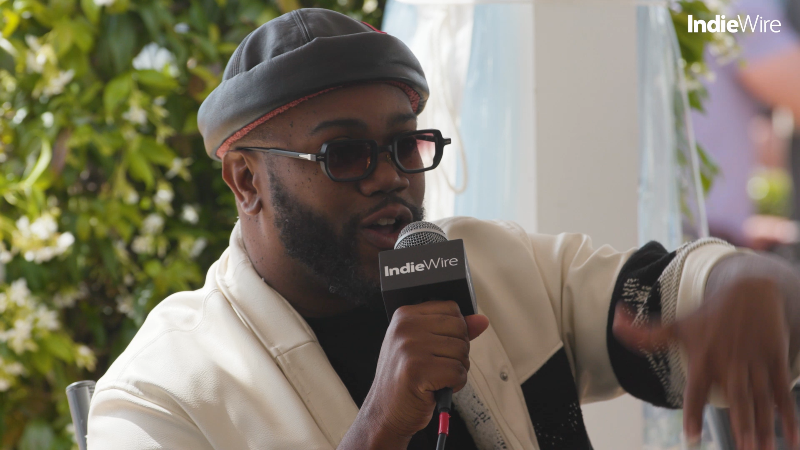
“I get particularly annoyed at the word ‘AI,’ because it means different things for different people. And it’s impossible to have a conversation when people are not speaking the same language,” Rodriguez said. “For some people it means a chatbot, for other people it means TikTok or a recommendation engine, for someone else it means a technology that can automate my labor, whereas for other people it means a new type of tool to enable artists. I think that as long as that’s not clear, we cannot even start having a conversation.”
O’Falt added that many of our conversations about AI are happening so early in the technology’s development process that we find ourselves reacting to the low level, gimmicky products that are unlikely to make their way into actual filmmaking. The actual AI integrations that could happen a decade from now are likely to look more similar to the tools that Hollywood has been using for years.
“It would be easier if we just thought of some of the things being done in AI as natural extensions of what we’ve been doing with CGI for a while. But the problem is, the minute you say AI you’re thinking of a bad Brad Pitt fighting Tom Cruise and the slop,” he said. “Creating a space where this can be talked about is very difficult. Because you’re talking about a world that is fueled by money. And then there’s an audience that the minute they hear it, are angry and turned off. So the question becomes, how do you even create the platform to have that conversation the way we talk about anything else?”
Hylton added that these conversations are not simply technological or economic: they’re philosophical. He argued that AI art has such a visceral impact on people because it seems to threaten our very definitions of being human. He doesn’t see that as the only endpoint, but he stressed that AI advocates have to acknowledge those fears in their counterarguments.
“As humans, we want our art to cost us something,” he said. “We can relate to hard work. We can relate to putting time into something and getting a return. And that cost is threatened when you have a platform that you can prompt and then you see something… We’re having really high level existential questions about what it means to be human and how valuable are experiences are.”
The notion of collaboration between human artists and AI technology was on full display during a musical performance from Hylton and a live cellist, with Rodriguez generating live images along with the music in real time.
The conversation soon turned to a more practical, pressing issue: copyright. Many artists worry about their work being used to train AI models without compensation, and technological advances in the field have been outpacing the legal developments. But the panelists noted that there are also plenty of positive examples of AI helping creators protect their own work.
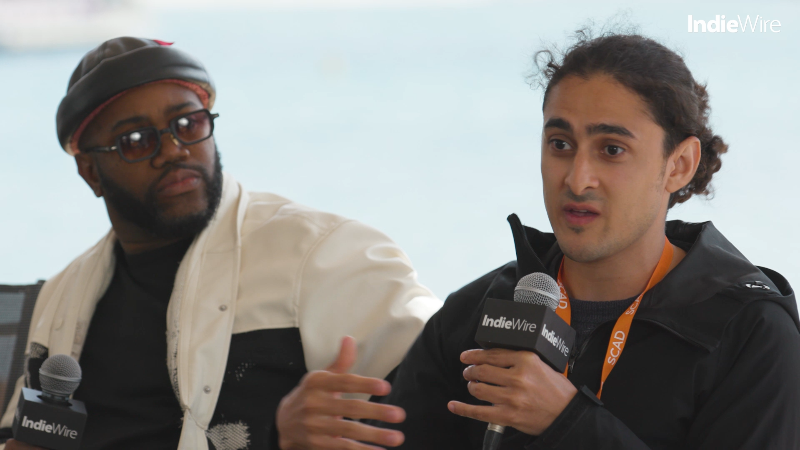
“I am so annoyed at the fact that regulators and IP owners think of AI as an enemy as opposed to a tool,” Rodriguez said. “I’m like ‘did you know that you can use AI to detect your IP at scale and tell if it’s being infringed?’ So now AI can literally help you find IP infringement.”
Small added that the infancy of AI could lead new infrastructure that might share the fruits of the entertainment industry more equitably than in the past. She argued that rather than fighting over whether Silicon Valley or Hollywood sees more of the profits from AI projects, this is the time for conversations about letting creators get in on the ground floor.
“It feels like a false decision,” she said. “Silicon Valley is getting the big meat of the pie, but before Silicon Valley, who was making those decision? When you think about where capital is centered, there are always those individuals who are filtering down and giving us a false sense of real participation. And I think that’s why this conversation is happening, because there are builders and creators and toolmakers that are saying ‘Hey, this is a very early industry… it is ripe for all of us to participate in the infrastructure building.’ At the end of the day those decisions are being made on the artist side and on the tech side. And then it is influencing, thorugh capital, what is happening on the regulatory side.”
Finally, attendees had a chance to witness another demonstration that combined AI and human artistry when Dave Clark, the co-founder and Chief Creative Officer of Promise Studios, took the stage. Clark joined Smalls for a fireside chat about his journey with AI that led him to found a new entertainment studio for the AI age.
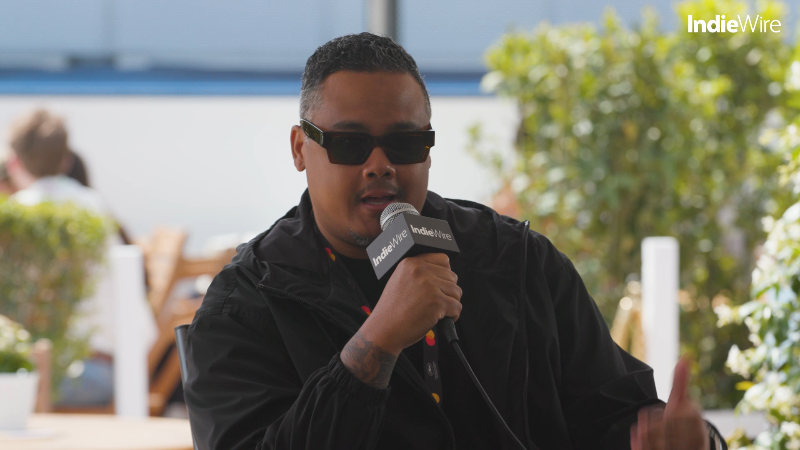
Before demonstrating AI-assisted work that Promise Studios did on a Coca-Cola ad, he explained his journey through traditional film school and his early years in Hollywood, where he was frequently told that his ideas were too large for his relative inexperience as a director. Clark explained that using AI tools to make his short film “Silent Valley” landed him a meeting with Ridley Scott, who echoed his belief that AI tools ultimately serve human storytelling processes.
“For him, it wasn’t about how it really looked. Because three years ago those tools were just, whatever. It was about the story,” Clark said of his meeting with Scott. “‘He goes, you found a way to take a tool that nobody knows what the hell it really does and get your story out there.’ There would be no way in hell I’d be able to do that and show that type of storytelling without the tool. But it was nothing without ten years of dedication of researching history and learning about the story that I wanted to tell that made the tool enable me to be the filmmaker I needed to be.”
The scope of the event, and the wide range of perspectives on display, confirmed how early we are in the AI process and how much we still have to learn. But the conversations also illustrated just how much nuance there is to the topic once we look past binary arguments about it. In her opening remarks, Smalls said that “the Cultural Leadership Fund is really dedicated to those who are shaping and building culture” and giving them a chance to share the financial gains they usher in. The day’s events made it clear that no matter what happens, the fund is well on its way to advancing that goal.
>

The “Bad Lieutenant” pseudo-franchise is one of the more unorthodox pieces of intellectual property floating around Hollywood. The series launched with a 1992 Abel Ferrara movie starring Harvey Keitel as a corrupt, nameless, drug-addicted NYPD cop who endures a crisis of faith amid all of the brutality he witnesses on a daily basis. Ferrara never wanted a follow-up, but 17 years later, Werner Herzog unofficially picked up the mantle by directing “Bad Lieutenant: Port of Call New Orleans,” a darkly funny cop story starring Nicolas Cage in the titular role.
There’s no official connection between the films, and Ferrara famously disavowed Herzog’s film and said he hoped Herzog and Cage would “die in Hell” for making it, but the films are forever associated in the minds of many cinephiles. And now a third legendary director is putting his spin on things with his own “Bad Lieutenant” story about a corrupt police officer.


IndieWire can exclusively reveal the first look at Takashi Miike‘s “Bad Lieutenant: Tokyo,” a new film from the ever-prolific “Audition” director set beneath the bright lights of Tokyo. The neo-noir, written by Miike’s frequent collaborator Daisuke Tengan, stars Lily James, Shun Oguri, and WWE wrestler Liv Morgan.
An official synopsis for the film reads: “A disgraced Tokyo detective spirals into a world of corruption, addiction, and violence as he becomes entangled in a twisted investigation involving a vengeful ex-yakuza, an enigmatic FBI agent, and a missing daughter of a powerful American family.”
“A team of incredibly talented actors and crew has gathered in Tokyo. Now. I’m about to throw a fastball straight down the middle of your strike zone — no tricks, no gimmicks,” Miike said in a statement when the film was first announced in 2025. “I’m confident we are about to break through every limit, to create unforgettable entertainment. Get ready for the ride with us!!”
“Bad Lieutenant: Tokyo” will have its world premiere at the Toronto International Film Festival. Neon will release the film domestically at an unspecified later date, and is also handling international sales for the film. Keep reading for first look images from the film, exclusively on IndieWire.


>

As “The Daily Show” celebrates 30 years on the air, correspondents Jordan Klepper and Ronny Chieng reflected on why the political satire program has managed to endure, and why the genre is “almost a responsibility” for American comedians.
Klepper and Chieng discussed the Comedy Central show’s longevity and the relevance of political satire in a Monday YouTube video, joking about just how long “TDS” has managed to stay relevant. “Thirty f–king years of this. Can you believe it? Of this kind of banter,” Klepper said.
“I feel like this show has outlasted America,” Chieng quipped. “We’ve outlasted quite a few things.”
Klepper then noted that while “The Daily Show” has been on the air for three decades, it is also part of a relatively unique television tradition. The pair pointed to “Meet the Press” as one of the longest-running television programs, but argued that a TV show devoted to political satire is a different kind of achievement.

“We’re also a show that’s like a current affair show kind of, you know, political satire,” Chieng said. “So, I do feel like there’s always a place for political satire, though, don’t you think?”
Klepper agreed, arguing that satire has long been intertwined with major cultural and political moments, even if televised satire is a relatively recent development. “I always think — I do think — like, satire is a part of every cultural moment and movement,” he shared.
Klepper pointed to historical satirists like Jonathan Swift and Mark Twain, joking that they likely would have embraced the medium had television existed during their careers. He also singled out Gore Vidal, who frequently appeared on talk shows, as someone who would have thrived as a television satirist.
For Chieng, the U.S. is particularly well positioned to sustain a daily political satire program because of a combination of factors: its protections for free speech, entertainment industry infrastructure, comedy culture and, perhaps most importantly, its often-chaotic political landscape.
“I always felt that if America couldn’t do a daily political satire show, nobody can do it,” he said. “You know what I mean? Like, if this is the country that has the most freedom of speech, the most money, entertainment, the most comedy infrastructure, nurturing writers and comedians, and we have the craziest politics … if those four things doesn’t combine to form a daily political satire show, if this isn’t a country that can do it, then no one can do it.”
Klepper took the argument a step further, suggesting that American comedians have a particular responsibility to turn the country’s political and cultural contradictions into comedy.
“Also, I think satire is almost a responsibility of like the American comedian,” Klepper said. “I think our American society is full of all of these things swarming into it with the freedoms that we have and the power that we have, the capitalism that we have … you’re swimming in it.”
Chieng then emphasized that they couldn’t discount that the show’s ability to exist in its current form is itself tied to America’s First Amendment. While political satire exists around the world, he noted, the legal protections afforded to American comedians help create an environment where a show like “The Daily Show” can thrive.
“Don’t discount the freedom of speech that we have as well,” Chieng said. “I think a lot of Americans don’t understand that this show is able to exist because of strong freedom of speech protections that most other countries don’t have.”
“You just see the freedoms that we have in America and the ways in which we express that,” Klepper concluded.

>

Prime Video’s “God of War” adaptation may have found its Kratos.
Dave Bautista is currently in talks to take over the main role in the live-action TV adaptation of the popular PlayStation game series. This news comes weeks after Ryan Hurst, who had already begun filming as Kratos, suffered a bicep injury on set that caused the production to recast the role.
Ronald D. Moore created the live-action adaptation and serves as showrunner. The show is produced by Sony Pictures Television, Amazon MGM Studios, PlayStation Productions and Tall Ship Productions.
Deadline first reported this news.
More to come …

>

Gonzalo Garcia & Cesar Palacios transfer news: Fulham sign Real Madrid pair

‘Bad Lieutenant: Tokyo’ First Look Images: Takashi Miike Returns

Yankees, Giants moving forward on trade for outfielder Heliot Ramos: Source
-

 movies2 months ago
Search For Canadian TV Actor Stewart McLean Now Homicide Investigation
-

 Fashion9 years ago
These ’90s fashion trends are making a comeback in 2017
-
Fashion9 years ago
According to Dior Couture, this taboo fashion accessory is back
-
Fashion9 years ago
Model Jocelyn Chew’s Instagram is the best vacation you’ve ever had
-
Fashion9 years ago
Your comprehensive guide to this fall’s biggest trends
-
Fashion9 years ago
9 Celebrities who have spoken out about being photoshopped
-
Fashion9 years ago
Emily Ratajkowski channels back-to-school style
-
Fashion9 years ago
A photo diary of the nightlife scene from LA To Ibiza