
Entertainment
TIFF 2026 Adds ‘Wild Horse Nine,’ ‘The Liberation,’ ‘Bucking Fastard’


In the interest of shoring up its already robust and very impressive 2026 slate, the Toronto International Film Festival has today announced its 11 final titles, including new films from Martin McDonagh, Guy Nattiv, and Werner Herzog.
In recent weeks, the festival rolled out its first films, including its official opening night gala (Siân Heder’s “CODA” follow-up “Being Heumann”). Following that announcement, the festival shared five additional films that will screen as part of this year’s Special Presentations program, plus its massive overall Galas and Special Presentations listing, its Platform and Discovery picks, its TV selections, and those big stars it will honor at its annual gala. And last week saw the release of both the TIFF Docs and Midnight Madness slates. Yes, it’s a lot.


Also on the docket today: the full lineup of TIFF’s In Conversation With… series, “expanding the festival experience beyond the screen through in-depth onstage interviews with festival artists in front of a live audience.” This year welcomes Lee Min-ho, Rachel Morrison, Chris Rock, Andrew Scott, and Hudson Williams to the stage for intimate conversations about their creative journeys, craft, and careers.
“This year’s In Conversation With… series brings together trailblazers and extraordinary storytellers for conversations that will offer audiences a deeper look at their craft and careers,” said Anita Lee, Chief Programming Officer, TIFF.
And, with all of that said, one more piece of TIFF news: the festival’s entire schedule is now available online. Get to to planning! The 51st edition of TIFF will take place September 10-20. The language below comes courtesy of the festival.
Films announced today (in alphabetical order):
“A Good Little Soldier” | Stéphane Brizé | France
North American Premiere | Special Presentations
“Bucking Fastard” | Werner Herzog | USA
Canadian Premiere | Special Presentations
“Closing Night” | Cody Fern | Australia, Canada
World Premiere | Special Presentations
“It’s My Time” | Bai Xue | China
North American Premiere | Gala

“It Will Happen Tonight” | Nanni Moretti | Italy, France, Spain
International Premiere | Special Presentations
“Neil Peart: No One’s Disciple” | Scot McFadyen, Sam Dunn | Canada
World Premiere | Special Presentations
“The Idiot(s)” | Małgorzata Szumowska, Michał Englert | Poland, Germany
Canadian Premiere | Special Presentations
“The Liberation” | Guy Nattiv | USA
Canadian Premiere | Special Presentations
“The Road Not Taken” | Peter Ho-Sun Chan | China
World Premiere | Special Presentations
“Trees are Watching” | Bahman Ghobadi | Turkey
World Premiere | Centrepiece
“Wild Horse Nine” | Martin McDonagh | USA, Chile
Canadian Premiere | Special Presentations
In Conversation lineup announced today:
In Conversation With… Lee Min-ho
Paging all devoted Minoz (미노즈): Join us at TIFF ’26 for an exclusive event celebrating the extraordinary career of global Hallyu icon Lee Min-ho. Here in Toronto for the World Premiere of his new film, “The Assassin(s),” co-starring Yoo Hai-jin (“Exhuma”) and Park Hae-il (“Decision to Leave,” TIFF ’22), and directed by Hur Jin-ho (A Normal Family, TIFF ’23).
In Conversation With… Rachel Morrison
Following the acclaimed premiere of her feature directorial debut, “The Fire Inside,” at TIFF ’24, Academy Award–nominated cinematographer and filmmaker Rachel Morrison returns to the Festival for the World Premiere of her highly anticipated sophomore feature, “Love of Your Life,” a romantic drama from Amazon MGM Studios starring Margaret Qualley, Aaron Pierre, Patrick Schwarzenegger, Gabriel Basso, and Catherine Keener, and produced by Ryan Gosling and Jessie Henderson.
In Conversation With… Chris Rock
As he presents the TIFF ’26 World Premiere of his latest film “Misty Green,” Emmy and Grammy Award–winning director, writer, actor, producer, and comedian Chris Rock joins us for a conversation about his multi-faceted career in front of and behind the camera.

In Conversation With… Andrew Scott, presented by Redbreast
Here at TIFF ’26 with one of the standout performances of the year in “Elsinore,” Andrew Scott proves once and for all that he’s one of the most versatile and captivating performers of our time. The conversation will explore the remarkable range of Scott’s career and celebrate this extraordinary new performance.
Making Waves With… Hudson Williams
This ICW is part of TIFF Next Wave initiatives that centre under-25 creators and audiences
Join us for an intimate conversation with Hudson Williams, one of the stars of the Primetime series “YAGA” from Kat Sandler. His massive breakthrough came when he was cast as Shane Hollander in Jacob Tierney’s award-winning series “Heated Rivalry,” adapted from the bestselling novels by Rachel Reid.The conversation will explore his cinematic and cultural inspirations and reflect on the early short films, community, and collaborations that helped shape his unique artistic voice.
In Conversation With… programming is led by TIFF Public Programming. Tickets go on sale to TIFF Members by level beginning Friday, August 21, and single tickets will go on sale to the public on Monday, August 31.
>
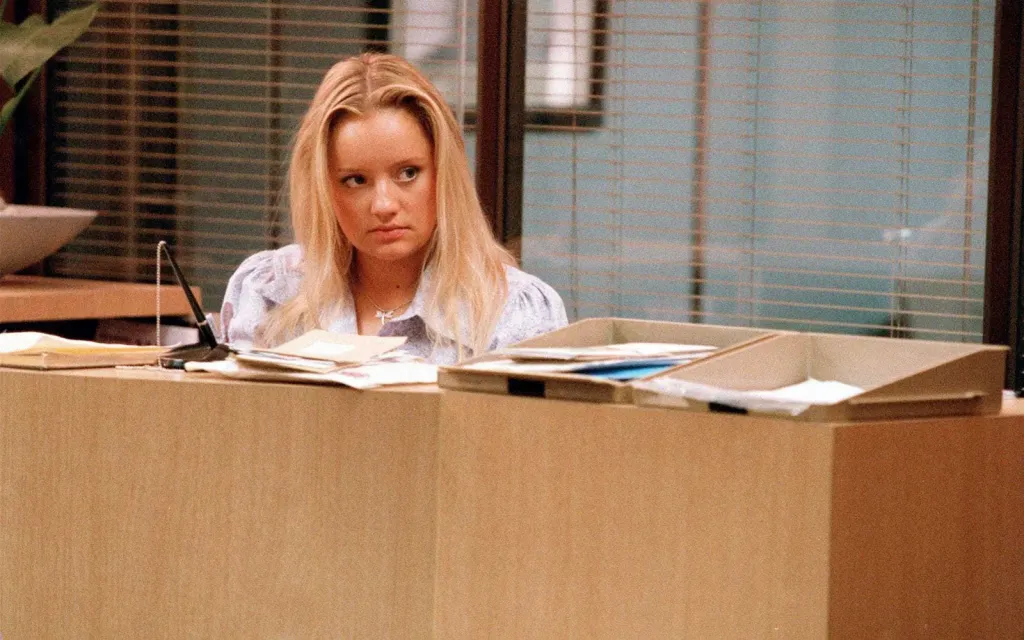
Lucy Davis, best known as Dawn Tinsley in the UK version of The Office, has revealed that she is terminally ill.
In an Instagram post on Tuesday, Davis, 53, told her 590,000 followers that she has incurable cancer after discovering a lump on her breast. She was diagnosed with stage 4 breast cancer, which metastasized to her bones.
“As of now, I’m trying to live out whatever might be left of my life in as fun a way as I possibly can. I always like to find the teachable moments in anything negative that happens. And cancer has not disappointed in that regard,” she wrote.
“The thing that has been most vital to me is humour. I asked my friends and family to make fun of me as much as possible (which they’re really good at), and most importantly of all to not treat me like a sick person.”
Davis said the pain from her condition can be acute at times, while standing and walking is not always easy. But she wants to continue acting and doing animal rights work.
“For those of you on a similar journey to mine, I do wish you well. Cancer asks a lot from us, physically and mentally. And we all get to do it however we choose,” she said.
Davis shot to fame in The Office, playing the receptionist at paper merchant Wernham Hogg. A nation cheered on her will-they-won’t-they relationship with Tim Canterbury (Martin Freeman), with Ricky Gervais and Stephen Merchant ultimately writing a happy ending for the duo. Tinsley was a character who ultimately gave rise to Jenna Fischer’s Pam Beesly in the U.S. series.
Mackenzie Crook and Martin Freeman recently eulogized about her performance in the BBC special Mackenzie Crook and Martin Freeman Remember… The Office. Crook described it as a “beautiful” and “subtle” performance that captured the hearts of British viewers. “The Tim and Dawn stuff with her… was f*****g joyful,” Freeman added.
Davis has also starred in Wonder Woman and Shaun of the Dead.
>


Both by definition and in practice, there’s nothing special about a ripoff. Aside from their obvious creative shortcomings, movies made to capitalize on the popularity of other movies are also plentiful: The Asylum in particular has built an empire on cheap films with titles that are just different enough from those of far more expensive productions to avoid getting sued. Given the popularity of these copycats, we can therefore assume that, if copyright protections didn’t exist, unscrupulous producers would ditch the maneuvering and cash in on other movies’ success more directly. And in some of the film industry’s more lawless corners, they’ve tried.


Due to the lawsuit factor, sequels to a hit movie that are made without the permission of the creators — and, more importantly, the studio — are rare. But they’re not unprecedented. They most commonly take the form of a sequel-in-name-only, in which an unrelated script is slapped with the name of a popular film series in order to draw in gullible audiences. The good-bad classic “Troll 2” is an example of this phenomenon, as are the more than 50 horror movies that incorporate the word “Amityville” somewhere in their title. (“Widely publicized events of public interest,” as a judge put it in 1989, are not subject to copyright.) But it’s the Italians that made them an art.
Taking a pre-existing movie and branding it as a sequel to a totally unrelated Hollywood hit was common practice in Italy from the late 1970s until the mid-’90s. This was the era of cannibal movies and cheap post-apocalyptic knockoffs, a time when, as Howard Hughes writes in his history “Cinema Italiano,” the country’s once-booming film industry “quite literally ate itself.” “Alien,” “The Texas Chain Saw Massacre,” “The Evil Dead” (“La Casa” in Italian), “Dirty Harry,” even Italy’s own “Django” movies — no series was safe, as lax copyright laws and a filmmaking culture built around genre cycles combined to create a staggering number of ripoffs and unofficial sequels.
First came a series of “The Exorcist” clones in the mid-’70s. 1974’s “Beyond the Door,” about a San Francisco woman whose pregnancy is complicated by demonic possession, is among the best of these. That was followed by a watery wave of “Jawsploitation” movies in the wake of Steven Spielberg’s blockbuster. This went on for quite some time: “Cruel Jaws”, directed by prolific knockoff artist Bruno Mattei, came out in 1995. As the influence of Hollywood blockbusters on the global film industry became more prominent, the wannabes became bolder, and by 1980 titles like “Alien 2: On Earth” straight-up claimed to be sequels to movies whose producers were far away in Los Angeles, completely unaware of their Italian counterparts. Or so the filmmakers hoped.
Ironically, many of these movies were ripping off James Cameron, who had started his own directing career with an Italian-made sequel, “Piranha II: The Spawning,” in 1982. (Roger Corman, who produced the original “Piranha” and sold the sequel rights, would never have turned down the opportunity to make money on the same movie twice.) 1989’s “Shocking Dark” — which changed its name from “Terminator 2” after “Terminator 2: Judgement Day” came out in 1992 — combines two Cameron ripoffs into one movie, lifting most of its plot from “Aliens” before adding a “Terminator”-style twist in the last 20 minutes. Although ostensibly set in Venice in the year 2000, it mostly takes place in a series of boiler rooms, as a heroic “Mega Force,” which includes a suspiciously Ripley-esque female scientist, fight their way out of an underground network of tunnels full of rubber-suit mutants. The score is pretty good, at least.
One unauthorized Italian sequel that does hold up is Lucio Fulci’s 1979 gore classic “Zombi 2 “(a.k.a.”Zombie”, a.k.a. “Zombie Flesh Eaters”). Originally called “Island of the Living Dead,” the movie was already in production when producer Ugo Tucci proposed changing the name to “Zombi 2” to piggyback off of George Romero’s “Dawn of the Dead,” which was released in Italy under the name “Zombi.” This, in turn, led to legal action, which was struck down when the court decided that “zombie” was a common word and therefore could not be copyrighted.
But while “Zombi 2” might have benefitted from this confusion at the box office, artistically it’s very much its own thing. Fulci’s films have a singularly hypnotic rhythm, and although his zombies move torturously slowly — one character stands and watches them for a minute or so, screaming, until it’s her turn to be bitten — Fulci fills their advance with a nightmarish inevitability. Combined with the grotesque gore effects and pulsing music, it triggers a primal terror that short-circuits your consciousness until you’re as frozen as the character who watches a gigantic splinter of wood approach her eye, millimeter by millimeter, unable to escape or even scream.
Although Italy was arguably more prolific in this area, the freewheeling attitudes of Hong Kong film studios in that industry’s golden era meant that unofficial sequels were not uncommon there, either. John Woo’s “Hard Boiled” is one hit that got the sequel-in-name-only treatment, as a movie called “The Last Blood by God of Gamblers” director Wong Jing was retitled and re-released as “Hard Boiled II” abroad. And for those who lament that Hong Kong cinema has lost its lawless edge, take heart: As recently as 2015, the completely unrelated “Ouija 4” capitalized on the American “Ouija” movies with a story about a group of software developers creating a mobile app based on the haunted board.
But the strangest and most fascinating Hong Kong spinoffs have to be the many spawns of “Mr. Vampire.” Director Ricky Lau started the trend in 1985 with his hit horror-comedy, which combined slapstick comedy with obscure folklore and created a craze for movies about jiangshi (geung si in Cantonese), commonly referred to in the West as “hopping vampires.” Sequels, spin-offs, and remakes abounded, many of them starring Lam Ching-ying, who played the Taoist priest in Lau’s original. Over time, it became unclear which of these were officially sanctioned, and which were not — a bonus for those that were not. That being said, there’s no mistaking “Crazy Safari” (1991) — an unofficial sequel to both “Mr. Vampire” and “The Gods Must Be Crazy” that inexplicably relocates ancient Chinese vampires to the African savanna — for the real thing.
Back in the United States, stricter copyright protections — not to mention greater proximity to major Hollywood studios — have made unauthorized sequels even more rare. But despite Disney’s best efforts, there are still workarounds. The so-called “95-year rule” that has given us all those godawful public-domain horror movies in recent years is one of them. Another is taking a public-domain story that has already been adapted by a bigger, more popular studio and modifying it just enough to make the case that it’s not plagiarism. It’s a “reimagining.”
One American film company that knew this quite well was Filmation, a Los Angeles-based animation studio that had its heyday in the ‘70s producing Saturday morning cartoons and
shuttered shortly after releasing the 1989 “Snow White and the Seven Dwarves” sequel “Happily Ever After.” In Filmation’s version, Snow White — now a happily married princess — teams up with the Seven Dwarves’ equally diminutive female cousins to defeat the Wicked Queen’s equally wicked brother, whose motivations are close, but not quite the same, as his sister’s. A stacked cast — Irene Cara, Malcom McDowell, Phyllis Diller, Dom DeLuise, and Carol Channing all lent their voices — made a play for commercial appeal. But “Happily Ever After” was met with cynicism and disbelief by both critics and audiences, and is remembered now mostly as a VHS-era curio.
Disney fought Filmation in court for years over the latter’s “New Classics Collection,” which also included unauthorized “Pinocchio” and “Alice in Wonderland” sequels. But, in classic amoral Hollywood style, the studio had indulged in a similar scheme in 1985 when it released the “Wizard of Oz” sequel “Return to Oz.” (Ironically, 13 years earlier, Filmation had released its own “Wizard of Oz” sequel, “Journey Back to Oz.:) In short, Disney owned the rights to L. Frank Baum’s source novels, but not the character designs from MGM’s 1939 film. And so this darker (Auntie Em sends Dorothy to a sanitarium for shock treatment at the beginning of the movie) and more Freudian (one character calls Dorothy “Mom”) take on the story made some alternations.
Director and co-screenwriter Walter Murch, who began his career as an editor and sound mixer in the New Hollywood of the ‘70s, was a lifelong fan of Baum’s “Oz” book series, and argued that he was staying close to the source material by replacing the flying monkeys with “Wheelers” who roll around on nightmarishly long forearms and the Tin Man with a copperpot robot named Tik-Tok. But “Return to Oz” was too scary for its target audience of young children, and its failure at the box office ensured that it was Murch’s first and last time directing a feature film.
Two years earlier, a similar scheme had allowed the semi-legitimate James Bond movie “Never Say Never Again” (1983) to slip through the cracks and into theaters, as permission to use the characters and story of “Thunderball” were split up between writer Kevin McClory and Ion Productions after a protracted court battle. Parceling out the elements of a film among multiple rights holders became a more common practice in the American film industry in general in the ‘80s: Everyone wanted in on the burgeoning home-video market, and B-movie studios like Cannon Films based their business models around pre-selling the rights to their films to various international territories. Combined with litigious creatives fighting over their share of the merch rights, this led to situations like the current state of the “Friday the 13th” franchise, where the character of Jason Voorhees and to his hockey mask are owned by different people.
By the 21st century, unauthorized sequels were mainly the territory of specialists like the previously mentioned The Asylum, which released “Titanic II” in 2010. (You can’t copyright the name of a boat, particularly one involved in one of those all-important “widely publicized events.”) In its place, a new phenomenon has arisen: Fan films, unofficial movies based on well-known properties that aren’t made for money and rely on the benevolence (or complicated siloing) of the original rights holders — and their lack of commercial prospects — to get by. Perhaps unsurprisingly, a lot of them are horror movies: Troll 2, itself a sequel-in-name-only, added another layer to its Russian doll of brazen copycats with a sequel to the sequel called “Under ConTroll” in 2019.
But while ripoffs and dodgy reboots are common in horror, some of the weirdest unauthorized sequels are the result of an obsessed fan self-financing a tribute to their favorite movie. Take Cincinnati lawyer Phil Pitzer, who took advantage of a long and frankly very sad legal quagmire to obtain the sequel rights toEasy Rider in the early 2010s. The resulting passion project, “Easy Rider: The Ride Back” (2012), is just bizarre enough to warrant a mention, if only as a case study in how the counterculture values of the 1960s slowly soured into flag-waving Boomer libertarianism.
But the ultimate example of the unauthorized sequel as a low-rent passion project has to be “Showgirls 2: Penny’s from Heaven” (2011), in which Rena Riffel modifies the plot of Paul Verhoeven’s camp classic “Showgirls” to revolve around her character, Penny, the new girl at Elizabeth Berekeley’s strip club who barely has minute of screen time in the original. Riffel — who also had a small role in David Lynch’s “Mulholland Drive” — wrote, produced, directed, edited, starred in, and self-distributed her continuation of the story on a $30,000 budget, shooting in private residences and black-box theaters throughout Southern California.
Riffel claimed at the time that Verhoeven had given his blessing to the project. And to her credit, she did pick up a few tricks from him, and from Lynch. But while the camerawork is occasionally above average, the script is a hodgepodge of quotes from the original movie and hardscrabble insights about the nature of sex work and how everybody’s a whore, baby, if the price is right. Many of these come out of the mouth of co-star Shelley Michelle, who takes on the Gina Gershon mentor role and teaches Penny how to dance ballet from her vagina. (Michelle is probably best known as Julia Roberts’ body double in “Pretty Woman.”)
No matter how quotable or bizarre, however, in the end you can’t deny that this is a movie whose nightclub scenes take place in someone’s living room, complete with a stuffed marlin above the fireplace. In terms of production value, it’s a long way from “Return to Oz” to here. But is it really that far to fall? Unauthorized sequels reveal the extremes of why people make movies in the first place, from purely cynical money grabs to pure — even naive — devotion to characters and their world. Every film, from the most disposable product to the greatest masterpiece, falls somewhere on this spectrum. An unauthorized sequel is just more obvious about its motivations than most.
>

“Josephine, can you tell me what you saw?”
Those seven words solidify the premise for Josephine, sophomore writer-director Beth de Araújo’s drama that has major awards buzz after landing the Grand Jury Award and Audience Award at Sundance in January. Today we got our first trailer for the film — watch it above — along with its theatrical release date.

Thge official logline: After 8-year-old Josephine (Mason Reeves) accidentally witnesses a crime in Golden Gate Park, she begins to act out violently to protect herself. This emotional trauma leads to conflicts between her parents (Channing Tatum and Gemma Chan) as they search for justice and a way to feel safe again.
The trailer is short on dialogue but long on tension as the parents struggle with how their little girl is dealing with sudden emotional upheaval. But not everyone is on the little one’s side. To wit, one grownup asks the third-grader, “If what you say you saw was so bad, why did you just watch from behind a tree?”
The double Sundance win fired up awards-season watchers, who recall that Best Picture winner CODA and nominee Minari and turned the same trick in 2021 and 2020, respectively.
In a competitive environment, Ash Avildsen’s Sumerian Pictures paid mid-seven figures to acquire U.S. rights to Josephine in February. The self-described “artists-led independent creative studio” has set a limited theatrical release for the awards-season sweet spot of November 20. The rollout will expand nationwide on December 4.
>

'Phenomenal!' – GB's Shanahan wins European 200m backstroke gold

Aptoide Games Becomes First Third-Party App Store on Google Play

‘The Office’ Star Lucy Davis Reveals She Has Incurable Cancer
-

 movies3 months ago
Search For Canadian TV Actor Stewart McLean Now Homicide Investigation
-

 Fashion9 years ago
These ’90s fashion trends are making a comeback in 2017
-
Fashion9 years ago
According to Dior Couture, this taboo fashion accessory is back
-
Fashion9 years ago
Model Jocelyn Chew’s Instagram is the best vacation you’ve ever had
-
Fashion9 years ago
Your comprehensive guide to this fall’s biggest trends
-
Fashion9 years ago
9 Celebrities who have spoken out about being photoshopped
-
Fashion9 years ago
Emily Ratajkowski channels back-to-school style
-
Fashion9 years ago
A photo diary of the nightlife scene from LA To Ibiza