
ABC’s ‘9-1-1: Nashville’
Disney / Jake Giles Netter



It has been one year since California lawmakers approved a dramatic increase to the state’s production incentive program, and the number of film and TV shows applying for a tax break to film in the Golden State has since dramatically increased.
But it’s far too early to declare “mission accomplished.”
In an exclusive video roundtable with TheWrap, leaders at the Directors Guild of America, Producers Guild of America and Stay in LA said that while there is reason for optimism, it will take many more years of work throughout the industry if there is any hope of undoing the years of decline in production work that has ravaged California’s entertainment workforce. Their comments provide scale to the magnitude of the problem the state faces in reviving Hollywood.
“I feel like some folks treated the tax credit like the finish line last year, and it’s great to hear that we’re kind of all in agreement that it was really the starting gun,” said Kate Holguin, producer and head of legislative affairs for Stay in LA. “Sacramento obviously made an enormous investment in making California competitive, but the incentives really just get California into the conversation, right?”

Holguin was joined by Rebecca Rhine, Western Executive Director for the DGA and president of the Entertainment Union Coalition, and Susan Sprung, president/CEO of the Producers Guild. Like Holguin, Rhine and Sprung were deeply involved in lobbying for the expansion of the California incentive program, which got a cap raise from $330 million to $750 million and expanded the types of projects eligible for incentives, including animation and large-scale competition shows.
While ProdPro reported a modest 5% increase in production spending in California in the second quarter of 2026, FilmLA reported that on-location shoot days in Los Angeles for that quarter dropped 12% year-over-year, continuing a years-long trend that was exacerbated by the 2023 industry strikes.
Sprung noted that it will still take several more months before the full impact of the first year of the incentive expansion will be reflected in the data. While the on-location shoot declines are a troubling sign, that does not include productions that have received the incentive but are largely soundstage based, like HBO’s “The Pitt.”
“Obviously [there] were programs that got it immediately and are up and running, but there are also a huge number of productions that are still in pre-production,” she said. “Fingers crossed, we want to see where we are six months, in a year from now, to see whether we have a consistent uptick.”

For Hollywood labor, 2026 was supposed to be a slower lobbying year compared to 2025. The primary focus had been on Assembly Bill 2319, which is up for a vote in the California State Senate in the coming weeks and would establish an incentive for post-production work available to projects shot in and out of the state. IATSE and its post-production locals, including the Motion Picture Editors Guild, have pushed for its passage.
But a twist came in late June with the passage of Senate Bill 122, a law intended to aid California’s often tricky budget balancing by limiting the amount of tax credits any business can receive annually to either $5 million or 70% of its total liability, whichever is greater.
Rhine said that the EUC scrambled over the past two months to push for an exemption for productions, warning that SB 122 could undermine California’s competitiveness for global production, as projects that applied for eligibility in the past year will suddenly have to wait years to get the full value of the tax credits they earned based on eligible in-state spending.

“In my view, [SB 122] puts us at risk of not being able to bring any production back here because it begs the question whether [producers] can rely upon the promises made in the state of California,” Rhine said. “There are two things productions have to have: their certainty and predictability. They have to know that what they’re promised is what they’re going to get when they make decisions, and they can’t be in a position where the rules change down the down the line.”
Lawmakers and union insiders have told TheWrap since the roundtable was taped that a deal is set to be announced in the coming days on changes to the incentive program to account for the SB 122 cap, including an exemption for independent productions and an acceleration of tax credit payouts to productions that complete their payments to workers and vendors. But the deal stops short of extending a full exemption to productions from major studios, as insiders say there is concern among lawmakers that it will lead to other industries calling for exemptions of their own.
It remains to be seen how those changes will affect studio interest in filming in California compared to other states, like New York and Illinois, which have also ramped up their efforts to bring in productions with their own incentive expansions, as well as major overseas hubs like London and Vancouver, which continue to offer extremely lucrative packages.

Sprung, Rhine and Holguin hope that the first year of the expanded program will bring noticeable improvement to California’s entertainment job market. That, in turn, can be used as evidence to used to push for further changes to make the incentive program even more competitive, such as allowing salaries of above-the-line talent like actors and filmmakers to count as eligible spending as it does in the U.K. and Canada. The lobbying campaign is also expected to extend to Washington, where plans are being made to push for a federal film tax credit in 2027 following this November’s congressional midterms.
And on the local front, Stay in LA has lobbied Los Angeles Mayor Karen Bass, FilmLA, the City Council and the Board of Public Works to continue reducing permitting fees and processing times to make it easier for productions, especially indie ones, to film in Los Angeles. Holguin said that they have urged officials to improve regional coordination between various jurisdictions on permitting, but have been told that the budget constraints that the city has faced since the 2025 wildfires have made it difficult to do so.
“I understand that local government is stretched thin, and regional coordination is genuinely very difficult. But that’s kind of how we already ended up here,” she said. “We can’t explain all the reasons you know a problem is difficult to solve, but then just stop there. So I really want decision makers at the local level to really own this work and bring the different jurisdictions together in the 30-mile zone, establish a plan, and be accountable for getting something like this done.”
Watch the full panel in the video above.

>

EXCLUSIVE: Teyonah Parris is joining the Apple Original Films pic Running from director Gavin O’Connor. The film currently stars Spike Fearn, Brian Tyree Henry and Rhea Seehorn. Bill Dubuque penned the script, which is based on a story by O’Connor and Dubuque.
The film, a co-production between Makeready and Waffle Iron Entertainment, follows a homeless high school running prodigy on the hunt for greatness as he uses his gifts to outrun his past and find a family.
This project marks a reunion for Parris and Apple as she will also star in Apple Original Films’ upcoming live-action adventure Matchbox the Movie, inspired by Mattel’s die-cast toy vehicle line, opposite John Cena and Jessica Biel. Matchbox is set to be released October 9.
Parris has built a career on disappearing into bold, wildly different worlds. She recently starred opposite John Boyega and Jamie Foxx in Netflix’s conspiracy comedy They Cloned Tyrone, directed by Juel Taylor. She also originated the adult role of Marvel superhero Monica Rambeau in the Emmy-winning WandaVision before taking the character to the big screen in The Marvels, starring alongside Brie Larson and Iman Vellani in the pic directed by Nia DaCosta.
She is repped by CAA and Fox Rothschild.
>

Paramount‘s pending acquisition of Warner Bros Discovery has evoked a range of emotion in Hollywood, mainly fear among creatives at the planned merger of two more major studios. But now that uncertainty is tinged with panic after CEO David Ellison threatened to relocate his Los Angeles-based company to Tennessee, Texas or Georgia.
Separately, the risks of both companies floating in limbo for the better part of a year as an antitrust suit by 12 state attorneys general wends its way to a March 2027 trial date has started to sink in.
So key guilds, trade groups and exhibitors are now urging Paramount and California Attorney General Rob Bonta to settle, even as many remain opposed to the merger, with a stream of sometimes confusing statements suggesting concessions to make the deal more palatable. But those proposed concessions are “behavioral,” Bonta has said. Promises, even in writing, aren’t the “structural” remedies, like asset sales, needed to preserve competition in markets the lawsuit claims are at risk.
“None of the noise from various constituencies makes Bonta’s case any weaker. It may pressure him to come to the table, but not to settle unless he feels that the competition in the market today will remain there afterwards,” said attorney Abiel Garcia, who began his career at the California DOJ as a deputy AG. He thinks the antitrust case is solid, “Not an easy win, but a good case. Ellison can’t do anything now except get Bonta to the table.”
Paramount had requested a November trial; the AGs asked for April. The judge set a March 2 start. “I think they [AGs] were looking at this in terms of what do we need to make sure our case is built as soundly as it can be,” said Garcia. “But the date had unintended consequences — the industry stepping in to say we can’t wait that long.”
Though both sides have agreed to the court-required mediation process, there are no formal settlement talks underway.
Speculation about a move to Nashville, where Ellison used to own a home, emerged earlier this summer and in August after he told Paramount’s leadership team that he would start the process of exiting California on October 1 absent settlement talks. Office headquarters could go first, followed by a slower move of studio staff and executives. The historic Melrose lot would likely be sold.
The date is timed to the October 1 trigger of a so-called ticking fee Paramount agreed to in the WBD deal – an onerous per-share payout that comes to about $7 million a day, or $650 million a quarter, until the deal closes. If the merger collapses altogether, Paramount would instead be on the hook for a $7 billion termination fee to WBD. The David Zaslav-led company has a contractual right to walk away as of June 4, 2027.
Bonta has called the threat to relocate “blackmail.” The Paramount camp denies that, insisting they’d prefer, of course, to stay in California but could save a boatload of money elsewhere, and that they don’t feel supported by their home state.
Taking him at his word, Nashville is a global music hub where Oracle, run by David Ellison‘s father Larry Ellison, has announced plans to expand. It’s building a massive campus for a world headquarters in the city’s East Bank area near the Cumberland River, a major area of new development.
Sony and other music labels and publishers large and small, adjacent business and countless musicians and artists have a large presence in there, as do agencies, and Paramount’s CMT (Country Music Television).
Tennesse’s core film and TV production incentive is a 25% rebate on eligible expenses in the state, with uplifts possible, on a minimum spend of $500,000.
“We aren’t big on red tape or fine print; there’s no per project cap, and this is not a first-come, first-served program,” says the website of the Tennessee Entertainment Commission. The state has no individual income tax on wages or salaries.
Projects shot there include films The Green Mike, Walk the Line, Hustle & Flow, Hannah Montana: The Movie, Robert Altman’s Nashville and the popular ABC/CMT drama of the same name starring the late Hayden Pannettiere. Also shooting there is 9-1-1 Nashville and the Prime Video series Scarpetta starring Nicole Kidman, where Nashville stands in for Alexandria, VA.
ABC’s ‘9-1-1: Nashville’
Disney / Jake Giles Netter
Asked for comment, the Tennessee Department of Economic and Community Development said only: “Paramount is a globally recognized company and well-respected brand. While we cannot comment on specifics, TNECD remains committed to working with companies across a wide range of industries that are exploring opportunities to invest and grow in Tennessee.”
In July, when the state first came up as a potential new home for Par, Gov. Bill Lee jumped in on X, saying: “Tennessee is a place where innovation & creativity thrive. Paramount has played an important role in shaping American culture, & we’d welcome the opportunity to see the next chapter of that story unfold in the Volunteer State.”
Georgia and Texas are both better known filming destinations. The Peach State in particular has supercharged its incentives, infrastructure and crew base dramatically over the past decade to rival California and New York as a major U.S. hub.
Georgia’s Department of Economic Development was mum on a Paramount move. “We don’t comment on speculation or private correspondence. However, as a major film production hub with long-term relationships with our industry partners, we welcome any such conversations.”
As for Texas, it is fast up-and-coming and has been successful bringing in production. A newly sweetened incentive package just took hold this summer, nudged along by native Matthew McConaughey who was a frequent presence at the State House in Austin during deliberations. Soundstages have been popping up as well, from Taylor Sheridan’s SGS Studios in Fort Worth, the largest in the state, to The Chosen‘s film campus in Midlothian. There is activity in buzzy Austin (home of SXSW), Dallas, Houston and San Antonio.
Sasha Calle at SXSW 2025 in Austin
Stephen Olker/SXSW Conference & Festivals via Getty Images
“Texas offers the best business climate in America,” said Gov. Greg Abbott’s press secretary Andrew Mahaleris in a statement. “The state has no corporate income tax and no personal income tax. Paramount already maintains major production facilities in Texas and has filmed numerous successful productions in Texas over the years. Companies that leave high-tax, high-regulation states like California will find opportunity and success here.”
The New York Post reported that Austin’s Bluebonnet Business Center, a big commercial development, is a possible location. Deadline hears that particular site is not under consideration for the company’s relocation.
“I’ve said this before, and I firmly believe it: the future of film is Texas. We have the space, major city centers, incredible workforce, a pro-business environment, and now the long-term incentive investment created by our state leadership to prove it,” Chase Musslewhite, co-founder of Media For Texas, a nonprofit that’s been front and center in the state’s production push, tells Deadline.
“What’s really exciting is the chance for major industry partners to seize this opportunity too. Texans have always had a strong independent spirit, but we also welcome anyone who wants to invest in our communities and build the future of this industry together. From the perspective of the Texas film community, our doors are wide open.”
Generally speaking, a handful of southern states are considered particularly good places to do business, while California is regularly slammed for high taxes, regulation and cost of living. Nashville, Atlanta, Charlotte and Dallas took the top four spots in trade pub SiteSelection’s 2026 annual survey of leading national site consultants on which cities they favor for corporate headquarters projects.
As it did in 2025, California received the most votes for the Worst Business Climate in America.
A survey by another publication, AreaDevelopment, for 2025 saw Georgia, Texas and Tennessee at No. 1, No. 3 and No. 6 among the top 10 states for doing business.
That said, every industry has unique needs and a crew base is essential to film and TV production. SiteSelection respondents cited a skilled workforce, cost of living, incentives, quality of life and worker training programs the key elements when considering where to move.
The reaction from filmmakers and reps to Paramount’s potential move runs the gamut. After all, production has been fanning out across the country for years as more and more states add or boost incentives. Markets are dotted by new state-of-art studio complexes.
“At its worse, this is yet another example of politics leveraging our business for their own agenda,” said producer Marty Bowen, whose Temple Hill has a deal on the Melrose lot. “Our business is contracting and no longer a competition between studios. It’s a competition for eyeballs and we’re losing to digital media,” the Smile producer warned. “If the state doesn’t allow the merger, then they’ll need to figure out how to hold onto the industry because it’s already shown that is doesn’t need California.
“It’s sad to say but it’s true. Temple Hill has made over 50 movies and only one has been shot in L.A.”
Some producers are fed up with living in Hollywood, with homelessness, crime in the hills and Mayor Karen Bass’ unpopular handling of the horrific 2025 fires. “Just look at the people who voted for Spencer Pratt in the last mayoral run-off — it’s eyebrow-raising,” said one. “A move to Austin or Nashville would be welcome.”
“We’re already making movies outside of Hollywood,” adds another. “Why would this make a difference?”
Many consider Paramount’s rumblings “a totally empty threat. It was said at a meeting with senior executives? It felt so planted… No one is moving out of Hollywood,” said one Hollywood insider.
A prolific producer in town fears that “the more David pokes the AGs, the harder it gets for him.”
Bonta, appearing on CNBC Thursday, was asked about the mounting industry pressure to settle. “I don’t care what people think, I care about the law,” he said. “If they really want to engage in structural remedies, keeping different corporate entities separate … we are open to those conversations and happy to have them,” he reiterated
He called the trial date “lightning speed when it comes to litigation. My Meta case took three years to get to court.” A landmark trial against Mark Zuckerberg’s social media giant claiming it deliberately tries to hook young users and lies about it, started Tuesday. It was brought by AGs from California, Colorado, Kentucky and New Jersey.
Asked about Paramount’s threat to leave the state, he said: “I called it blackmail. I still call it blackmail. … They’re saying if you dare enforce the law against us … we will pick up our ball and leave. And they’re trying to say, don’t sue us. Drop this case. Do what we want. Allow us to merge unlawfully. We’re not going do that. We’re never going do that.”
A handful of producers on the Paramount lot say they’d likely keep an office in L.A. should the mountain-top logo studio head out of state. Writers rooms in addition to meet-ups with talent and agents still occur in person in L.A., not to mention it’s common for talent from overseas to make the rounds of the lots; Zoom culture has ebbed post-Covid for many.
“I don’t want to see the studio leave, but I understand that David needs to do what he needs to do, just like I would,” one blockbuster Paramount producer said.
“Look, we want to keep them here,” Top Gun franchise producer Jerry Bruckheimer told Deadline recently at D23. “It’s unfortunate that it’s got this kind of political circle around it, which is a shame, and hopefully they work it all out: they stay here, and the business gets healthier.”
Bruckheimer has been a vocal supporter of Ellison and Paramount’s pursuit of Warner Bros, noting the CEO’s promise of 30 films annually. He declined to sign a petition against the merger supported by over 3,000 industry insiders.
Asked about that at a CinemaCon panel this past spring, Bruckheimer said, “You can sign all the petitions you want, but [the merger is] already being approved by European countries. It’s happening. So there’s not much we can do about it other than take David at his word that he’s going to make 30 movies [a year], and that would be fantastic.”
Bonta and others have called that 30-movie-a-year promise less than meets the eye, missing specifics and hard to enforce.
The Paramount-WBD deal has, in fact, been approved by the EU, as well the UK, the U.S. Department of Justice and every other international regulatory body. Ellison anticipated the merger would close in the current third quarter. The deal had an air of inevitability until the AGs sued five weeks ago, especially after the federal judge in District Court in Northern California agreed to a temporary restraining order based on the AGs argument around wide-release movies, one of three markets addressed in the suit.
The threat to move Paramount sent shockwaves through the rest of Hollywood, riling up state and local politicians, union leaders and Ellison’s fellow studio executives, who have been campaigning to bring production jobs back to California for years.
DGA and IATSE leadership were among the first to plead with Ellison and Bonta to find a path toward a deal, or, at the very least, move up the trial date.
The truth of the matter is, while Paramount leaving California would be an inconvenience for top talent and executives (who already travel plenty for jobs as production hubs crop up across the world), it would devastate rank-and-file workers, especially below the line, who are responsible for the state’s deep well of production infrastructure and skill. Production is still declining in most of the state, even after the mega-infusion to the Film & TV Tax Credit Program last year, which is also now in jeopardy thanks to a revision to the state tax code that limits corporations’ ability to decrease their tax liability in a given year. Lawmakers have until the end of the legislative session August 31 to find a solution for that.
It makes sense that the DGA and IATSE would be two of the unions to push for a quicker solution, given that many of their members are among those will be most impacted by any outcome. IATSE represents many below-the-line crew, and in addition to directors the DGA represents BTL professionals including assistant directors and unit production managers.
Below-the-line crew are typically hired locally at a higher rate than top actors, directors or even writers. Some territories even require a percentage of the production team to be local hires, and those requirements are often met via the crew.
Insiders at the unions tell Deadline that leadership at the DGA and IATSE still fundamentally oppose the merger, but they fear a prolonged fight will leave any independent version of Warner Bros worse for wear — if there is even an outcome that includes an independent WB at the end of all this — should the March 2027 trial date stand.
Both studios are still independently operating as the merger fight continues. Paramount alone just secured billions in California tax credits for local productions including the Clueless reboot. However, prolonged uncertainty on the fate of two major film and television studios would undoubtedly play a role in business decisions going forward.
Alicia Silverstone, ‘Clueless,’ (inset) Josh Schwartz, Stephanie Savage and Jordan Weiss
Getty/Paramount/Kristin Burns/Austin Hargrave
Production sources tell Deadline that leadership across both studios are considering the ongoing battle, and the financial toll it could take, when making decisions not only on production location but also on future development at large.
The WGA is one guild still planted fiercely in the no-deal camp, not surprising since it’s got a parallel lawsuit to block the merger that’s advancing in tandem with the AGs’ case but focused on jobs and industry impact rather than antitrust.
“By threatening to leave the state because it doesn’t want the government to enforce the law, Paramount further proves the danger of its outsized power over the industry and what that will mean for writers and the creative community,” the writers guild told Deadline.
Guilds and others in the industry have called out Ellison for publicly championing Hollywood and local jobs back when Skydance acquired Paramount and after unveiling the WBD merger, only to now talk about decamping entirely.
“My promise to you is to build a stronger Hollywood, by keeping both of these legacy studios operating separately, thereby preserving and potentially increasing jobs,” Ellison wrote in a March letter to California lawmakers Sen. Adam Schiff and Rep. Laura Friedman who had asked him how the merger would impact the state.
“The Los Angeles area provides some of the most talented and well-trained film and television workers in the world, and it is my expectation that the commitments I have made will preserve and expand good-paying film and television jobs in the area,” Ellison wrote.
He wasn’t specific and the combined company’s $6 billion cost saving target plus the large debt load it would carry post-merger has fueled fears of major layoffs.
In a report this week, the L.A. County Department of Economic Opportunity warned that if the deal goes through (and the merged studios stay in L.A.), about 4,500 film and TV jobs in the county could be lost over the three-year period when the companies combine operations.
It sees a potential overall loss of 15,567 corporate roles that overlap across both companies, with 6,099 shared, and 2,495 jobs specifically in Los Angeles County. Plus, it noted the impact on 2,661 indirect jobs at small businesses that support production — prop houses, printers, transportation companies, and other vendors – and 3,204 other less direct jobs at restaurants, retailers and service providers.
Wall Street is one constituency that’s been relatively muted on the drama.
“While the press is focused on Ellison’s threat to move Paramount out of California, we are more interested in the $500+ million question,” wrote Lightshed Partners analyst Rich Greenfield. That’s a number Ellison mentioned to leadership. The total savings over time would likely be much more.
“If relocating a film and TV studio to Texas or Tennessee really saves that much per year,” Greenfield wondered, “why hasn’t every major studio already done it? And if the economics are that compelling, does this merger battle end up being the thing that finally breaks Hollywood’s geographic lock on the entertainment industry?”
>
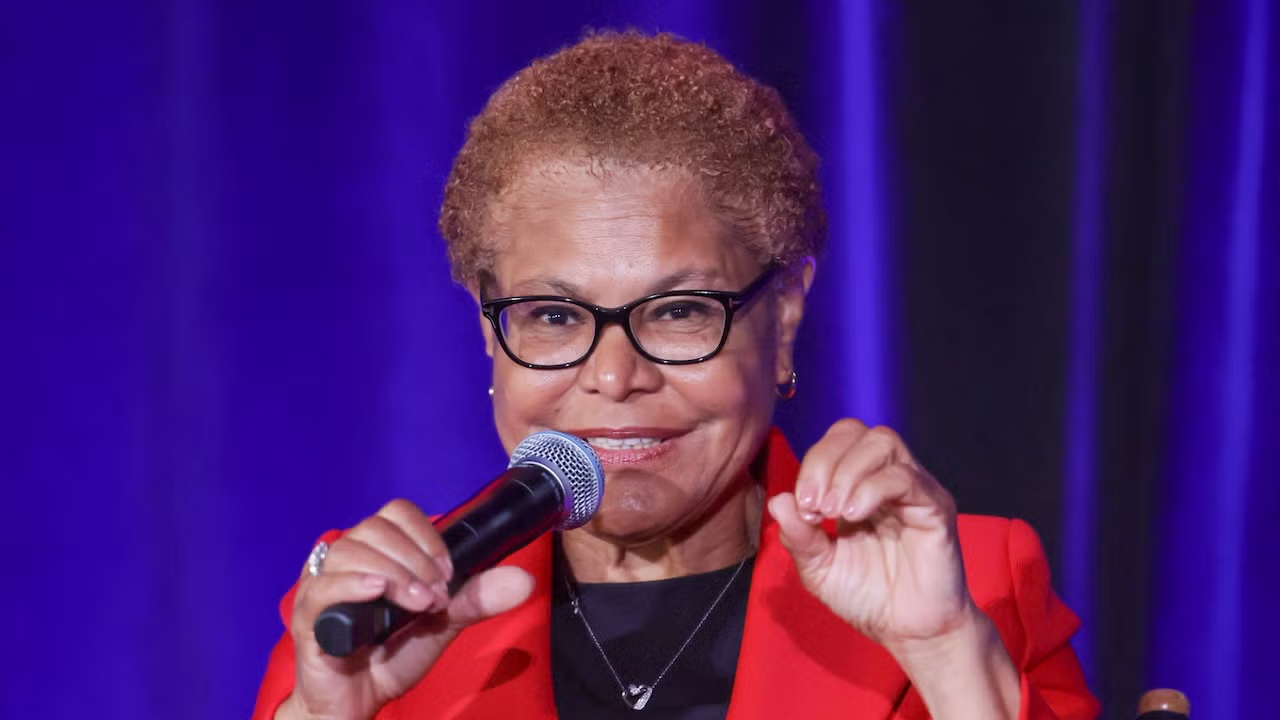
Los Angeles Mayor Karen Bass is urging David Ellison and California Attorney General Rob Bonta to “find common ground” and settle a lawsuit seeking to block the pending $110 billion Paramount-Warner Bros. Discovery merger.
“While there are varying perspectives on the proposed transaction, today we are united around one clear message: It is time for all parties to come to the table,” Bass said during a news conference on Thursday. “The continued uncertainty is not good for workers, not good for productions and not good for the future of this industry. Too many productions in L.A. are now at a standstill, which means Angelenos are out of a job and they’re not getting paid.”
“As mayor, I cannot stand by while the job security of thousands of hardworking union members is being put at risk. That is why we are calling on Paramount, Attorney General Rob Bonta, and all relevant parties to come together, engage directly and in good faith, and work urgently to find common ground and keep our vital industry in Los Angeles at a time when film and television production is already facing significant challenges,” Bass continued. “We cannot afford prolonged uncertainty that delays investment, puts production on hold, and creates greater instability for thousands of workers and family. Any resolution must put workers and the long-term health of our entertainment industry at the center, it must include meaningful and enforceable commitments to keep Paramount and Warner Brothers Discovery in L.A. as well as maintaining jobs, productions, and investments in L.A. and California.”
Bass’ call for a settlement comes after TheWrap was first to report a new study by L.A County’s Department of Economic Opportunity and CVL Economics, which found that the merger could result the loss of nearly 4,500 TV and film jobs over the next three years.
It could also risk 2,661 indirect jobs at small businesses that support production — such as prop houses, printers, transportation companies and other vendors — and 3,204 induced jobs that exist because film and TV workers spend money in the local economy — including restaurants, retailers and service providers.
Overall, the economic impact of losing these jobs would be $1.26 billion in wages, $2.78 billion in economic value, $4.06 billion in total business output and $547 million in tax revenue, including $78.6 million in local taxes — most of which (63%) comes from property taxes, per the study.
Meanwhile, Paramount CEO David Ellison has threatened to begin the process to move the company’s operations out of the Golden State starting Oct. 1 if Bonta does not come to the table on a settlement. Bonta has called the threat “blackmail” and maintains that he is open to a settlement, but that Paramount needs to offer structural remedies, such as divestments, rather than behavioral remedies.
More to come…

>


Search For Canadian TV Actor Stewart McLean Now Homicide Investigation


These ’90s fashion trends are making a comeback in 2017
According to Dior Couture, this taboo fashion accessory is back
Model Jocelyn Chew’s Instagram is the best vacation you’ve ever had
Emily Ratajkowski channels back-to-school style
9 Celebrities who have spoken out about being photoshopped
Your comprehensive guide to this fall’s biggest trends
A photo diary of the nightlife scene from LA To Ibiza