
‘Art Sex Magic’ photo courtesy of Luke Clayton Thompson


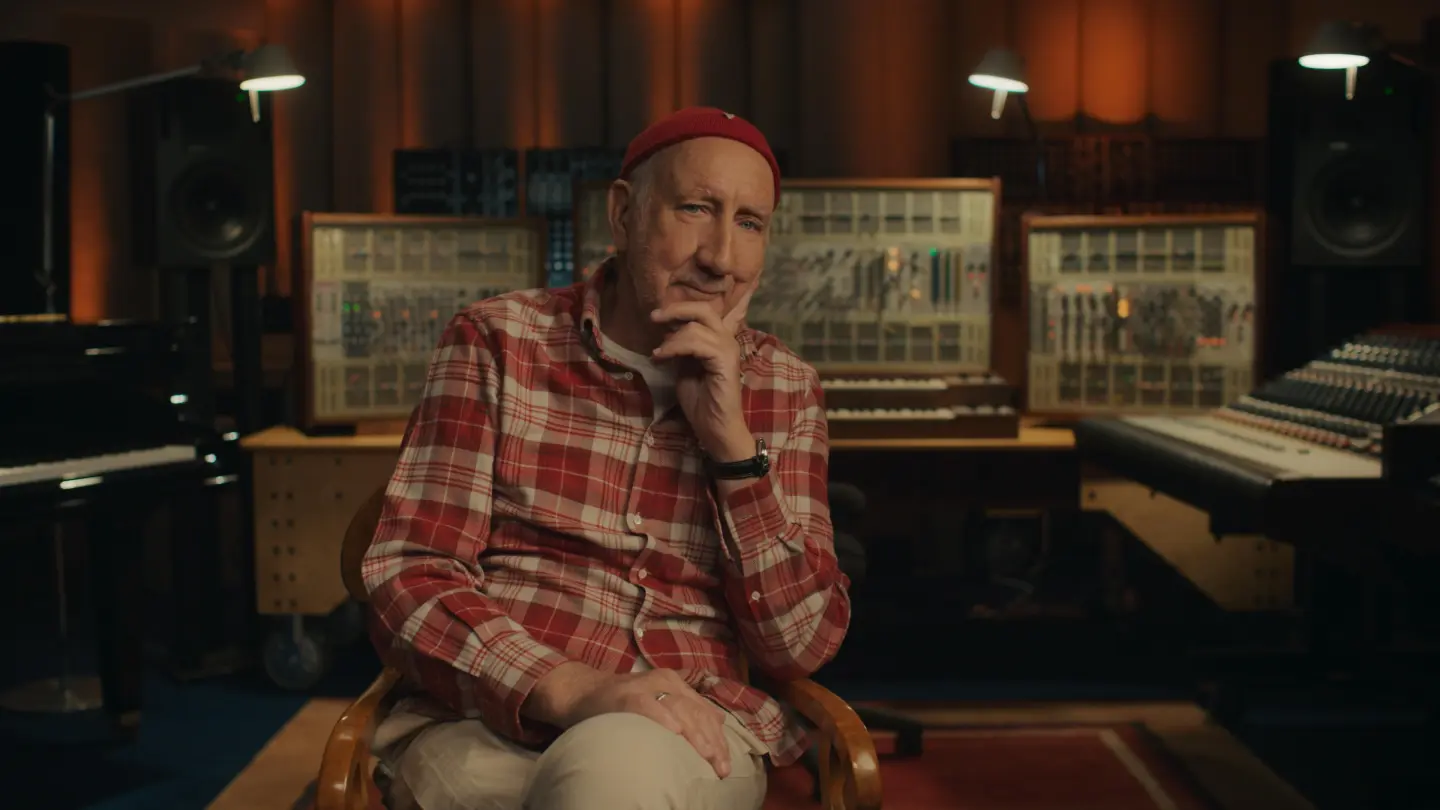
The legendary singer/songwriter Pete Townshend of The Who has cooperated with a documentary feature about his colorful life and career, and specifically about a time that almost destroyed him and his band: when, shortly after the release of the album Tommy, Townshend and The Who tried to make a science fiction rock opera called Lighthouse.
Behind Blue Eyes, which was co-directed by Frank Marshall and Nigel Sinclair, is headed to multiple fall film festivals as a sales title. The film’s backers — it was produced by Kennedy Marshall Documentaries, White Horse Pictures and VICE Studios, and is presented by Sobey Road Entertainment in association with Spirit Music Group, Polygram Entertainment and Trinifold Management — hope it will land a buyer and a spot in this season’s awards race.
Marshall and Sinclair exclusively discussed the film with The Hollywood Reporter.
What was it about Pete Townshend’s story — and specifically the story of Lifehouse — that made you feel this was a film that needed to be made now?
FRANK MARSHALL It’s a fascinating story and very compelling as a film now because the world has finally caught up with it. In 1971, no one could understand what Pete was talking about and he thought Lifehouse had failed. The irony is, 55 years later, we’re living inside his story.
NIGEL SINCLAIR And the other part of this is that Pete’s reached a point in his career and life where he is prepared to take a very intense look back at his creative process, with all its twists and turns; and that was captivating.
As you dug into this period of Pete’s life, what surprised you most about him or changed your understanding of the man behind the music?
MARSHALL I was surprised by how intellectual Pete is, his art school background and how he was trying to describe the future with technology. His solution wasn’t destroying technology, but human connection. He wanted to connect to the audience and bring them together through music. And out of that apparent failure came “Baba O’Riley,” “Won’t Get Fooled Again,” “Behind Blue Eyes,” “The Song Is Over” and other amazing music originally connected to Lifehouse.
SINCLAIR What surprised me was how self-aware he was from an early stage in his career. Discovering the link between his childhood torment and the character of Tommy was an extraordinary revelation. The other thing was the intense duality of his personality — the introvert and the extrovert, the rock superstar and the internal artist who wanted to be thought of as a writer not a rockstar.
Lifehouse emerged from a deeply personal crisis that nearly tore apart both Pete and The Who. How did you approach telling that story in a way that captures both the enormous musical ambition of the project and the personal stakes for Pete?
SINCLAIR Ironically, the enormous musical ambition of the project resulted in Who’s Next, which is easily the biggest album The Who released, groundbreaking, and often considered one of the top 10 rock albums of all time. In two days of interviews, Pete opened up his heart and explained how much Lifehouse was intended to reconcile the two sides of his personality, the rockstar and the artist. So its failure was heartbreaking then and, it appears so, now, as he tells it. So many of the later decisions Pete made about his career were so obviously driven by this “disaster.” And maybe from it came the wisdom that gave Pete a greater sense of fulfillment later, and made his relationship with Roger even more powerful.
What do you hope audiences come away understanding differently about Pete Townshend — and his place in music history — after seeing the film?
SINCLAIR Pete Townshend was one of the avatars who took rock and roll as a form of popular music and turned it into an anthem, a generational call to action, for then and for so many generations since. With Townshend, a select group — John Lennon, Bob Dylan, Ray Davies of the Kinks, and a little later David Bowie — gave the music, the lyrics and the performance of rock and roll the power to become an identity for millions and millions of people on earth. If Dylan changed the narrative with his The Times They Are a-Changin’ album, Pete turned it up to another level with the Tommy double album.
>

EXCLUSIVE: Here are the first stills from Art Sex Music, a feature documentary directed by Caroline Catz and produced by Andy Starke (Free Fire, Kill List).
The doc, which has just wrapped, is based on artist, musician and author Cosey Fanni Tutti’s bestselling memoir of the same name and explores her work as an uncompromising cultural pioneer who was once described as a “wrecker of civilization” in UK Parliament in 1976 following her controversial Prostitution art exhibition at the Institute of Contemporary Arts in London.
Art Sex Music unfolds within an immersive cinematic world build from Fanni Tutti’s archive, transforming decades of diaries costumes, photographs, films, artworks and correspondence into a living environment of interconnected installations through which she revisits and reflects upon her own life.
The film follows Fanni Tutti’s evolution from her working-class upbringing on a council estate in Hull to one of Britain’s most influential artists, charting a life that dissolved the boundaries between art, music, performance and personal identity through her early days in the bands COUM Transmissions and Throbbing Gristle as well as her collaborations with British musician Chris Carter and her solo work. Central to the film is Fanni Tutti’s transformation of her work and personal experiences in the sex industry into a radical artistic practice that challenged conventional ideas of sexuality and representation.
Catz is an award-winning filmmaker, actress and narrator. She wrote, starred in and directed BBC doc Delia Derbyshire: The Myths and the Legendary Tapes in 2020. She is best known for her role as Louisa Glasson in long-running ITV drama Doc Martin. Art Sex Music marks the second feature collaboration between Catz, Stark and Fanni Tutti for banner Anti-Worlds.
“It is a personal honor and privilege to be collaborating with Cosey once again, this time exploring the remarkable continuum of her life, work and artistic vision,” said Catz. “Art Sex Music invites audiences into Cosey’s creative realm through her personal archive, into the experiences, ideas and materials that shaped her life and inspired her autobiography. It is a portrait of an artist who has continually redefined what it means to live and create on her own terms. This is a film that explores eroticism not as a provocation but as an artistic, political and cultural force.”
‘Art Sex Magic’ photo courtesy of Luke Clayton Thompson
>

Sony has set a November 6 global release date for fantasy action-adventure saga Ramayana, starring Ranbir Kapoor, Yash, and Sai Pallavi.
Ramayana is planned as a two-part movie event based on the 5,000-year-old saga. The synopsis reads: “An ancient epic follows a young prince and princess whose marriage and subsequent exile mark the beginning of a legendary journey. Their story of love, duty and destiny sets the stage for greater challenges ahead.”
The film is produced by Namit Malhotra through Prime Focus Studios and directed by Nitesh Tiwari and features music by Oscar-winning composers Hans Zimmer and A.R. Rahman. Sony is handling the release outside of India.
The movie will be released internationally in multiple languages, including an English-language version.
The production features action choreography by Terry Notary and Guy Norris, with production design by Ramsey Avery and Ravi Bansal.
>

Romania has picked its Oscar contender, selecting Cristian Mungiu‘s Fjord starring Renate Reinsve and Sebastian Stan to be its official selection for the 99th Academy Awards in the Best International Feature race.
In the drama about progressive politics, religious faith, and the limits of tolerance, Reinsve and Stan play two fundamentalist parents who relocate from Romania to a small Norwegian village, only to find themselves accused of child abuse, and forced to defend their beliefs, and strict parenting style, in court. The film is in Romanian and Norwegian with substantial portions in English.
Fjord premiered in Cannes, where it won the Palme d’Or for best film. Neon snatched up the film for domestic release ahead of the festival.
Reinsve, hot off her box office success with horror sensation Backrooms, starred in this year’s Best International Feature winner, Joachim Trier’s Norwegian melodrama Sentimental Value.
The film’s star power and its hot-button themes, as well as the Palme d’Or prestige, could help Mungiu secure his first-ever Oscar nomination. The Romanian director won the Palme d’Or back to 2007 victory with his breakout 4 Months, 3 Weeks and 2 Days, but that film was not put forward for the Academy Awards, triggering an outcry. His 2012 feature Beyond the Hills was Romania’s official Oscar pick and it made the shortlist, but did not secure a nomination.
To date, the only Romanian film to be nominated for an Oscar is Alexander Nanau’s documentary Collective, about an investigation into hospital corruption in the wake of a nightclub fire. Collective was nominated for two Academy Awards, in both the Best Documentary and Best International Feature categories. A Romanian film has yet to win an Oscar.
The Academy of Motion Picture Arts and Sciences will announce the 15 films on the best international feature film shortlist on Dec. 15. The five nominees will be announced Jan. 21, 2027. The 99th Academy Awards ceremony will take place on March 14, 2027.
>


Search For Canadian TV Actor Stewart McLean Now Homicide Investigation


These ’90s fashion trends are making a comeback in 2017
According to Dior Couture, this taboo fashion accessory is back
Model Jocelyn Chew’s Instagram is the best vacation you’ve ever had
Emily Ratajkowski channels back-to-school style
9 Celebrities who have spoken out about being photoshopped


Rurouni Kenshin: Hokkaido Arc Manga Takes 1-Issue Break – News
Your comprehensive guide to this fall’s biggest trends