
Tech
ClickUp vs Notion (2026): Which Project Tool Should You Choose?


ClickUp and Notion are two well-known project management tools, but they serve different priorities. Having used both extensively, I have found that the better choice depends on whether your team prioritizes task management or managing projects alongside company knowledge. In this ClickUp vs Notion comparison, I’ll examine pricing, AI, collaboration, and ease of use to determine where each platform performs best.
ClickUp vs Notion: At a glance
| My rating | ||
| Best for | ||
| Free plan | ||
| Starting monthly fee | ||
| Docs and wikis | ||
| AI capabilities |
|
|
| Time tracking | ||
| Learning curve |
How I evaluated ClickUp vs Notion
To provide an unbiased comparison of ClickUp and Notion, I evaluated both platforms using a scoring rubric developed from five years of reviewing project management software. My assessment draws from hands-on testing, official product documentation, and verified pricing data.
Pricing (20%): I compared each provider’s free plan, entry-level pricing, and included features per plan. I also reviewed add-on costs and how pricing changes as businesses require more functionality.
General features (25%): I evaluated how each platform handles project work, from task management and project views to team collaboration. Workflow automation also factored into the score, particularly the features for managing routine processes.
Advanced and niche features (20%): I examined the tools available for dependencies, scheduling, and resource management, as well as portfolio reporting and time tracking. For AI, I focused on capabilities that support broader project work rather than content generation.
Ease of use (10%): I assessed each platform’s navigation and configuration process upon setup. User feedback from G2 and Capterra provided additional context on learning curves and user experience.
Support (10%): I reviewed the support channels available to customers and the resources provided for troubleshooting. I also considered each provider’s user community, security controls, and data governance options.
Expert score (15%): I used my experience reviewing PM platforms to assess each platform’s overall value and depth of functionality. I also considered third-party ratings and the quality of available product documentation.
Why you can trust TechRepublic
|
I’ve spent the past four years testing nearly 20 project management platforms, and some of them have become part of my workflow. Writing dozens of PM software guides for businesses of all sizes taught me what individuals and teams need from these tools beyond the marketing pitch. I also build custom scoring rubrics for each review to ensure fairness and that selected platforms get evaluated on the same criteria.
|
 Marianne Sison
Pricing
Winner: ClickUp
ClickUp offers a clearer pricing advantage because businesses can move from entry-level to higher-tier plans at a lower per-user cost than with Notion. Its $7-per-user Unlimited plan is 30% cheaper than Notion Plus at $10 per member per month, while ClickUp Business at $12 costs 40% less than Notion Business at $20. Note that the price gap grows as more paid users are added.
| Free plan | ||
| Entry paid plan | ||
| Business plan | ||
| Annual billing discount | ||
| Full AI access | ||
| Additional AI usage |
AI pricing differs considerably between ClickUp and Notion. Notion includes its primary AI capabilities with the $20 Business plan, so companies that expect widespread AI use can account for project software and AI under one per-user price. ClickUp’s AI pricing can add another per-user expense on top of the monthly subscription, reducing its initial price advantage depending on the selected AI package.
Project and task management
Winner: ClickUp
As an AI project management software, ClickUp provides more control for projects involving multiple task levels, connected schedules, or competing workloads. Notion covers the core features of task management, but its database structure requires more configuration and has fewer scheduling options for projects with complex dependencies.
Notion has an advantage when project records need documentation. A database item can function as both a task and a Notion page, allowing teams to keep supporting files alongside the task information. ClickUp also connects tasks to Docs, but its task model provides more options for managing projects.
| Task hierarchy | ||
| Multiple assignees | ||
| Dependencies | ||
| Dependency types | ||
| Automatic date shifting | ||
| Schedule baselines | ||
| Critical path | ||
| Milestones | ||
| Workload view | ||
| Time tracking |
Docs and knowledge management
Winner: Notion
Notion stood out for knowledge management because it combines databases and documentation within the same workspace. Users can organize wikis into nested pages, assign an owner to each page, and set dates for content reviews. This enables teams to maintain policies, technical documentation, and internal reference material as their knowledge base expands.
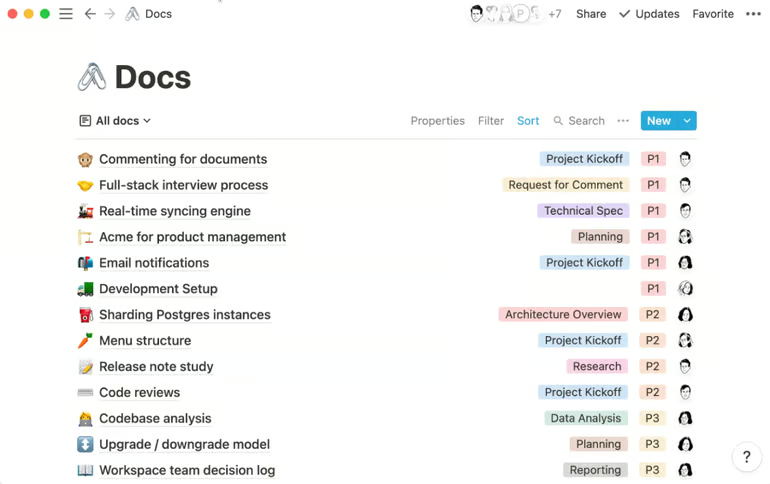
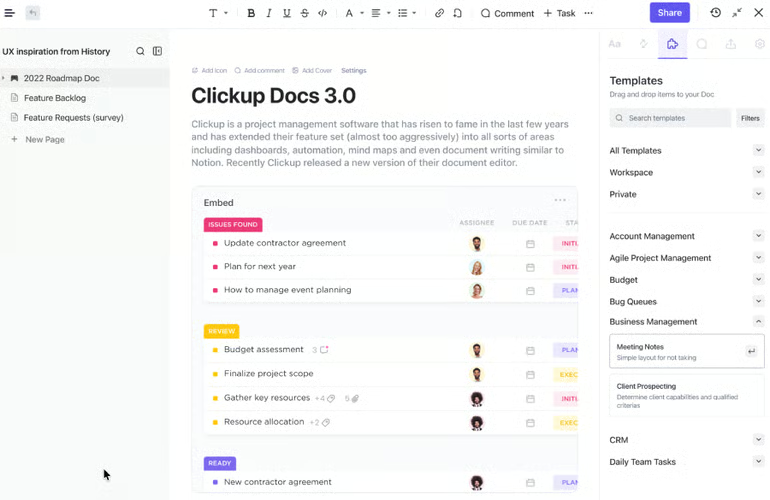
ClickUp also supports nested Docs, wikis, version history, and document permissions, while Docs Hub organizes workspace documentation in one place. Its integration with project management features allows teams to create tasks from text in a Doc and link Docs to related tasks. Notion, however, offers more knowledge management features such as page verification and ownership, while databases can connect related documentation across projects.
AI & automation
Winner: Notion
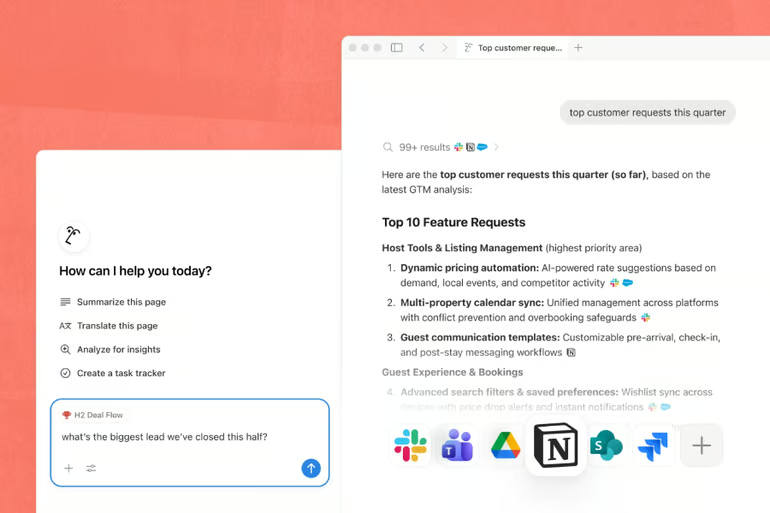
Notion wins for enterprise AI search because employees can search across project data while controlling which sources the AI uses for its answer. Enterprise Search covers the Notion workspace and connected apps such as Slack, Microsoft Teams, Google Drive, Jira, GitHub, SharePoint, and OneDrive,
Filters let users narrow a query to a specific app, page, teamspace, or person. Since AI-generated answers include citations, employees can also return to the source when they need additional context or want to verify a result.
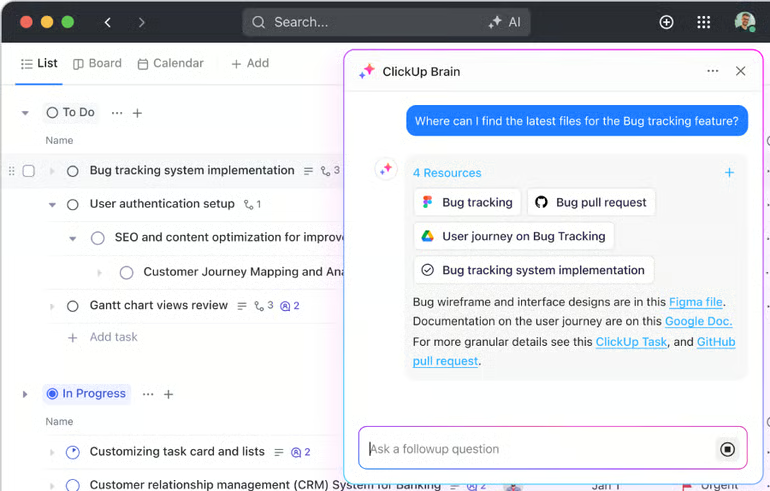
ClickUp Connected Search covers many of the same business applications, but its search capabilities are more closely connected to project execution. For example, Brain can create a task or Doc from retrieved data, while Super Agents can reference connected sources when completing assigned actions.
Notion, however, is better suited to enterprise-wide knowledge retrieval because users have more options for narrowing the search scope and identifying the sources behind AI-generated answers.
Collaboration and communication
Winner: ClickUp
ClickUp wins for collaboration and communication because conversations can lead to project actions without leaving the workspace. ClickUp Chat includes channels, direct messages, threads, and posts, while users can link discussions to tasks or Docs and create tasks from messages.
Notion approaches collaboration primarily through shared content. Teams can edit pages together, leave inline or page comments, use mentions, and receive updates through Inbox, which works well when discussions revolve around documents, project databases, or internal knowledge. However, ClickUp covers a wider range of communication needs within the project workspace, particularly when you need to convert conversations into tasks or meeting follow-ups.
Ease of use and administration
Winner: Notion
Notion is easier to adopt because its navigation centers on a sidebar, pages, and databases, so new users have fewer project-specific concepts to learn before they can start working.
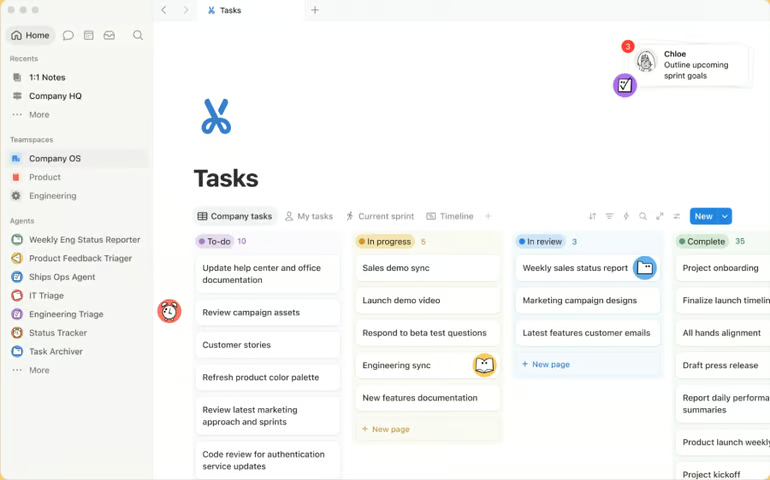
Teamspaces separate content by department or group, while shared and private sections make access boundaries visible from the sidebar. For admins, this reduces the amount of workspace configuration required at the outset, although database design and page organization still require governance as usage expands.
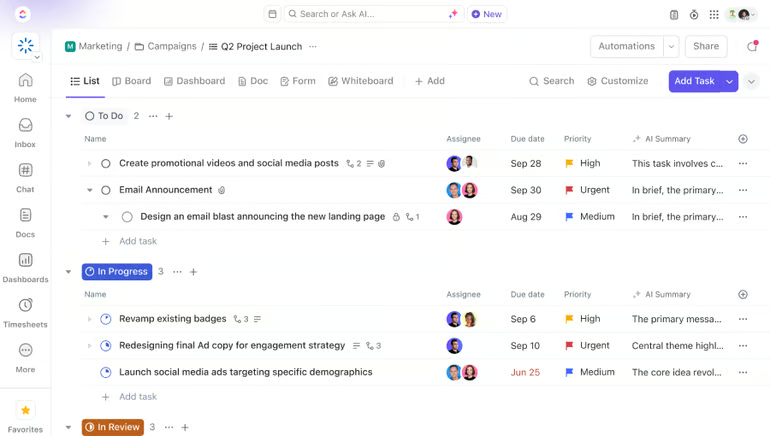
ClickUp requires more initial setup because work is organized across a hierarchy of Workspaces, Spaces, Folders, Subfolders, Lists, and tasks. Administrators also need to decide where views, statuses, custom fields, and permissions should apply, since settings vary across hierarchy levels. This gives companies more control over how departments or project types are configured, but it also increases the complexity of maintaining an organized workspace.
Best Project Management Software
Alternatives to ClickUp & Notion
ClickUp and Notion support many project management needs, but alternatives like monday.com, Wrike, and Smartsheet cater to more specific use cases. These alternatives are worth considering when workflow automation, resource planning, or spreadsheet-based project controls are higher priorities.
| monday.com | Choose monday.com when you want configurable workflows with less setup complexity than ClickUp and more native automation options than Notion. | ||
| Wrike | When capacity planning is a priority, since its resource management tools provide dedicated tools for managing team availability and assignments. | ||
| Smartsheet | If you prefer to plan projects in spreadsheets but need scheduling, reporting, and portfolio capabilities within the same interface. |
ClickUp vs Notion: Which is better overall?
ClickUp is the better overall choice for project management because it provides more native controls for scheduling, resource management, time tracking, and workflow automation. Notion is the better choice when project work depends heavily on documentation and company knowledge, particularly for organizations that want AI search across their workspace and connected business apps.
- Choose ClickUp if: Your projects involve dependencies or detailed task hierarchies, and you need native workload, time tracking, or portfolio tools. It is also better suited to teams that want AI and automation to support project work.
- Choose Notion if: Documentation plays a central role in your projects or company information is spread across multiple applications. Its database model also gives teams more freedom to customize how project information and internal knowledge are organized.
- Consider using both if: Some organizations may use ClickUp for project management while keeping Notion as their company knowledge base. This approach can work when each platform has a clearly defined purpose, although overlapping tasks, documentation, enterprise search, and AI subscriptions can increase software costs and lead to duplicate information.
FAQs
Is ClickUp better than Notion for project management?
ClickUp is better for project management if you need dependencies, Gantt scheduling, workload views, native time tracking, or portfolio controls. Notion is better suited to teams that manage projects alongside documentation and database-based knowledge.
Is Notion easier to use than ClickUp?
Notion generally has a simpler interface because work is organized around pages, databases, and teamspaces. ClickUp requires more setup because teams may need to configure Spaces, Lists, views, statuses, Custom Fields, and permissions before standardizing project workflows.
Which is cheaper, ClickUp or Notion?
ClickUp’s subscription plans are cheaper than Notion. ClickUp Unlimited starts at $7 per user per month with annual billing, while Notion Plus starts at $10 per member per month. The price gap increases at the Business tier.
>

Listen Labs, a market research startup that uses voice AI to conduct customer interviews, recently signed a term sheet for a $125 million Series C at a $1.5 billion valuation, with Menlo Ventures set to lead the round, according to several people with knowledge of the matter.
But that round never closed, the people said. Listen Labs walked away from the signed term sheet, a rare occurrence in the venture world and one that is generally frowned upon, according to VCs.
The financing likely collapsed because of acquisition talks with Salesforce. The CRM giant has recently held talks to buy Listen Labs for around $2 billion, Business Insider reported. The discussions are not finalized, however, and may not result in a deal, the outlet notes.
Listen Labs is one of the leading startups in the rapidly growing field of automating customer research with AI. The three-year-old startup has about $30 million in annualized revenue, about three times more than Simile, a competing startup that predicts human behavior, according to two people familiar with the companies’ financials. In late July, Simile announced that it had closed a $200 million Series B at a $2 billion valuation led by Greenoaks — likely setting a new valuation benchmark for Listen Labs, one person said.
If talks with Salesforce collapse, several VCs told TechCrunch that they expect Listen Labs to return to market and target a valuation of $2 billion or higher.
While acquiring Listen Labs could strengthen Salesforce’s AI capabilities by using the startup’s AI to help predict customer needs, the CRM giant may ultimately decide that paying a 67 times revenue multiple is too steep a valuation, according to a person with experience negotiating exits to Salesforce.
Listen Labs, Salesforce, Menlo Ventures, and Simile did not immediately respond to requests for comment.
Listen Labs was co-founded in 2023 by Florian Jüngermann, a former German national champion in competitive computer programming, and Alfred Wahlforss, who previously founded a staffing startup called Bemlo. The two met while pursuing master’s degrees at Harvard.
Listen Labs’ AI develops survey questions and interviews customers over audio or video. The resulting conversations are then packaged into reports and PowerPoint presentations, similar to those traditionally produced by human market researchers.
Fortune 500 companies rely on this type of research to gauge customer needs and satisfaction with their brands and products, but traditional market research is expensive and can take weeks to complete.
Listen Labs’ technology helps reduce the time and cost of these projects, enabling companies to quickly understand how customers are reacting to product changes and iterate on them more efficiently.
The startup’s customers include Microsoft, Canva, Anthropic, and Sweetgreen. Listen Labs and Simile aren’t the only startups using AI to disrupt the customer research market.
Besides Simile, competitors in the space include Outset, Keplar, and Aaru. While some platforms automate interviews with real humans, others startups — like Aaru and Simile — take a synthetic approach, using AI to simulate human behavior and predict responses without interviewing anyone at all.
Listen Labs was previously valued at $500 million when it announced a $69 million Series B round in late January led by Ribbit Capital, with participation from returning backers Sequoia, Conviction, and Pear VC.
When you purchase through links in our articles, we may earn a small commission. This doesn’t affect our editorial independence.
>

TL;DR: Get online protection and extra security with this lifetime subscription to the GhostShield AI-Powered VPN Premium Plan, on sale now for $49.99 (MSRP $399).
A VPN is great, but does yours have AI capabilities that can protect you in a pinch? GhostShield AI-Powered VPN can actually see a threat before you can, protecting you from dangerous domains and questionable connections before you even reach them. This VPN lets you secure 10 devices for one low price — and right now it’s just $49.99.
Give your VPN an AI upgrade with this lifetime subscription
Looking for a VPN? You can go with a basic option that hides your IP address, or you can step up your security with GhostShield AI-Powered VPN. This VPN protects your internet activity just like your usual VPN would, while also offering an AI threat analyzer that inspects your traffic in real time and protects you from malware and sketchy domains.
You’ll be notified the second GhostShield determines a risk — not after you clicked a dangerous link and your data has already been exposed.
With GhostShield, your connection is encrypted with ChaCha20 over WireGuard and routed through 20 different server locations across 16 countries. You can stream and download large files easily, with no bandwidth caps, throttling, or data limits to worry about.
You get the added perks of ad and tracker blocking, as GhostShield stops them in their tracks. There’s also a strict no-logs policy, so you can rest easy knowing all your internet activity isn’t recorded or monitored. There’s also a kill switch that will automatically cut your internet if the tunnel drops, ensuring your real IP address is never exposed.
Your lifetime subscription covers 10 devices at the same time, so you can share it with family or secure all your devices with one account. It also offers Family Mode, which blocks gambling and adult content while still allowing access to social media.
Lock in a lifetime subscription to the GhostShield AI-Powered VPN Premium Plan for $49.99 today.
StackSocial prices subject to change.
>

OpenAI is reserving future AI compute in Malaysia before the facilities are even online. The move gives the company another foothold in Asia-Pacific’s fast-growing infrastructure buildout.
Firmus said Sept. 8 that OpenAI will become an anchor customer for two Malaysian AI Factory sites under a multi-year agreement for dedicated computing capacity. The deal lifts the Nvidia-backed infrastructure company’s total contracted capacity across all customers above 900 megawatts.
OpenAI’s allocation, the contract value, exact site locations, and service dates remain undisclosed. That leaves the scale and timing of the Malaysian capacity unclear even as demand for AI infrastructure accelerates across the region.
What the Firmus deal actually secures
OpenAI Vice President of Compute Strategy Sachin Katti said the Malaysian facilities will help meet growing demand in Asia-Pacific and elsewhere. Firmus said in its partnership announcement that it operates two AI factories, in Australia and Singapore, with five more under development.
Firmus has not disclosed how many megawatts OpenAI has contracted or where the two Malaysian facilities will be located. Reuters reported that Firmus declined to disclose the contract value; the 900 MW figure covers contracted capacity across Firmus’s entire customer base, not OpenAI alone.
The company plans to deploy Nvidia Vera Rubin systems across its Asia-Pacific infrastructure. The Malaysian sites will use Nvidia’s DSX AI Factory Platform to integrate Vera Rubin NVL72 rack-scale systems with Firmus’s HyperCube design, which combines liquid cooling, mechanical systems, and electrification.
Malaysia is part of a wider Southeast Asian expansion for Firmus. The company is also planning a 360 MW Nvidia-powered AI data center in Indonesia, with initial operations targeted for 2027, while Firmus lists seven AI factories across Australia, Singapore, Indonesia, and Malaysia.
Malaysia’s AI infrastructure squeeze
Malaysia is already drawing heavy digital infrastructure investment. The Malaysian Investment Development Authority said data center and cloud projects accounted for RM95.8 billion, or about $23.6 billion, in approved investment in the first half of 2026. That was close to 44% of the country’s total approved investment during the period.
The buildout is tightening demand for power, water, cooling, and connectivity. Johor alone has an 8,542 MW data center pipeline but a colocation vacancy rate of just 0.7%, underscoring the gap between announced projects and capacity enterprises can actually use.
Malaysia’s Data Centre Task Force now clears projects only when developers can demonstrate secured electricity and water supplies and green compliance. Singapore remains the region’s dominant base for data center equity funding, even as more physical capacity spreads into neighboring markets such as Malaysia and Indonesia.
Firmus has not said when either Malaysian site will begin serving OpenAI workloads. The Sept. 8 agreement secures future capacity rather than infrastructure available for immediate deployment.
OpenAI’s deal adds another major customer to Malaysia’s AI infrastructure pipeline. The next significant disclosures will be OpenAI’s allocated megawatts, the Malaysian sites’ locations and launch dates, and whether the added capacity eventually changes regional availability for OpenAI services.
Read more: OpenAI is also widening its enterprise presence in APAC, with Vietnam’s FPT joining its partner network to support AI deployments across the region.
Let us teach you How to Talk to AI for free! Try our six-minute course at The Neuron Academy and learn a few simple ways to write better prompts and get more useful results from AI, or browse our other AI course for free for seven days. Check out all the lessons here →
>

Atomic bomb survivor who became baseball legend – Isao Harimoto dies age 86

Kayleigh Llewellyn Adapting Sarah Waters Novel ‘The Paying Guests’

Mike Tomlin’s NFL debut for NBC: He needs the ‘tapeworm’ to reach his TV potential
-

 movies4 months ago
Search For Canadian TV Actor Stewart McLean Now Homicide Investigation
-

 Fashion9 years ago
These ’90s fashion trends are making a comeback in 2017
-
Fashion9 years ago
According to Dior Couture, this taboo fashion accessory is back
-
Fashion9 years ago
Model Jocelyn Chew’s Instagram is the best vacation you’ve ever had
-
Fashion9 years ago
Emily Ratajkowski channels back-to-school style
-
Fashion9 years ago
9 Celebrities who have spoken out about being photoshopped
-

 Anime3 months ago
Rurouni Kenshin: Hokkaido Arc Manga Takes 1-Issue Break – News
-

 Anime2 months ago
HIDIVE to Stream English Dubs for The World Is Dancing, The Forsaken Saintess and Her Foodie Roadtrip in Another World, The Dangers in My Heart: The Movie Anime – News