
Tech
Smart ring maker Ultrahuman to roll out biological-age model across UAE

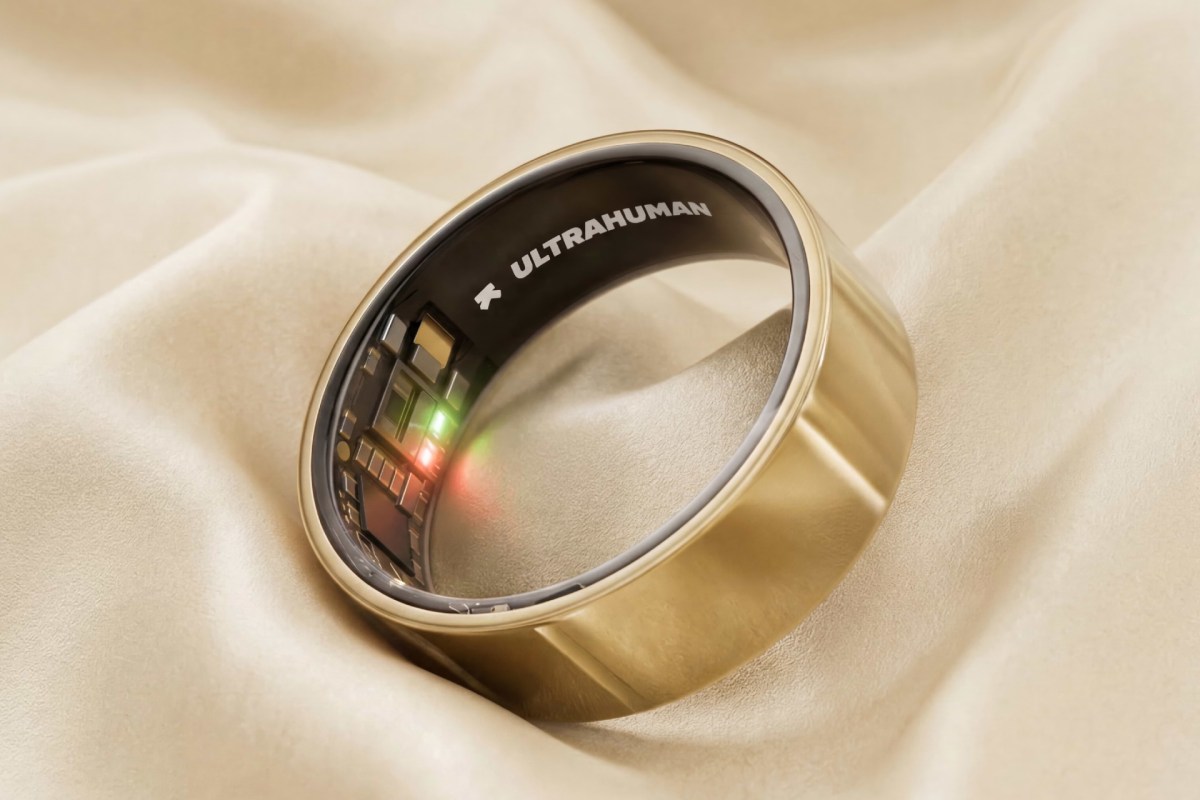
Ultrahuman, a Bengaluru-based health tech startup best known for its smart rings, has partnered with Abu Dhabi health authorities to develop a biological-age model that it says will eventually be made available to people across the United Arab Emirates.
On Monday, Ultrahuman announced that it had signed a two-year memorandum of understanding with the Abu Dhabi Public Health Center (ADPHC) to develop and validate the model, which will combine clinical biomarkers with data from wearable devices. The partnership aims to use these signals to estimate how quickly an individual is aging and identify factors — including sleep, activity, cardiovascular health, and metabolism — that may be accelerating or slowing that process.
The partnership marks Ultrahuman’s latest effort to go beyond selling wearable hardware and deploy its health algorithms at a much larger scale. The startup increasingly sees itself as a health-data company, with its smart ring serving as one way to collect information that can underpin algorithms spanning aging, longevity, and other areas of health, CEO Mohit Kumar said in an interview.
“If you look at Ultrahuman as a company, we obviously have the Ultrahuman Ring, which is a way to acquire data from the human body,” Kumar told TechCrunch. “But truly, what we care about is not just the form factor, the ring, but what do we do with this data?”
Working with a government gives Ultrahuman the opportunity to apply its algorithms to a far broader population than its own customer base, Kumar said. The startup has sold around 800,000 smart rings globally so far. The Abu Dhabi partnership is Ultrahuman’s first step toward deploying a health algorithm at a national scale, with the health age model eventually intended to be available to people across the UAE, according to the company.
Even though Ultrahuman is known for its smart rings, Kumar said the biological-age model is being designed to be wearable-agnostic, allowing data from rings, wrist-worn devices, straps, and patches to feed into the system alongside clinical biomarkers. Individuals will eventually be able to access their health age through government digital-health platforms including TAMM and Sahatna, the startup said.
Ultrahuman and ADPHC will spend the next two years working on research and clinical validation of the model. Kumar told TechCrunch that the broader rollout will happen in phases, but did not provide a timeline.
The UAE is already among Ultrahuman’s 10 largest markets and accounts for about 4% to 5% of its overall revenue, Kumar said. The startup has operated in the market for nearly five years and sees about 25% higher retention there compared with its other markets, he noted.
Ultrahuman’s existing customer base gives it a narrower view of the population than a government health system. Its typical users are between 25 and 43 years old, Kumar said, while deploying the model across the UAE would expose it to a much broader range of age groups.
The underlying biological-age model was developed using Ultrahuman’s existing data, combining users’ chronological ages with wearable signals and, for some users, blood-test markers, Kumar told TechCrunch. That allows the startup to track how health markers typically change with age and identify deviations from those patterns.
Kumar stressed the model will not be trained on data from the UAE. “We will deploy an algorithm on the UAE data,” he said, adding that Ultrahuman will not have access to personally identifiable information through the program.
Ultrahuman is not the only smart-ring maker working with Abu Dhabi on preventive health. In May, the Department of Health – Abu Dhabi announced a partnership with Ultrahuman arch-rival Oura to combine the company’s wearable data with the emirate’s longitudinal health data, initially focusing on women’s health and cardiometabolic risk.
Kumar told TechCrunch that Ultrahuman is not aware of another company working with Abu Dhabi authorities on the health age model specifically. While he acknowledged that the government works with multiple health-tech companies, he declined to comment on the scope of Oura’s work with Abu Dhabi.
The parallel partnerships come as Ultrahuman and Oura compete in the smart-ring market while looking to push their businesses beyond wearable hardware and deeper into preventive health. The work with the Abu Dhabi authorities also comes as Ultrahuman is looking to build a smart ring that can run software on the device and even power everything from AI interactions to games.
When you purchase through links in our articles, we may earn a small commission. This doesn’t affect our editorial independence.
>

If there’s one lesson the OpenAI-Hugging Face incident taught us, it’s that AI agents can be unpredictable.
“Imagine if something like that happened in the physical world,” Howie Sun, CEO and co-founder of Laplace Intelligence, told TechCrunch. “AI agents are moving from computers into the real world, and we don’t really want physical AI to fail in the real world.”
Ann Arbor-based Laplace is building automated red-teaming — essentially, stress-testing a system by deliberately trying to make it fail — for robotics and physical AI. The company is betting that the only way to make sure physical AI is safe is to have AI test it.
“Our goal is to help companies discover and fix problems before deployment—and, over time, build a shared foundation of evidence that customers, insurers, and regulators can trust,” Sun said.
Laplace is one of 20 startups competing in Startup Battlefield, TechCrunch Disrupt’s three-day pitch competition in downtown San Francisco. It will present on the Startup Battlefield stage Monday afternoon, October 13.

Sun, alongside his co-founder and chief scientist Henry Liu, founded Laplace a year ago out of the University of Michigan. Sun has spent the last eight years in academia researching how to challenge autonomous driving AI in simulation. In 2023, he and Liu — his then-PhD advisor — published a paper on the subject that made it onto the cover of the top scientific journal Nature. That’s when the calls started coming in from autonomous vehicle companies interested in implementing their ideas.
“I realized that I wanted to build this and take it from purely academic research into a product that’s useful in the real world,” Sun said.
Using their academic research as a base, Sun and Liu built Laplace, so named for “Laplace’s demon,” an 1814 thought experiment by French scholar Pierre-Simon Laplace that imagined that if you knew the exact state of everything in the universe, you could predict the future with total precision.
“We are essentially using simulation to predict the real world’s future,” Sun said.
At the startup’s core is a high-fidelity simulation reconstructed from the real world, paired with an AI agent that constantly probes for weaknesses and failure points. The goal is to ensure that any physical AI — be it a robot, autonomous vehicle, or smart city solution — is safe in simulation before it’s deployed in the real world.
The simulation environment is a post-trained version of Nvidia’s Cosmos, an AI world simulation platform, that’s grounded in the real world, allowing Laplace to reconstruct anything from an Arizona highway to a Paris pedestrian crossing. Simulations are generated by blending a mesh of different real-world information. A Google Street View image could serve as a reference from which an entire street is generated. But rather than generating something random, the simulator combines real-world map data to recreate an environment that’s true to scale.
Developers can then use language prompts to change the setting in real time, like adding in afternoon traffic. Sun says Laplace pulls real-time traffic and congestion information from navigation providers like TomTom.
Within Laplace’s simulations, not only the environment is simulated, but also the behavior of other actors. For example, during a demo, Sun directed the test agent vehicle to swerve into oncoming traffic. The car it would have hit — or driven through, as is common among some generative world models — moved out of its way to avoid a collision.
“It’s truly an interactive simulation environment,” Sun said. “Everyone is reacting to everything. …This is more like a world model with interactive participants.”
While the simulated environment is an important part of Laplace’s product, the real unique selling point is the AI agents the startup is developing to automatically design corner cases (tricky, rare scenarios that could trip up an AI system) moving the human further out of the loop.
“They can design from the news, from police reports on collisions — all kinds of information to actively challenge the autonomous vehicles and other physical AI agents,” Sun said.

Today, autonomous vehicle developers mostly train an AI to handle edge cases using recorded footage that they then turn into a simulation, or by relying on humans to come up with new ideas and design them. While many AV companies have done what Laplace is pitching and started embracing AI to create edge cases for training — self-driving truck company Waabi comes to mind — the need for this kind of technology will really become apparent when we start placing generalized robots in the real world.
“There’s less data on generalized robotics,” Sun said. “No one knows what the edge cases will be in the real world.”
Despite Sun and Liu coming from academia, with no shiny Silicon Valley tech company pedigrees, the two have managed to start generating revenue and even turn a modest profit. Most of the money is coming from autonomous driving use cases, with customers including Japanese trucking manufacturer Isuzu and Texas-based autonomous trucking firm Bot Auto.
Nvidia is also a customer, says Sun. The two companies, alongside T-Mobile, are working together on a free smart city pilot for the City of San Jose to provide high-level traffic operations. Laplace is also in the early stages of working with partners building humanoid robotics for warehouses.
Most of Laplace’s customer contracts are project-based today, and the company is working towards turning that into recurring revenue. The startup’s near-term goal — which it hopes will be aided by competing at Disrupt — is to raise funds and scale so it can compete with its rivals.
Chief among its rivals is Applied Intuition, a buzzy late-stage startup that’s raised $1.2 billion to date at a $15 billion post-money valuation. Isuzu is also one Applied’s customers.
Sun isn’t too worried. He believes Laplace’s core methodology of using AI to test AI is a “new paradigm that changes the testing of physical AI entirely,” turning it into a “dynamic interactive testing process.”
“That will be the biggest moat,” he said.
When you purchase through links in our articles, we may earn a small commission. This doesn’t affect our editorial independence.
>

The problem with giving everyone in a company access to AI tools is that people will use them in unexpected ways. And that fact is steadily seeding fears that companies now have new, gaping security holes in their systems or, at least, will soon.
Illustrating the pace of AI tool adoption within enterprises driving such fears, Shahar Bahat, CEO and co-founder of Pluto Security, says a newly announced AI tool can show up inside companies’ environment within a mere two hours of its release. And about 60% of the risks her company detects across its customer base are in tools vibe-coded by non-developers: Finance departments are the biggest source of such risks, she told TechCrunch, followed by marketing and legal teams. Developers rank fourth, she said.
Her startup’s tools apparently found a vibe-coded app made by a finance employee at a Fortune 500 company to manage customer information and churn, but the app was left exposed to the internet.
Pluto, fresh out of stealth with $42 million in funding, is the latest in a new crop of security startups that have quickly sprung up to help companies address those fears gaps, and all of them are raising big money from investors on the back of the conviction that only using existing security software to monitor and control AI tools, connectors and usage is a square-peg-round-hole approach.
Bahat tells TechCrunch her startup started selling only in April, and has already found some takers for its tech, which helps companies gain context, risk analysis, visibility and control over how their employees use AI tools. She said Pluto began selling in April and has already crossed $2 million in annual recurring revenue, with more than 30 enterprise customers who include Oscar Health, Workato, Sixt and AlphaSense.
Pluto’s funding spans an $8.5 million seed round led by TLV Partners, with cybersecurity firm Armis’ founders also investing. The company recently raised a Series A of $34 million led by Jump Capital, with Skinos (Check Point co-founder Shlomo Kramer’s venture firm), Ansa Capital, and other angel investors participating.
That’s decent traction for a young startup, though not unique in this AI era. But it may be because the breadth of the risk isn’t isolated to large tech companies that lead the AI adoption charts.
When I asked Bahat where she’s seeing the biggest risks, she said the issues are differentiated by the mindset of the CISO and how willing the organization is to adopt AI, but there were risks to be found anyway.
“In general, I’ll say there was not one POC in which we entered and didn’t find malicious stuff,” she said. “Whether those are extension packages or skills — some of them had active live attacks while we did the POC. Which again, for me, product-wise is amazing. For the companies, it’s not very good.”
Pluto’s entire bet is that securing such environments will require security tools to pay attention to what AI agents are doing in real time, in addition to keeping track of what and how employees are building and deploying.
“We’re moving from user behavior to agent behavior,” Bahat said.
In line with that vision, the startup’s software monitors the AI tools employees use, the skills, extensions, MCP servers, and other components those tools rely on, as well as the apps and agents being created. The company says it can identify risky components, spot potentially dangerous agent activity, and enforce security policies without stopping employees from using or making AI tools.
To do all that, Pluto connects to endpoint security and device management systems, and can deploy its own sensors through them or directly onto devices. It gathers information including prompts, commands, running processes, permissions and users’ previous activity, and uses its own “lightweight” models on endpoints to help assess what an agent is trying to do.
What stood out is that Pluto’s system can intervene while an agent is working, Bahat said. If an agent tries to gain permissions beyond what a user intended, for example, the system can stop the action or add instructions into the session that prompt the agent to ask for confirmation.
“We can inject context back to the session, and this way I can change how the agent is working,” Bahat explained.
The startup also takes an unusual approach to finding customers. In April, it launched Plutonium, a free platform that lets anyone check risks associated with publicly available AI skills, connectors and add-ons. There’s also an MCP scanner and a catalog of verified components. Bahat claims thousands of security professionals use Plutonium, and that the community around it has become an important source of feedback and prospective customers.
She said 70% of Pluto’s sales pipeline now comes from inbound interest, although she didn’t break down how much of that comes directly through Plutonium.
Pluto said it plans to invest the new capital in developing its product, expanding its security research efforts, and growing its presence in the U.S. It has 40 employees in the U.S. and Israel.
When you purchase through links in our articles, we may earn a small commission. This doesn’t affect our editorial independence.
>

Diesel fuel powers everything from shipping to agriculture, and with prices hitting record highs in recent weeks, governments around the world are scrambling to contain the fallout.
For now, that’s meant releasing fuel from stockpiles, but in the coming years, the answer might be a new technology from an MIT startup called LNK Energies.
LNK has created a way to convert existing heavy-duty trucks from diesel to hydrogen, slashing pollution and costs while shielding operators from the price spikes that result from geopolitical instability like the war in Iran. “If you look at total cost of ownership of a Class 8 truck, it’s 13% cheaper than diesel,” Alexis Huynh, chief technology officer at LNK Energies, told TechCrunch. (Class 8 is the heaviest category of trucks, including big rigs.)
Automotive companies have been exploring the use of hydrogen in long-haul trucking in part because refilling a hydrogen tank is faster than recharging the massive batteries those trucks require. But hydrogen is challenging to move to refilling stations, and the pressure tanks required to store it on the truck are large and costly.
LNK’s approach is to carry hydrogen chemically attached to another compound. Liquid organic hydrogen carriers, or LOHCs, are liquids that can absorb and later release hydrogen, and they have been widely studied, but mostly for moving large quantities of hydrogen from refineries to fueling stations. The equipment needed to separate hydrogen from the LOHC, known as a reactor, has been too big to fit onto a truck.
“A lot of the reactors that LOHC companies have today are really large. They’re about the size of a shipping container,” Huynh said. “We have shrunk that basically to the size of a mini fridge.”
Moving the reactor onto the truck saves a surprising amount of energy. When hydrogen is stored on a truck, it must be pressurized to more than 11,000 psi (800 bar), roughly 800 times normal air pressure, and squeezing it that hard takes a lot of power. Because LNK’s fuel carries the hydrogen in liquid form and releases it on board as needed, that step goes away. “We’re eliminating the expensive compression step,” Sayandeep Biswas, co-founder and CEO of LNK Energies, told TechCrunch.
In LNK’s system, once the hydrogen is released on the truck, it can be burned in a conventional internal combustion engine, the kind in today’s diesel trucks, with just a few modifications. The company uses waste heat from the engine to help power the on-board reactor. Or, if the trucking company wants to fully eliminate combustion emissions, it can use fuel cells instead, which convert hydrogen into electricity to power electric motors.
The LOHC can be stored in a traditional fuel tank and dispensed using pumps, just like diesel. “The entire hydrogen infrastructure doesn’t need to exist,” Biswas said. “It’s just a standard diesel station.”
Biswas and Huynh have a demonstration reactor working in the lab that can power an engine from a lawnmower. In 18 months, they plan to install a larger version in a commercial truck.
The trucks will cost more up front, but promise to be cheaper to operate. The duo are confident that they can undercut diesel at a price of $6.50 per gallon after they’ve made just 50 to 100 trucks. None of their projections include government subsidies. “The idea isn’t to have a technology that is cheaper at scale, but one that is cheaper even during that adoption period,” Biswas said.
LNK will present live on stage at TechCrunch Disrupt on Wednesday Oct 13-15 as part of our Startup Battlefield pitch competition. Come join us in San Francisco and take part in the action.
When you purchase through links in our articles, we may earn a small commission. This doesn’t affect our editorial independence.
>
‘Miami Vice ’85’ Cast: Haley Lu Richardson Latest To Join (EXCLUSIVE)
Rams to release kicker Harrison Mevis, sign Blake Grupe off Jets' practice squad: Source

Jesse Eisenberg Breaks Down His Process Writing Songs For ‘The Debut’
-

 movies5 months ago
Search For Canadian TV Actor Stewart McLean Now Homicide Investigation
-

 Fashion9 years ago
These ’90s fashion trends are making a comeback in 2017
-
Fashion9 years ago
According to Dior Couture, this taboo fashion accessory is back
-
Fashion9 years ago
Model Jocelyn Chew’s Instagram is the best vacation you’ve ever had
-
Fashion9 years ago
Emily Ratajkowski channels back-to-school style
-
Fashion9 years ago
9 Celebrities who have spoken out about being photoshopped
-

 Anime4 months ago
Rurouni Kenshin: Hokkaido Arc Manga Takes 1-Issue Break – News
-

 Anime3 months ago
HIDIVE to Stream English Dubs for The World Is Dancing, The Forsaken Saintess and Her Foodie Roadtrip in Another World, The Dangers in My Heart: The Movie Anime – News