
Tech
Pluto Security raises $42M as AI gives enterprise security teams a new headache

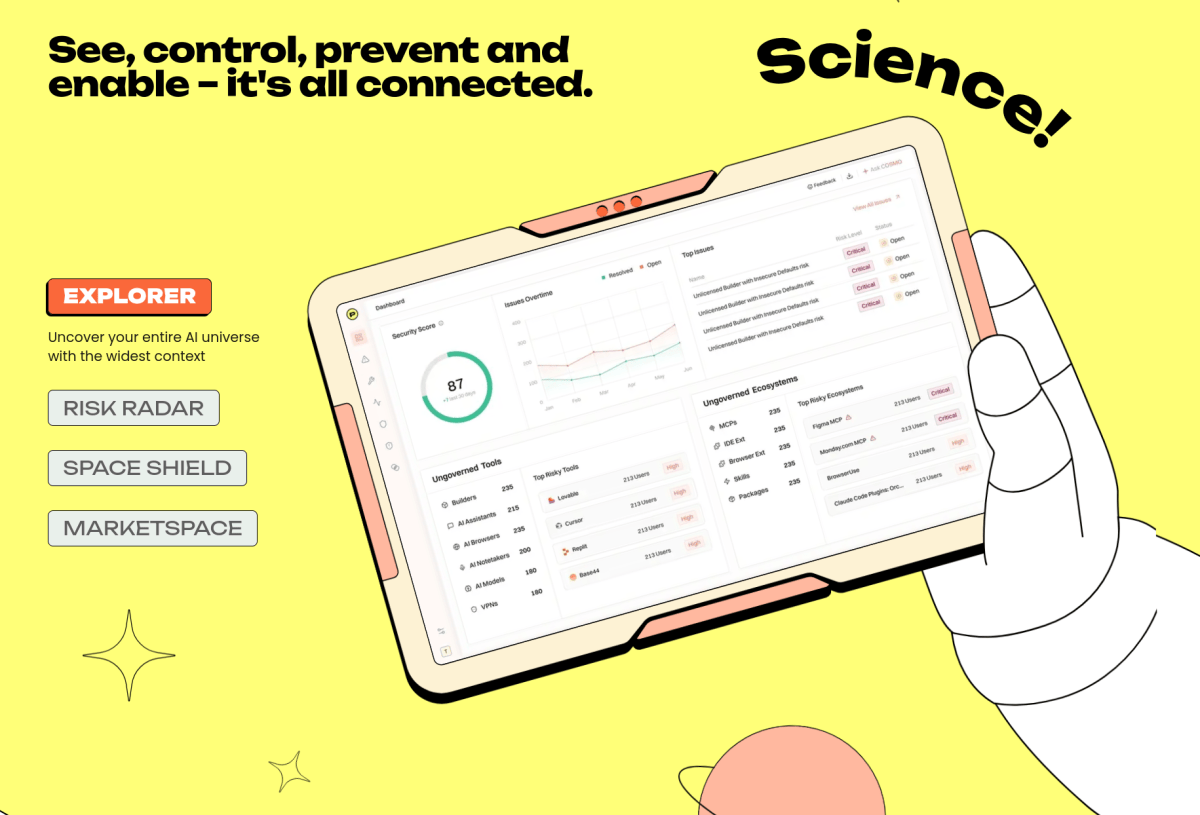
The problem with giving everyone in a company access to AI tools is that people will use them in unexpected ways. And that fact is steadily seeding fears that companies now have new, gaping security holes in their systems or, at least, will soon.
Illustrating the pace of AI tool adoption within enterprises driving such fears, Shahar Bahat, CEO and co-founder of Pluto Security, says a newly announced AI tool can show up inside companies’ environment within a mere two hours of its release. And about 60% of the risks her company detects across its customer base are in tools vibe-coded by non-developers: Finance departments are the biggest source of such risks, she told TechCrunch, followed by marketing and legal teams. Developers rank fourth, she said.
Her startup’s tools apparently found a vibe-coded app made by a finance employee at a Fortune 500 company to manage customer information and churn, but the app was left exposed to the internet.
Pluto, fresh out of stealth with $42 million in funding, is the latest in a new crop of security startups that have quickly sprung up to help companies address those fears gaps, and all of them are raising big money from investors on the back of the conviction that only using existing security software to monitor and control AI tools, connectors and usage is a square-peg-round-hole approach.
Bahat tells TechCrunch her startup started selling only in April, and has already found some takers for its tech, which helps companies gain context, risk analysis, visibility and control over how their employees use AI tools. She said Pluto began selling in April and has already crossed $2 million in annual recurring revenue, with more than 30 enterprise customers who include Oscar Health, Workato, Sixt and AlphaSense.
Pluto’s funding spans an $8.5 million seed round led by TLV Partners, with cybersecurity firm Armis’ founders also investing. The company recently raised a Series A of $34 million led by Jump Capital, with Skinos (Check Point co-founder Shlomo Kramer’s venture firm), Ansa Capital, and other angel investors participating.
That’s decent traction for a young startup, though not unique in this AI era. But it may be because the breadth of the risk isn’t isolated to large tech companies that lead the AI adoption charts.
When I asked Bahat where she’s seeing the biggest risks, she said the issues are differentiated by the mindset of the CISO and how willing the organization is to adopt AI, but there were risks to be found anyway.
“In general, I’ll say there was not one POC in which we entered and didn’t find malicious stuff,” she said. “Whether those are extension packages or skills — some of them had active live attacks while we did the POC. Which again, for me, product-wise is amazing. For the companies, it’s not very good.”
Pluto’s entire bet is that securing such environments will require security tools to pay attention to what AI agents are doing in real time, in addition to keeping track of what and how employees are building and deploying.
“We’re moving from user behavior to agent behavior,” Bahat said.
In line with that vision, the startup’s software monitors the AI tools employees use, the skills, extensions, MCP servers, and other components those tools rely on, as well as the apps and agents being created. The company says it can identify risky components, spot potentially dangerous agent activity, and enforce security policies without stopping employees from using or making AI tools.
To do all that, Pluto connects to endpoint security and device management systems, and can deploy its own sensors through them or directly onto devices. It gathers information including prompts, commands, running processes, permissions and users’ previous activity, and uses its own “lightweight” models on endpoints to help assess what an agent is trying to do.
What stood out is that Pluto’s system can intervene while an agent is working, Bahat said. If an agent tries to gain permissions beyond what a user intended, for example, the system can stop the action or add instructions into the session that prompt the agent to ask for confirmation.
“We can inject context back to the session, and this way I can change how the agent is working,” Bahat explained.
The startup also takes an unusual approach to finding customers. In April, it launched Plutonium, a free platform that lets anyone check risks associated with publicly available AI skills, connectors and add-ons. There’s also an MCP scanner and a catalog of verified components. Bahat claims thousands of security professionals use Plutonium, and that the community around it has become an important source of feedback and prospective customers.
She said 70% of Pluto’s sales pipeline now comes from inbound interest, although she didn’t break down how much of that comes directly through Plutonium.
Pluto said it plans to invest the new capital in developing its product, expanding its security research efforts, and growing its presence in the U.S. It has 40 employees in the U.S. and Israel.
When you purchase through links in our articles, we may earn a small commission. This doesn’t affect our editorial independence.
>

Diesel fuel powers everything from shipping to agriculture, and with prices hitting record highs in recent weeks, governments around the world are scrambling to contain the fallout.
For now, that’s meant releasing fuel from stockpiles, but in the coming years, the answer might be a new technology from an MIT startup called LNK Energies.
LNK has created a way to convert existing heavy-duty trucks from diesel to hydrogen, slashing pollution and costs while shielding operators from the price spikes that result from geopolitical instability like the war in Iran. “If you look at total cost of ownership of a Class 8 truck, it’s 13% cheaper than diesel,” Alexis Huynh, chief technology officer at LNK Energies, told TechCrunch. (Class 8 is the heaviest category of trucks, including big rigs.)
Automotive companies have been exploring the use of hydrogen in long-haul trucking in part because refilling a hydrogen tank is faster than recharging the massive batteries those trucks require. But hydrogen is challenging to move to refilling stations, and the pressure tanks required to store it on the truck are large and costly.
LNK’s approach is to carry hydrogen chemically attached to another compound. Liquid organic hydrogen carriers, or LOHCs, are liquids that can absorb and later release hydrogen, and they have been widely studied, but mostly for moving large quantities of hydrogen from refineries to fueling stations. The equipment needed to separate hydrogen from the LOHC, known as a reactor, has been too big to fit onto a truck.
“A lot of the reactors that LOHC companies have today are really large. They’re about the size of a shipping container,” Huynh said. “We have shrunk that basically to the size of a mini fridge.”
Moving the reactor onto the truck saves a surprising amount of energy. When hydrogen is stored on a truck, it must be pressurized to more than 11,000 psi (800 bar), roughly 800 times normal air pressure, and squeezing it that hard takes a lot of power. Because LNK’s fuel carries the hydrogen in liquid form and releases it on board as needed, that step goes away. “We’re eliminating the expensive compression step,” Sayandeep Biswas, co-founder and CEO of LNK Energies, told TechCrunch.
In LNK’s system, once the hydrogen is released on the truck, it can be burned in a conventional internal combustion engine, the kind in today’s diesel trucks, with just a few modifications. The company uses waste heat from the engine to help power the on-board reactor. Or, if the trucking company wants to fully eliminate combustion emissions, it can use fuel cells instead, which convert hydrogen into electricity to power electric motors.
The LOHC can be stored in a traditional fuel tank and dispensed using pumps, just like diesel. “The entire hydrogen infrastructure doesn’t need to exist,” Biswas said. “It’s just a standard diesel station.”
Biswas and Huynh have a demonstration reactor working in the lab that can power an engine from a lawnmower. In 18 months, they plan to install a larger version in a commercial truck.
The trucks will cost more up front, but promise to be cheaper to operate. The duo are confident that they can undercut diesel at a price of $6.50 per gallon after they’ve made just 50 to 100 trucks. None of their projections include government subsidies. “The idea isn’t to have a technology that is cheaper at scale, but one that is cheaper even during that adoption period,” Biswas said.
LNK will present live on stage at TechCrunch Disrupt on Wednesday Oct 13-15 as part of our Startup Battlefield pitch competition. Come join us in San Francisco and take part in the action.
When you purchase through links in our articles, we may earn a small commission. This doesn’t affect our editorial independence.
>

Your vibe-coded applications can now be easily run on Android smartphones without having to first go public on the Google Play Store, the tech giant announced on Tuesday. A new feature will allow users to launch their own personal apps on their device via Google Play using their standard Google account, but they will remain completely private.
These personal apps won’t show up in Google Play’s search or listing pages, and won’t be shared with anyone except for the app’s creator.
The idea comes as more people are experimenting with building their own applications via AI for specific, personal needs. However, being able to use that app on their own Android device has meant publishing to Google Play, making it accessible to the Play Store’s some 3 billion users. That led many to limit their vibe-coding efforts to web apps that could run on any device instead of something built natively for Android.
Now, Google says Android device owners can vibe code an app using Google AI Studio, then launch it for their own use.

These apps are still required to comply with Google Play’s existing policies, but allow users to experiment more directly with building apps for Android.
Initially, the feature will be available to users in the U.S., age 18 and up.
“That’s why the future of apps on Google Play is personal, secure, and built by everyone — and it’s why Play is leading the charge and moving from ‘there’s an app for that’ to ‘there’s an app for me,’” said Sam Bright, Google’s VP & GM for the Google Play and Developer Ecosystem, in a press briefing ahead of Tuesday’s launch. “We started Google Play with a simple goal: to connect you with the apps you love. But after today, we hope it’s clear: Play has evolved to become so much more than that.”
In the months ahead, the company said that users will be able to share their vibe-coded creations with a network of trusted friends. That means the apps you built for family or friends, or maybe your child’s T-ball league, could be used with a small group of people, without having to go public on the Play Store.
And if the app ever really becomes popular, there will be a way to shift the personal app to one that’s published on the Google Play Store for everyone to try, after completing the trust and safety reviews.
Related to AI’s impact on app development, Google said it’s also building better ways to curate the Google Play experience — for instance, by leveraging Google’s AI to create a personalized game recommendation engine, called Game Finder. The feature, first available in the U.S. in English, will be based on what the user likes to play combined with Google’s knowledge derived from its game community’s 1.2 billion players.

Google will also allow users to curate their own lists of games, post questions about games to a new Community Posts section, and join new 48-hour gaming challenges called Sprints, among other gaming-related feature updates.

Plus, the Play Store’s built-in AI assistant, Ask Play, is being updated to offer comparisons, allowing users to see the key differences between similar applications. Google Play apps and games will also be more deeply integrated into Gemini’s conversations.
The changes are rolling out alongside Google Play’s new support for an age range feature that allows parents to share their child’s age range, but not their exact birthdate, with developers to get an age-appropriate experience.
When you purchase through links in our articles, we may earn a small commission. This doesn’t affect our editorial independence.
>
Tech
Satlyt, founded by a former Google and SpaceX product manager, raises $8M to run AI on satellites

The way Rama Afullo tells it, he saw orbital data centers coming.
The Kenyan American engineer previously worked in Google’s cloud computing business before a brief stint at SpaceX’s Starlink communications network in 2024. His experiences convinced him that there was untapped potential for computers in space.
“When I was at SpaceX, I tried to pitch this internally. They said no. When I was at Google, I tried to pitch this internally. They said no,” he tells TechCrunch.
So he left SpaceX and co-founded Satlyt, a new company with headquarters in Sunnyvale, California, and Nairobi, to build software for satellites that he hopes will let many satellites share the work of large computing jobs in space. The company has raised an $8 million seed round, Afullo exclusively told TechCrunch.
The timing looks good for him. SpaceX has since gone all-in on orbital data centers, and Satlyt’s software is set to launch Thursday on a SpaceX rocket alongside the first prototype for Google’s space data center effort, Project Suncatcher.
Unlike SpaceX, Google, or startups like Starcloud and Cowboy Space Company, Satlyt isn’t planning to build its own spacecraft. Afullo’s team is building the software to operate AI models on satellites, comparing his approach to VMware and Snowflake — companies whose platforms let users run complex software without worrying about the underlying infrastructure.
“The folks like SpaceX who are doing orbital data centers — if they are the iPhone, we’ll build Android as a horizontally integrated, open ecosystem,” he said. In other words, Satlyt wants to offer software that works across many companies’ satellites.
Satlyt has already flown its software on two demonstration missions. The initial focus is finding operational efficiencies for spacecraft, which typically depend on flight controllers on the ground to solve any problems that arise. Sending data back to Earth, known as downlink, is expensive and often slow, so using AI to make decisions on the spacecraft can mean real savings, either when resolving anomalies or by processing sensor readings on the spacecraft instead of on the ground.
Earlier this year, Satlyt deployed Google DeepMind’s Gemma AI model onboard a spacecraft operated by Momentus. The model cut the size of a transmission about onboard software errors by more than 60%, the kind of efficiency that Afullo says can save hundreds of thousands of dollars per satellite each year.
This week’s launch will put Satlyt’s software to work onboard a spacecraft built by TakeMe2Space, an Indian startup that builds computing hardware for satellites. The mission involves three customers: NASA, which is paying the company to test protocols for cloud computing in space; Stellerian, a startup focused on space surveillance (tracking objects in orbit) that wants to test image processing workloads; and TakeMe2Space itself, to show the satellite can host other companies’ software.
Right now, few high-powered GPUs are in orbit. For now, the most likely opportunity lies in the kinds of workloads Satlyt is working on. But the company’s next project is to show that it can create a shared computing system — a cloud — spanning two different satellites, which it expects to attempt next year. If successful, it will allow the company to build a true compute cloud in orbit as a third-party provider to spacecraft builders.
The way to think about it is that we turn your satellite into a revenue-generating managed service,” Afullo said.
Satlyt’s seed round was led by Houston-based Non Sibi Ventures, where partner Bernard Harris, who served as a NASA astronaut for more than 20 years, helped ground the firm’s conviction in a novel, space-based business.
One reason the firm invested was that Satlyt doesn’t depend on a highest-octane vision of space data centers, which faces uncertain economics and a launch bottleneck. “We don’t need data centers in space for Rama to be wildly successful, right?” Non Sibi partner Kent Lucas told TechCrunch. “It can just be driven by the number of satellites going up.”
Afullo’s hope is to be live on 20% of satellites by the end of the decade, when he expects virtually every spacecraft builder to be putting GPUs and similar advanced processors in their satellites.
“If you’re putting up a satellite without putting up a GPU on it, at the very least, you’re doing yourself a disservice, right?” he says.
Satlyt is among dozens of other startups vetted by TechCrunch and appearing at Disrupt as part of our broader Battlefield competition happening this week in downtown San Francisco. It all kicks off on Tuesday. Learn more here.
When you purchase through links in our articles, we may earn a small commission. This doesn’t affect our editorial independence.
>

IndieWire Hires J. Kim Murphy as Film and Media Reporter

Mark Harmon & Michael Weatherly To Reunite On ‘NCIS: Origins’

Manga Creator Masako Watanabe Dies at 97 – News
-

 movies5 months ago
Search For Canadian TV Actor Stewart McLean Now Homicide Investigation
-

 Fashion9 years ago
These ’90s fashion trends are making a comeback in 2017
-
Fashion9 years ago
According to Dior Couture, this taboo fashion accessory is back
-
Fashion9 years ago
Model Jocelyn Chew’s Instagram is the best vacation you’ve ever had
-
Fashion9 years ago
Emily Ratajkowski channels back-to-school style
-
Fashion9 years ago
9 Celebrities who have spoken out about being photoshopped
-

 Anime4 months ago
Rurouni Kenshin: Hokkaido Arc Manga Takes 1-Issue Break – News
-

 Anime3 months ago
HIDIVE to Stream English Dubs for The World Is Dancing, The Forsaken Saintess and Her Foodie Roadtrip in Another World, The Dangers in My Heart: The Movie Anime – News