
Tech
Windows 11 Search Adds 5 Quick Actions Without Opening Settings

Microsoft’s redesigned Windows 11 Search lets Insiders adjust settings and organize windows without opening Settings. Here’s what works and how to try it.
The post Windows 11 Search Adds 5 Quick Actions Without Opening Settings appeared first on TechRepublic.
>
Tech
Forget rockets — Longshot wants to fire cargo into space from a gun. See it at TechCrunch Disrupt 2026
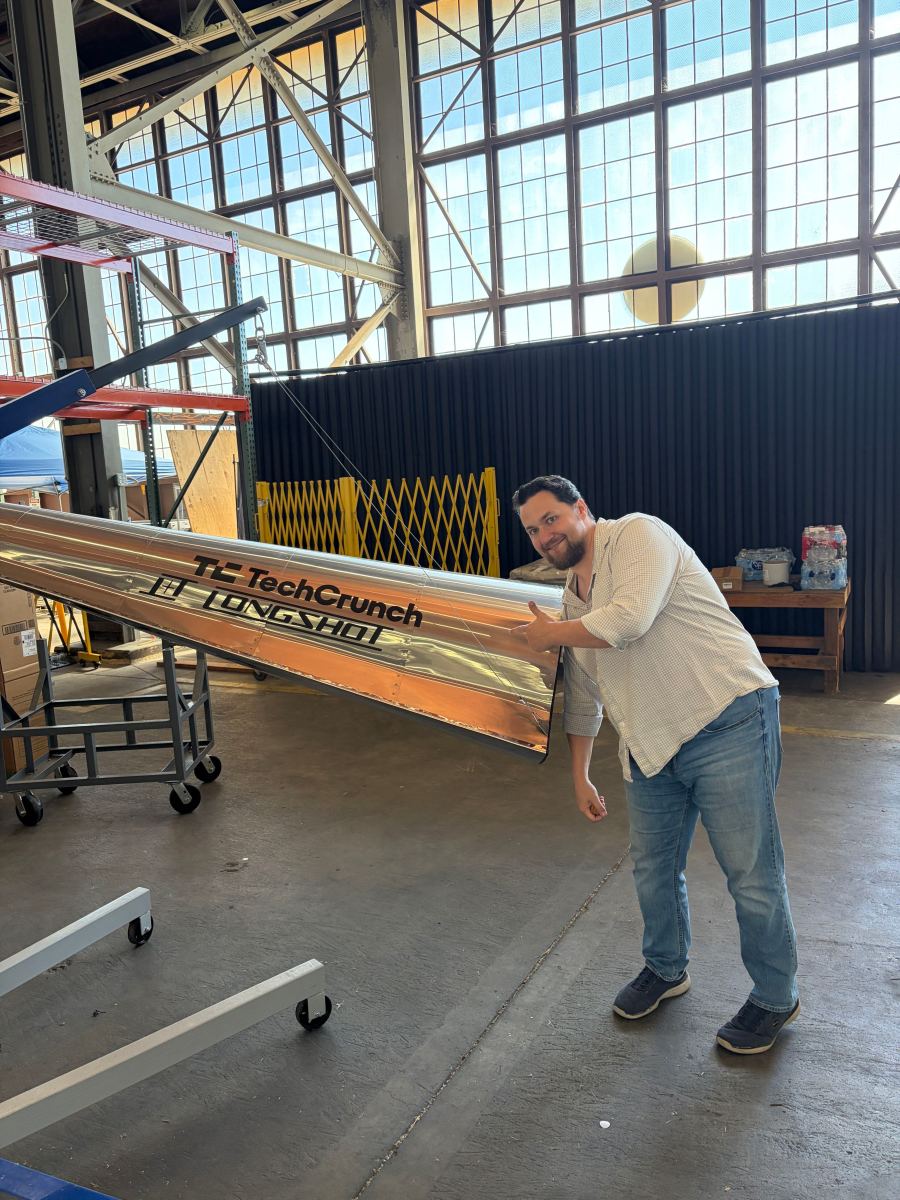
Rockets are, infamously, a real pain in the butt. Our old friend physics forces rockets to be built with almost no room for error, and even then only a small fraction of their weight makes it to orbit.
There are, at least in theory, other ways to do the job—space elevators, centrifuges, or a big chain hanging from a satellite in space and scooping up cargo from Earth. (Blue Origin spent some time thinking about that one before the idea wound up in a Neal Stephenson novel.)
And then there’s an idea dating all the way back to Jules Verne: Use a big gun to shoot a projectile into space.
Longshot Space Technology, a startup based in Alameda, California, is working on exactly that. The cofounders, CEO Mike Grace and CTO Nato Saichek, see an opportunity to take a technology that has already proven its worth, and apply it to the pressing need for space launch. The startup has raised about $20 million from venture investors in service of its mission.
When it comes to frontier technology, Grace says, “you can build something that has a lot of novelty, or you can do something really hard. You don’t get to do both.” He points to SpaceX as an example of a company that has “taken classically de-risked technology and scaled it aggressively.” What SpaceX did with NASA rocket research, he says, Longshot will do with multi-injection guns — designs that give a projectile extra boosts as it moves down the barrel — built for World War II and during 1960s research programs.
The idea is to take all the work done by the first stage of a launch vehicle and collapse that into a reusable accelerator on the ground. Picture a steel pipe mounted horizontally over the ground, with tanks of high-pressure gas attached at ports spread across its length. When a projectile is fired and moves down the barrel, the tanks fire off at precise times to accelerate it — to speeds as high as Mach 4, thus far.
The company is currently firing an 70-foot gun with a 6-inch diameter at its test site near Barstow, California, and says it can accelerate projectiles up to near-hypersonic speeds. Soon, it expects to start firing a 140-foot-long gun with a 30-inch diameter at its Alameda test site. After that, the company is preparing to build out a 30-inch diameter gun that is 328-feet long, with plans to extend it to about 3,000 feet—making it the largest gun on the planet. It will be capable of launching 220-pound payloads up to speeds of Mach 8, the team says.

These guns will let Longshot keep proving its technology works while also generating revenue from performing hypersonic testing for the US military, which has awarded the company several contracts. Grace envisions building one of his guns on a US military installation like Fort Bliss, where it could be part of the infrastructure for testing the next generation of US interceptors. (And no, the guns don’t need to point up at an angle. Longshot’s projectile is a lifting body, meaning its shape generates lift, so it will aerodynamically gain altitude once it exits the barrel.)
“If you want to practice shooting down a Chinese or Russian hypersonic missile, wouldn’t it be nice not to pay $30 million for that?” Grace asks. “This is a way for half a million, a quarter of a million bucks, of doing hypersonic clay pigeons, throw them and shoot them down, and do it really fast and really cheap.”
The ultimate goal, however, is putting large payloads into space. The team is confident it can scale up its current design to accelerate payloads to as much as 5 kilometers per second (more than 11,000 mph). That’s fast enough to get into space if the payload, which effectively serves as the second stage of a rocket, has its own propulsion system. But doing that would require a gun 10 kilometers (about 6 miles) long and nearly 10 feet in diameter. As you might imagine, one problem the company faces is simply finding suitable worksites.
“The hard part is not building the thing, it’s finding a place where they will let you build the thing,” Saichek jokes.
But if Longshot can realize its vision, the math is very attractive: The system is cheap to construct and to fuel, and is highly reusable. Grace expects that if everything works out, they can send payloads to space for a hard-to-believe $50 per kilogram (about $22 per pound). Considering that the much-hyped orbital data center industry needs prices to fall to around $300 per kilogram to get off the ground, that leaves Longshot plenty of room to offer a competitive price.
It will require some modification to launch spacecraft in this form factor and conditions, but at that price point, satellite operators will be willing to try.
If you want to learn more about Longshot from the company itself — while also checking out dozens of startups, hearing their pitches, and listening to guest speakers on four different stages — join us this week at Disrupt, Tuesday to Thursday, in San Francisco. Learn more here.
When you purchase through links in our articles, we may earn a small commission. This doesn’t affect our editorial independence.
>
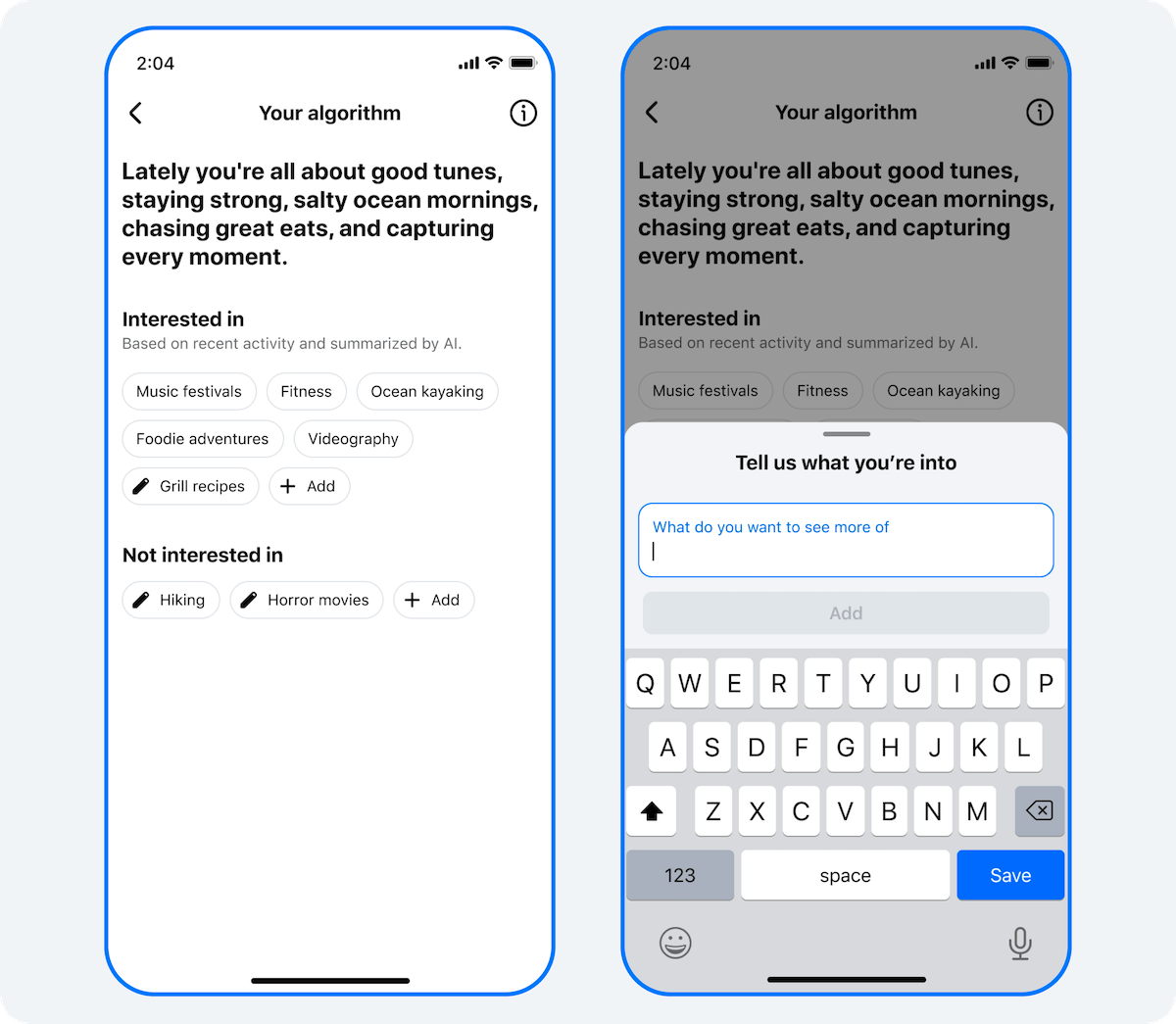
Facebook is the latest social media platform to give users greater control over the algorithm that determines what appears in their feeds.
Meta announced the launch of its new AI-powered feature, “Your Algorithm,” on Tuesday, a feature it first launched on Instagram. The new tool allows Facebook users to influence the content they see in Feed and Reels by describing their preferences in their own words using natural language. Rather than relying entirely on automated recommendations, users can now communicate directly with the platform about the topics and content they want to see more or less frequently.
According to Meta, the feature is designed to make content recommendations more relevant. Users can adjust their preferences and interact with the algorithms responsible for ranking and recommending posts, with changes reflected in their recommendations in real time.
The company has also updated Facebook’s three-dot menu, making it easier for users to manage their content preferences directly from individual posts. By opening the menu, users can access “Your Algorithm” or select the “Interested” and “Not interested” options to indicate whether particular content aligns with their preferences.
Meta says the platform may ask follow-up questions to better understand what users liked or disliked, allowing them to provide more detailed feedback. Users can explain what they want to see more or less of, helping Facebook refine its recommendations based on their responses.

The introduction of “Your Algorithm” reflects Meta’s broader effort to give people more influence over their social media experiences as AI increasingly shapes content discovery. The move signals a shift away from the traditional recommendation systems that have shaped social media experiences for years, bringing the platform closer to streaming services that allow users to personalize recommendations based on their interests and preferences.
The launch also builds on Meta’s existing personalization efforts across its other platforms. Instagram introduced Your Algorithm in June, extending customization options across Feed and Explore after first launching the feature for Reels in December 2025.
Threads also introduced its own related feature, called “Dear Algo,” which allows users to influence the content recommended to them.
When you purchase through links in our articles, we may earn a small commission. This doesn’t affect our editorial independence.
>

If there’s one lesson the OpenAI-Hugging Face incident taught us, it’s that AI agents can be unpredictable.
“Imagine if something like that happened in the physical world,” Howie Sun, CEO and co-founder of Laplace Intelligence, told TechCrunch. “AI agents are moving from computers into the real world, and we don’t really want physical AI to fail in the real world.”
Ann Arbor-based Laplace is building automated red-teaming — essentially, stress-testing a system by deliberately trying to make it fail — for robotics and physical AI. The company is betting that the only way to make sure physical AI is safe is to have AI test it.
“Our goal is to help companies discover and fix problems before deployment—and, over time, build a shared foundation of evidence that customers, insurers, and regulators can trust,” Sun said.
Laplace is one of 20 startups competing in Startup Battlefield, TechCrunch Disrupt’s three-day pitch competition in downtown San Francisco. It will present on the Startup Battlefield stage Monday afternoon, October 13.

Sun, alongside his co-founder and chief scientist Henry Liu, founded Laplace a year ago out of the University of Michigan. Sun has spent the last eight years in academia researching how to challenge autonomous driving AI in simulation. In 2023, he and Liu — his then-PhD advisor — published a paper on the subject that made it onto the cover of the top scientific journal Nature. That’s when the calls started coming in from autonomous vehicle companies interested in implementing their ideas.
“I realized that I wanted to build this and take it from purely academic research into a product that’s useful in the real world,” Sun said.
Using their academic research as a base, Sun and Liu built Laplace, so named for “Laplace’s demon,” an 1814 thought experiment by French scholar Pierre-Simon Laplace that imagined that if you knew the exact state of everything in the universe, you could predict the future with total precision.
“We are essentially using simulation to predict the real world’s future,” Sun said.
At the startup’s core is a high-fidelity simulation reconstructed from the real world, paired with an AI agent that constantly probes for weaknesses and failure points. The goal is to ensure that any physical AI — be it a robot, autonomous vehicle, or smart city solution — is safe in simulation before it’s deployed in the real world.
The simulation environment is a post-trained version of Nvidia’s Cosmos, an AI world simulation platform, that’s grounded in the real world, allowing Laplace to reconstruct anything from an Arizona highway to a Paris pedestrian crossing. Simulations are generated by blending a mesh of different real-world information. A Google Street View image could serve as a reference from which an entire street is generated. But rather than generating something random, the simulator combines real-world map data to recreate an environment that’s true to scale.
Developers can then use language prompts to change the setting in real time, like adding in afternoon traffic. Sun says Laplace pulls real-time traffic and congestion information from navigation providers like TomTom.
Within Laplace’s simulations, not only the environment is simulated, but also the behavior of other actors. For example, during a demo, Sun directed the test agent vehicle to swerve into oncoming traffic. The car it would have hit — or driven through, as is common among some generative world models — moved out of its way to avoid a collision.
“It’s truly an interactive simulation environment,” Sun said. “Everyone is reacting to everything. …This is more like a world model with interactive participants.”
While the simulated environment is an important part of Laplace’s product, the real unique selling point is the AI agents the startup is developing to automatically design corner cases (tricky, rare scenarios that could trip up an AI system) moving the human further out of the loop.
“They can design from the news, from police reports on collisions — all kinds of information to actively challenge the autonomous vehicles and other physical AI agents,” Sun said.

Today, autonomous vehicle developers mostly train an AI to handle edge cases using recorded footage that they then turn into a simulation, or by relying on humans to come up with new ideas and design them. While many AV companies have done what Laplace is pitching and started embracing AI to create edge cases for training — self-driving truck company Waabi comes to mind — the need for this kind of technology will really become apparent when we start placing generalized robots in the real world.
“There’s less data on generalized robotics,” Sun said. “No one knows what the edge cases will be in the real world.”
Despite Sun and Liu coming from academia, with no shiny Silicon Valley tech company pedigrees, the two have managed to start generating revenue and even turn a modest profit. Most of the money is coming from autonomous driving use cases, with customers including Japanese trucking manufacturer Isuzu and Texas-based autonomous trucking firm Bot Auto.
Nvidia is also a customer, says Sun. The two companies, alongside T-Mobile, are working together on a free smart city pilot for the City of San Jose to provide high-level traffic operations. Laplace is also in the early stages of working with partners building humanoid robotics for warehouses.
Most of Laplace’s customer contracts are project-based today, and the company is working towards turning that into recurring revenue. The startup’s near-term goal — which it hopes will be aided by competing at Disrupt — is to raise funds and scale so it can compete with its rivals.
Chief among its rivals is Applied Intuition, a buzzy late-stage startup that’s raised $1.2 billion to date at a $15 billion post-money valuation. Isuzu is also one Applied’s customers.
Sun isn’t too worried. He believes Laplace’s core methodology of using AI to test AI is a “new paradigm that changes the testing of physical AI entirely,” turning it into a “dynamic interactive testing process.”
“That will be the biggest moat,” he said.
When you purchase through links in our articles, we may earn a small commission. This doesn’t affect our editorial independence.
>
College football odds Week 7: Ohio State favored at Indiana, Notre Dame at BYU, more

Forget rockets — Longshot wants to fire cargo into space from a gun. See it at TechCrunch Disrupt 2026

‘The Magician’s Nephew’ Trailer: A Stairway To Narnia As Only Greta Gerwig Could Build It
-

 movies5 months ago
Search For Canadian TV Actor Stewart McLean Now Homicide Investigation
-

 Fashion9 years ago
These ’90s fashion trends are making a comeback in 2017
-
Fashion9 years ago
According to Dior Couture, this taboo fashion accessory is back
-
Fashion9 years ago
Model Jocelyn Chew’s Instagram is the best vacation you’ve ever had
-
Fashion9 years ago
Emily Ratajkowski channels back-to-school style
-
Fashion9 years ago
9 Celebrities who have spoken out about being photoshopped
-

 Anime4 months ago
Rurouni Kenshin: Hokkaido Arc Manga Takes 1-Issue Break – News
-

 Anime3 months ago
HIDIVE to Stream English Dubs for The World Is Dancing, The Forsaken Saintess and Her Foodie Roadtrip in Another World, The Dangers in My Heart: The Movie Anime – News