
Katseye on ‘Saturday Night Live’


Iranian American actor Anthony Azizi says the continuing Middle East conflict has sparked rising persecution of Iran’s Baha’i minority, including its members being jailed and tortured under the threat of execution.
“This a war on human rights and humanity and people who have no rights,” Azizi, a veteran series regular on U.S. dramas like CSI, Tehran and Gaumont TV’s The Deal, tells The Hollywood Reporter. He stars in Cast Aside the Clouds, an Iran-set romance thriller about a young Baháʼí woman, played by Parmiss Sehat, who navigates her faith and systemic persecution.
The indie from co-directors Mary Darling, Bre Vader and Felicia Sobhani will have a U.S. premiere on May 18 at Cinema Village in New York City, followed by a Los Angeles premiere from June 4 at Lumiere Music Hall. There’s additional theatrical dates set in Chicago and northern Virginia in June.
Shot in Athens doubling as Tehran, Cast Aside the Clouds has Azizi playing Farhad Khosrovi, a bookstore owner whose daughter Utab (Sehat) attends a secret university aligned with the Iranian Bahá’í spiritualist faith.
After the bookstore is attacked, a hospitalized Utab meets a young Muslim neurologist, Dr. Sasan Naderi, played by Behtash Fazlali, and they fall for one another. With a romance between a Muslim and a member of the Bahá’í faith opposed by both of their families, their relationship is also tested when Utab learns Sasan has plans to go to Germany and she is arrested, imprisoned and tortured for being a Baha’i.
A drama about persecution in Iran resonates with Azizi, who was born in Tehran and into a Baha’i family where relatives lost jobs, were jailed, had property confiscated and two defiant uncles were executed after refusing to disavow their Baha’i faith.
“Both of my uncles rejected that notion and said there’s no way we will ever renounce what we believe is the elixir for all of mankind’s problems. You’re asking us to renounce what we believe is the answer. So they did not renounce their faith in Bahá’u’lláh and were murdered. Simply murdered,” Azizi recalled of his family members defying their interrogator and sticking to their belief in the Iranian founder of the Baha’i faith.
The Iranian American actor argues the long-standing persecution of the Baha’is in Iran has only escalated with the current Middle East tensions. “To murder people on the basis of their religious belief, it’s unreal to me that this is happening in 2026,” Azizi added.
Director Darling, while pointing to persecution of the Baha’is in Iran going back to the 1800s, echoed how the current Middle East crisis had escalated that threat to the religious minority. “Because of the ongoing war in Iran, the Baha’is are being scapegoated as spies for Israel, spies for America,” she warned.
Darling pointed to recent high profile imprisonments of Baha’i cousins Peyvand Naimi and Borna Naimi, who have undergone torture to force confessions and face possible death sentences. “It’s really horrible. They blindfold them, they beat them, they put them in a chair, they cover their heads, then they try to force confessions for being spies. And they think they’re going to die,” the director insisted.
Hollywood actors Penn Badgley, Mark Ruffalo and Rainn Wilson have released an Instagram video calling for the release of the Naimi cousins from the infamous Kerman Prison.
Other recent imprisonments of Baha’i women include Faranak Zabihi being held in Tir Kola Prison after an April 8 arrest, and Neda Badakhsh, 63, who received a 10-year prison sentence in the Dowlatabad Prison in Isfahan.
Darling, who co-wrote her romantic thriller along with fellow Baha’i and husband Clark Donnelly, added the title for her Cast Aside the Clouds film came from a poem by Iranian writer Forough Farrokhzad about replacing ignorance with world unity, a key tenet of the Baha’i faith. “She talks about casting away these clouds, these veils of ignorance that get between us and the reality around us, that we are actually one big family,” the director argued.
Darling added her Persian and English language drama also hopes to open up a wider discussion about religious persecution worldwide — from Uyghurs in China and Rohingya Muslims in Myanmar to Christians and Yazidis in the Middle East. To that end, she’s looking to the upcoming U.S. theatrical runs leading to a wider distribution of Cast Aside the Clouds after ongoing discussions.
“We see this as a very, very important story and we know there are distributors out there who would be interested in being on the right side of history on this,” she added.
>
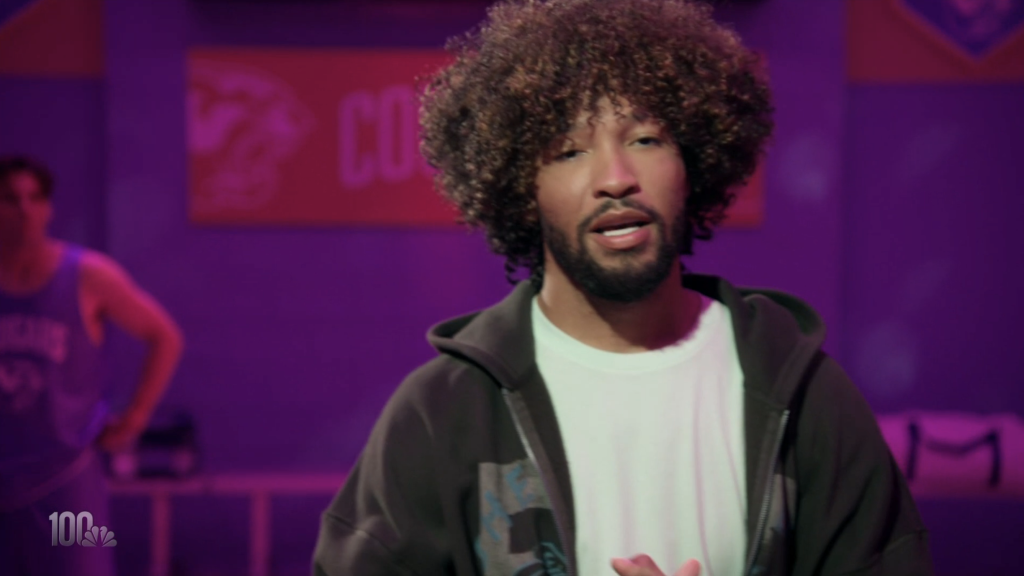
Following the Knicks’ big win at Madison Square Garden, Jalen Brunson took the stage at 30 Rockefeller Center for his Saturday Night Live hosting debut.
On Saturday’s Season 52 premiere, the NBA Finals 2026 MVP showed off some comedic chops in an otherwise business-as-usual episode of the NBC sketch comedy show, which featured Katseye as its musical guest.
Introducing new cast members Grace Reiter and Saidah Belo-Osagie, Katseye returned to a parody season of The Debut: Dream Academy to crown a new girl group. The quartet also performed in a mini music video with the awkward group of ladies, also featuring Jane Wickline and Veronika Slowikowska.
The next sketch was a support group featuring Brunson as one of several men whose spouses were grinded on at Usher and Chris Brown’s The R&B Tour.
“When I spent $1,200 on that meet-and-greet, I never expected her to actually greet his meat,” said Brunson as the other group members comforted him.
Katseye on ‘Saturday Night Live’
Jeremy Culhane and Jalen Brunson in ‘Saturday Night Live’
Jalen Brunson, Jeremy Culhane and Ben Marshall on ‘Saturday Night Live’
Brunson also starred in the parody sketch High School Musical: The New Generation as an athletically gifted new student who hilariously keeps dunking on the new Troy Bolton stand-in (Jeremy Culhane) and steals his girlfriend (Slowikowska).
As Shark Tank judge Daymond John, Brunson asked if the invention Respectacles, a pair of glasses that sounds an alarm when the wearer looks at breasts, “works for ass.” The inventors’ (Culhane and Ben Marshall) presentation keeps getting interrupted as they check out Lori Greiner.
Saturday Night Live kicked off its 52nd season this weekend on NBC with host Brunson and musical guest Katseye. The season continues with guest hosts Dakota Johnson, Shane Gillis and Inde Navarrette, along with musical guests Turnstile, Rosalía and Gracie Abrams.
>
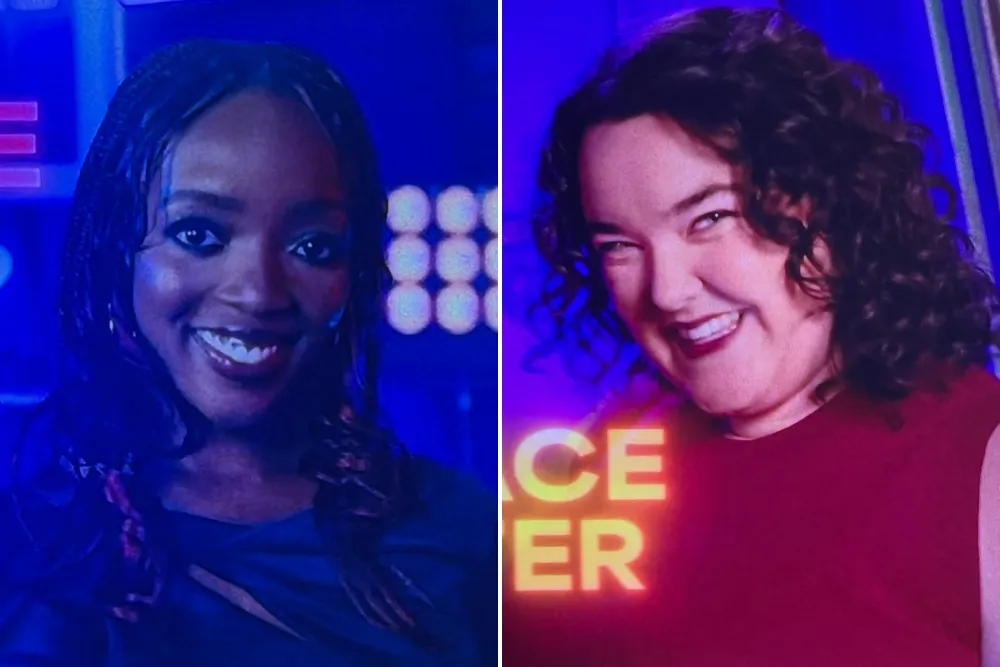
For those wondering how SNL‘s new cast members factored into tonight’s season premiere, the answer is: not much.
The two new featured players, Saidah Belo-Osagie and Grace Reiter, were introduced together, as part of an early sketch on the search for reality competition The Debut: Dream Academy‘s next breakout girl group.
Belo-Osagie played Neelsa Boyce, a 17-year-old entrant who sought to become a pop star after playing Young Nala in The Lion King on Broadway when she was a kid.
Reiter got more screen time as Margle, who “only wear [s] flip flops because I keep passing out when I try to tie my shoes.”
After she’s first introduced onscreen, Margle shows up fully nude to a dance choreography session. We later learn that she and another eccentric contestant on the series named Duff (Jane Wickline) were only invited to participate after witnessing an executive behind the show, played by Ashley Padilla, committing a hit and run.
Margle is surprised to learn what Dream Academy is actually about, as a show: She says she thought it was a “show where you learned to control dreams.”
Subsequently, she pitches “Moose Knuckle” as a band name and the line “Newton’s Cradle, come and get it” during a songwriting exercise.
The sketch culminates with a performance by the final girl group, featuring Margle, who performs the hot new single “Newton’s Cradle” alongside The Debut Season 1’s KATSEYE (who happened to be the SNL season premiere’s musical guest).
Reiter made one other appearance tonight in the night’s final sketch, which opens on host Jalen Brunson (of the recent NBA Finals-winning New York Knicks) in the locker room. He won’t be meeting with reporters after tonight’s game, he says — though he’s visited regardless by a grey-haired Kenan Thompson, who reveals himself to be the NBA star’s third-grade coach — you know, the one who had a “really bad drinking problem”?
Coach Dennis has come around seeking a “small loan” and in hopes of getting Brunson to read his porno screenplay. Thompson introduces Reiter as Tonya, an immigrant who came to the U.S. eight years ago with a dream, who he hopes to rope into his porn. Kam Patterson also features in the sketch, which culminates in his, Reiter and Thompson’s characters stealing jerseys from the empty locker room and running away.
That was all the night had in the cards for Belo-Osagie and Reiter. Often, SNL will use its Weekend Update segment to help break in its new talent, though special segments of tonight’s presentation were instead devoted to special panelists Dario Amodei (played by Wickline) and Tucker Carlson (played by Jeremy Culhane).
Before returning for the new season, SNL said goodbye to Chloe Fineman and writer-performer Martin Herlihy, who was first introduced on the show as part of the trio Please Don’t Destroy. Other returning cast includes Kenan Thompson, Michael Che, Colin Jost, Mikey Day, Sarah Sherman, Marcello Hernández, James Austin Johnson, Andrew Dismukes, Ben Marshall, Tommy Brennan, Kam Patterson and Veronika Slowikowska.
Jalen Brunson, point guard for the 2026 NBA Finals-winning New York Knicks, hosted the kickoff episode for Season 52. Upcoming episodes will pair Dakota Johnson & Turnstile (October 3), Shane Gillis & Rosalía (October 10) and Inde Navarette & Gracie Abrams (October 31).
>
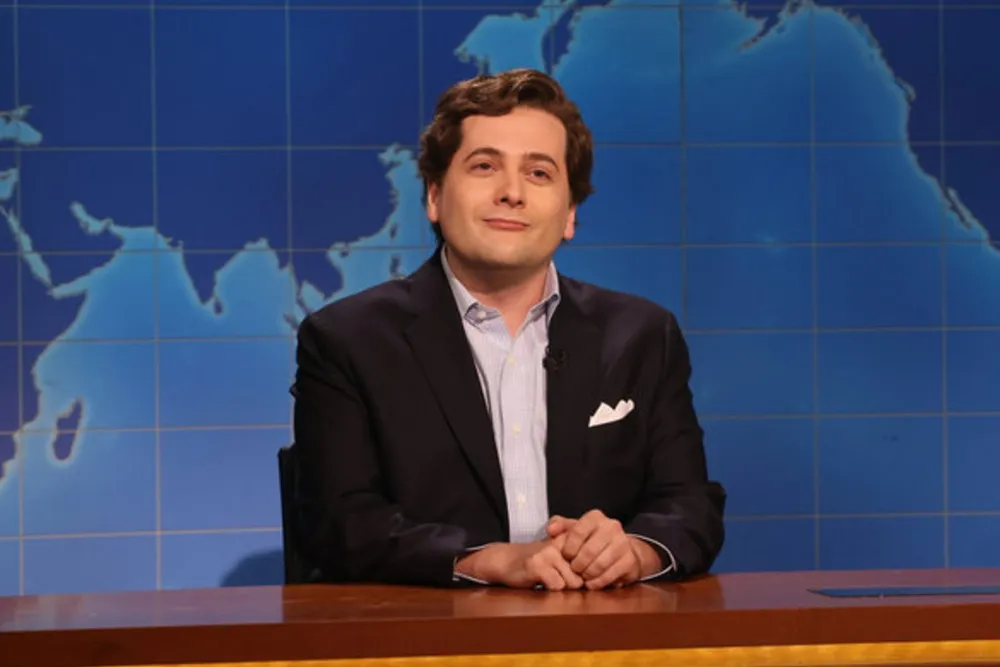
Saturday Night Live’s Weekend Update was back and focused on the movie business.
Jeremy Culhane returned as Tucker Carlson and he was giving his thoughts on the summer’s slate of blockbusters.
“It’s movie time, let’s find our seats, silence our cell phones and abandon Christian values,” he opened. “Of course, I’m talking about Paw Patrol: The Dino Movie. Let me get this right: Jesus didn’t live at the same time as the dinosaurs but Paw Patrol did? What are we doing? What’s going on?”
Other kids movies in the spotlight were Toy Story 5 and Minions and Monsters.
“It was also a big summer for Minions and Monsters and no I’m not talking about the children’s film, I’m talking about the Trump cabinet. That’s right, I’ve turned on Trump, I’m so brave,” he said.
On the fifth installment of Disney’s Tom Hanks-narrated film, he added, “Let me understand this, you’ve got a friend in me and his name is Woody?”
It wasn’t just the kids slate that took a hit. Culhane’s Carlson also had some words for Christopher Nolan’s The Odyssey, Spider-Man: Brand New Day and Obsession.
“The Hollywood cabal shoots its filth with millimeters, or what I like to call it, the gay edge. I like The Odyssey, it’s so nice to see Greek people do something other than make women feel uncomfortable,” he said.
On Tom Holland’s superhero flick, he said, “Everybody Loves Spider-Man: Brand New Gender. Spider-they, Spider-them, uses whatever bathroom it feels like.”
On Curry Barker’s horror movie, he added, “Obsession, the left’s idea of a horror movie is that a woman is forced to love a man. Oh no, help, I’m being chased by a heterosexual relationship.”
All of this came after Weekend Update anchor Michael Che took aim at David Ellison’s Paramount+ and Taylor Sheridan.
“The White House responded to major news networks canceling coverage of President Trump by launching a live stream called Trump TV. But if that’s Trump TV, what the hell is Paramount+?,” joked Che.
The shows on screen? Sheridan’s Yellowstone, prequel 1883, spinoff Dutton Ranch and Sylvester Stallone-led Tulsa King.
>


Search For Canadian TV Actor Stewart McLean Now Homicide Investigation


These ’90s fashion trends are making a comeback in 2017
According to Dior Couture, this taboo fashion accessory is back
Model Jocelyn Chew’s Instagram is the best vacation you’ve ever had
Emily Ratajkowski channels back-to-school style
9 Celebrities who have spoken out about being photoshopped


Rurouni Kenshin: Hokkaido Arc Manga Takes 1-Issue Break – News


HIDIVE to Stream English Dubs for The World Is Dancing, The Forsaken Saintess and Her Foodie Roadtrip in Another World, The Dangers in My Heart: The Movie Anime – News