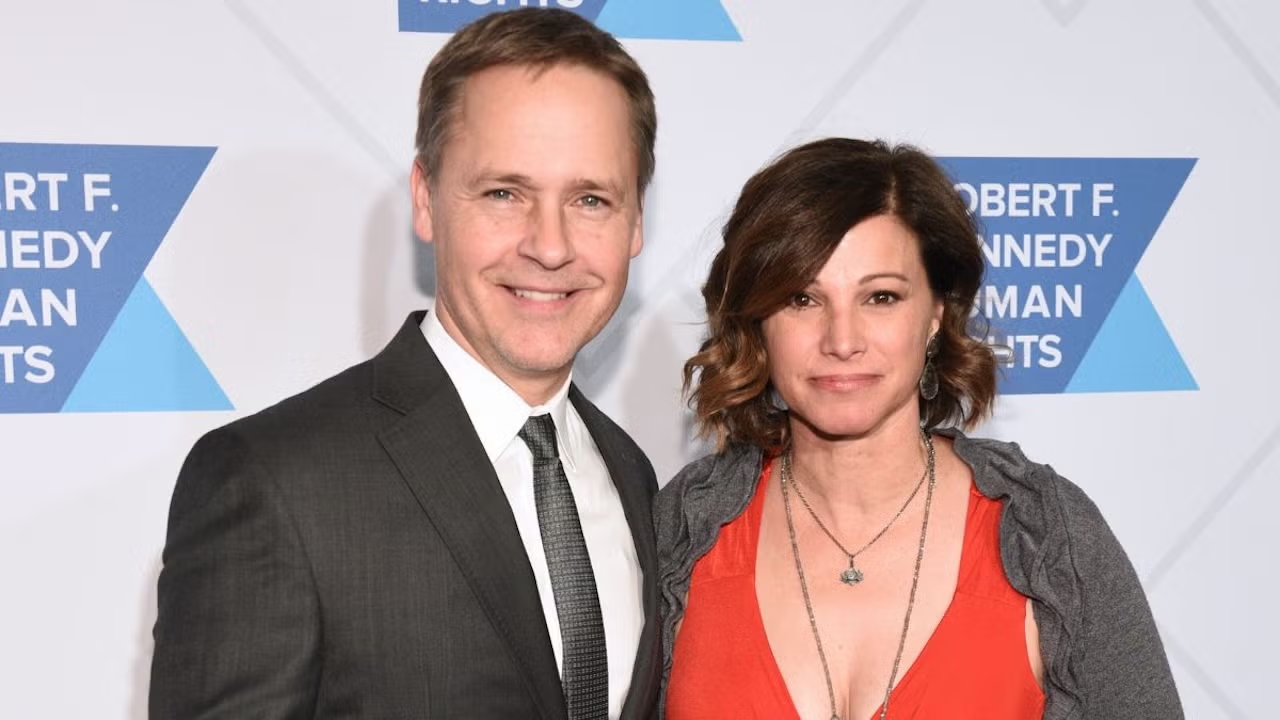
Chace Crawford as The Deep, Antony Starr as Homelander and Nathan Mitchell Black Noir in ‘The Boys’
Jennifer Lopez will be honored with the inaugural Adelante Award for Industry at the opening night of the 25th edition of the Los Angeles Latino International Film Festival (LALIFF), organizers announced on Wednesday.
Meanwhile, Paulina Chávez will receive the Next Gen Award, recognizing her as an emerging talent shaping the future of entertainment. She is known for her performances in “The Long Game,” “Alexander and the Terrible, Horrible, No Good, Very Bad Road Trip” and as Ariana in the hit series “Landman.”
“Jennifer Lopez is part of a generation of artists who have helped define what was possible for Latino representation across film and television,” Edward James Olmos, co-founder of LALIFF, said in a statement. “We first worked together many years ago, on ‘Mi Familia’ and ‘Selena,’ and coming back together now as both actors and producers on ‘Office Romance’ for Netflix reflects how that creative journey has continued over time. Honoring her at this milestone edition of LALIFF carries particular meaning.”
The event will take place on May 27 at the TCL Chinese Theatre Imax at 7 p.m. The award recognizes visionary leaders whose work has created lasting impact and expanded opportunity across the entertainment landscape.
The evening will celebrate the Opening Night Gala of LALIFF’s 25th edition, featuring a special presentation of “Valentina,” directed by Tatti Ribeiro and starring Keyla Monterroso Mejia (“Curb Your Enthusiasm,” “The Studio”), with Jessica Alba serving as executive producer.
Ribeiro, who won the Film Independent Spirit Award for Someone to Watch, brings a distinct voice to this year’s program. The screening will include a brief conversation with the filmmaker, followed by an afterparty at the Hollywood Roosevelt.
>
Few careers have a clearer origin than Nicolas Winding Refn’s.
The Danish filmmaker emerged at just 25 with “Pusher,” which, over the decades, proved an ample prediction: ruthless underworlds, the men who act as their envoys, stomach-churning violence delivered placidly, and a relentlessly mean sense of humor.
Financial catastrophes engendered by his 2003 English-language debut “Fear X” would also necessitate, against Winding Refn’s desire, a return to his first commercial success, but the back-to-back sequels (“Pusher II: With Blood on My Hands” and “Pusher III: I’m the Angel of Death”) are sadder, stranger, altogether more mature in form and tone. What would’ve been a sell-out move nine times out of 10 only validated Winding Refn’s initial instincts threefold.
However massive the success Winding Refn has found in decades hence — and a frankly unlikely one at that, given his enviable roster of Ryan Gosling, Elle Fanning, Miles Teller, Amazon, Netflix, and Cannes — his “Pusher” trilogy is, at least stateside, perhaps slotted as a curiosity before an essential. That status may change imminently: restored in 4K, Magnolia Pictures is beginning a theatrical rollout at the IFC Center on Friday, May 8, allowing one to either rediscover or be fully surprised by one of the 21st century’s most influential careers (plus the debut of a boyish, bald Mads Mikkelsen).
I spoke to Winding Refn on this occasion, which coincides with a major moment all its own: He’s weeks from premiering “Her Private Hell,” his first feature in 10 years — while the interceding, epic-length, wholly worthwhile streaming excursions “Too Old to Die Young” and “Copenhagen Cowboy” might constitute a parallel career — at Cannes ahead of a July 24 theatrical release from Neon. That the 2011 Cannes Best Director winner (“Drive”) would return in an out-of-competition slot suggests something less palatable, more openly hostile. (Maybe not above “Only God Forgives,” but that’s a check-clearing movie if ever the 2010s had one.) No true fan would wish for less.
The following interview has been edited for clarity and brevity.
IndieWire: How are you? This is quite the month.
Nicolas Winding Refn: Oh, it’s all very hectic.
I can imagine.
But, no — better to do things than not do things.
Hopefully, talking about your earliest films will be a nice way to cool down. They were so formative to this amazing career you’ve had. The “Pusher” restorations came out well, and I think part of what was so fantastic about them is that they didn’t bend over backward to change these films’ initial sense — the mid-90s to the mid-2000s. What was the process, intuitive or material, to making the “Pusher” trilogy look fresh and restored, but still unique to their time and still respectful of their era?
Well, I mean, the good news is that I shot them on Super 16. And a lot of films, it turned out, from that era — where digital was beginning to emerge — the files and resolution of a lot of these digital negatives was diminishing and couldn’t be upscaled or couldn’t be rescanned. So that was one of the good things about having shot on film. Shoot on film, for God’s sake, if you can — at least back then. Then I think it was a lot about just capturing what the films originally looked like. Because that’s one of the things we go through in these, you know, evolutions of technology and home entertainment — what you can and cannot do — and so I think for me, here, it was like, “This is the definite restoration. This is it, end of the line.”
[Laughs] So I did spend a long time making sure that the films looked as they would have. But at the same time, trying to find ways to interconnect them, because they’re all shot by the same cinematographer [Morten Søborg], and even though there were years apart between one and two and three, it still had to feel almost like one movie in a way.

What were some of the things that helped unite them?
When I made [“Pusher”] two and three, television had really begun to have a resurgence of, like, brilliance. You know, it was the time with “The Sopranos” and HBO. I think that kind of just took the… canvas much broader. So you can say there is a sense of serialized narrative within the “Pusher” trilogy. It’s very much like fly-on-the-wall, and they’re all connected in the same way that the first half is about setting up, and then the second half of each movie takes over one night where everything comes apart again.
[Laughs] So they’re all designed in similar ways, that is very important: that’s consistent throughout the films. Even though I had changed a little bit, I guess, when I made two and three, because it was some years later, I didn’t want to change the DNA of the films. They still had to remain the same.
I once read that you own a DVD, a Laserdisc, a 16mm print, and a VHS of Sergio Sollima’s “Violent City,” which suggests that you like the imperfections and eccentricities of each format. It’s interesting that, here, you have to kind of get the definitive version. That seems like a unique process.
Mmm-hmm. Well, I think it was important that when you make these restorations — because of technology — the 4K kind of clarity and the 4K definition and just the idea of information was a bit like: wow. It’s a bit like you’re bringing the original, when-you-saw-them-for-the-first-time-in-the-lab crispness to then reevaluating them on a physical media to a television screen, which, essentially, is very different from a 35 experience.
Um, but I think that, for me, when I look at these objects — because I very much value physical entertainment. I like physical media generally. I like to touch it. I like to go out and buy it in a store. I like to talk about the object. I like to see the object. Even though I know the reality is that most things will be seen online, because that’s just the way of the world. But I still hold, very dearly, the physical-media experience, and also that’s where you can do all the upscales and all these [laughs] creative, you know, the idea of making it as good as you possibly can.
But I don’t know in terms of what else to really do other than “this is it.” And when I made the Danish box, which I distributed myself, I included three movies that I had purchased the rights to and the negatives some years ago — about 10, 10, 12 years ago — which were of a Danish filmmaker called Poul Nyrup who, very unknown, had made three very similar movies to the “Pusher” trilogy back in the ‘60s in Copenhagen. I hadn’t seen them when I made my films, so obviously I knew nothing of them until much later in my life. But I was able to buy the negatives and the rights, and I did the same restoration with those films and included them in the Danish box set as a kind of both a companion piece to say, “Before me there was actually someone who was doing the exact same thing back in the ‘60s.”
And, in a way, much more revolutionary, because Danish cinema at least was only really just, you know, comedies or the emergence of the French New Wave inspiration. But genre cinema — especially American — was very, like, anti-Danish in a way, because it was politics of the time. But this American genre movie was really made in Danish back then, and I thought it was just very interesting to see the juxtaposition between these six movies that are each a trilogy, one way or another, kind of combined. So that I also spent much detail, the restoration, on.
“Drive” feels like a very 2011 movie to me. Is there a kind of excitement and pleasure in how much your films have been aesthetic products of their time, or do you want them to set a template, to stake out new territory, for the era in which they’re coming out?
It’s a very interesting question, because you’re right: I think that we are obviously reflecting the times we live in through our work, or at least the ability to. It’s touching upon, also, politics and touching upon aesthetics. I think that I started making films trying to capture authenticity. You know, the idea of making it real and as real as possible was the agenda. Which is ludicrous [laughs] because reality doesn’t really exist, except in the moment you’re in it. But starting from there, and then obviously post-“Pusher” trilogy, realizing that I am no longer… or maybe I am searching for something I’ll never find. So I changed my route and started making films about unreality.

And obviously, that’s where “Bronson” and the films that came afterward began to shift in a different aesthetic approach. It all kind of culminated in “Copenhagen Cowboy,” because it was my first Danish-language — even though it was multilingual like the “Pusher” trilogy — but it was my first time working in back in my home country again after so many years, and essentially making what I think “Pusher” would be today.
So if I were to make “Pusher” today, what would it be? And who was I now compared to who I was 30 years ago? So in my own trajectory, I can see how I was wandering through various forests, and in a way never looked back but continued to push forward, but at the same time trying to challenge the aesthetics of the times that I am in, in the moment — to see what will come in the future.
I think it’s worth noting you’re about three weeks away from premiering a new film. I won’t prod too much about “Her Private Hell,” but I would be curious to know, broadly, what your feeling is on the eve of showing work at Cannes. Are you happy with the film? Are you excited about the Cannes premiere? What is that calm-before-the-storm feeling?
Well, first there’s a lot of logistics you got to deal with. That’s… but no, look: obviously my Cannes experience started at a certain time in my life, where things were changing again. I mean, you can kind of say my life has certain pivotal moments through my work — of how that really affected everything around me. Here, now — not having done a movie in ten years practically — to go back and make a movie in a time where cinema has really shifted compared to 10 years ago. So much has happened to cinema that it’s almost like entering a strange forest where it’s all a bit inconcrete. It’s hard to even define what the ecosystem is even like. And the power of the internet essentially driving everything and being the backbone of everything. Well, it’s a new playing field, I’ve been feeling. But the idea of creativity is still the same. It’s just the rules are a little bit different, but the aspirations are the same. And how do you navigate through that?
I love Cannes, obviously. It’s a great place to premiere. It has the best red carpet; it has the best of all those things, which is part of the experience. I mean, I love glamour and glitz and glitter and all that because that is part of the DNA of what we do. It’s kind of connected. But I also see a brighter future because I think that we’re moving towards something that we can’t quite put our finger on yet, of where things are going. But I believe that, with technology now suddenly putting a new spin on everything because of AI, it will continue to part the oceans between what it means to create and why you create. That having been flooded with technology — well, let’s say “content”; that’s what it’s called — to the point of: you’re basically overstuffed on opportunities to, just, everything comes and goes, like it was wiped.
But at a certain point, the mind can’t comprehend. Or this idea that everyone thought, that if you just open the floodgates, people would just sit and… well, maybe that wasn’t really true either. So it’s like: what is the real reality of the future? And I think that what’s gonna come now is much more focused on the survival of the heart. Meaning that, if you create with the heart — and I mean sincerely — that is what will not be affected by the technical evolution. But all the other things that are not genuine — and I mean pretending to be genuine — will just vanish into this sphere of just wipes. Just to say: I am very optimistic about the future, but just want to get that across.
I’m excited to see how “Her Private Hell” reflects that. I suppose it was a foregone conclusion that your first movie since the formation of a company called Neon would be released by them.
Well, Neon is called Neon because of “Neon Demon.”
Actually?
Yeah.
I didn’t know that. OK, well: self-fulfilling prophecy
Tom Quinn has been very instrumental in my life. Because he brought the “Pusher” trilogy to the U.S., and we did “Only God Forgives” together, which was a very, in a way, pivotal point in my own creative endeavor. We have always remained very close over the years, and so when I wanted to make a movie again, he was the one and only that I reached out to … he’s just amazing, and he was like, “What do you need?” And I explained what I needed, and he was like, “I’m in.”
That kind of reminded me of the experience with “Pusher One,” where I was like, “What do I need? Well, I need this.” And the government just gave it to me. [Pulls up blank paper] My CV was as blank as this piece of paper. I had no prior anything. And with Tom, it was like, “What do I need? This is my CV.” It has a few little things on it, but he was still, you know, “I’m in.” And that kind of gave me a re-evaluation of everything around me, but also an incredible amount of joy and pleasure in wanting to make a movie in how I see movies are for me now.
The “Pusher” film series is now available on physical media in 4K, with a theatrical re-release starting Friday, May 8.
>
Director James Cameron and The Walt Disney Company are facing a lawsuit alleging the unauthorized use of an Indigenous actress’ likeness in the “Avatar” franchise without her consent.
In a complaint obtained by TheWrap, actress Q’orianka Kilcher alleges that Cameron used her facial features, taken from a published photograph when she was 14 years old, as the basis for the Na’vi character Neytiri in the “Avatar” franchise. Kilcher, who at the time had portrayed Pocahontas in Terrence Malick’s “The New World,” claims her likeness was extracted from a Los Angeles Times image and incorporated into early character design work.
“The plaintiff never consented to Defendants’ use of her likeness, either in Avatar or in any related product or promotion,” the filing states.
The lawsuit, filed Tuesday in U.S. District Court for the Central District of California, names Cameron, Lightstorm Entertainment, The Walt Disney Company, 20th Century Studios, Industrial Light & Magic, Weta Digital and other visual effects vendors, alleging Kilcher’s image was reproduced across multiple stages of production, including sketches, sculptures and digital models distributed across art departments and VFX pipelines, ultimately appearing in films, posters and marketing materials, sequels and merchandise.
“What Cameron did was not inspiration, it was extraction,” Kilcher’s lawyer Arnold P. Peter said in a statement. “He took the unique biometric facial features of a 14-year-old Indigenous girl, ran them through an industrial production process, and generated billions of dollars in profit without ever once asking her permission. That is not filmmaking. That is theft.”
Kilcher and Cameron reportedly met briefly at a 2010 charity event following the 2009 release of “Avatar.” According to the complaint, Cameron later invited her to his office, where she was given a framed sketch of Neytiri accompanied by a handwritten note reading: “Your beauty was my early inspiration for Neytiri. Too bad you were shooting another movie. Next time.”
“When I received Cameron’s sketch, I believed it was a personal gesture, at most a loose inspiration tied to casting and my activism,” Kilcher said in a press release accompanying the lawsuit. “Millions of people opened their hearts to ‘Avatar’ because they believed in its message and I was one of them. I never imagined that someone I trusted would systematically use my face as part of an elaborate design process and integrate it into a production pipeline without my knowledge or consent. That crosses a major line. This act is deeply wrong.”
The complaint alleges Kilcher only learned of the alleged use last year after a video interview with Cameron resurfaced online, in which he discusses Neytiri’s design. “The actual source for this was a photo in the L.A. Times, a young actress named Q’orianka Kilcher,” Cameron says in the interview. “This is actually her… her lower face. She had a very interesting face.”
Kilcher also alleges violations under California’s recently enacted deepfake-related statute, along with claims including misappropriation of likeness, invasion of privacy, defamation, negligence and interference with economic advantage. Her attorneys further argue that the alleged use of her likeness in scenes involving sexual content constitutes an unauthorized digital replica in an explicit context.
Kilcher disputes that she was unavailable during casting and claims she was never given an opportunity to audition for the role. Her legal team also alleges that her representatives attempted to secure her a reading for the project at the time.
The original “Avatar” film grossed more than $2.92 billion worldwide and remains one of the highest-grossing films in history. The franchise has since expanded into multiple sequels and is among Hollywood’s most commercially successful properties.
The complaint seeks compensatory and punitive damages, disgorgement of profits, injunctive relief and corrective public disclosure, including an order barring further use of Kilcher’s likeness.
Kilcher has appeared in TV series including “Yellowstone” and “The Alienist.”
Representatives for Cameron, Disney did not immediately respond to TheWrap’s requests for comment.
>
As The Boys heads into its final two episodes, Eric Kripke is stressing the importance of concluding every character’s story.
The creator of the Prime Video series recently responded to social media complaints about “filler episodes” in the fifth and final season of the comic book adaptation, which releases its penultimate episode next Wednesday on the streaming platform before the series finale premieres May 19 at 9:30pm in 4DX theaters and its Prime debut the next day.
“None of the things that happen in the last few episodes will matter if you don’t flesh out the characters. I’m getting a lot of online dissatisfaction, to put it politely,” he told TV Guide. “And I’m like, ‘What are you expecting? Are you expecting a huge battle scene every episode?’”
Explaining there was not enough budget for constant fight scenes in the final season, Kripke argued that direction “would be so empty and dull, and it would just be about shapes moving without having any import.”
Kripke added, “At no point during the writing of it was I like, ‘Oh yeah, we’re making filler episodes. So who cares?’ We all thought at the time we’re really getting these important character details. We have something like 14 characters, maybe 15. And I owe it to all of them — in that television is the character business — I owe it to all of them to flesh them out and humanize them and their stories.”

Chace Crawford as The Deep, Antony Starr as Homelander and Nathan Mitchell Black Noir in ‘The Boys’
The 2x Emmy nominee and his writers felt they provided some “crazy, big things” for the final season. “It’s just sometimes it’s a giant character movement,” said Kripke.
“But apparently, just because it’s not plot, you’re like, ‘Nothing happened!’ I’m like, ‘Nothing happened, what?’” added Kripke. “The craziest, biggest moves happened. It just wasn’t someone shooting someone else and going, pew, pew, pew. And if that’s what you want, you’re just watching the wrong show.”
Although The Boys is coming to an end, the prequel series Vought Rising premieres on Prime Video in 2027, and Kripke previously told Deadline that The Boys: Mexico is “heading in the right direction” as executive producers Diego Luna and Gael García Bernal develop the spin-off writer Gareth Dunnet-Alcocer.
Meanwhile, college offshoot Gen V was cancelled after two seasons last month, and the animated series The Boys Presents: Diabolical is unlikely to get a Season 2 renewal.
>
These ’90s fashion trends are making a comeback in 2017
According to Dior Couture, this taboo fashion accessory is back
Your comprehensive guide to this fall’s biggest trends
Model Jocelyn Chew’s Instagram is the best vacation you’ve ever had
A photo diary of the nightlife scene from LA To Ibiza
The tremendous importance of owning a perfect piece of clothing
Emily Ratajkowski channels back-to-school style
9 Celebrities who have spoken out about being photoshopped