
Entertainment
Viva Carmen Review: Sébastien Laudenbach Spins Bizet’s Tragic Opera

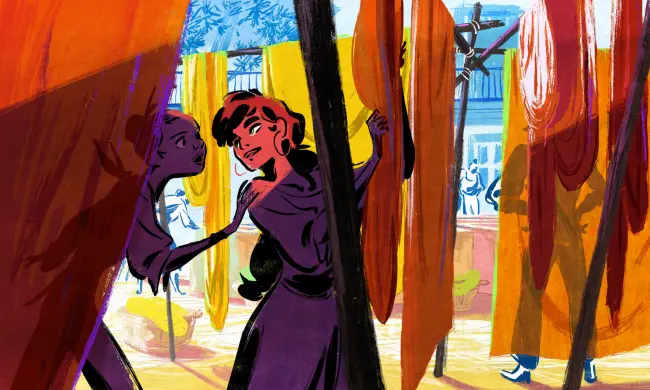
Feature-length animation has largely become a merciless and exacting thing, every frame invested with such a fortune’s worth of pre-determined purpose that there often isn’t any room left over for the audience to move around the images for themselves. These films used to implore our imaginations to fill the space between each cel, but the ones they make now are as seamless and inviting as the blades of a helicopter — watch from a safe distance, keep your hands to yourself, and try to enjoy the ride.
And then are the films of French animator Sébastien Laudenbach, whose expressionistic linework is so colorful and free that his characters look more like aura readings than people, and whose stories — even the darker ones — betray none of the burden that was required to bring them to life. His 2023 gem “Chicken for Linda!,” for example, was a modern-day musical adventure about a girl named Linda who really wants chicken for dinner. It rules.


A swooning and sketch-like distillation of Georges Bizet’s “Carmen,” Laudenbach’s new feature obviously takes on a slightly heavier subject than his previous work (including his 2016 debut “The Girl Without Hands,” which is about a girl without hands), but it retains the same blitheness of spirit. Like the director’s earlier films, it would almost seem to have been made on a whim if not for how self-possessed it feels in the telling, just as its characters — their thick black outlines filled with ever-changing swatches of color — would threaten to blend into the backgrounds if not for how clearly Laudenbach defines their feelings.
And the feelings are naturally intense in “Viva Carmen,” which shrinks Bizet’s opera down to a bite-sized snack that (older) kids should be able to follow and enjoy. The French-language film begins in Spain circa 1820, when Antonio, the blind knife-sharpener, returns to Seville to the great delight of local brigands and soldiers, whose blades have grown dull in his absence. He arrives with his sensitive tween apprentice Salvador (voiced by “Anatomy of a Fall” breakout Milo Machado-Graner) in tow, the boy coming home for the first time since he was a child. He doesn’t remember Carmen (voiced by Camélia Jordana), the beautiful Romani woman whose green eyes he spots in the darkness by a river one night, but perhaps he wasn’t so attuned to such things when he was a child.
Alas, whatever crush Salvatore may or may not be harboring for Carmen is soon eclipsed by a more urgent impulse, as Antonio — who can see the future of a knife as he sharpens it — discovers that a strapping young soldier named José will eventually stab Carmen with his dagger, a fate that his naive assistant inevitably sets into motion by trying to prevent it. And why not? José had never even met Carmen when the prophecy was foretold. But love is the only force more powerful than death, and woe to those who get in its way.
Like much of the story in this movie, the coup de foudre that sparks between Carmen and José is condensed to a degree that makes Bizet’s opera feel positively nuanced in its depiction of lust, but the speed at which things develop here — soundtracked by the jaunty clatter of castanets — reflects the velocity of the emotions at work, as well as the difficulty of holding onto hope in a world that feels like it’s careening towards disaster. Laudenbach and co-writer Santiago Otheguy also recognize that kids only have so much time for romance, and rewardingly choose to divert a large portion of the movie’s attention to a character named Belén instead, a street-tough Seville girl who serves as a bridge between the naivete of Salvatore’s fantasies and the unyielding reality of Carmen’s future (she’s also a total badass with a bolo, which “Viva Carmen” takes full advantage of during its few but fantastic action scenes).
Together, Salvatore and Belén sow a sweet friction into the film’s relationship between the dictums of fate and failure, especially as they allow “Viva Carmen” to emphasize how Seville’s community of lost children might respond to the bloodshed in their midst. The mishegoss between and Carmen and José still drives the plot of course, just as it shapes the story’s rhythm; Laudenbach uses it as an excuse to riff on Bizet’s “Habanera” in the first of the film’s two musical numbers, and later — in a scene crucial to this adaptation’s emphasis on female agency and the folly of impinging upon it — to stage a moonlit bonfire that unites Carmen’s friends in song, the animation distilling these women into pure feeling with a clarity that mocks the literalism of “Inside Out.” But the doomed lovers are largely relegated to the background here, as Laudenbach reframes the opera’s star-crossed romance for its impact on the kids who are forced to watch it unfold.
“Viva Carmen” is still packed to the gills with more plot than it can handle, but the film sings — sometimes literally — through its details. The shadows that flicker across the walls of a narrow alley as Belén fights off some witless soldiers. The way that Antonio’s carving stone turns the entire screen slate gray, the sparks from José’s knife popping off like shooting stars. The sunset that anachronistically melts into a Monet painting, pointing forward to the beauty that will survive the sadness to come.
“Fate is fate,” one character laments. “It sucks.” That may be the case, but the future will always remain unfinished in our own time, a fact that Laudenbach’s mutable animation — which appears to be unfinished itself, the colors always looking for cracks in the lines around them — more vividly brings to life than his film’s script ever could. For all of her well-earned cynicism, Belén will come to appreciate that past isn’t always prologue; that today’s failures don’t necessarily doom us to the tomorrow they seem to anticipate. “They say a person is never truly dead if you still think about them,” someone consoles her. And the same, this entrancing spindle of a movie suggests, might also be true of hope.
Grade: B+
“Viva Carmen” premiered at the 2026 Cannes Film Festival. It is currently seeking U.S. distribution.
Want to stay up to date on IndieWire’s film reviews and critical thoughts? Subscribe here to our newsletter In Review by David Ehrlich, in which our Chief Film Critic and Head Reviews Editor rounds up the best new reviews and streaming picks along with some exclusive musings — all only available to subscribers.
>

“In the spring of 2011, at the age of 18, my brother Matthew got his first real girlfriend,” explains Jackie (Tallie Medel) in voiceover at the beginning of “The Unspeakable Act,” written, edited, and directed by Dan Sallitt in 2012. “I had somehow thought that he and I had an unspoken agreement that we belonged to each other,” she continues, “which was really pretty stupid of me.”
Those words kick off Jackie’s final year of high school as she confronts her longstanding unrequited desire for her brother. Matthew (Sky Hirschkron), who’s aware of and patient with his sister’s feelings for him, and understandably wants to put some distance between them to explore other relationships, including some he might actually consummate. His decision to set boundaries sends Jackie into a spiral. She has trouble keeping food down, she can’t sleep, and she constantly badgers her brother for information about his new girlfriend, that is until he dumps her. Jackie’s yearning for Matthew still burns bright after he departs for college, but his absence forces her to build a life outside of her attraction to him, even if she thinks about him while sleeping with guys in her class.


Sallitt’s greatest coup in “The Unspeakable Act” is his refusal to treat his characters as pawns in service of a “shocking” premise. Jackie and Matthew are mostly typical teenagers with full social lives and creative hobbies. They have opinions on literature, music, and sex. They’re close with their mother but distant from their older siblings. Medel and Hirschkron portray their characters as intelligent, self-aware people guaranteed to chart respectively fruitful paths, even if they occasionally get in their own way. They are profoundly regular, except for that one thing.
But as much as Sallitt doesn’t sensationalize Jackie’s amour fou, a provocation unto itself, he also approaches her unconventional infatuation, and Matthew’s responsive equanimity, with appropriate gravity. Her feelings for her brother are real, which means that she has to actually deal with them if she wants to be a part of society. Her emotional tumult stems from her realization that she can’t continue into adulthood still pining for Matthew, which inevitably means that she won’t remain as emotionally close to him. With “The Unspeakable Act,” Sallitt honed in on a crucial coming-of-age lesson: you can’t always get what you want.
Fourteen years later, Sallitt returns with “What Can’t Be Mentioned,” a sequel to “The Unspeakable Act” that picks up roughly a decade later when Jackie, now in her late-twenties, learns that Matthew is about to have a child with his partner Lily (Kit Zauhar, director of “Actual People” and “This Closeness”). While Jackie exhibits all the outward trappings of stable adulthood, mainly a good job as a professional therapist and a shared apartment with her boyfriend Anthony (Kyle McCormack), Sallitt quickly reveals cracks in the façade. She experiences newfound sexual incompatibility with Anthony that eventually pushes them both into sex therapy, complete with awkward take-home exercises that Jackie struggles to take seriously. She seems to excels at her job, yet she also admits to feelings of countertransference with a forty-something client who privately worries that her two children might be exploring their sexuality with each other.
Sallitt depicts Jackie’s personal and professional struggles as specific hiccups that might manifest for anybody. But he also casts them in the shadow of her youthful attraction to Matthew, which may still be lingering in her subconscious like a party guest that has overstayed their welcome. When she receives news about Matthew’s impending child, she treks upstate for a week ostensibly to reconnect with him and her partner, whom she describes to Anthony as “okay, but totally not good enough for him.” Instead of ingratiating herself to the couple, however, she spends the week getting tanked on red wine and probing Lily with deliberately provocative questions about her bisexuality and how pregnancy has impacted her sex life with her brother.
Lily responds with monk-like composure in response to Jackie’s rude queries. (“My parents are hippies,” she says calmly. “Talking about sex is like talking about the laundry.”) Sallitt crucially abstains from underlining the irony that Jackie can’t process that Matthew and Lily’s shared disposition makes them compatible. Zauhar matches Hirschkron’s even-keeled temperament even when Lily tries to coax more information about Jackie from Matthew. Is she an alcoholic? “She just likes to cut loose some times. She’ll be fine when she’s back home,” Matthew calmly responds. Is she gay? After all, people hide it from those closest to them all the time. “Believe me, she’s not gay,” Matthew insists. A secret that can’t be uttered forms a small fracture between the happy couple that might balloon over the years.
“Mentioned” runs a little over an hour, making it the rare film where you wish the filmmaker expanded his work by even 10 or 15 minutes, maybe to further enrich some of its muted conflicts, or even just to give the viewer a little more time with the characters. Sallitt replicates the formal style of “Unspeakable” in “Mentioned” (static compositions, no camera movement), but changes the editing rhythm to sharper cuts that capture the more rigid routine of professional young adulthood. He also deepens the world of “Mentioned” by peppering in references to characters from “Unspeakable”: Jackie’s childhood therapist Linda (Caroline Luft) makes an appearance over Zoom to offer advice, and Matthew mentions speaking to their mother and eldest sibling Will. (Meanwhile, their second-oldest sibling Jeanne, whom Jackie predicts will one day leave and never look back in “Unspeakable,” is never mentioned.) Sallitt strives for an understated continuity that signals a fully lived-in world bursting with unspoken history.
“Unspeakable” and “Mentioned” are distinct enough entities that one could conceivably watch the latter without having seen the former and still feel fulfilled. However, “Mentioned” is obviously a richer text in the context of “Unspeakable,” if only to fully appreciate how Medel reinterprets Jackie between the two films. They convincingly develop their character’s previously restrained adolescent instability into matter-of-fact adult neuroticism without sacrificing any complexity. They bring a familiar but ultimately more mature charge to Jackie’s scenes with Matthew, who Hirschkron commits to portraying as almost defiantly unflappable. (He may have moved on from reading Mueller to “Stoner,” but he’s still basically the same person as he was in “Unspeakable.”) Medel lends Jackie a spiky, unpredictable quality even when they’re sitting in a chair and glaring at whomever will catch their eye. Most of the acclaimed, visible performances this year can’t muster that level of intrigue.
In a Filmmaker interview upon the release of “Unspeakable,” Sallitt perceptively comments that he doesn’t “see Jackie’s incestuous desire as a transitory thing or part of her passage to adulthood.” Instead he thinks “it’s just the way she is, and she will have to keep a lid on that desire in order to live comfortably, will have to cultivate other aspects of herself.” “Mentioned” effectively progresses from this specific vantage point, with Mendel at times depicting Jackie like she’s managing a chronic condition, and Hirschkron capturing a sibling’s unique sympathies for their sibling’s pain. The final couple scenes of “Mentioned” illustrate Sallitt’s updated perspective over the interim near-half decade, which feels discomforting but ultimately hard won. It turns out that if you try sometimes, you just might find that you get what you need.
Grade: B
“What Can’t Be Mentioned” premiered at the 2026 New York Film Festival. It is currently seeking U.S. distribution.
>

>
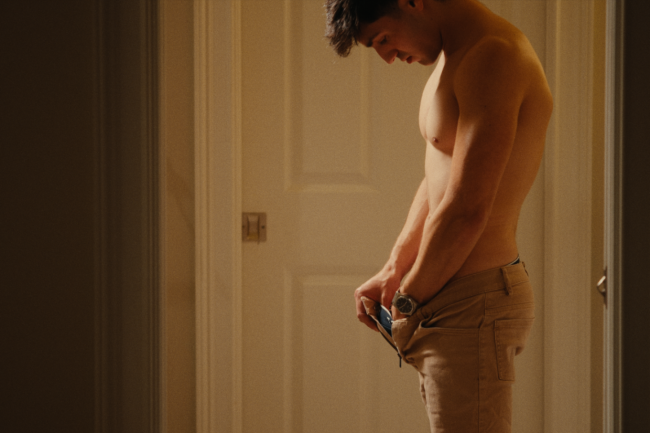
In the SXSW documentary “Manhood,” one man is trying to make penis enlargement procedures as easy and commonplace as a few spritzes of Botox. Dallas entrepreneur Bill Moore’s PhaloFILL procedure offers a solution to men’s worst insecurity. But it’s not without complications of its own, as the film shows an OnlyFans star and a father of five who put their bodies on the line — and face a complex emotional aftermath. IndieWire shares the exclusive trailer for the film, directed by “White Noise” filmmaker Daniel Lombroso. Executive producers include Penny Lane, Sheila Nevins, and Fenton Bailey and Randy Barbato for World of Wonder.


“The manosphere and its brand of toxic masculinity is taking over America, from social media to the White House,” said director Daniel Lombroso, who spent two years in male enhancement clinics to make the film, in a statement. “I wanted to explore the tremendous well of male shame and insecurity it all comes from.”
“Masculinity, and what makes a man, is a headline topic these days,” said executive producers Fenton Bailey and Randy Barbato of World of Wonder. “Size matters, but as Daniel so powerfully demonstrates, it’s the dimensions of the story that count. ‘Manhood’ is a story full of heart, humor, and humanity.”
More from IndieWire’s SXSW review: “‘I can fill your penis with filler, but I cannot fill the hole in your heart,’ Moore tells his patient/lover David. The patient-doctor relationship here is certainly ethically questionable, but at what point are ethics just sort of tossed out the window when we’re talking dicks? Still, Lombroso takes his subject and his subjects seriously, and treats them with respect. David, marveling near-tears at the results of his reconstructive surgery, makes for a moving moment — who knew a documentary about penile enhancement could touch a nerve and the heart, too?”
“Manhood” will open at the Laemmle NoHo in Los Angeles on October 28 and the Village East by Angelika in New York on October 30, with a week-long engagement at each, followed by a nationwide theatrical release. The film will be available on digital platforms November 17, with more details to be announced at a later date.

>
$1.2M live bet cashed: How Chiefs, Rams comebacks swung key NFL Week 4 betting results

What Can’t Be Mentioned Review: A Beloved Incest Drama Gets a Sequel
Seahawks escape Chargers with sloppy win, vow to be better with 49ers showdown looming
-

 movies5 months ago
Search For Canadian TV Actor Stewart McLean Now Homicide Investigation
-

 Fashion9 years ago
These ’90s fashion trends are making a comeback in 2017
-
Fashion9 years ago
According to Dior Couture, this taboo fashion accessory is back
-
Fashion9 years ago
Model Jocelyn Chew’s Instagram is the best vacation you’ve ever had
-
Fashion9 years ago
Emily Ratajkowski channels back-to-school style
-
Fashion9 years ago
9 Celebrities who have spoken out about being photoshopped
-

 Anime4 months ago
Rurouni Kenshin: Hokkaido Arc Manga Takes 1-Issue Break – News
-

 Anime3 months ago
HIDIVE to Stream English Dubs for The World Is Dancing, The Forsaken Saintess and Her Foodie Roadtrip in Another World, The Dangers in My Heart: The Movie Anime – News