
Tech
Judge pauses $110B Paramount-Warner Bros merger


Paramount Skydance’s proposed acquisition of Warner Bros. Discovery has hit a roadblock after a judge temporarily paused the deal in response to a lawsuit filed by a coalition of 12 state attorneys general who argue that the merger would harm competition.
U.S. District Judge Araceli Martínez-Olguín issued a 14-day pause on Monday after hearing arguments from both sides last week. The coalition, which is being led by California Attorney General Rob Bonta, could seek another pause after the 14 days, further delaying the merger.
The lawsuit from the states alleges that the deal would harm movie theaters, basic cable distributors, and audiences. They argue that if the two companies are allowed to merge, it would lessen competition in three areas: wide release theatrical film distribution, “top-grossing” theatrical distribution, and basic cable licensing.
“This is a critical first win in our case to ensure this megamerger never sees the light of day,” said Attorney General Bonta in a statement. “History tells the tale of what happens when a few people have great power over markets that are central to Americans’ lives: fewer opportunities for more people, worse products and services for all people. With our lawsuit, we’re fighting for a free and fair market and a thriving film and television industry that serves creatives and audiences alike. We have a full tank of gas, the law on our side, and look forward to continuing to make our case.”
The deal would combine two notable film studios as well as streaming platforms Paramount+ and HBO Max. It would also create one of the largest portfolios of television networks, bringing together Paramount’s CBS and MTV with WBD’s CNN and HBO.
Paramount CEO David Ellison had said in May that the transaction was on track to close by September. The legal roadblock has the potential to derail Paramount’s efforts to transform into a major competitor to companies like Netflix.
The proposed acquisition has received scrutiny from filmmakers, actors, and industry professionals who argued that the deal would reduce competition and further consolidate the U.S. media industry.
Paramount and WBD did not immediately respond to TechCrunch’s requests for comment.
When you purchase through links in our articles, we may earn a small commission. This doesn’t affect our editorial independence.
>

The impressive capabilities of Chinese lab Moonshot’s Kimi K3, the biggest open-weight large language model, has kicked off a debate that conflates two things: the economic possibilities of American AI giants and the future of LLMs as a technology.
OpenAI’s head of strategic futures, Dean W. Ball, went so far as to argue that the US government should find a pretext to create regulatory fear, uncertainty, and distrust around the new models, since open-weight models must necessarily deter capital spending by the frontier labs.
People freaked out, with tech luminaries like Yann LeCun and Martin Casado arguing that open software can accelerate innovation and coexist with proprietary projects. Ball soon retracted his claims that a regulatory crackdown was the White House’s “best strategy” and that open-weight models necessarily slow down advances in the technology.
However, Axios reports that the Trump administration is considering banning K3 and other advanced Chinese models at the behest of American frontier labs. Another report from Politico said that the Department of Commerce would not take that step anytime soon.
The benefit for major AI companies is clear: Open-weight models, running on independent infrastructure or inside major enterprises, offers cheaper intelligence than Anthropic or OpenAI’s class-leading models. If users increasingly spend more outside the closed labs, that means smaller return on their massive investments in model training.
That view extends far beyond OpenAI. “Strong, frontier-caliber open source models will place a squeeze on the margins and will bring down the prices of the frontier companies,” Braden Hancock, the co-founder of Snorkel AI and a former Meta Director of AI, told TechCrunch. “It will not necessarily mean that the amount of AI usage goes down a little bit. You know, obviously, quite the opposite.”
That’s not a problem for people without shares in Anthropic and OpenAI. AI will still proliferate. So what’s the justification for the government to block Americans from purchasing something in our ostensibly free markets?
Concerns over Chinese models come in several flavors. One is protecting US data from the Chinese government; the US banned the import of modern Chinese EVs over concerns about their data gathering. But experts tend to think that open-weight models run on US servers are unlikely to leak data back to China, although it’s not impossible that such a thing could be done.
Another is that the models may have implicit bias toward the PRC — but it’s not clear what that might mean for, say, coding tasks.
A third common worry is that Chinese models lack the guardrails that the US government has mandated (through an opaque process), which aim to prevent leading US LLMs from being used to exploit closed computer systems or create weapons. However, those same guardrails may make US companies more vulnerable: David Sacks, the venture capitalist and Trump adviser, has been sharing cases of US companies turning to Chinese LLMs to close security gaps when US frontier models refuse to do the tasks.
But the most significant motivation for restricting the models is that fear that China will be able to outpace the US if the frontier labs slow down.
Sam Bresnick, a China-focused research fellow at Georgetown’s Center for Security and Emerging Technologies, says the growing importance of AI to the US military operations gives the US a reason to support continued investment in AI at the frontier labs. But the whole question, he says, is fraught.
“Why should the weight of the U.S. government be aimed at protecting these these companies from competitors that are being locked out from the U.S. market based on their origins?” Bresnick asks.
Advocates for open AI say that the frontier companies are creating a false binary between innovation and closed models.
“The bigger the bigger impact of having these open source models come from China is less that they’re sneaking in back doors, and more that they are owning the innovation,” Hancock told TechCrunch. “You end up with, effectively, an expanded workforce on your model. PyTorch became the industry standard because it was open source, and so the whole community could contribute to it rather than just one company, and it grew and grew, and all the rest of the deep learning libraries kind of died in comparison.”
Hancock and other advocates of fear that Chinese LLMs will become the locus of international research. Already, US graduate programs mainly build on open-weight Chinese models, and Hancock says that half of the papers students study are coming from Chinese institutions, with American frontier labs increasingly reticent about sharing their work widely.
“Restricting open models wouldn’t make AI safer,” said Clem Delangue, the CEO of Hugging Face, a platform for open AI collaboration. “It would simply hide the risks, concentrate power in the hands of a few and make it harder for the next generation of builders, researchers, academia, non-profits, governments to participate in making AI safer and more beneficial for all.”
Bresnick says that the real way to slow China would be to focus more on chip export controls. A better way to preserve US AI leadership would be to stop selling Nvidia H200 processors to China. “That,” he says, “could potentially keep us out of this thorny debate about banning open source technologies that huge numbers of US companies want to use.”
Part of the problem is that uncertainy around AI economics. “The open business model, the proprietary business model — neither one is figured out. AI companies are are struggling to figure out how to make money on their tools, especially as training costs need to go up and up,” Bresnick points out.
The same challenges that play out in the US are also playing out in China, where AI companies are also struggling to generate revenue and access compute power, and the government is seen as encouraging open releases for policy reasons despite the challenge in capitalizing on them.
Some US companies, including Thinking Machines Lab and Nvidia, are trying to make a business around releasing open models. Hancock points out that Nvidia would do better “if there are dozens or hundreds of companies building AI than rather than two or three and two or three that are well capitalized enough to make their own chips,” which is one reason behind its investment in Nemotron, a collection of open models.
“The main point is the U.S. would be very well served to have its own very capable, much less expensive open models,” Bresnick said. “It just clashes with the approach the frontier labs have taken.”
With additional reporting from Rebecca Bellan.
When you purchase through links in our articles, we may earn a small commission. This doesn’t affect our editorial independence.
>

Nearly a year ago, Elon Musk-owned X announced it would begin rebuilding the Android version of its app, which had not held up well compared with its iOS counterpart. On Monday, the company shipped the refreshed app, which is now available to download.
The new Android version of X was built from scratch and promises improvements to loading, scrolling, notifications, and more, X said in its announcement.
The update has been in development for nearly a year. Last August, X head of product Nikita Bier said the social network company was putting together an Android “dream team” to reshape the experience. Later that fall, he also noted that X had one of its biggest weeks ever for Android downloads in October — a reason why the new app was a priority for the company.
With today’s release, Bier described the effort as “one of the largest engineering projects” in the company’s history, saying the new Android app was built from scratch rather than simply being updated.
“It’s faster, smoother and more reliable. But most of all: it will enable us to build new features at lightning speed,” Bier wrote on X. The Elon Musk-owned social network has been rolling out a number of new features in recent months, including X Money and X Chat, which were given their own standalone apps.
The Android release could also potentially entice more users in global markets, where Android is the dominant smartphone platform, to either download or return to X, after years of platform neglect. (Problems on Android were so bad at one point last year that the X app couldn’t even load X posts when users clicked links.)
However, Bier warned that there are still some rough edges to iron out, including improving performance on older Android devices and adding support for Spaces, X’s live audio feature. Those updates are still underway. Bier added that other features, including the new video editor, the react-with-video feature, cashtags, and custom timelines are also coming soon to Android.
Existing Android users can get the new X app by updating their existing app through the Google Play Store.
When you purchase through links in our articles, we may earn a small commission. This doesn’t affect our editorial independence.
>

AI agents are starting to execute more sophisticated tasks, such as identifying vendors that can deliver freight, comparing prices, and messaging the vendor to organizing a delivery. But when it comes to making a payment for the shipment, they still need to involve a human.
Today’s financial sector relies on financial rails, the underlying infrastructure that moves money and information between a money and financial information between banks, businesses, and consumers. But these financial rails were built for human-initiated transactions, not autonomous AI agents. For example, traditional payment systems like credit cards and ACH rely on human authorization for transactions, which slows down agents engineered to work autonomously.
One new startup, Natural, is tackling the problem by redesigning the whole system from the ground up. And it now has $30 million in fresh capital to pursue an ambitious plan that will put it in direct competition with giants like Stripe.
About a year ago, Natural co-founder and CEO Kahlil Lalji realized that AI agents were evolving faster than existing financial architecture, which can’t support tasks like autonomously paying a vendor, collecting payments, or transacting with each other.
Lalji has a background in banking and finance, but as he prepared to launch another startup he had hoped to avoid the sector. His previous startup Ivella, a YC-backed banking and financial product for couples was sold in 2023 to Earnin, where he worked as an engineer for two years. He told TechCrunch he had been burned by the finance sector after the Zero Interest Rate Policy era ended.
And yet, Lalji couldn’t ignore the opportunity.
“I kept on coming back to it,” he said. “It just feels obvious that agentic payments are going to be structurally the most important problem [in the] space.”
Lalji teamed up with Eric Wang, his co-founder at Ivella, and Walt Leung, a former engineering manager at Nextdoor, and founded Natural in 2025. The startup positions itself as an agent orchestration layer that enables AI agents to move and store funds. By integrating Natural’s infrastructure, companies can allow their agents to make autonomous payments, collect funds, and transact with both humans and other agents.
Natural got the attention of Kirsten Green, founder and managing partner at VC firm Forerunner. Green, whose firm focuses on consumer experiences and the future of commerce, led its $30 million Series A round in the company, bringing the company’s total funding to $40 million.
Green was attracted by Natural’s broader ambitions. The startup isn’t just focused on helping agents pay for and check out goods on behalf of consumers, it’s also trying to reinvent payment infrastructure, including how disputed transactions are handled.
Although Natural has operated in a beta trial until now, Lalji told TechCrunch that the startup has made enough critical architectural decisions to give it a “good shot” at competing with incumbents like Stripe, which is also racing to redesign payment rails for AI agents.
Lalji hopes that Natural’s fast development speed will allow it to outpace established giants and build the payment infrastructure that will serve as the financial backbone of AI agents. The startup’s mission has attracted senior staff who previously worked at fintech giants Stripe, Ramp, and Square.
Although Natural views Stripe as its main competitor, several other startups, including DCVC-backed Skyfire Systems, are trying to reinvent the payments backbone for AI agents using USD-backed stablecoins. While Natural plans to incorporate stablecoins into its architecture, it is also building support for traditional bank payments.
While there is a fierce race to dominate the field, Lalji is betting the entire market could grow significantly if transactions happen at computer speed rather than human speed. “The number of payments that may occur in the world may be two or three or four orders of magnitude greater than the number of payments that exist today,” he said.
When you purchase through links in our articles, we may earn a small commission. This doesn’t affect our editorial independence.
>

Rebel Wilson’s ‘The Deb’ Get First Trailer, Digital Release Date Amid Legal Flap

How to watch Reds vs. Mariners: TV channel and streaming options for July 20

5 New Shows Streaming This Week (July 20-27)

-

 Fashion9 years ago
These ’90s fashion trends are making a comeback in 2017
-
Fashion9 years ago
According to Dior Couture, this taboo fashion accessory is back
-
Fashion9 years ago
Model Jocelyn Chew’s Instagram is the best vacation you’ve ever had
-
Fashion9 years ago
Your comprehensive guide to this fall’s biggest trends
-
Fashion9 years ago
9 Celebrities who have spoken out about being photoshopped
-
Fashion9 years ago
A photo diary of the nightlife scene from LA To Ibiza
-
Fashion9 years ago
Emily Ratajkowski channels back-to-school style
-
 Tech3 months ago
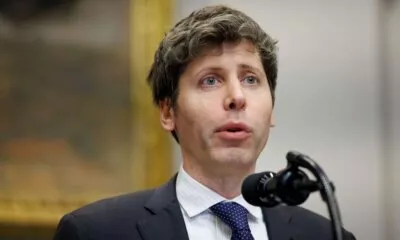
OpenAI CEO apologizes to Tumbler Ridge community

