Connect with us

Sports

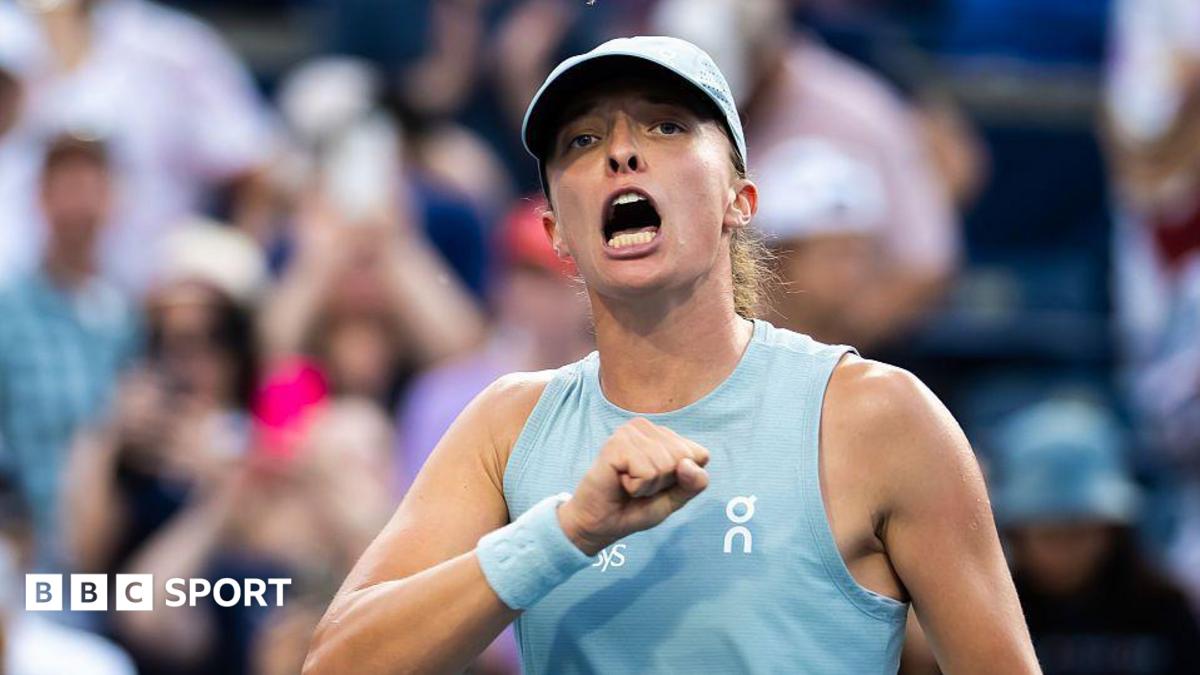
Canadian Open final: Iga Swiatek beats Elena Rybakina to win first WTA title of season

Published

on

Iga Swiatek secured her first WTA title of the season with a straight-set victory over Elena Rybakina in the final of the Canadian Open on Thursday.

The six-time Grand Slam winner was cheered on by the crowd in Toronto as she beat world number two Rybakina 6-2 6-3.

Australian Open champion Rybakina struggled in the opening set and made 12 unforced errors, while Swiatek, 25, broke the Kazakhstan player’s serve twice – and saved two breaks points of her own – to take the first set.

In the second set, Rybakina, 27, was unable break world number eight Swiatek, and the Polish player clinched her 26th career title in one hour and 15 minutes.

“It means so, so much to me because the past months were not easy,” said Swiatek, who will return to the top five in the rankings following her first Canadian final victory.

It has been a tough campaign for Swiatek, who is looking to claim her first major title since her dominant win in the Wimbledon final last year when the US Open starts later this month.

She advanced to the quarter-finals in Melbourne in January but was beaten by eventual champion Rybakina. In the French Open and this year’s Wimbledon, she only reached the fourth and third rounds respectively.

“I’m really happy that I kept focusing on growing, changing my game a little bit, improving despite all the opinions that many people have about me every day on the internet,” said Swiatek.

“It’s not easy to deal with all of that.”

Rybakina led 2-1 in the second set before Swiatek won five of the final six games to end the match as champion. She had one ace and four double faults, hitting just 13 winners and making with 23 unforced errors in total.

“I tried my best but it wasn’t enough,” said Rybakina, whose previous three matches went to three sets.

Meanwhile, Great Britain’s Katie Boulter earned her first career win at the Cincinnati Open by defeating American Katie Volynets 7-5 0-6 6-4 in the first round.

After sealing her first victory since June, 30-year-old Boulter will face Wimbledon champion and sixth seed Linda Noskova in the second round.

>

Continue Reading

Sports

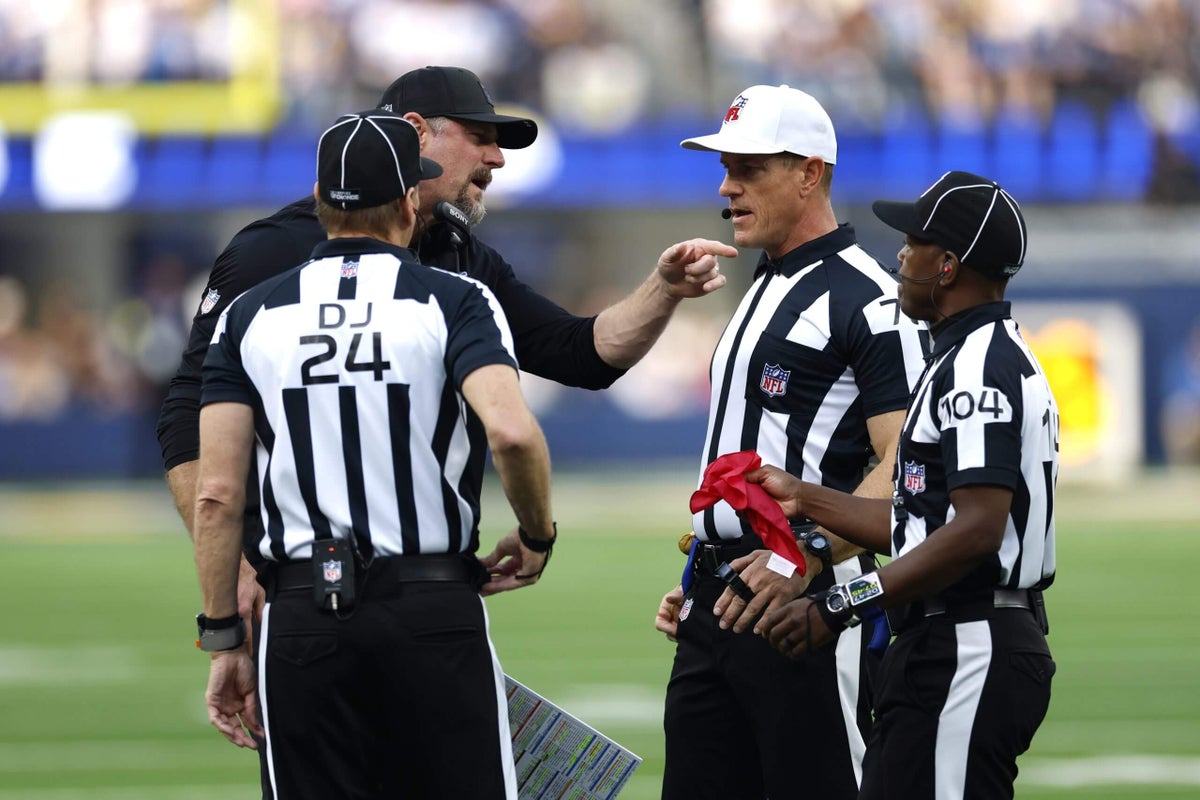
It’s time to throw the red flag on NFL challenges. Why are they needed at all?

Published

on

The NFL is changing its challenge system this season. Maybe instead, it’s time to challenge the challenges.

For the first time since the red flag challenge system was introduced in 1999, head coaches can now designate an assistant coach or staff member as the official flag bearer. It’s reasonable to wonder why we need them at all.

Before the two-minute warning, coaches have exclusive authority to force formal reviews over many ordinary plays. After the warning, that authority flips: coaches are barred from challenging, and the replay official alone decides what deserves another look. If the league trusts the booth when the stakes are highest, why not use the same system for the other 28 minutes?

When coaches first began tucking red flags in their socks and were instructed to throw them on the field whenever they were unhappy with the officiating, the world was panicking over a potential Y2K computer crash. That’s how long we’ve been doing this. Former coaches like Dick Vermeil, Ray Rhodes, Bruce Coslet and Mike Ditka were carrying red flags long before dating apps turned them into pop-culture slang.

Roger Goodell on technology and officials

Mike Jones

A lack of technology may have made them necessary back when replay review was antiquated and cumbersome. We have reached an age when NFL replay officials in New York can monitor every available broadcast angle from every game across the country within seconds.

Regardless of who is throwing the flag, the NFL requires teams to spot a mistake, grab a handkerchief, find an official before the ball is snapped again and wager one of their timeouts against whether the referees got a call wrong.

Coaches have essentially become trial attorneys: File the right motion, at the right time and on the correct grounds, or have the entire case thrown out.

Detroit Lions coach Dan Campbell correctly believed the Los Angeles Rams’ Colby Parkinson was down at the 4-yard line in a December game last year and challenged the spot when officials instead placed the ball at the 3.

But a spot is only reviewable when it impacts a first down or touchdown. Parkinson caught a short pass from Matthew Stafford on first-and-10 and turned it into a big play. Since the disputed yard did not affect whether the Rams gained a first down, officials ruled the spot was not challengeable and charged the Lions with a timeout. Replay assistance corrected the call, and officials placed the ball at the 4 anyway — but still took a timeout away from Detroit.

“I won the challenge, but I lost my timeout,” Campbell said.

Football is uniquely suited for an official-led system because every play is followed by a built-in review window. The play clock gives a replay official time to examine what just happened while teams huddle, substitute and prepare for the next snap. Correcting an obvious mistake during that window often wouldn’t require an additional stoppage.

More fundamentally, enforcing the rules should remain the league’s responsibility. A receiver’s foot was either out of bounds or it wasn’t. A runner’s knee was either down or it wasn’t. Those facts shouldn’t change because one coach had a timeout available, recognized the mistake or employed a better replay staff than his opponent.

The NFL already accepts that principle on scores, turnovers, failed fourth downs, and during the final two minutes. Those plays aren’t automatically reviewed because replay officials suddenly become more capable when the stakes rise. They’re reviewed because the league has decided those calls are too important to leave to coaching strategy. A mistake in the first quarter is no less wrong.

Keep automatic reviews for scores, turnovers and failed fourth downs. For other reviewable plays, transfer the authority to initiate corrections from coaches to the replay official. Give a dedicated replay decision-maker assigned to each game a limited window to correct clear, objective errors.

That would require one dedicated decision-maker for every game, rather than supervisors juggling several games at once. No problem. The NFL can afford the staffing.

If the replay official needs additional time to check an angle, he should have the authority to signal the referee and briefly delay the snap. The delay could be capped — maybe no more than 20 seconds. Replay should correct the obvious, not provide time for New York to launch an investigation.

Such a system might create an occasional brief delay, but it should eliminate most lengthy replay stoppages. The NFL is already monitoring every play.

Baseball offers a useful model for making the final decision: MLB’s replay umpire in New York makes the ruling and relays it to the crew chief. The on-field umpires don’t review the evidence themselves. The NFL doesn’t need to bring a tablet onto the field for an expedited correction. Make the call in New York, relay it to the referee and play on.

It would eliminate the coach-triggered formal reviews and sideline theater that occur when coaches run down the field with a flag while assistants scream into their headsets. Or moments such as Thursday night, when New England Patriots coach Mike Vrabel played long toss with his flag to protest a fumble call.

Why should coaches have to weigh whether a first-quarter officiating error is important enough to risk a timeout? Getting a call right shouldn’t depend on whether a coach is willing to make a bet.

The NFL has tried a booth-driven system before. From 1986 through 1991, replay supervisors decided which plays warranted review. The league dumped it amid complaints about delays and frustration that teams had no way to request a review.

Technology has evolved quite a bit since the late 1980s. Video was primitive, and the process was excruciatingly slow. Now replay officials can view synchronized, high-definition angles through Hawk-Eye Innovations and communicate directly with officials on the field. The concept wasn’t necessarily wrong; it just arrived about 35 years too soon.

Tennis has largely eliminated human line judges in favor of the same Hawk-Eye system for line calls. Soccer uses its own version of Hawk-Eye for goal-line technology and semi-automated offside technology.

The obvious objection is that the replay official may occasionally miss something a coach would have challenged. Of course that could happen. But the NFL already removes the coaches’ role during the final two minutes, precisely when a missed call can do the most damage. If booth-only authority is sufficient during a winning drive, it should be sufficient in the first quarter, too.

The speed at which these games are played makes perfect officiating impossible. No one is demanding perfection, but rather giving them a little help from the sky when they need it. We shouldn’t need a red flag to do it.

>

Continue Reading

Sports

How to watch Yankees vs. Blue Jays: TV channel and streaming options for August 15

Published

on

The New York Yankees visit the Toronto Blue Jays on Saturday at Rogers Centre, at 3:07 p.m. ET. Cam Schlittler (10-6, 2.21 ERA) gets the start for the Yankees, who are 68-54 this season and second in the AL East. Braydon Fisher (3-3, 3.54 ERA) is starting for the Blue Jays, who are 60-64 and fourth in the AL East.

How to watch New York Yankees vs. Toronto Blue Jays

Yankees vs. Blue Jays odds

  • Favorite Moneyline: Yankees -169
  • Underdog Moneyline: Blue Jays +140
  • Total: 7.5
  • Total Over Odds: +100
  • Total Under Odds: -120

Injury reports

Yankees

Giancarlo Stanton: 10 Day IL (Leg), Cody Bellinger: 10 Day IL (Leg), Carlos Rodon: 15 Day IL (Elbow), Kervin Castro: 15 Day IL (Elbow), Aaron Judge: 60 Day IL (Rib), Clarke Schmidt: 60 Day IL (Elbow)

Blue Jays

Luis Urias: 10 Day IL (Quadricep), Jonatan Clase: 10 Day IL (Foot), Spencer Arrighetti: 15 Day IL (Foot), Jameson Taillon: 15 Day IL (Forearm), Trey Yesavage: 15 Day IL (Knee), Cody Ponce: 60 Day IL (Knee), Anthony Santander: 60 Day IL (Shoulder), Jake Bloss: 60 Day IL (Elbow), Bowden Francis: 60 Day IL (Elbow), Joe Mantiply: 60 Day IL (Knee), Addison Barger: 60 Day IL (Elbow), Yimi Garcia: 60 Day IL (Elbow), José Berrios: 60 Day IL (Elbow), Lenyn Sosa: 60 Day IL (Wrist), Patrick Corbin: 60 Day IL (Shoulder), Vladimir Guerrero Jr.: day-to-day (Head)

Stats to know

  • New York’s Ben Rice has hit 32 home runs this season, which ranks 6th in MLB. He has also tallied 76 RBIs (12th in MLB) and has scored 75 runs. In 500 plate appearances, he has recorded a .253 BA, .348 OBP and .535 SLG with a 12.2% walk rate and a 25% strikeout rate.
  • In 411 plate appearances, Luis Garcia is hitting .278/.309/.546 with a .855 OPS. He has hit 24 long balls (20th in MLB), driven in 78 runs (7th in MLB) and scored 51 times.
  • Toronto’s Ernie Clement is slashing .280/.306/.403 this season with nine home runs, 42 RBIs and an OPS of .709. He has a 9.7% strikeout rate and a 3.5% walk rate in 487 plate appearances, and he has scored 50 total runs.
  • In 486 plate appearances, Vladimir Guerrero Jr. has posted a 13.4% strikeout rate and a 9.7% walk rate while slashing .263/.337/.356 with seven home runs, 46 RBIs and 61 runs scored. He has stolen seven bases on 10 attempts.

This watch guide was created using technology provided by Data Skrive.

Betting/odds, ticketing and streaming links in this article are provided by partners of The Athletic. Restrictions may apply. The Athletic maintains full editorial independence. Partners have no control over or input into the reporting or editing process and do not review stories before publication.

Photo: Jamie Squire, Ishika Samant, Scott Taetsch, Alika Jenner / Getty Images

Connections: Sports Edition Logo

Connections: Sports Edition Logo

Connections: Sports Edition

Spot the pattern. Connect the terms

Find the hidden link between sports terms

>

Continue Reading

Sports

How to watch Cardinals vs. Cubs: TV channel and streaming options for August 15

Published

on

The Chicago Cubs and St. Louis Cardinals clash on Saturday at 2:20 p.m. ET. Matthew Boyd (8-1, 3.50 ERA) gets the start for the Cubs, who are 72-51 this season and second in the NL Central. Michael McGreevy (4-9, 3.64 ERA) is the expected starter for the Cardinals, who are 61-61 and third in the NL Central.

How to watch St. Louis Cardinals vs. Chicago Cubs

Cardinals vs. Cubs odds

  • Favorite Moneyline: Cubs -182
  • Underdog Moneyline: Cardinals +150
  • Total: 9.5
  • Total Over Odds: +100
  • Total Under Odds: -120

Injury reports

Cubs

Matt Shaw: 10 Day IL (Hand), Daniel Palencia: 15 Day IL (Elbow), Hoby Milner: 15 Day IL (Appendicitis), Gavin Hollowell: 15 Day IL (Shoulder), Phil Maton: 15 Day IL (Knee), Edward Cabrera: 15 Day IL (Hamstring), Riley Martin: 60 Day IL (Elbow), Porter Hodge: 60 Day IL (Elbow), Justin Steele: 60 Day IL (Elbow), Shelby Miller: 60 Day IL (Elbow), Hunter Harvey: 60 Day IL (Tricep), Cade Horton: 60 Day IL (Forearm), Christopher Austin: 60 Day IL (Knee), Ben Brown: 60 Day IL (Neck)

Cardinals

Ramón Urías: 60 Day IL (Elbow), Max Rajcic: 60 Day IL (Elbow)

Stats to know

  • Chicago’s Pete Crow-Armstrong is slashing .279/.378/.534 this season with 27 home runs (9th in MLB), 73 RBIs (17th in MLB) and an OPS of .912 (7th in MLB). He has a 27.1% strikeout rate and an 11.9% walk rate in 546 plate appearances, and he has scored 86 total runs. Crow-Armstrong has recorded 30 steals on 37 attempts.
  • In 549 plate appearances, Alex Bregman has slashed .253/.344/.406 this season. He has hit 16 long balls and driven in 61 runs with a strikeout rate of 15.8% and a walk rate of 11.1%. He has come around to score 69 times.
  • Alec Burleson has hit 19 home runs this season. He has also tallied 84 RBIs (4th in MLB) and has scored 65 runs. In 512 plate appearances, he has recorded a .285 BA, .352 OBP and .478 SLG with an 8.6% walk rate and a 16.4% strikeout rate.
  • In 503 plate appearances, Jordan Walker has hit 23 long balls, tallied 84 RBIs (4th in MLB) and scored 72 runs. He is batting .282/.342/.486 and has posted a 24.5% strikeout rate and an 8% walk rate. Walker has recorded 16 steals on 21 attempts.

This watch guide was created using technology provided by Data Skrive.

Betting/odds, ticketing and streaming links in this article are provided by partners of The Athletic. Restrictions may apply. The Athletic maintains full editorial independence. Partners have no control over or input into the reporting or editing process and do not review stories before publication.

Photo: Jamie Squire, Ishika Samant, Scott Taetsch, Alika Jenner / Getty Images

Connections: Sports Edition Logo

Connections: Sports Edition Logo

Connections: Sports Edition

Spot the pattern. Connect the terms

Find the hidden link between sports terms

>

Continue Reading

Trending

Copyright © 2017 Zox News Theme. Theme by MVP Themes, powered by WordPress.